Throughout 2023 and into 2024 I felt that the two previous series of works I’d been engaged with – WHENEVERwhen and An Ensign for Miyoko Ito – were integrating and becoming something slightly different. Therefore, I’ve decided to update/restructure a statement that amalgamates some of the things I was working through in those past works, but which aims toward some new vistas. See below.
For many years, my painting, drawing, and printmaking have oscillated between symbolism-heavy representational imagery and formal explorations in the tradition of 20th century abstraction. This seemingly broad swing of subject and purpose in my work is directly related to my conviction that the core visual dynamics of either mode are, essentially, the same. I often tell my students that I’ve been making the same picture for my entire artistic life.
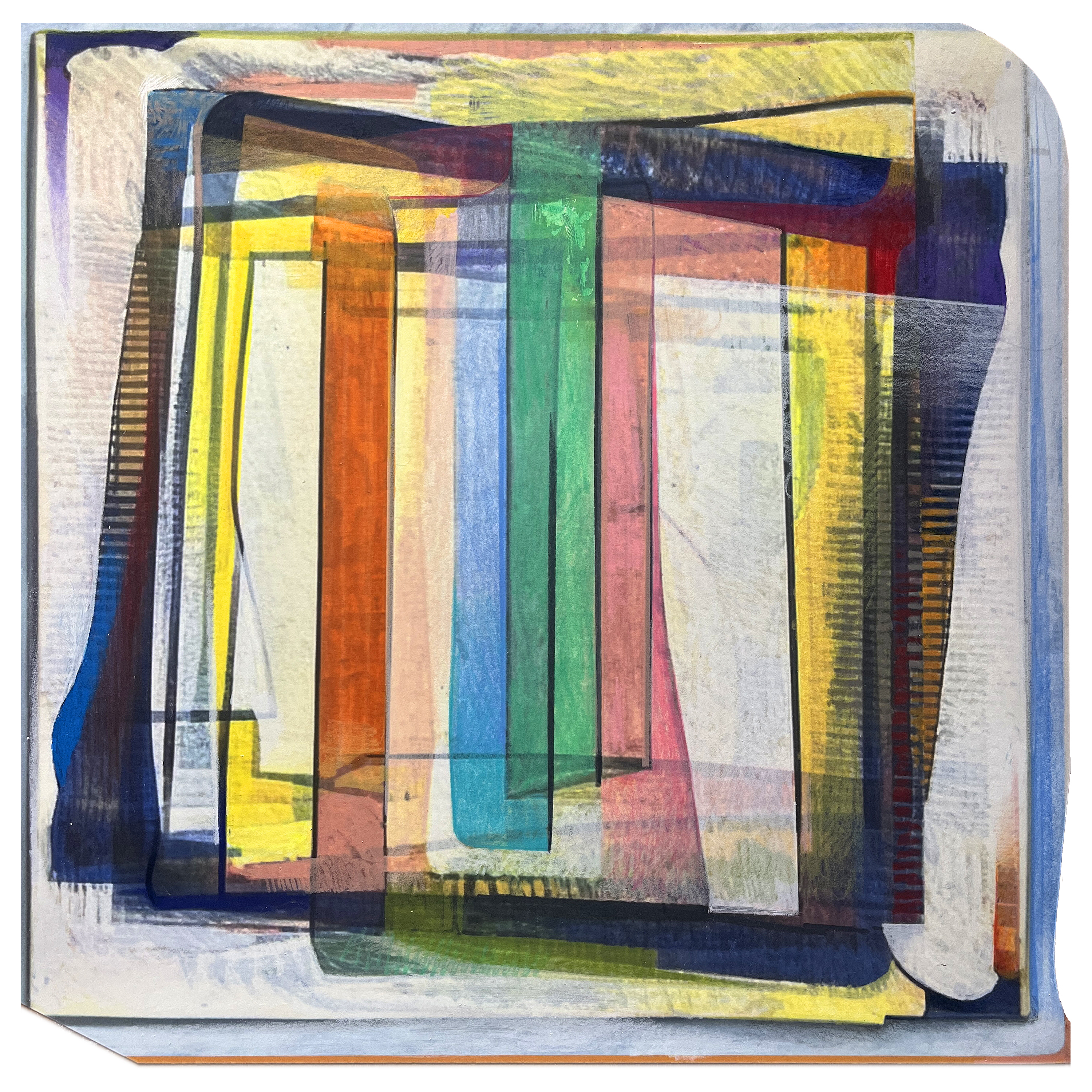
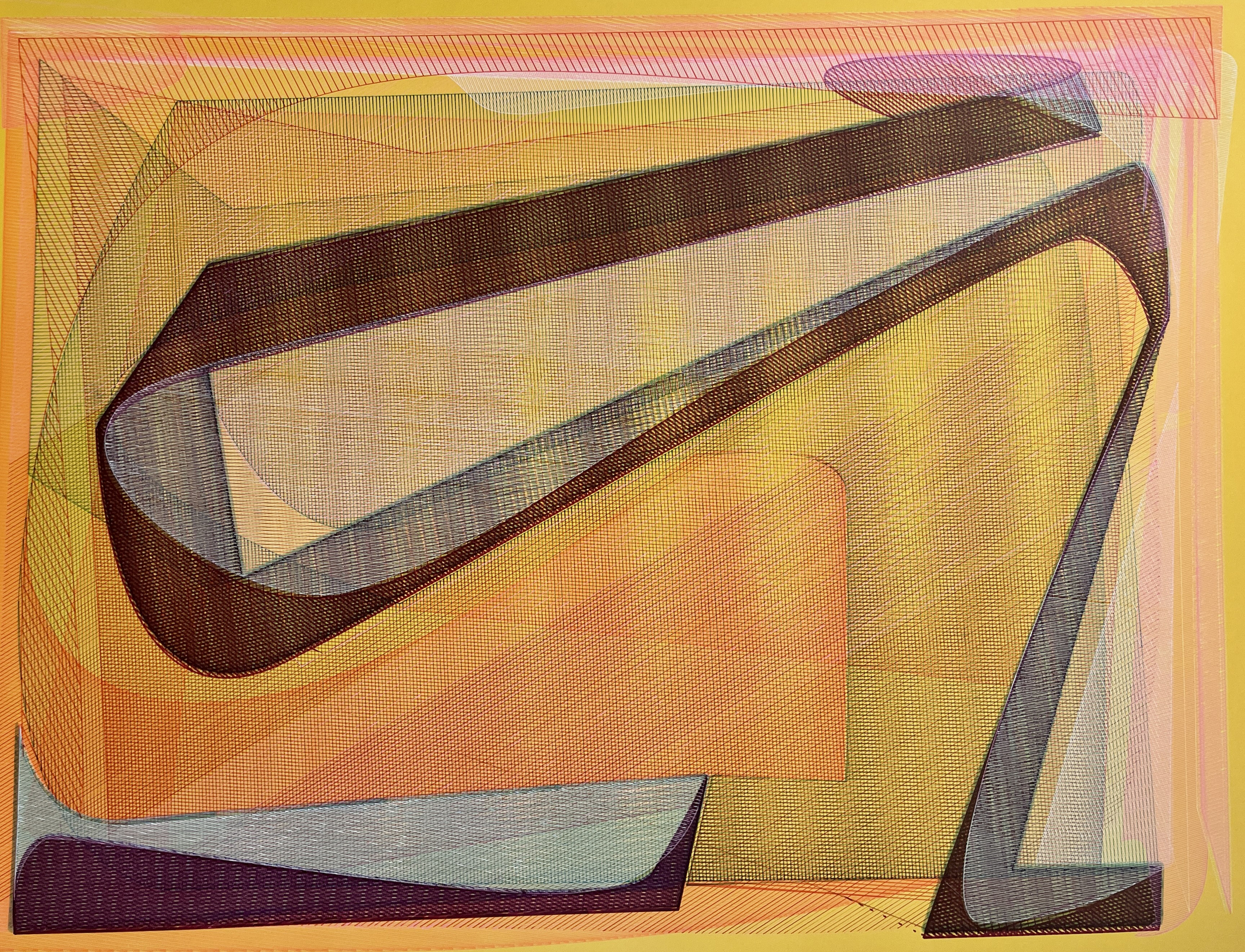
Sometimes I have felt led to apply those underlying compositional forces to the service of representational imagery, and other times I have felt the need to strip away everything but color, material, and surface. When I pursue abstraction, the resulting work is a foray into perceptual and physical experience. Thus, even though the works do not depict discernible objects, they are still – to me – realist in the sense that they focus on observational and haptic (sense of touch) phenomena.
Over the last five years, several bodies of work have developed out of these pursuits. I deploy an array of formal strategies that accumulate over time and leave a record within the work. These strategies are diverse; they might function in terms of simultaneity of form – for example, an area may appear to manifest as both light and solid structure – or display a counterintuitive sense of weight and balance. I have also incorporated a significant amount of collage, relief cutting, carving, and digital prototyping into my working methods.
I continue to be inspired by the work and ideas of artists such as Miyoko Ito, Marcelo Bonevardi, Richard Diebenkorn, and Vincent Fecteau among many others. Additionally, my research into Eastern and Western mandala forms, as well as direct experience with ongoing generations of digital and physical tools, inform my methods.
In my most recent works, I seek out the compacted and the overdrawn; the enclosed and the layered; the transformed and the solidified. I look for shapes, colors, and spaces that go far beyond a simple tension between figuration and abstraction, trying instead to suggest a layered arena of observational and haptic information.
Miyoko Ito (Japanese-American, 1918-1983) – whose work has been a key influence on me over the last 25 years – was able to activate subtle surfaces with the illusion of space and an evocative sense of palpability. This is what I’m investigating: the experience of perception apart from particular, representational depiction. In my exploration, questions arise: Does flat form appear to move away from my angle of view? Will color resolve into both static surface and suggested movement? Can space and color align to reinforce both static structure and an expression of time? Might the poetics of silent, unmoving images actually produce phenomena akin to those found in dreams, memories, ecstatic sensations, and atemporal musings?
What is the value in this work? I believe it stimulates reflection about our instincts and perceptions. Our senses are neither complete nor altogether reliable. Instead, they manifest representations that are useful – or rather have been useful in the past.






 eikonktizo