MF DOOM (keep caps on that name!) was a highly skilled and influential British rapper. Throughout the years, fans have been drawn to creating various artistic interpretations of his famous mask, behind which the artist almost always appeared/performed.
My good friend Jesse Slade, proprietor of KING THEODORE RECORDS, got me more interested in MF DOOM years ago. I’ve created representations of the mask in the past for illustrations/artworks using in Jesse’s record shop, but I wanted to make a move into a Lego version (or two) after I saw some folx creating them online.
Shout out to The Canvas Don and u/vonaudy for their versions of a building block/Lego MF DOOM mask. Both are awesome. I also like the “blockheadz” versions here and here. These examples served as inspirations, but mostly I just played around with what I’ve got in the old Lego vault.
I created the two versions below in standard light blue-gray, dark gray, and white, but then spray painted them with a chrome silver for proper effect. Take a look and enjoy. The smaller one is 4x5x2 inches and the larger is 5x6x2.5 inches.
Smaller MF DOOM Lego Mask. Click to see larger versions.
Larger MF DOOM Lego Mask. Click to see larger versions.
Recently I rotated a bunch of the art in our home, and so I felt that an update to my ongoing series of posts featuring various artworks I’ve collected over the years was in order.
My most recent purchase is this wonderful gouache painting on handmade paper by Mary Sandbothe.
Mary Sandbothe. Mystery Snowball. Gouache on handmade paper. 7×5 inches. 2023.
Mary is an awesome artist and educator here in Columbia, MO, and has been a pillar of the art community here for many years. She had a wonderful show at the Columbia Art League late in 2023 that really stood out to me. Called “Heritage Unfolded: Gouache Interpretations of Missouri Quilts,” (you can see the works here), the show featured some evocative, intimate works. I knew I needed to jump on one of them, and I’m glad I did.
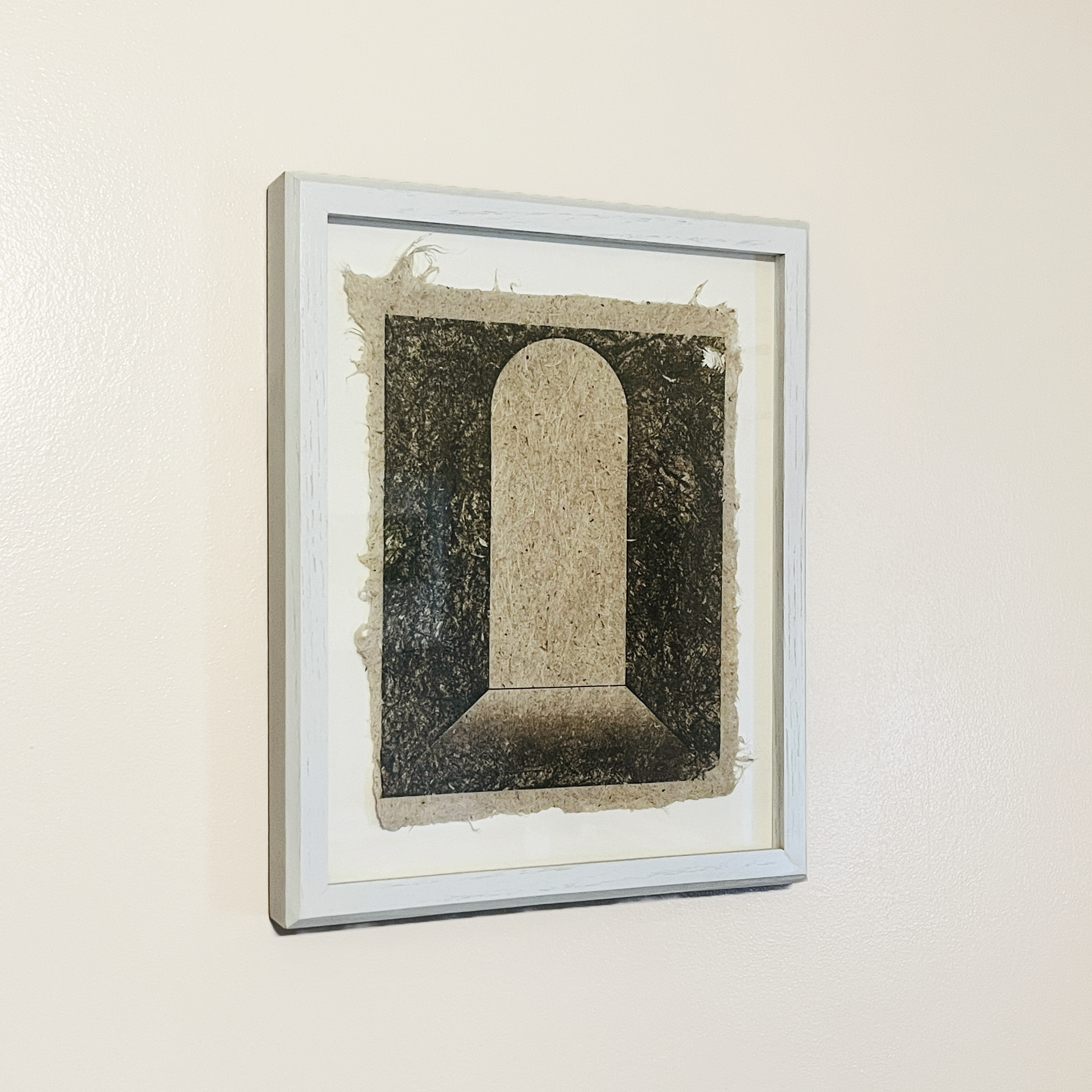
Next to the Sandbothe Mystery Snowball piece is a striking print on handmade Yucca paper by Caleb McMurray. The untitled work features a doorway or aperture, something that McMurray has returned to again and again.
I also have a sister print to this one, but it features an arching opening that is in the distance rather than up close like this one. Windows, doors, and other passageways are features of many of the works I’ve collected over the years.
Lastly, a small painting by Hayley Auxier‘s shares the wall with the two works I’ve shared above. Hayley was one of my stand out undergraduate students, and I love seeing her carry on her artwork as she has since graduating. This piece is one of a series she made celebrating National Parks and celebrating her experiences of them. Hayley shows a strong affinity for gouache, so I’m glad to have an example of her painting in that medium.
Hayley Auxier. Acadia National Park. Gouache on paper. 4 by 6 inches. 2018.
Acadia National Park is special to me because that’s where my partner and I went on our honeymoon all those years ago, so I like the piece because of it’s connection to my own history. But it’s also got a wonderful note from Hayley on the verso, and so the small work feels like it connects all of these different threads of my life: personal, professional, aspirational, and historical. That synergy of references – those that I bring to the work and those the artist embeds within the piece – is what makes art special.
I’m loving seeing these three works every day as I have a meal or hang out with my family. Art that lives with us is the best kind. Really thankful to have these pieces close to me.
Eight years ago today one of the few most significant pivots of my life happened. My cardiac arrest is intimately tied to the death of my sister, to my experience of my home town, to my understanding of life and spirituality, and to my way of moving through every day life.
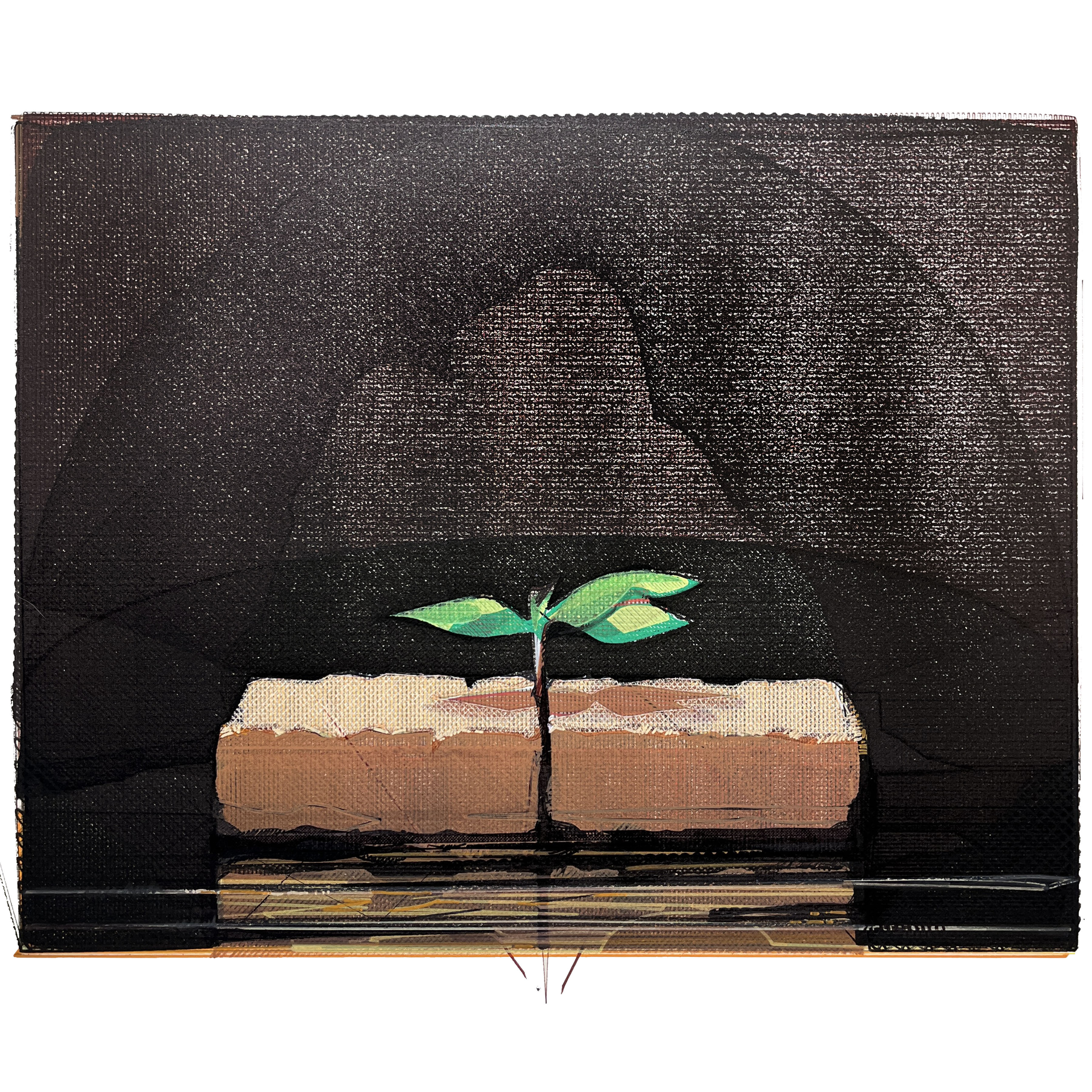
This year I’m commemorating the traumaversary with a new version of an old work. I first created Situation and Circumstance Overcome in 2003. It is definitely my most successful and most owned work, as I’ve created many copies – both paintings and prints – of the work as fundraisers for adoptions and other charitable occasions. For this version I chose to use my AxiDraw X&Y plotter. Using a new print of my old mezzotint plate of the piece (fig. 1) as a visual source, I created a large vectored image in Inkscape that had roughly 30 layers printed upwards of 5 times each (fig. 2).
Fig. 1: Situation and Circumstance Overcome. Mezzotint print on paper. 16×20 inches. 2023.
Ink the vectored image you can see many of the layers along with the direction of the hatch fills and choices I made for density of pigment load. Each color was created with Sharpies, Posca acrylic markers, and a few other ink-based markers. The layers shown in the Inkscape file don’t correspond fully to the final image (fig 3.) because I made adjustments/changes to individual layers as I moved through building the image. There is a call and response between the digital and physical realms here that I really appreciate. I’ve also included a few details of the piece so you can see the finer textures and lines.
Fig. 3: Situation and Circumstance Overcome (’24 Traumaversary Version). Ink and acrylic on Arches paper. 16×20 inches. 2024.
I like having a rich, sentimental image like this following me through life. I’m convinced we’re all sentimental (if we’re honest and not sociopathic). By this word I don’t mean any kind of unexamined, saccharine idealization of some past version of reality. Rather, I mean that we really did experience real things in our pasts, and those things carry with them real emotions, real artifacts of our real selves. In some sense, sentimentality can give us momentary access to who we used to be in the past. It is a simultaneous connection and rupture. We know we can’t return to that person or that experience. And we know that we can’t really feel anything the same way again. And yet… some part of that reality is there for us in our sense of sentimentality. It’s akin to a certain scent or song taking us back to a prior state of being. There’s nothing wrong with this. Moreover, I suspect it has some adaptive advantage for the species by stimulating social/familial/relational/tribal/spatial cohesion.
In any case, I think making the image of life in the form of tiny sapling breaking up between the bricks has been a worthy thing for me. It’s a little picture of triumph in the midst of hardship. I’m glad it resonates with so many people. I’m glad variations of this piece hang in homes all over the world. And I’m glad I’m still here to appreciate it and add to its legacy.
I’m glad I didn’t miss these last eight years. There have been a lot of situations to overcome, but the life I’ve seen makes it all worth it. Here’s to another year. Peace.
If you’d like to inquire about purchasing the traumaversary robot version of Situation and Circumstance Overcome, contact me over here.
I have mentioned the importance of Miyoko Ito many times before (here, here, and here), but there’s a little more to celebrate this Christmas day: I just received the new book Miyoko Ito: Heart of Hearts hot off the press.
Published by Pre-Echo Press, and featuring the research and writing of Jordan Stein, Heart of Hearts is the major publication that Miyoko Ito and her work deserve. Jordan Stein is an active and insightful curator who has developed a major presence nationally over the last decade. His research into and presentations on Ito are extremely significant, adding great depth to what is available on the artist.
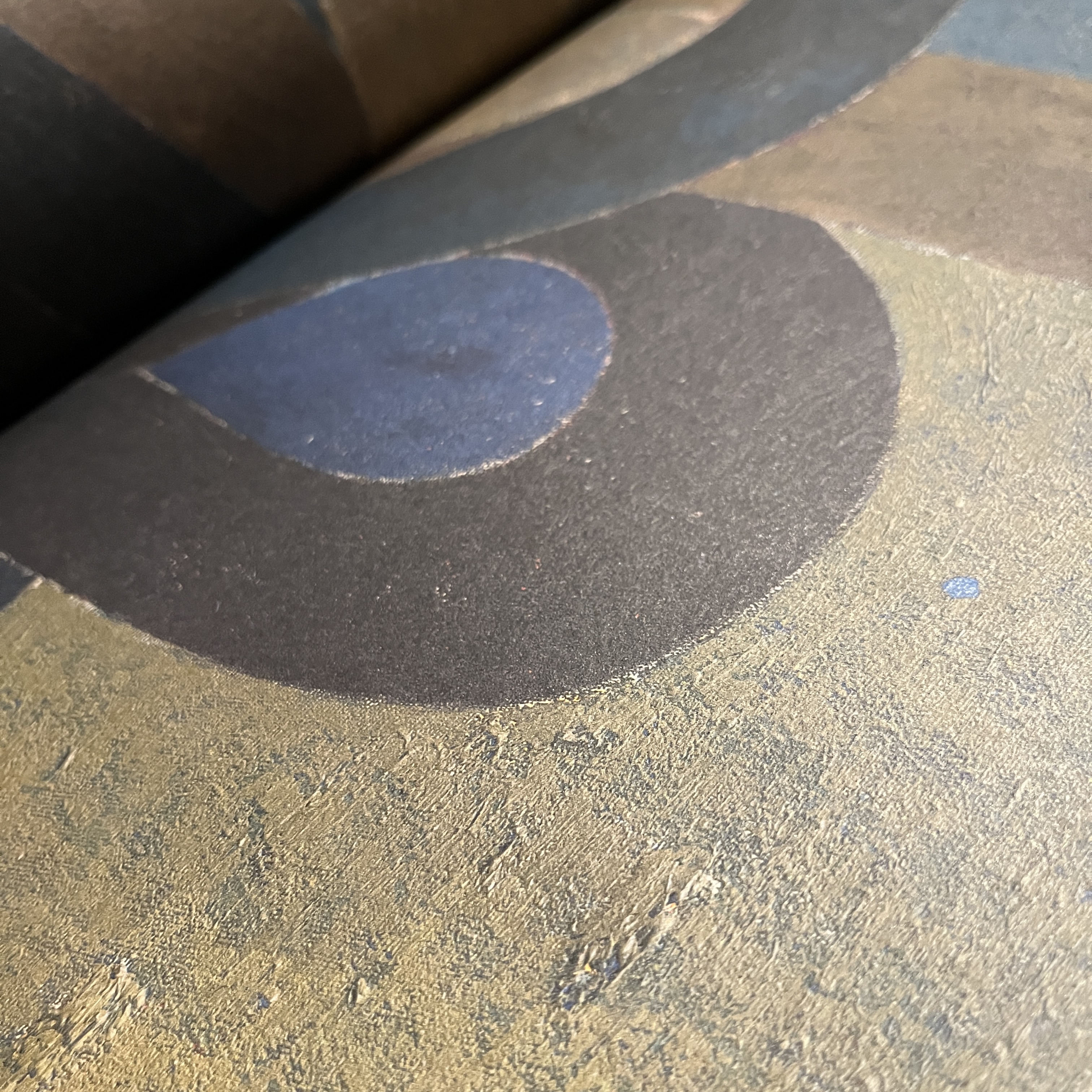
Detail of Orange Cloud from 1977 by Miyoko Ito as shown in Heart of Hearts.
Loaded with chromatically accurate images, Heart of Hearts is the most complete compendium of Ito’s work available. Beyond this, the book provides a single place from which students and admirers of her painting can find all pertinent information about her life and process. Stein’s essay provides key context, deftly connecting Ito to not only her roots in the Chicago art scene but the broader aesthetic superstructure to which she belonged.
Detail of Susquehanna (The River) from 1959 by Miyoko Ito as shown in Heart of Hearts.
These two arenas – solid text and quality images – really set this publication apart. From the beautiful debossed cover (front AND back) to the matte surfaces of the large full color spreads, this book delivers. The sense of texture and painted action is wonderfully realized in these pages. I kept being surprised by the surfaces of the paintings coming to life. This is an ESSENTIAL book for anyone interested in mid-20th century painting generally, or Miyoko Ito in particular. To finally have one volume that really pulls it all together is just wonderful.
Front and back covers of Heart of Hearts.
This book is an appropriate celebration of Miyoko Ito as a person and as an artist. It includes nearly all of her work, some of which have been lost. While not technically a catalogue raisonne, it might be the next best thing, as it provides the most complete picture of her work that we’ve ever had. For this, we can thank Jordan Stein and Pre-Echo Press.
In my opinion Miyoko Ito: Heart of Hearts is the most important publication dealing with American painting since Yale’s four-volume catalogue raisonne of the work of Richard Diebenkorn. Go buy it.
This past week I gave a talk for The Honors College at The University of Missouri. The theme this fall was The Art and Science of Living, and they asked me to give a guest lecture about the nature of the body in the context of my work. I chose to focus on a number of artists who have shaped my ideas about the meaning of the body. – from Anne Harris and Robin F. Williams to Kathe Kollwitz and Charles White.
To hear the talk and see all of the artists and images I explore in the presentation, click the link here.
I had the opportunity to sit on a panel at The Columbia Art League on October 12, 2023. Moderated by Diana Moxon and including CAL Executive Director Kelsey Hammond, the wide-ranging talk engaged with a lot of what artists are thinking about in the age of AI. Watch the video below to see a visual presentation of our research, examples, opinions (and humorous asides) as you follow along with the discussion.
Pastor’s Kid, a film by Benjamin I. Koppin, must be a labor of love. Billed as being based on a true story, the movie does indeed function with a strong sense of authenticity, at least to my eyes. Viewers follow Riley (Courtney Bandeko), a disaffected and conflicted young woman, in the hours and days after being roofied at a bar. Our perspective trails Riley in moments of reflection and realization that attend her dismay, not only at what happened at the bar, but at the experiences she’s had her whole life. In some sense the entire film is comprised of vignettes of those reflective moments, and we pop back and forth between the present moment and key situations from Riley’s past.
Anchoring the past is young Riley, played with grace and unique presence by Marisol Miranda. The filmmakers struck gold with this actor, who mirrors the pensive inner life that Bandeko gives to older Riley. Both act well with their eyes, and the interiority suggested by their performances allows them truly own their scenes. In many ways, the world of the film orbits them. They become a still point in the midst of the tumultuous realms that surround them.
This is a film that lives in the tension between active seeking and accidental finding, between finding yourself lost and being surprised that you’ve been found. Coming as it does in the midst of a potent moment of spiritual deconstruction among younger Americans, the film is situated to strike a particular chord. It could easily have come off as preachy, or too easy, or – indeed, in one of the strongest lines from the movie – as “a cliché.” I think the filmmakers and actors managed take it beyond those kinds of trite, pedantic resolutions.
Without giving anything away, I think Pastor’s Kid is able to highlight the potential for redemption in the midst of what simply can’t be undone in our lives. We do things that can’t be taken back. Things are done to us that we alone can’t repair. Riley understands that she’s lost something of herself in the attack; that loss is disconcerting and painful. But the event is also a catalyst causing her revaluate her relationship with her estranged mother and – maybe – with her equally-estranged faith. Riley is both a protagonist and an antagonist. Will she return to numbing herself or will she allow herself to open up to past experiences and emotions? Whichever route she chooses will hurt.
Healing wounds requires touching them, and that’s the painful part; sometimes running away is the only response that seems valid. We’re all traumatized, and we all live in various states of fight, flight, or freeze. It makes sense, then, when Riley’s mother, the voice of God, and even Riley herself are left asking, “Are you done yet?” Done with anger, done with fear, done with running, done with dissipation; the viewer is left to parse the potential of that question and any answers that might follow.
Pastor’s Kid is a unique movie with intriguing pacing, strong performances, and solid, memorable characters. It feels like a distant cousin to Rian Johnson’s classic neo-noir film, Brick. Though less stylized than that movie, Pastor’s Kid is a film with a similarly confident perspective. To me, it succeeds most strongly in moments of subtlety and ambivalence. It’s a film worth your time.
On a personal note, I’ve known a lot of PKs. I’ve seen their struggles up close. It feels honorable to provide a particular view into their world in a way that feels honest and heartfelt. Kudos to Koppin and the whole writing and production team for that.
Full disclosure: the featured actor in Pastor’s Kid, Courtney Bandeko, was a model for many of my Drawing classes in the Art Program at The University of Missouri. I’m glad to know she’s gone on to do creative work she loves.
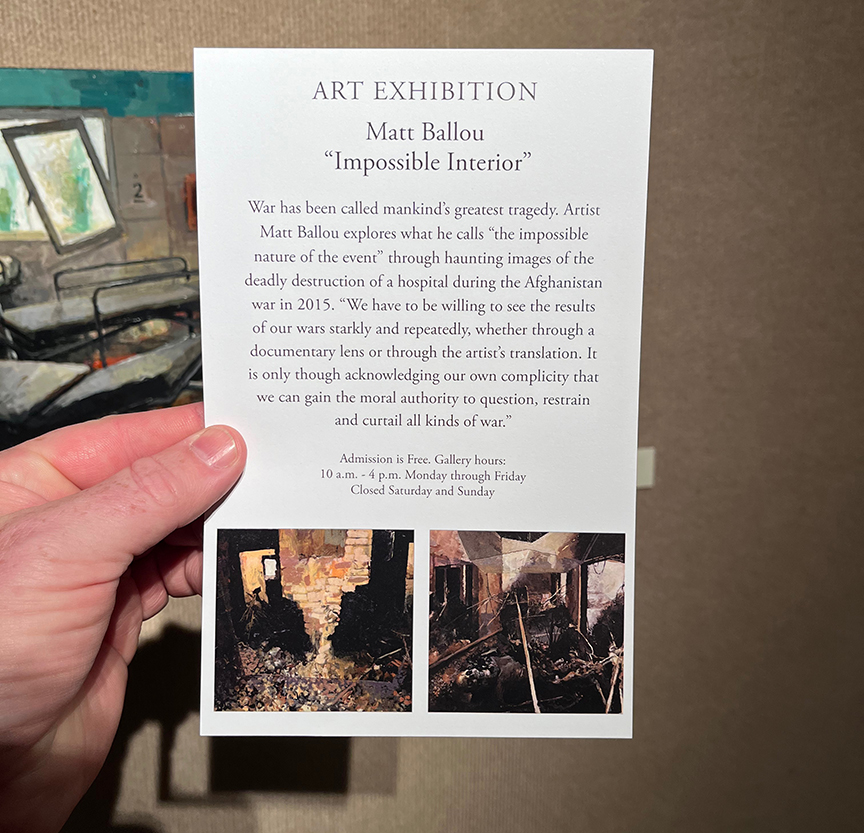
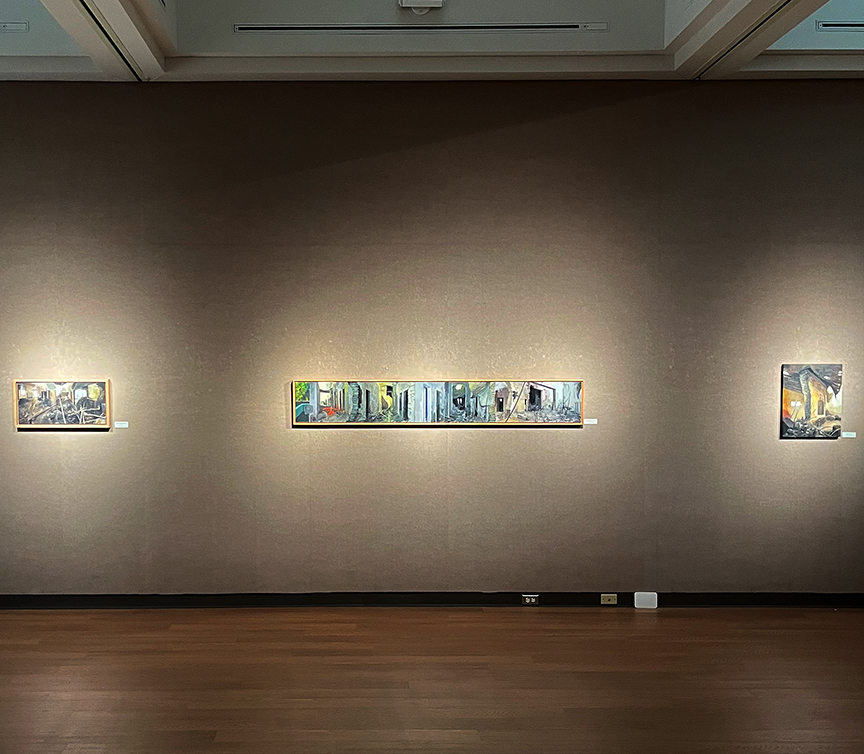
I’ve got a group of works on display at William Woods University in Fulton, Missouri. The show runs through October 6th, and I’ll be giving a talk that evening. For a preview, look below.
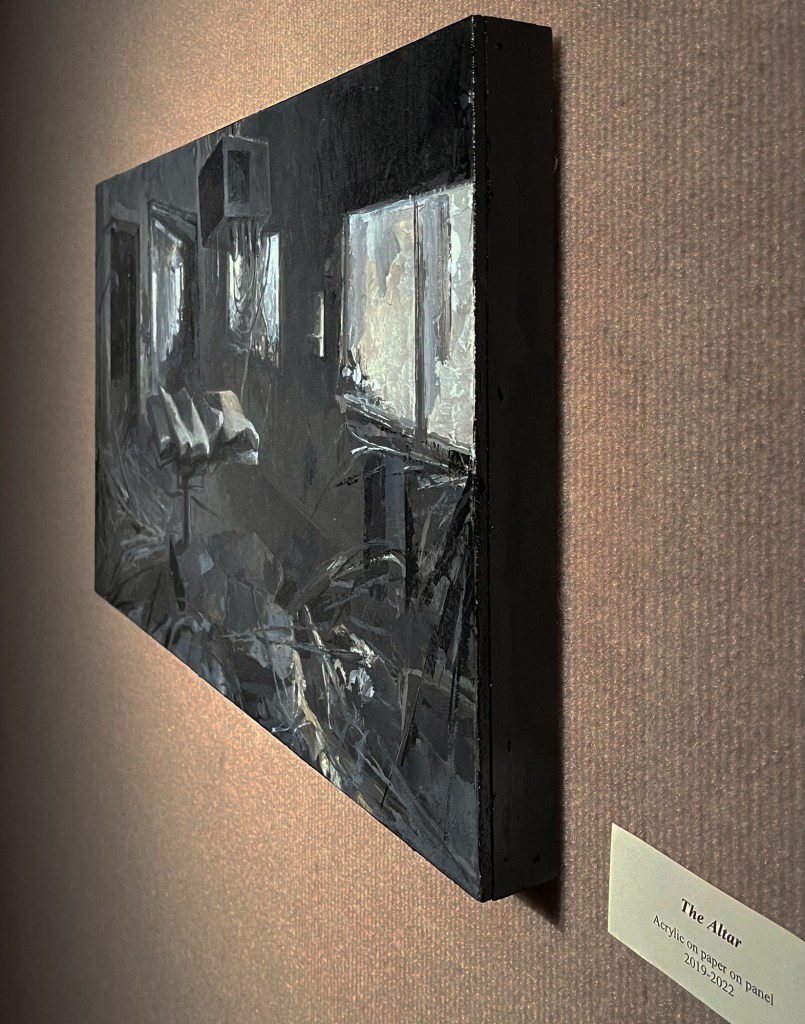
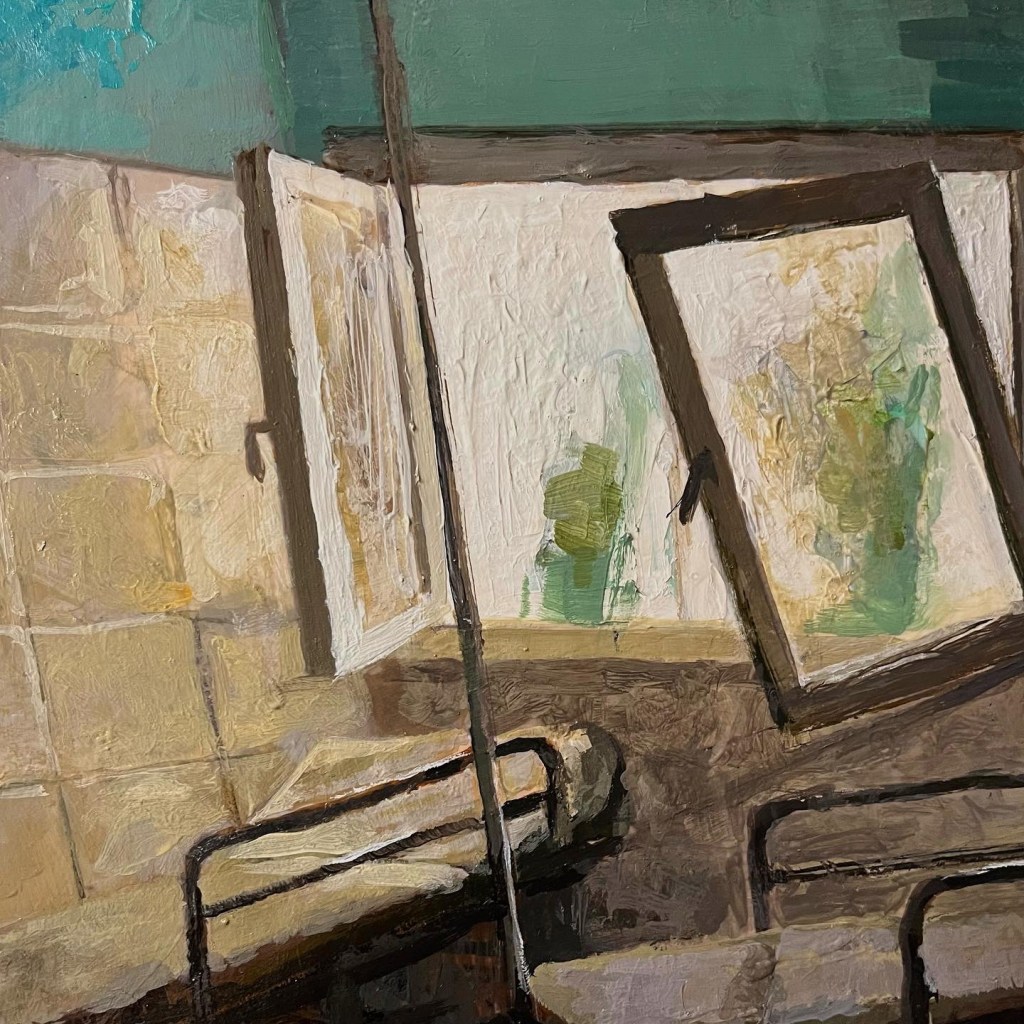
This is the third time I’ve shown this body of work, and I’d like to get the chance to show it again. The subject of the work – a “friendly-fire” bombing of a Doctors Without Borders hospital in Kunduz, Afghanistan. If you’d like to see more about this situation, check out my writing about it here.
The card for the exhibition.Back of the card with description of the show.Here are just a few of the works on display, along with some details. There’s a lot to see, so come on by!
I’m also pleased to have a small group of my collaborations with Joel T Dugan also on display at the gallery. These Phoneme works are some of my favorites, and there are a number of just finished works included.
A lot of people picked up a new skills and or hobbies during our collective quarantine. Some people got going with a sourdough starter. Some people began learning a new language. Others just worked on their alcoholism.
What I did was decide to watch as many Nicolas Cage movies as I could.
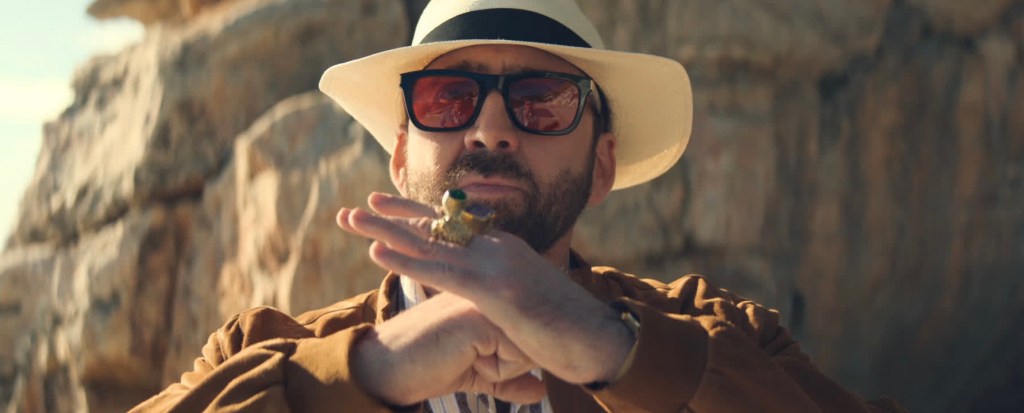
Nicolas Cage in “The Unbearable Weight of Massive Talent” 2022.
While I didn’t make it through his entire oeuvre, what I did do was see a good mix of older and newer movies, both good and not so good. From that exploration I’ve collected five below that I think demonstrate the recent best of Nicolas Cage. I’ll also rank them from #5 to #1.
Nicholas Cage in “Vampire’s Kiss” 1988.
I’ve got a lot to say about each of these films but I will constrain myself to just a few sentences, a few tasty bits of weirdness, to get you in the door. Why try to convince you? Because I really think that these are high-quality Nicolas Cage movies. You may have a sense that Nicolas Cage is not the greatest actor of his generation and, sure, there are some reasons why one might think that. He is a polarizing figure. Whether you love him or hate him, you can’t say he’s boring. I think that if you look at specific moments in the Oscar-winning actor’s career, you will see that he has moments of pure transcendence.
Given that, I’m always down for a foray into cinematic ridiculousness with him.
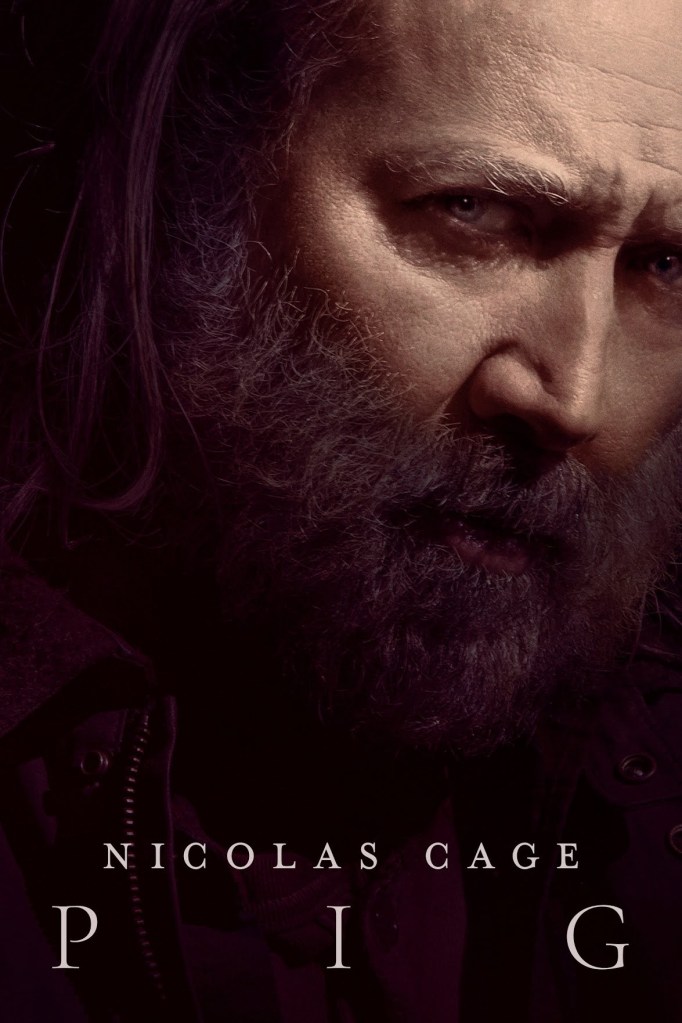
5) Pig (2021)
Nicholas Cage as a grimy, crazy, disaffected former-chief who goes all Fight Club in an attempt to recover his stolen truffle-sniffing pig. What more do you need? Best part: When our pig hunter shames the hell out of the hoity-toity world of fine dining.
“Pig” movie poster
4) Mom and Dad (2017)
This genre-bender reverses a lot of what you might expect from where you think it is headed, and that’s good. There are classic one-liners, great Cage rage sequences, and some fun camera work and editing. Best part: Selma Blair (i.e. Mom) in a great match up with Cage in a role that plays off his crazy with some crazy of her own.
“Mom And Dad” movie poster
3) Between Worlds (2018)
Ok, listen. This is one weird movie. It’s got an interesting sci-fi premise and would have been a much worse movie in less confident hands. Cage and veteran Franka Potente (Run Lola Run, The Borne Identity) anchor the film with seriousness and earnestness, in spite of how ridiculous parts of it are. And parts are really ridiculous. The scene where Cage’s character is being hosed down while dancing is just next level. And then there’s the scene where the character is having sex while READING A BOOK OF POETRY BY NICHOLAS CAGE. Ok? We’re getting meta here. It’s worth the watch just for the water hose thing.
Nicholas Cage and Penelope Mitchell in “Between Worlds”“Between Worlds” movie poster
2) Willy’s Wonderland (2021)
Imagine walking into an abandoned, decrepit Chuck-E-Cheese’s and being attacked by animatronic characters that have been possessed by evil forces. That’s the basic idea here. Ok, now imagine you’re Nicholas Cage AND YOU HAVE NO DIALOGUE AT ALL. No words are spoken by the star and top-billed actor in the movie. None. This movie is mostly just campy fun, but half of the tension it carries is found in waiting for and expecting words to come out of Cage’s mouth. This full-on indie project must have been someone’s labor of love that just happened to get Cage behind it. It’s so odd and off-tone in ways, yet it works. Come for the epic death blows to possessed animatronics, stay for Cage’s wordlessness.
“Willy’s Wonderland” movie poster
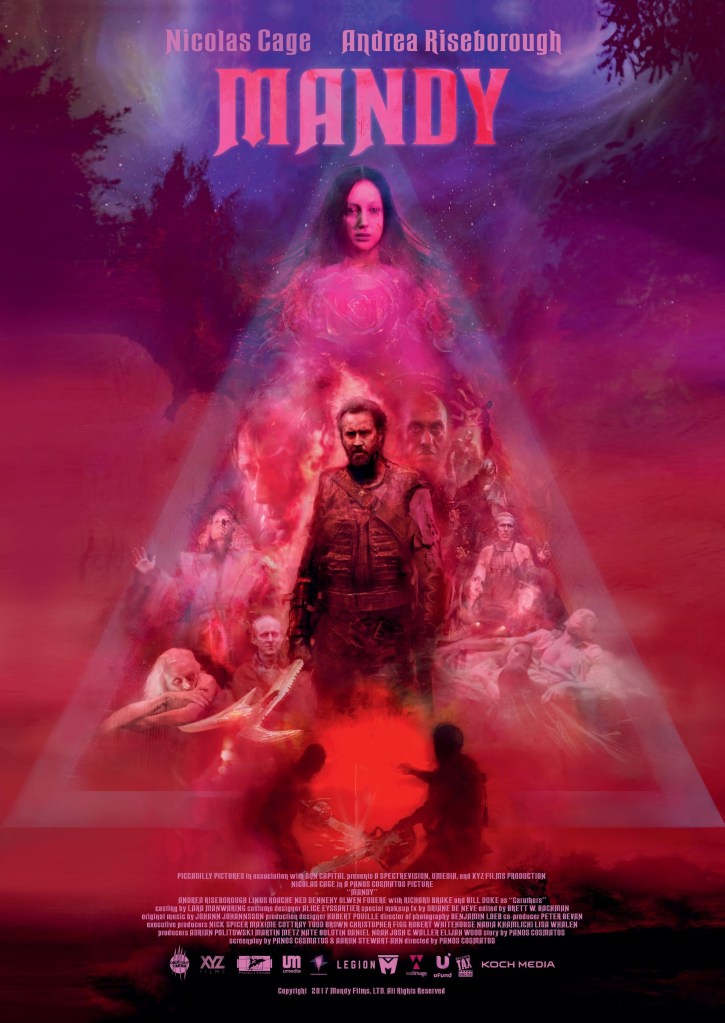
1) Mandy (2018)
Mandy is a work of art. Italian-Canadian Director Panos Cosmatos continues in Mandy the qualities that made his epic Beyond the Black Rainbow so strange and powerful. Atmospheric space and light. Intense color. Aural compositions that influence the space and visuals. The use of chiaroscuro to force viewers to complete the dynamics of action and scenic structure. Absolutely one of the best movies I’ve seen a decade, Mandy embraces its heavy-handed narrative and unanswered questions. Yet the emotion that comes through is palpable and so important to how it remains re-watchable. Andrea Riseborough’s subtle and keenly-felt performance is a wonderful foil to the insanity mounting in Cage’s character. If you see only one movie here, see this one.
“Mandy” movie poster
To conclude, I have to say that the movies Nicholas Cage has made in his mid to late 50s are bending toward a quirky and chaotic quality that can’t be easily dismissed. Yes, there are duds, and perhaps Cage himself is a dolt of a dude. But with roles like the ones I’ve listed above, he’s continuing to show himself to be a capable, if odd, actor more often than not.
Like many kids I was I influenced by the work of Beverly Cleary. She died today at age 104. That’s a solid life.
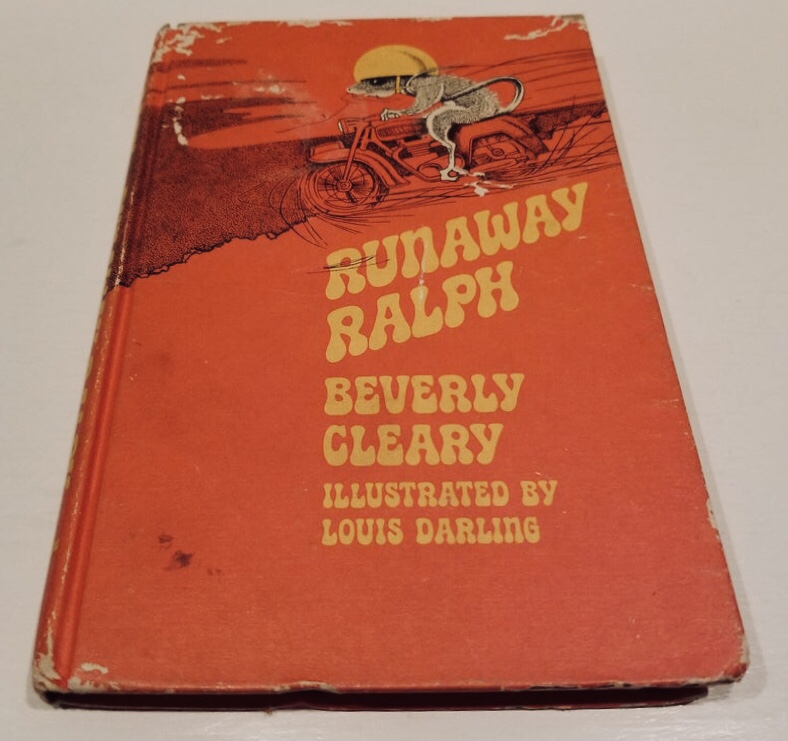
Perhaps as important as her writing were the illustrations and book designs that went with them. This one in particular has stuck in my mind for more than 40 years:
Cover of the 1970 edition of Runaway Ralph.
This particular edition – put out by William Morrow & Company – was in my home. I think the font, the colors, and (obviously) the illustrations by Louis Darling made a huge impression on me. I recall thinking about how the motorcycle that Ralph rode was depicted to show speed, how the idea of “small” was presented, and how the story could be shown with such subtle, one-note clarity.


















 eikonktizo