


The best part about this drawing session with my daughter was the way she put her left hand over mine when she’d go to make a mark with her right…
The best part about this drawing session with my daughter was the way she put her left hand over mine when she’d go to make a mark with her right…
“The public make use of the classics of a country as a means of checking the progress of Art. They degrade the classics into authorities. They use them as bludgeons for preventing the free expression of Beauty in new forms. They are always asking a writer why he does not write like somebody else, or a painter why he does not paint like somebody else, quite oblivious of the fact that if either of them did anything of the kind he would cease to be an artist. A fresh mode of Beauty is absolutely distasteful to them, and whenever it appears they get so angry and bewildered that they always use two stupid expressions—one is that the work of art is grossly unintelligible; the other, that the work of art is grossly immoral. What they mean by these words seems to me to be this. When they say a work is grossly unintelligible, they mean that the artist has said or made a beautiful thing that is new; when they describe a work as grossly immoral, they mean that the artist has said or made a beautiful thing that is true.” – Oscar Wilde, (from this New Yorker article)
Though I don’t believe in “newness” or “originality” I resonate with what Wilde is saying here. What we consider new or original is really just a recombination of the elements and assumptions that underlie our experience and expression of being into a form that is somewhat removed from our well-worn paths of knowing. We are uncomfortable with this reconfiguration, this reconstitution, and so we react by calling it unintelligible or immoral, as Wilde observed. I think Wilde’s greatest contribution is in his knowing and deft agitation of our assumptions about what we know, his precise jostling of our convictions of certainty. He is one of the few artists whose work I seamlessly love.
One of my fondest memories of experiencing Wilde is related to seeing the Tom Stoppard play “The Invention of Love” at the Court Theater of the University of Chicago with my wife and father in law several years ago. In it Wilde makes a striking appearance with the main character of the play A.E. Housman, on the shore of the river Styx. His teeth blackened, condemned by law and society, Wilde is an exuberant yet melancholic figure in death. Still dapper and spouting axioms, dressed in lilac and reading from his own work as Housman comes upon him in the afterlife, Stoppard’s Wilde is a revelation. The scene catalyzed my appreciation for Wilde, so I guess I have Stoppard to thank for that. Here’s a review of the play if you’re interested.
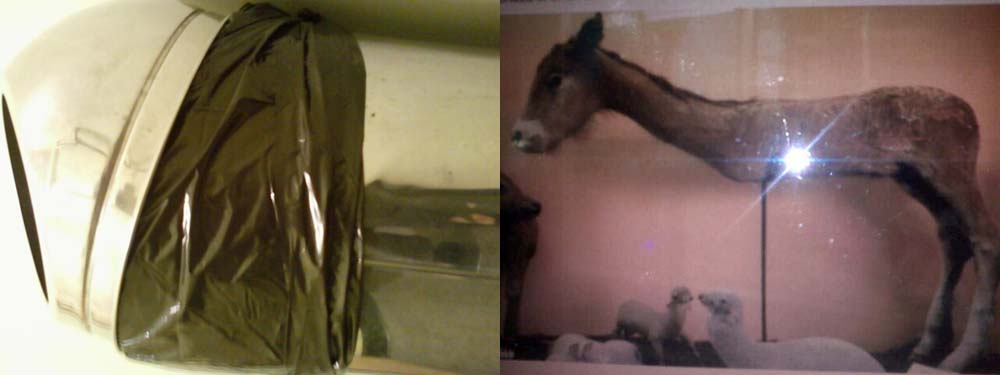
Marcus sends images to me. I send images to Marcus. Often the pairings are glorious.
Here are just a few… Marcus on the left, mine on the right. Click to enlarge.

1

2

3

4

5

6

7
8

9

10

“As I reflect on this experience from the mitigating distance of years, I am staggered by the power it still holds within my heart. And by my heart I mean the seat of my emotions as well as that physical member within me. Perhaps this is because, as with all fantasies, I remember it in an idealized form. Yet even the least ideal aspects of the time hold a remarkable glow to me.”
“At the time, I saw that land – that Large Place – as a separate sphere, a space out of time, out of normalcy. It strikes me how, when I am able to recall it very clearly, my heart almost seizes within my chest as I briefly sense again the stinging joys that I felt there.”

“It was an exploration of myself, not simply a holiday from the reality I had always known. Sitting there on the shore of that ancient lake, gazing back west towards the big city that has since become my home, I marveled how it seemed that I was gazing across some chasm of time and space.”


“I was dislocated, thrown, out of my time into another, somehow timeless, yet time-full arena. I was looking backward and forward to that other shore of past experience and an unsure future. I could never be the same.”

“I could never be the same.”


“I could never be the same.”
“I could never be the same.”


 All text: from A Mnemonic of Longing, an unpublished essay, 2002-2009.
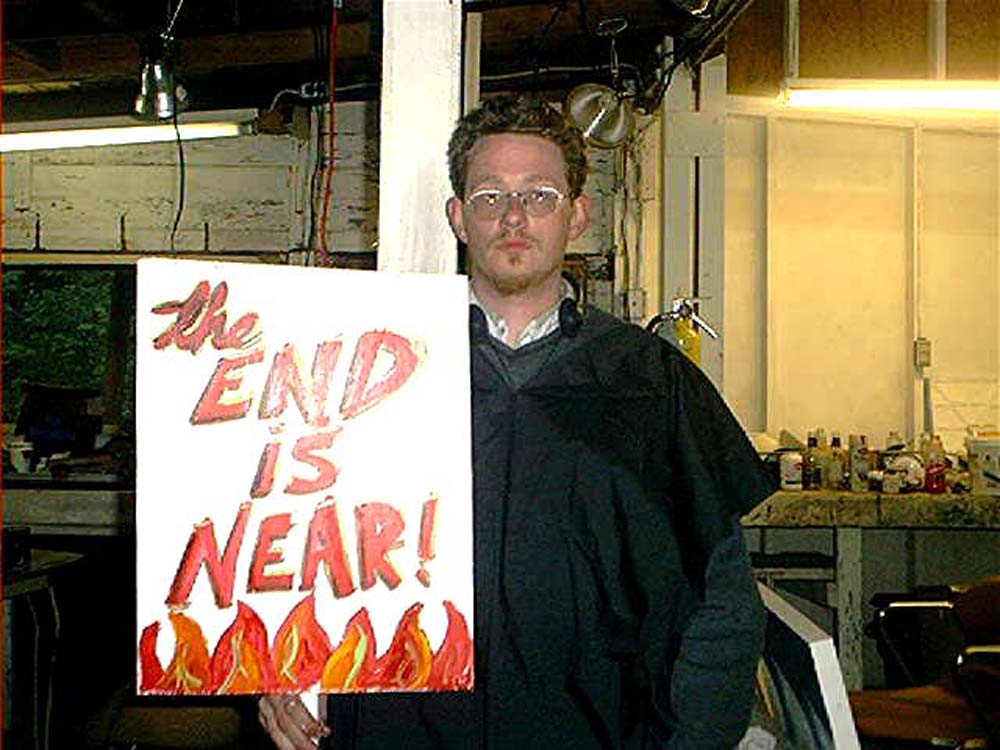
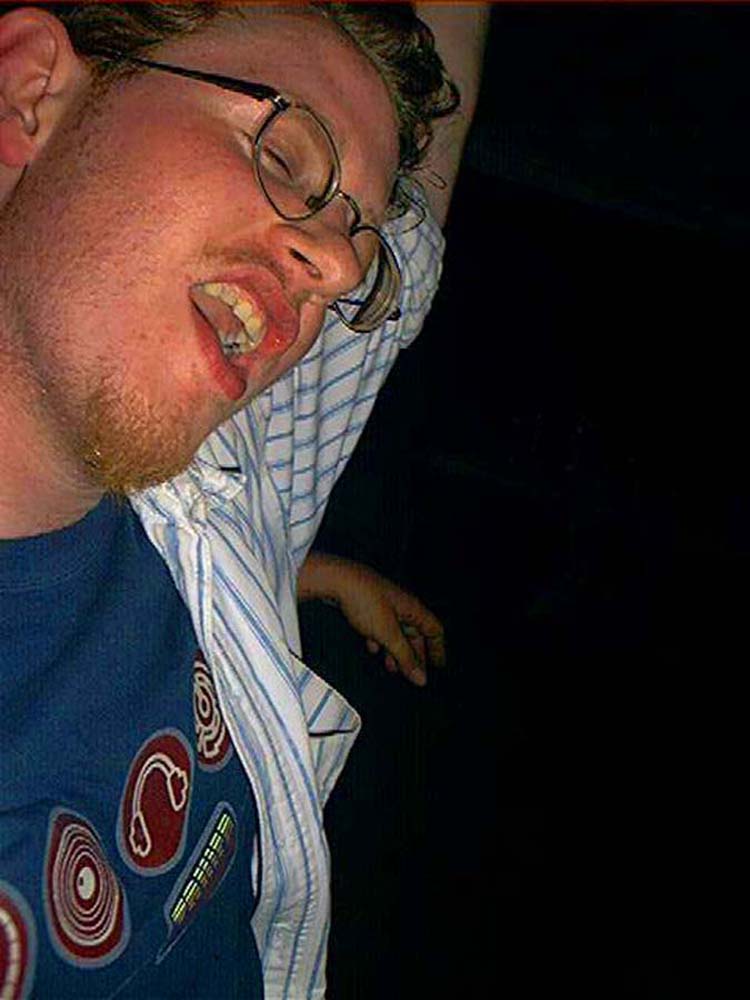
All photos: Self-portraits taken between May 2001 and August 2001, in roughly chronological order.
Drawing: Matt (Hardass). Ink and Sharpie on paper, 11 by 14 inches, 2001, by Reid Thompson and unknown Ox-Bow Fellow (A.G.).
PS: Don’t smoke, kids.
It’s a huge loss. Artists of his stature are so rare. Sleep well in the light of the Divinity you helped reveal.
“Image-making in this place seemed axiomatic. You live to make. Or, at least, in living you make. Let us take the ninety-degree turn twice and go back to where we once were, shall we? It was fun, challenging, and worthy; the most worthy and real thing I did that summer. It is the most abiding thing I did, even now. Alas, all the rest is dust, chaff, and stubble – ‘which are burnt and which the wind drives away’ – though it all was so beautiful while strewn on the ash pile there. And we, like the old pagans, went down to color it and cover our nakedness with it.” – from A Mnemonic of Longing, an unpublished essay, 2002-2009.
 Above: the studio I used during the Summer of 2001 while at Ox-Bow on a Fellowship Residency. Click for larger view.
Below: a sign one of my fellow Fellows left for me one day. I’ve saved it all these years. I have a feeling who left it on my chair that night, but was never sure. Click for larger view.

I’ve recently collected some bodies of work into small catalog format. The Lamentations 3 Series, from 2009-2011, and shown recently at Gordon College in Massachusetts, is collected along with images of the copper plates in process, some installation shots, and an essay that I gave as a lecture at Gordon during the opening for my show there. Click the image below for more info.

The second book is a collection of some of the 100 or so Locus Series works that I created between 1999 and 2001. I present about 20 images along with a short essay I wrote in 2001 when I concluded the series. I also wrote another short contemplation this year to reflect on what the Locus Series has meant to me. Click the image below for more info.

 “Can I remember it only in some half-form? Can I remember it only as a chimera, made of memory and will and hope? Can I not recall it totally, fully, being in myself as I was? Does no one understand the fullness of the emptying time? Does no one sense it in themselves, that time when they lost the tether? Let it loose again, to feel that it is gone! Alone. This is the deep pit of sensing, where I know the contour of death and dying. Suspended above the abyss. Glory.” – from A Mnemonic of Longing, an unpublished essay, 2002-2009.

“Look… an abyssal missive, a doctrine of smoke… ‘into dust.’
In the end I suppose that I wish for it, (and sometimes still seek it with nervous hope) that confusion. Sweet psychological instability – the wobbly legs of a newly drunken lad – here as the land curves away beneath me. I guess that, at times, the seeking is more interesting to me than the knowing. I’ve seen it here, right here on this land; is there self-loathing? What’s beneath the surface of us all? Did I see myself here for the first time, or was I just revealed anew, from a novel angle and in skewed light? The absolute beauty of being permissive, of stepping aside and watching oneself from the wings – it can’t be beat, though it stays with you in some way I can’t yet fully understand. I don’t think I ever will understand it. Watching others though – there’s the bittersweet fruit. The fallen human trembles and tumbles through life, and even at the lowest point renders to itself the most poetic, romanticized stroke.” – from A Mnemonic of Longing, an unpublished essay, 2002-2009.
Still falling
Breathless and on again
Inside today
Beside me today
A round broken in two
’til your eyes shed into dust
Like two strangers turning into dust
’til my hand shook the way I fear
I could possibly be fading
Or have something more to gain
I could feel myself growing colder
I could feel myself under your face
Under…your face
It was you
breathless and torn
I could feel my eyes turning into dust
And two strangers turning into dust
Turning into dust.
“Into Dust” by Mazzy Star

All images above are from digital photos taken between May and August 2001.
Henry Ossawa Tanner has been a major presence in my life as a painter for many years. His grasp of overt and subtle visual dynamics is astounding, as is his dual ability to modulate fields of colors and negotiate edge quality. In many ways his works prefigure the Abstract Expressionists who were to follow him 40 or 50 years later. The work below, Nicodemus Visiting Jesus by Night (1899, Collection of the Pennsylvania Academy of Fine Art), is one of his masterworks. You can read more about the image here, and click on it for a larger view.

To me, this work below is the painter’s absolute triumph:

Annunciation (1898, Collection of the Philadelphia Museum of Art). Click to expand.
My glorious former grad students (AND NEWLY-WEDS!) Natalie Hellmann and Ian Shelly visited my (and Tim Lowly’s) show at the 930 Art Center today. Yay!
 Natalie likes to visit my shows. Here she is with one of my works at MANIFEST in Cincinnati!

 eikonktizo
