A number of years ago I saw John Dubrow’s painting Rephidim. It inspired – eventually, after some gestation – this painting:
The work is titled Taming the Tongue, Study #2. The Dubrow work inspired this sketch, not the previous or subsequent works. After a while I manifested the idea in this work, but I have always been drawn to this small work and its connection to Rephidim. Learn more about that painting and John Dubrow himself here.
Thursday and Friday, October 28th and 29th, 2010, painter and educator Matt Klos visited the University of Missouri Art Department. His talk – as much a short lecture on the richness of painterly exploration over the last 75 years as it was an elucidation of his art – was a vibrant and refreshing event.
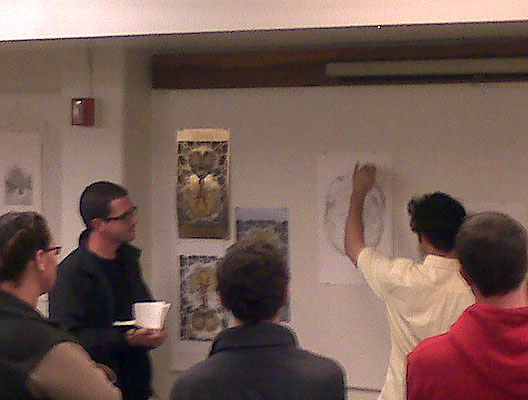
After the talk, Professor Klos led a large group of Mizzou undergraduate students in a critique of works from art majors Derek Frankhouser, Marcus Miers, Danielle Moser, and John Schneider.
The talk and critique were well attended and really modeled the intense, engaged dialogue we are trying to foster among our undergrads here.
Nine years ago this month I was hired at Good’s of Evanston, in Evanston, IL. It was a great place for an artist to be – and the best art stores always employ artists. Good’s hired artists as clerks, shipping and receiving crews, framing specialists, and book-workers. I started there as the primary shipping and receiving guy. I’d deal with the trucks of supplies that arrived each day, check the orders to make sure they were complete, fill out paperwork for what was off, and stage the checked merchandise so the floor crew could either store or put out for sale.
One of my favorite coworkers was Fred. He was thoughtful, well-spoken, engaged in the world, had a quirky sense of humor and great taste in music. He turned me on to Kitchens of Distinction and HUM, both bands I still listen to all these years later.
Me and Fred hanging out in the paper department at Good’s
Fred and I would often engage in debates of various kinds, always talking politics and public policy, musing on the current events and the changing post-911 world. Our friend and fellow Good’s employee Ronnie would often come upon our chats and, eventually, he would provide outside commentary and “lead-in” type introductions when he saw that we were ramping up for a talk. Over time, Ronnie created the fictitious “GoETV” network as a place where On Point! With Fred Sturkey and Matt Ballou (as Ronnie named it) could take place.
Good times, good memories. Here’s hoping Fred is doing well! Unfortunately Good’s no longer carries art supplies, so much of the old crew is gone. But they still do high quality framing, so if you need something done and you’re in the Chicago area go see them!
Thanks for visiting. My name is Matt Ballou. I teach at the University of Missouri’s School of Visual Studies, where I’ve been since 2007. At this site you can see a range of my visual and written work.
Who I Am
I am an artist, teacher, writer, and dad who lives in Mid Missouri. This blog, which I began in 2009, records my art practice, as well as words and images that I use to reflect on my experiences in this life. I’m trying to learn how to see and dream well.
Please browse the various areas in the menu above for more about me. In particular, my adventures in China and at Ox-bow have been integral to who I have become. Additionally, my heart attack was a watershed event that produced radical changes in my art and life.
Context
I have shown my artwork in exhibitions across the US, from Illinois, Kansas, and Massachusetts to New Hampshire, New York, Ohio, and Washington. I have developed and curated exhibitions in Illinois, Maryland, Missouri, and Nebraska. My areas of research include:
Comparing and contrasting Eastern and Western Mandala forms
Investigating how natively digital art practices interact with physical materials
Developing pedagogical uses of technology and online learning environments
Using CNC routers, laser engravers, and various drawing robots in the development of artworks
Writing
My writing has been a key aspect of my practice for over twenty years. Publication highlights include a cover feature on the work of Odd Nerdrum in Image Journal, a profile on painter Joey Borovicka in The New Territory, and an extensive review of Richard Diebenkorn’s Ocean Park Retrospective for the Chicago-based publication neotericART. In the last few years I completed invited texts for The MU Museum of Art and Archaeology, SEEN Journal, and Oxford University Press (Grove Art). See my Bio and CV for more. Several of my personal favorites are linked here.
Current Art
I have had several areas of art-making going on simultaneously over the last decade or so:
I’ve finally gotten to set up my tondo making jig in my new woodshop. Here’s a run down of how it looks and an example of what it can do.
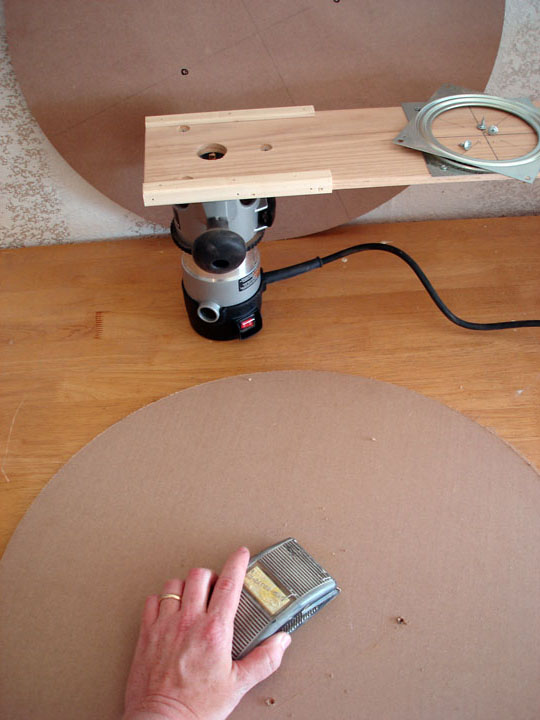
Here you can see the basic layout. I’ve created the body of the jig on a nice piece of half inch by 6 inch by 3 foot oak. Being a hard, strong wood, the oak will hold the mounted router well. The router itself (a nice mid-range Porter Cable model) is attached by removing its base plate and mounting it to the oak board as shown. The screws are recessed to assure good connection to the router.
Then I mounted a small “lazy susan” type ball bearing swivel deck to the other end of the board. I’ve measured and pre-drilled stations for the swivel deck in my standard tondo sizes – 12 inches (to give me a 24 inch tondo), 20 inches (40 inch tondo) and 24 inchs (48 inch tondo). I set it up to move the swivel deck to reduce wear and tear on the router mount area. I don’t want to take the router off at all. You can see how I’ve put some base plates along each edge of the board on the router end so the swivel deck and router approach are level when placed on the board to be cut.
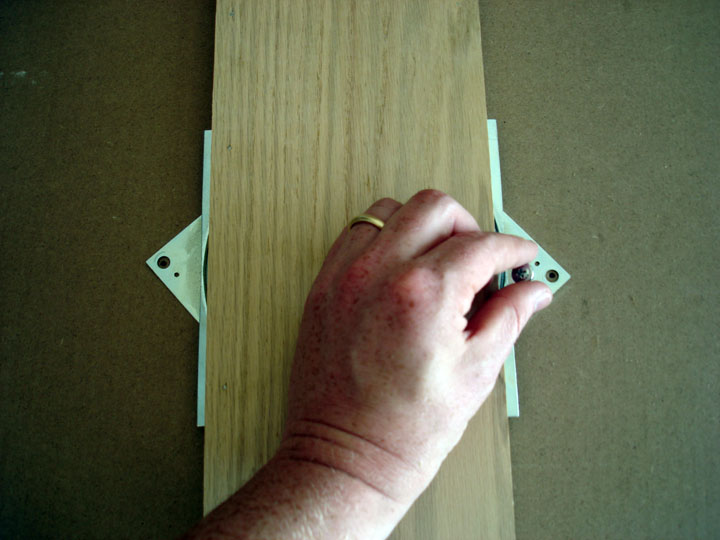
To cut a tondo, I select my size (in this case, I want a 24 inch tondo) and put the swivel deck there (above). Then I screw down the other side of the swivel deck to the board to be cut so things are nice and secure (below).
Then – with the bit still recessed up into the body – I will start the router and slowly plunge the bit about halfway into my wood. I learned in my previous experience with cutting tondos to take it slow and cut in a few passes to ensure a good, smooth cut but also to protect the router. The harder the wood, the more wear on the router – obviously with this piece of MDF the router could have done the entire cut in one pass, but I feel more comfortable taking a few extra minutes to keep the tool nice.
After the first pass – and each subsequent one – I use my compressor to blow out the dust. This increases the ease of the next pass and keeps the risk of charring or actual combustion down. I also make sure to blow out the vents of the router since the sparking within the motor can ignite dust that collects there.
In the above picture you can see the bit being adjusted down for the final pass.
After the final cut I remove the excess wood and blow off the dust (above), then remove the swivel deck and start to sand any burrs (below)
Here’s a look at the edge of the tondo – pretty smooth cut!
 The work is titled Taming the Tongue, Study #2. The Dubrow work inspired this sketch, not the previous or subsequent works. After a while I manifested the idea in this work, but I have always been drawn to this small work and its connection to Rephidim. Learn more about that painting and John Dubrow himself here.








 eikonktizo
