Inspiration: Students

I started this blog five years and two days ago, and one of the things I’ve enjoyed most about it is sharing the work of my students. I never try to over-sell it. Most of my students are not Art majors. Many of them have had very little art-making experience before they take my classes. Yet they always make transformational movements, always end up showing themselves things they never imagined doing. I want to share a few of my Spring 2014 students’ works and words below. They were inspirational to me this semester. All images and words shared with permission.

photo 1Tayler Newcomer, Undeclared Major. Self Portrait Study, 14 by 11 inches, Graphite.

“Everything changed when I walked in this classroom at the beginning of this semester. This class has changed the way I thought of drawing, and even my perspective on life. I found myself more focused and calm when I drew instead of anxious and judged. It helped to bring back this hope and urge to draw that I used to have when I was a little kid and I’m not sure if I can even fully explain what that means to me. What I’ve taken from this class is honestly a little more uncertainty, but I know that’s not a bad thing… I just had thought to myself that I could never be an artist or a musician or a writer. Yet I still draw, still play music, and I still write on that novel I’m almost sure I’ll never finish. I want to go out and appreciate this wonderful gift of life that has been bestowed upon us.” – Tayler Newcomer.
imageTayler Newcomer, Undeclared Major. Self Portrait Study, 18 by 24 inches, Graphite.
~
2014-05-03 16.00.51Emily Crane, Graphic Design Major, Softball. Master Copy after LeRoy Neiman, 24 by 18 inches, Pastel.
“I want to see things through others’ eyes and be open to change! In the rest of my life I want to keep trying to be slow to anger and quick to love, and care as Jesus would. I pray my life will be a light for people in one way or another!” – Emily Crane.
2014-05-03 15.55.14Emily Crane, Graphic Design Major, Softball. Self Portrait Off Third Base, from a M, 24 by 18 inches, Pastel.
~
image[1]Blessing Ikoro, Psychology Major. Self Portrait Study, 14 by 11 inches, Colored Pencil.
“If it were not for a sense of the whole I would not be me when I draw my self portraits. I would not be such a pronounced image within the scene that I draw; it is the universe itself that helps pronounce my image. The drawing then has a sense of the whole as well.” – Blessing Ikoro.
image[2]Blessing Ikoro, Psychology Major. Study of Busts of Caesar and Apollo, 24 by 18 inches, Charcoal.
~
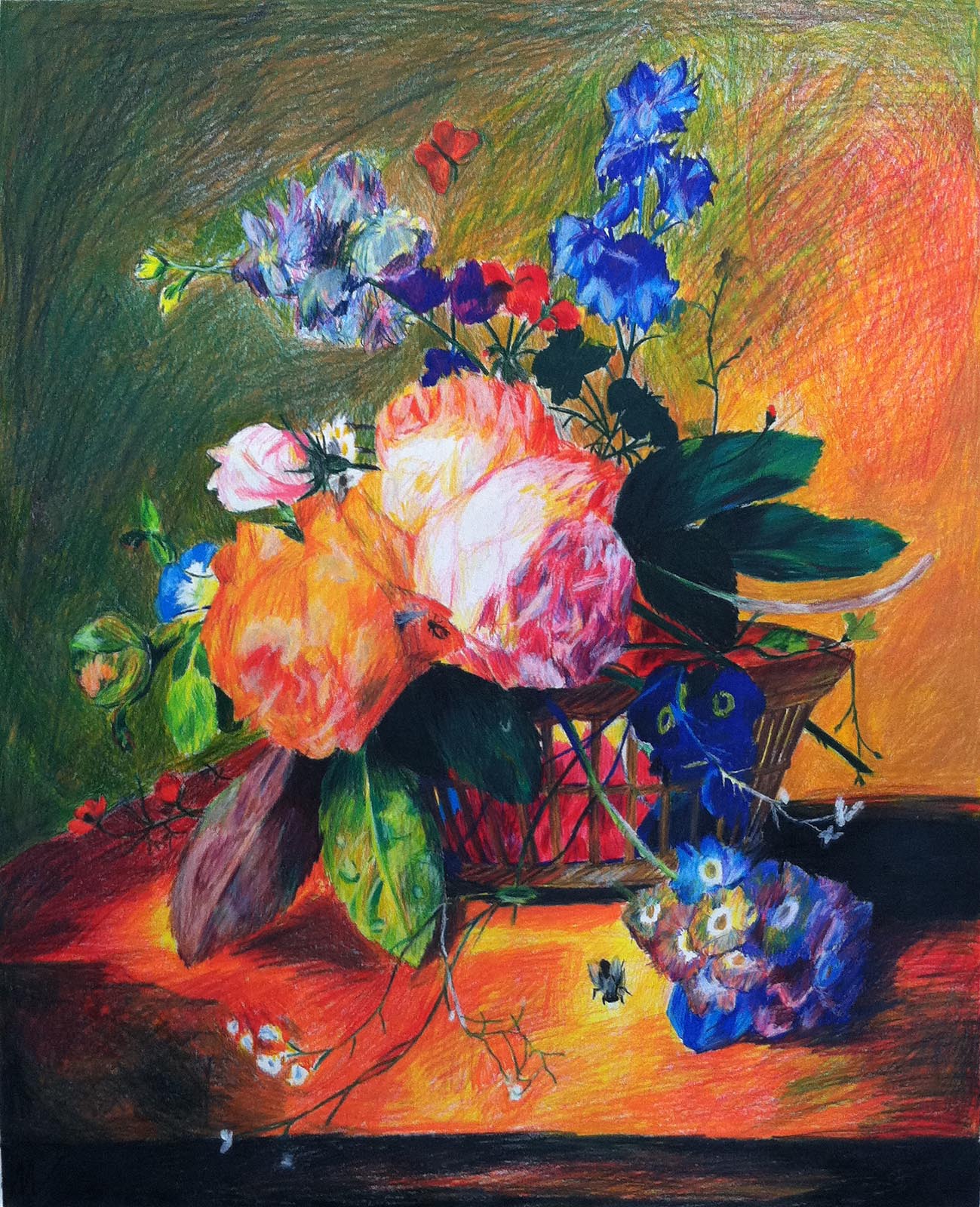
2014-05-03 16.00.58Amanda Bradley, Art Major. Master Copy after Dutch Master, 24 by 18 inches, Colored Pencil.
~
2014-05-03 16.00.38Shayna Painter, Business Administration Major. Master Copy after Kupka, 18 by 18 inches, Colored Pencil.
~
“The way you see something and the way you experience it are so different. The visual aspect of anything isn’t more important than what you learned from it or now it made you feel.” – Hunter Whitt, Elementary Education Major.
~
These young women were just a few of the outstanding students I had this semester. Here’s hoping they continue on with the art impulse.

Banality

I’ve had a number of what could be termed crises of faith over the last few years. Given that my life isn’t particularly compartmentalized, arenas slide over and influence one another. This can be for good or ill: A car needing to get fixed shows up on my choice of palette. The sickly child informs my lesson plans. A poorly executed drawing demonstration syncs up with indigestion.

One of the difficulties I have found in teaching the fundamentals of drawing and painting (something I’ve been doing for nearly a decade) is that I have become more and more detached from the epic expansiveness of potential meaning I once saw so easily in everything.

If that seems counter-intuitive, you’re right. On the one hand, I’m opening up this huge world for students and advocating for its meaning-making properties. Sometimes I do a good job at this; sometimes it clicks. On the other hand, however, often I have to break things down so far that they become divested of their mystery. This is probably because I’m not the best teacher – nor the best student – I could be.

But it is also that, amidst the urgency of schedules and diapers and curricula and learning goals and policy committees and trying to eat right and falling off ladders and mowing the lawn and hoping I’m a good dad, the horizon of my universe has shrunk. I can no longer connect to the mysteries. When I look in their direction they seem blank – I seem blank. I look at pictures that used to inspire me and fire me up… I can feel the echoes of what I felt 10 or 20 years ago, yet they seem vague, hollow, incomplete, impotent, and affected attempts. I painfully sense the depths to which I once could swim, but realize I no longer try those fathoms. The shallows, it seems, are the extent of my aesthetic, spiritual, and intellectual submersion these days.

All of the hard-fought attempts I’ve made as an artist and writer seem to, generally, make little or no connection to others. This is not a statement meant to engender pity toward me. I’m not begging for praise. I simply recognize that the average viewer/reader receives perhaps 10% of the passion, reflection, or depth I intended. I am thankful for that 10% of understanding. I’m thankful for every picture I’ve had the honor to show or sell and grateful for every piece of writing I’ve had the privilege to publish into the world. Yet I feel that I can no longer put so much time or energy into these things. It’s not that I don’t want to do it, it’s that I don’t have the depth anymore. Those corridors are closed off. I have shrunk. The extent of my vision has stalled. The infinite chiaroscuro of the universe has fled from me.

I’m not writing this to garner sympathy. I’m just trying to be honest. I think this is part of the life of an artist. Perhaps this too shall pass. I only know that my ability to believe in the value of plumbing the depths is all but gone, and I’m almost not even sad about it. What happens when you no longer feel tethered to what used to be your deepest motivation?

So much of what happened in the best work I’ve made over the last 20 years can be chalked up to faith. I can see passages of paintings and drawings where I had faith, where I had belief in the work. What happened in them was beyond technique and ability, beyond solid ideas or philosophical underpinning. The best ones went far beyond my knowing how to make them. When you lose that faith, how can you ever see or do those things again?

I know I am lucky. I get to teach, get to make paintings and drawings and prints. I get to show my work. But in doing all of that I can see how things atrophy and become stilted. The raging river stagnates. Will I be making tame pictures of flowers in 20 years? I hope not. Yet I feel a domestication growing. When one has a creative itch to scratch but no longer has emotional, spiritual, or intellectual access to the deep things of life the result is often the height of banality.

So artists, pundits, and mass-shooters proliferate. Another day, another war, another hundred thousand more orphans. Google knows what Star Trek-themed trinket I’m most likely to buy (and I actually consider buying it). I remember less and less of the awkward dreams of the 20-year-old me while the 40-year-old me who can no longer run with his kids comes more and more into focus. Perhaps it’s all an episode that would pass with a couple more hours of sleep each night, or with actually cutting red meat out of my diet. Or perhaps it’s just how things are, and I’ll have to figure out how to reach those old depths again after another decade and a second wind.

Becoming the Student, #13: Kevin Stark

Way back on St Patrick’s Day Kevin Stark and I sat down to share some Guinness and make a portrait. After a long while I’m finally posting it. It’s one of my favorites of the Becoming the Student series, and I am very happy I documented its creation in a video. See that video at the bottom of this post.

2014-03-18 17_17_11Kevin Stark. Digital drawing created with Adonit Jot Touch 4 in Sketchbook Pro on iPad Air, 2014. Click for enlargement.

On Shared Experiences

“I try to be present. I don’t like it when I’m not. That’s why I’ve been doing this game night thing. The games themselves are a blast – I love the strategy and going for the win and all – but I really love the way that games reveal things about people and you get to know them. I’ve always been big on shared experiences. I derive quite a bit of joy from knowing and being with people. Like, I’m not so interested in going to see a movie with someone. But, for instance, going to the True/False festival with someone – doing something you have to journey through together – is something I love. You’re participating in it together, sharing it together, and every connection between you is growing. Those are the kind of things I’m big on.”

On His Rebellious Childhood

“Everything that I’m into now I said I hated as a kid, like Star Wars, the Red Socks, and The Beatles. My dad tried to introduce me to each one of them and I was like, ‘NOO!’ I’m glad I grew out of that ‘cause they’re pretty awesome.”

On Mellowing Out

“I’m more OK with people mellowing out. I used to be annoyed that this concept of a ‘restless youth’ thing was just a youth thing. The idea that people sometimes become confortable with things… I guess I’m mellowing out about mellowing out.”

On Music

“I’m really into discovering new music right now. There’s too much. Too much. I really like Daytrotter. It’s a download website where a bunch of bands from around the world share four song sets and they get posted.”

“And Destroyer. You ever heard Destroyer? Oh, man – it’s great! Get into Destroyer. He has two albums that have affected me greatly.”

“I’m annoyed at how much I’m a sucker for long songs.”

On His Portrait

“Thanks for not making me make a stanky face for two hours.”

Digital painting of my friend Kevin Stark. Two hours.

Becoming The Student #11: Allison Jacqueline Reinhart

Allison Reinhart (go to her website here) is a former student of mine who has been pretty instrumental in my growth as an educator over the last few years. We’ve worked together on a number of projects, each one more beneficial than the last. Her last solo exhibition was fantastic, and I was able to write about it for neotericART (click here to read the piece). Allison, as a student leader and presence on campus here at Mizzou, has had a deep impact for educational accessibility, universal design, and inclusiveness in our community (you can read about some of that here).

IMG_9291The Gaze of Allison Jacqueline Reinhart, pastel on paper mounted on panel, reclaimed oak. 18 by 18 inches, 2014. (Click for enlargement)

This portrait of Allison is one of my favorite works in a long time. Not only do I feel that it captures something of her take no BS attitude and strength, I also think the drawing has a clarity and directness that Allison also possesses. The reclaimed oak frame was something I built from a very old drawing desk that had been thrown out. When I saw the desk in the dumpster I knew I could make something substantial and beautiful from it. I think the frame really completes the piece, giving it a sense of solidity and authority.

I don’t want to go on and on, but Allison (as well as Gina Ceylan, who will be a forthcoming Becoming The Student subject) has been important in helping me to grasp the reality that affording access as broadly as possible – be that educational, social, or political – is not to be an afterthought for civilized societies. It should be front and center. It is not a special service or add-on benefit to accommodate the access and needs of my students; it should be a primary focus of my work as an educator. I’m thankful for the many conversations Allison and I have had about these issues.

On Neil deGrasse Tyson Explaining Things

“Listening to Neil deGrasse Tyson explaining things makes you realize how cool things are and could be, but also how shitty things actually are… and then I get sad. I mean, we understand all these great things about the universe but can’t even make health care affordable and universal. Makes me want to just go back to bed.”

On Her Portrait:

“Where’s my ermine?”

“That’s how I roll. This is my sitting up posture. It’s also my laying down posture.”

On the Becoming The Student Project:

“You sure know a lot of hairy men!”

On Awkwardness:

“I wish everyone understood that we’re all fucking awkward. Just go with it, people.”

To hear more from Allison – as well as other who have worked toward a better, more inclusive environment at Mizzou, watch this short film.

~

Becoming the Student #8: Joel T Dugan

Joel T Dugan is an amazing painter and educator who works as a professor at Fort Hays State University in Kansas. A few weeks ago my family had the honor of hosting him for a few days and the time we spent together in the studio were some of the best drawing hours I can remember. Our conversation ranged wide. We spoke of everything from “ignorant faithfulness” to the “chase” aspect of painting. Especially beneficial to me was sharing our experiences in teaching. It was an epic evening.

IMG_0023Portrait of Joel T Dugan, Digital drawing, Dimensions variable. 2014. Created with an Adonit Jot Touch 4 in Sketchbook Pro on an iPad Air.

~

On Reality and the Ignorantly Faithful

“In terms of reality… I’ve been thinking a lot recently about the notion of individuality and that how we perceive worth can be so saturated with our own assertions we might experience certain things as so much more impactful than anyone else could.

What do we know? What do we expect? What do we allow to resonate? In my life, so many things have happened – circumstances have aligned themselves, so many nuances have taken place – that you almost wonder if there’s a Suspect at work, something that we might call fate.

But the very notion of fate is so saturated with the hoax-y, with… the ignorantly faithful, those who… allow themselves to… view things in terms of a Divine Plan or Divine Timing while not… taking responsibility for their own choices and motivations. That’s also about not being willing to accept any of the obvious cues that something might not be what we think it is. It’s often a cover up for really not wanting to engage with deep concerns. “

On Perception and Ignorance

“I wonder about perception. I wonder a lot about what truly is valuable. But then you just completely get lost in the kids and it’s always a great release to see that pure innocence and awe. I fear for my kids, that they’ll lose that wonder.”

We’re all subjected to selective ignorance. We utilize that state by default without even knowing it. We’re creatures of comfort in the sense that we love to feel like we’re right. It makes us feel like our efforts are fulfilling, that our existence is poignant.”

On Painting as Existential Chase

“I question myself about the impact of the things that I do, questioning what is the true exchange that takes place when creating art. Being able to share, or even just include, the viewer in the mystique of the work, of that chase… that very much is a kind of lustful relationship. And I just keep thinking to myself that if I could get closer to that same feeling of epiphany, of surprise and recollection that takes place when you struggle with doubts and failures – even after absolute trust and immense security – and you think to yourself ‘I’m a fool. Today is not the day’ so you turn away, put on your coat to leave…. But then you glance back. And you think, ‘That’s not too bad. You know what, with ten more minutes that could really be something.’ And after all the rest of that time it’s almost like you stole it. Almost like you took something that was just a failure and you ripped it from the hands of mediocrity and re-purposed it. If that moment could be shared with everyone you would never have doubt that it was worth it. But how the hell do you do that without just saturating it with your own judgment?”

 On Teaching

“One of the hardest things about teaching is asking people to be both more accepting of judgment and more confrontational with opinion. I just love seeing the light bulb turn on in their heads. You lay the cheese in front of them and they think they found it themselves; that’s when learning how to learn takes place.”

~

If you ever get a chance to spend time with Joel, do it. He’s a man of faith, family, and joy. My daughters really fell in love with him and he gave them such positive attention and care. Our youngest, CaiQun, asked, “Can Mr Joel could be a part of our family forever??”

IMG_0521Mr Joel and CaiQun working with the Sensu Brush in ArtRage on Joel’s iPad.

  IMG_0560Joel breaking down one of Eric Norby’s paintings.

~

On the Drawing I Made of Him:

“I’m glad you love my head.”

I was blessed to get to hang out with Joel for a few days – everyone is better for a few hours with the guy. Thank you, sir!

Working with the Adonit Jot Touch 4 and Sketchbook Pro

I recently began working with the Adonit Jot Touch 4 stylus. It’s a really phenomenal tool. As an artist who has been learning, working, and teaching in analog painting and drawing for almost 25 years, I have a really high standard for the feel of the art making tools I use. The Jot Touch 4 has been great to work with.

photo 3Interior of a Church, Digital Sketch created with Adonit Jot Touch 4 in Sketchbook Pro on iPad Air, 2014. 45 minutes.

Pros:

* The Jot Touch really does have analog level pressure sensitivity. It’s not really like drawing with a pencil or moving a brush, but it’s close enough to allow for the intuitive knowledge I have of those traditional approaches to apply.

* Excellent feel – the Jot Touch has the weight and surface quality of a fine ball pen. Holding and moving it feels natural and I soon forgot that I was using it. The mark of a good tool is that it feels both necessary and melds seamlessly with the nature of the task. The Jot Touch does this for me.

* Effectiveness. Particularly when paired with a nice application – I use Autodesk’s Sketchbook Pro on an iPad Air and a Kindle Fire – I find the Jot Touch 4 to be exactly as advertised. I have always been frustrated with different stylus options I’ve tried in the past but this thing does basically everything I need.

Cons:

* Price. The Jot Touch 4 is not something most people can just buy on a whim. It was recommended to me by a friend in the iPad app development field; I expected that it was a quality item. In exploring the device I could see how superior it was to basically every other stylus out there (except the Sensu brush, which I’ll talk about in a later post). The Touch 4 is expensive, but it’s worth it for graphic designers and artists. It just feels so much more natural than Wacom tablets or lesser stylus options.

* The palm rejection isn’t sufficient. I tend not to use it since I almost never simply rest my palm on a surface while I’m drawing. I view drawing as an action that originates in the body, especially in the shoulder. Even when sketching in a seated position I tend to keep my hand off the surface. It’s not writing essays, it’s making a drawing. That said, I think that a broader, more robust palm rejection area could be useful. I have tried it out a few times and just don’t feel that it’s effective at this point.

photo 1My Daughter Painting, Digital Sketch created with Adonit Jot Touch 4 in Sketchbook Pro on iPad Air, 2014. 20 minutes.

In the month since I started using the Jot Touch 4 I’ve made dozens of drawings, but a few really highlight how I use the device. Below are three movies that show a process of building a drawing. These are the prototypes for more developed demos that I will create for an online Beginning Drawing course at The University of Missouri next fall. The first two – portraits of friends – show the development of pieces made for my Becoming the Student series. Watch out for the posts about these two portraits coming up soon!

Digital painting of my friend Kevin Stark. Two hours.

Digital painting of my friend Michael Winters. One Hour 45 minutes.

Still Life Demo. One Hour 30 minutes.

All in all I’m really pleased with the Jot Touch 4 as it works within Sketchbook Pro. I have used the Sketchbook series of drawing apps for about a year and a half and have enjoyed them. The Pro is the best yet, and for the $5 price it’s completely worth it. Even without a stylus Sketchbook Pro is glorious.

Below: Red French Press, Digital Sketch created with Adonit Jot Touch 4 in Sketchbook Pro on iPad Air, 2014. 3 minutes.

photo 2

The Fine Arts Building Has Never Seemed So Mysterious

My current crop of Beginning Drawing students at Mizzou are doing some great work. Below are just a few of their Interior Space drawings – these works are their first attempts at realizing accurate perspective and accumulation of value. I think this group of (mostly) non Art Majors is doing nicely.

IMG_0381Cailin Carter

IMG_0386Jane Grossman

IMG_0387Libby McKown

IMG_0389Tayler Newcomer

IMG_0392Jordan Giljum

IMG_0390Mandy Lupardus

IMG_0388Blessing Ikoro

~

It’s shaping up to be a great semester!

Becoming The Student, #1: Shalonda Farrow

Starting this month I will be periodically posting a new series of portraits, beginning with the one below. The title of this series, Becoming the Student, is based on my desire to be quieter and learn from others rather than be entirely bound up in my identity as an educator. In Becoming the Student, I hope to present thoughtful, dignified portraits and use the time while creating the works as an opportunity to learn from the people who sit for me. With each post I will include some observation, quote, or other tidbit of glory that the subject shared with me.

The one below was created in 3 hours or so at a portrait workshop I conducted at The Columbia Art League yesterday. Pictured is my friend (and fellow CAL instructor) Shalonda Farrow. I was struck by how often she used the word “love” (as in: “Thank you, love” or “Do you need any of this, love?”) during the session. In speaking to her friends, she’s always intentional about communicating care and awareness. Shalonda seemed like a perfect initial entry into the Becoming the Student series. Here’s to many more. And thanks to Shalonda and the ladies at CAL!

20131208-155201.jpgShalonda, 13 by 11 inches, pastel on paper. 2013.