There are a number of my friends posting their versions of this list to Facebook these days. Lists such as these always fail in some way. Of course, I also fail at writing them. It’s so easy to come off either pretentious or flippant (or both). I prefer to share my true, deeply-held likes and dislikes in direct conversation. Preferably along with good bourbon or a nice beer.
But I decided to go ahead and try this one. I think that I’m in a stage of my life where my motivations and interests are shifting (yet again), and in times such as these it’s good to take stock and see what remains influential. And so I’ll add my own ten-plus to the never-ending generator that is human activity on the internet. I will present a main list – with commentary – in no particular order.
The criterion I used to gather this collection was simple: did the book initiate some transformation in me, either immediately or upon reflection? I read quite a lot, but I wanted to be careful to choose only the works that have really stuck with me. That’s why there are all sorts of different types of book here (I have intentionally left out the expressly Art and Art Theory books that have been important to me, as there are so many). There are comics, theology, grand adventure, memoir, philosophy, and most of those arenas all mixed together. I’m surprised (and pleased) how many of them I actually experienced in very early childhood. I know there are some big names and obvious choices… that’s just how it is. This selection is not meant to be exhaustive or exceptional in any universal sense; I know there are better and, perhaps, more notable pieces of writing. For each I’ve included there are many more that could have been present. These are just pieces of writing that I know have shaped my life. I felt like sharing them. Enjoy.
~
SPACE, TIME, and INCARNATION by Thomas F Torrance
Thomas F Torrance took on an enormous task in this slim text. Published in 1969, Torrance wrote the book in an attempt to explain Divine interaction in space and time in the light of contemporary scientific developments in theoretical physics and cosmology. Rather than allowing theology a trump card to get out of any exchange with science, Torrance drives deep into the epistemological questions that arise when one seriously examines spatial and temporal ideas involved in theological conceptions. I discovered the book in an old, disused inn library in 2001, and went on to fill my copy with outbursts of marginalia. It remains dear to me.
THE ANNOTATED LOLITA by Vladimir Nabokov (Annotations by Alfred Appel Jr.)
From its tip-of-the-tongue beginning to its devastating denouement, Lolita is one of those books lauded as a masterwork generation after generation that actually lives up to the hype. Alfred Appel’s annotations of the history and meaning behind Nabokov’s astounding and astute prose helped provide access to me as a Nabokov neophyte. The next Nabokov novels I read – Invitation to a Beheading, King, Queen, Knave, and Glory – were all immensely enhanced by the background The Annotated Lolita provided. “I shall be dumped where the weed decays, and the rest is rust and stardust.” (Page 257)
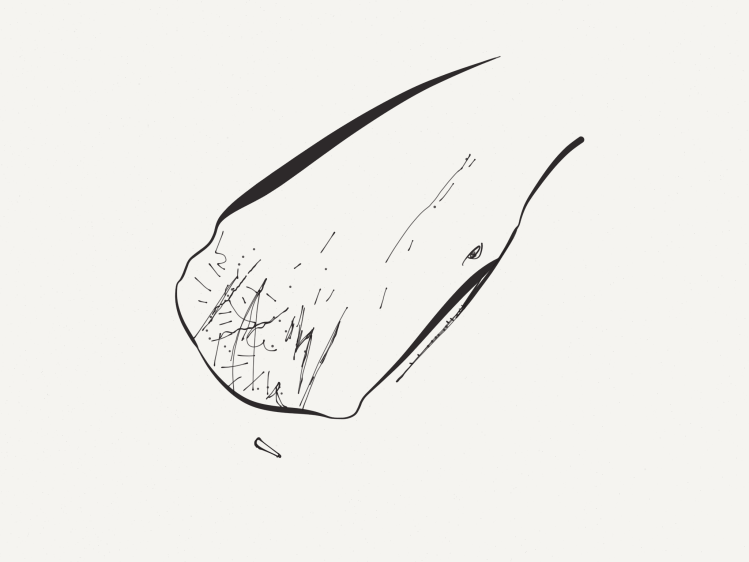 The Leg and The Whale – Illustration for Moby Dick. Created in Paper with Pencil. 2014.
MOBY DICK by Herman Melville
In Summer 2013 I completed my third journey through this book. Each time it has become more subtle and significant to me. I know that Moby Dick is popular, and that it is popularly unread. This is unfortunate. Its dense passages offer much to submissive, receptive readers. The pugnaciousness, humor, and visual presence of this book make it one I know I’ll keep returning to over and over throughout my life. I even love the endless chapters on Cetology.
EPISTLE to the ROMANS by Saint Paul
Romans is, perhaps, the ultimate biblical text… maybe even more than the gospels themselves. It integrates the disparately organized theological concepts of the early Christian writers into an organized legalese. Though it contains many key chapters (One, Five, and Eight in particular) it is Chapter Five that has, for me, held an intensely disruptive power. Hundreds of readings and years of study have done nothing to dissipate its existential shock.
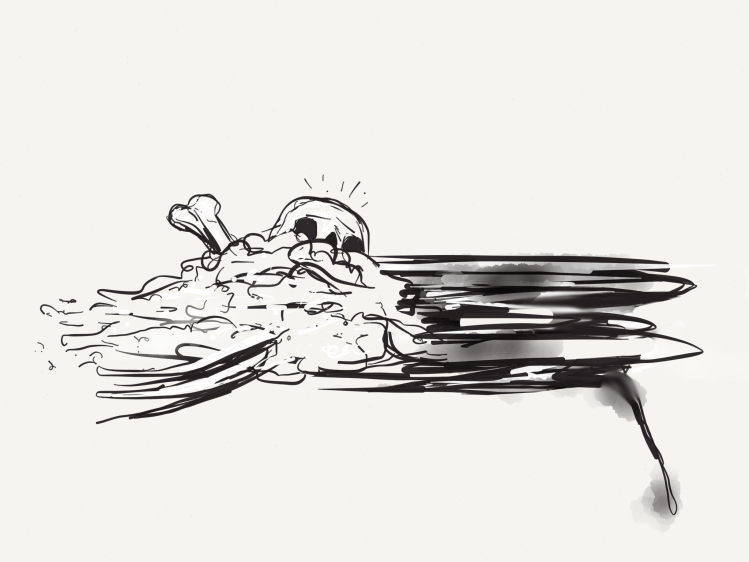 Dirt and Blood – Illustration for Romans. Created in Paper with Pencil. 2014.
THE LIFE HISTORY of the UNITED STATES (Volumes 1, 2, and 3 of 12) by Henry Graff and Time/LIFE
As a young boy I loved to dive into these books. They were among my first exposure to “fine” art, not to mention the wild and wooly early history of America. I especially enjoyed the first three volumes of this set and, after a while, never really looked beyond them. They were extremely key to my life-long interests. The reproductions they contained of colonial era political cartoons have never left my mind’s eye.
ADA, or ARDOR: A FAMILY CHRONICLE by Vladimir Nabokov
Passionate, sweeping, and strange, Ada is a killer of a novel. Deeper and more powerful than its more famous sister (Lolita), Ada is one of the few books that have stopped me in my tracks. I mean this quite literally. On several occasions – my mind obsessed with the story – I pulled my car over (during my commute to and from school) to continue reading. It is a crushing emotional journey, one that forces consideration of not only the motivations of protagonists Van and Ada but also those that rumble within the reader. This book happened to be the first book my wife (then my girlfriend) and I read in tandem, sharing our thoughts and insights as we read.
GHOST in the SHELL by Masamune Shirow
The best of Masamune Shirow is on display in this, his magnum opus effort. In it he leaps beyond the dregs of manga cyberpunk and erotica to grasp higher ground. He asks huge questions: what is life, consciousness, and person-hood? Sociopolitical wrangling, heavy weaponry, and seamy underground characters collide in a richly imagined post-apocalyptic world on the rebound. His central character, Major Motoko Kusanagi, transcends her sex appeal to deliver existential queries that rock attentive readers. Unfortunately, Ghost in the Shell, along with earlier projects Appleseed and Orion, were Shirow’s only truly deep works. It’s too bad that he has never again turned his considerable artistic skill toward more redeeming themes.
THE ALPHABET VERSUS the GODDESS: THE CONFLICT BETWEEN WORD and IMAGE by Leonard Shlain
Though only a very cursory survey of the historical struggles contained within its pages, this book served as a major jumping off point for me to explore a variety of issues that have altered the course of my life as an artist and educator. Some of my greatest joys in teaching have come from discussions born of this text.
DIRK GENTLY’S HOLISTIC DETECTIVE AGENCY by Douglas Adams
Over the years, Douglas Adams‘ two Dirk Gently novels (the one above and The Long Dark Tea-Time of the Soul) have become my favorites among his various writings. In Holistic Detective Agency, Douglas weaves a tale of trans-historical curiosity, tying together his trademark humor, dual love of Bach and computers, the politics of vanity publishing, and just where exactly Coleridge came up with his vision of Kubla Khan‘s pleasure dome. The book is an epic, joyful trip. It finds ways to explain the strange, ridiculous nature of history so that the reader can laugh and weep with the realization. Adams was a genius.
PILGRIM at TINKER CREEK by Annie Dillard
No dilettante to Thoreau, Dillard finds a way to make her words – written as a 27 year old – take on majestic and epoch-encompassing power. Perhaps I was prepared to love it by my readings of theology and some of the American Transcendentalists, but Pilgrim at Tinker Creek does feel like a singular expression. I love her 20th century version of perception and awareness. A huge influence.
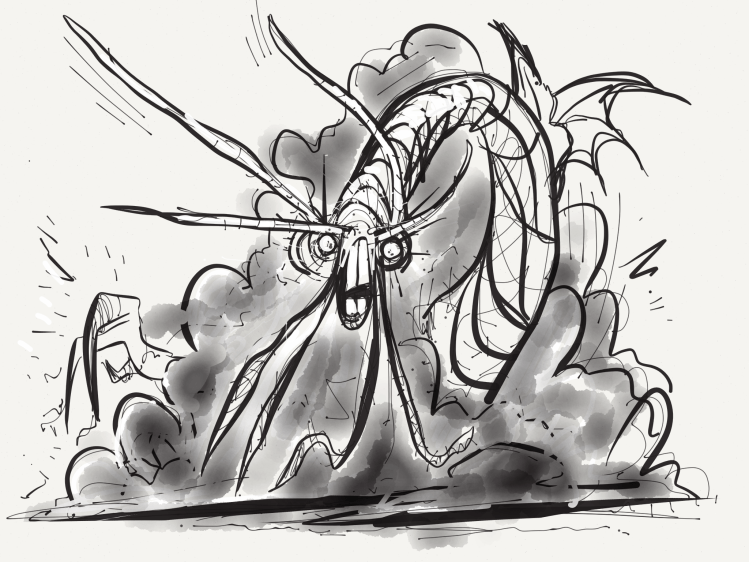 The Jub-Jub Bird – Illustration for The Annotated Alice. Created in Paper with Pencil. 2014.
THE ANNOTATED ALICE: ALICE’S ADVENTURES in WONDERLAND and THROUGH the LOOKING GLASS by Lewis Carroll
This book has stayed with me since early childhood. It was my first inkling that something else may be going on under the surface subject matter of a story. The layering of concepts beyond the directly obvious – logic, mathematics, socio-political and theological suggestions – created a backbone to this text making it live far beyond its Victorian and children’s genre roots. If you visit my classroom you may hear me break into a dramatic recitation of The Jabberwocky for my undergraduates from time to time…
SCIENTIFIC PROGRESS GOES ‘BOINK’ by Bill Watterson
Calvin and Hobbes. Childhood and Imagination. Dreams and Awareness. Play and Learning. What else do I need to say?
INTERPRETATION and OVERINTERPRETATION by Umberto Eco and Richard Rorty
A roiling debate between Eco and Rorty forms the basis of this text and underpins so much of my own thoughts on how meaning is shaped. I routinely share it with my own graduate students in the spirit it was shared with me – with excitement and engagement. I was originally exposed to both Eco and Rorty by my fellow MFA grads at Indiana University. Fellow grad Matthew Choberka stimulated many of us in the program, and pushed our dialogue beyond the common complaints. Kudos to him.
SKETCHES IN CRUDE OIL: SOME ACCIDENTS and INCIDENTS of the PETROLEUM DEVELOPMENT in ALL PARTS of the GLOBE, CHAPTER XVII: SOME NITRO-GLYCERINE in THIS (Pages 383-406) by John J McLaurin
This chapter of a book published in 1898 loomed large in my imagination as an 8 year old in Grove City, PA. My then step-father George was studying at Grove City College under Austrian School economist Hans Sennholz. The college served as my initial exposure to academia and was a central catalyst in my intellectual imagination. I was allowed to roam the grounds and halls of Grove City; I’m certain that it provided the push that eventually led me to my current vocation as an educator. Sketches in Crude Oil was a book that George had been looking at and he read from the nitroglycerine chapter many times. The stories of wagons exploded into nothingness, men blown to atoms, flesh and bones thrown hundreds of yards, and single drops of the explosive hit with hammers have stuck with me for 30 years. That library, those books, and the pages of this volume permeated my conception of history, education, and life for the better.
 The Big Bang – Illustration for The Elegant Universe. Created in Paper with Pencil. 2014.
THE ELEGANT UNIVERSE by Brian Greene
Another popular science survey, but a good one. Reading Brian Greene‘s book, though certainly secular, was one of the most spiritual experiences I’ve had. His description of the various phase transitions taking place in the first millionths of a second after the Big Bang became nothing short of a transcendent sight to my inner eye. Making enormously complex ideas understandable is Greene’s business, and this book addresses many of those issues in direct, accessible language. Good stuff.
~
TEXTS (I have recently read) WHICH MAY EVENTUALLY WORM THEIR WAY ONTO THIS LIST…
CLOUD ATLAS by David Mitchell
BRIEF INTERVIEWS WITH HIDEOUS MEN by David Foster Wallace
BLOOD MERIDIAN: OR the EVENING REDNESS in the WEST by Cormac McCarthy
THE DUNWICH HORROR by H.P. Lovecraft
ABSENCE OF MIND: THE DISPELLING of INWARDNESS FROM the MODERN MYTH of the SELF by Marilynne Robinson
AN ETHICS FOR TODAY: FINDING COMMON GROUND BETWEEN PHILOSOPHY and RELIGION by Richard Rorty
PARADOX IN CHRISTIAN THEOLOGY: AN ANALYSIS of its PRESENCE, CHARACTER, and EPISTEMIC STATUS by James Anderson
THE POETICS OF SPACE and THE POETICS OF REVERIE by Gaston Bachelard
~
BOOKS WHICH HAVE BEEN INFLUENTIAL BY DEFAULT (And thus require no comment)
THE CHRONICLES OF NARNIA by C.S. Lewis
THE LORD OF THE RINGS by J.R.R. Tolkien
THE WIND IN THE WILLOWS by Kenneth Grahame
THE PSALMS
PROVERBS
The Books of THORNTON BURGESS
The Books of LAURA INGALLS WILDER
TO KILL A MOCKINGBIRD by Harper Lee
~
Thanks to Jill for tagging me in this one:)


 eikonktizo
