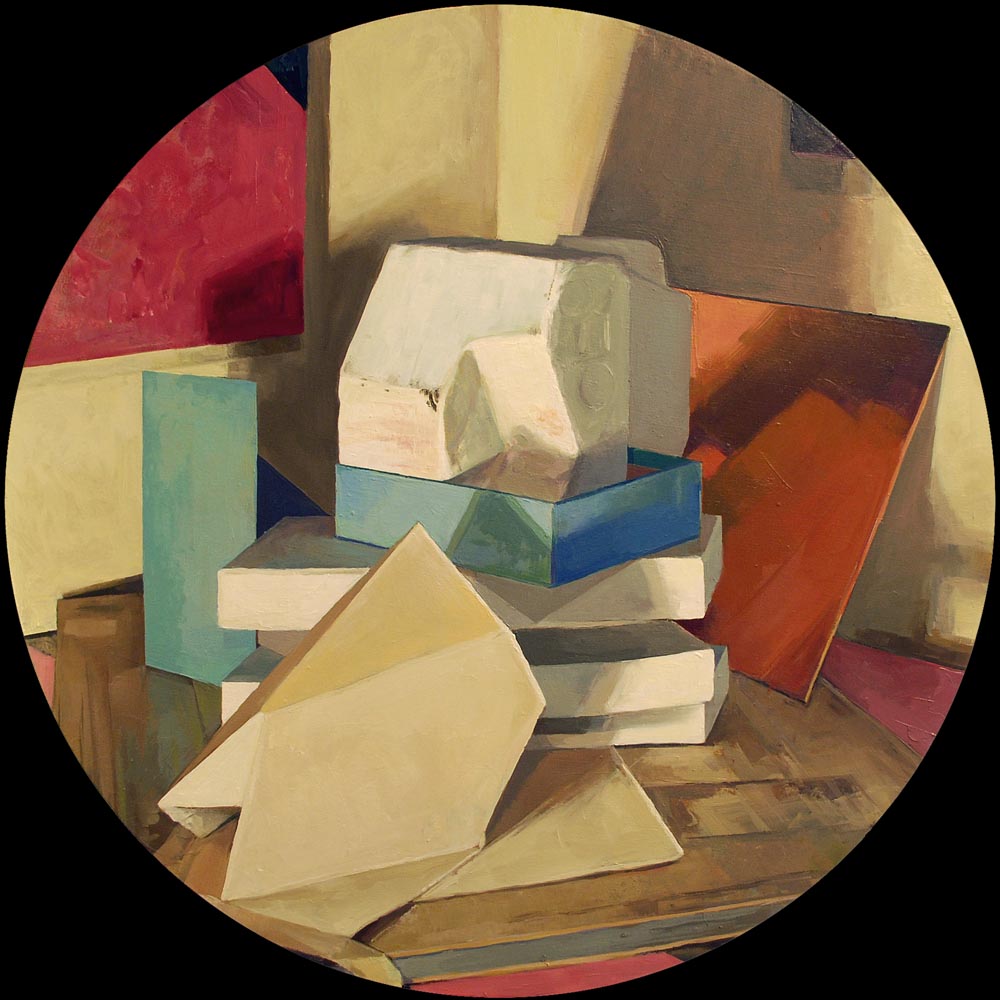
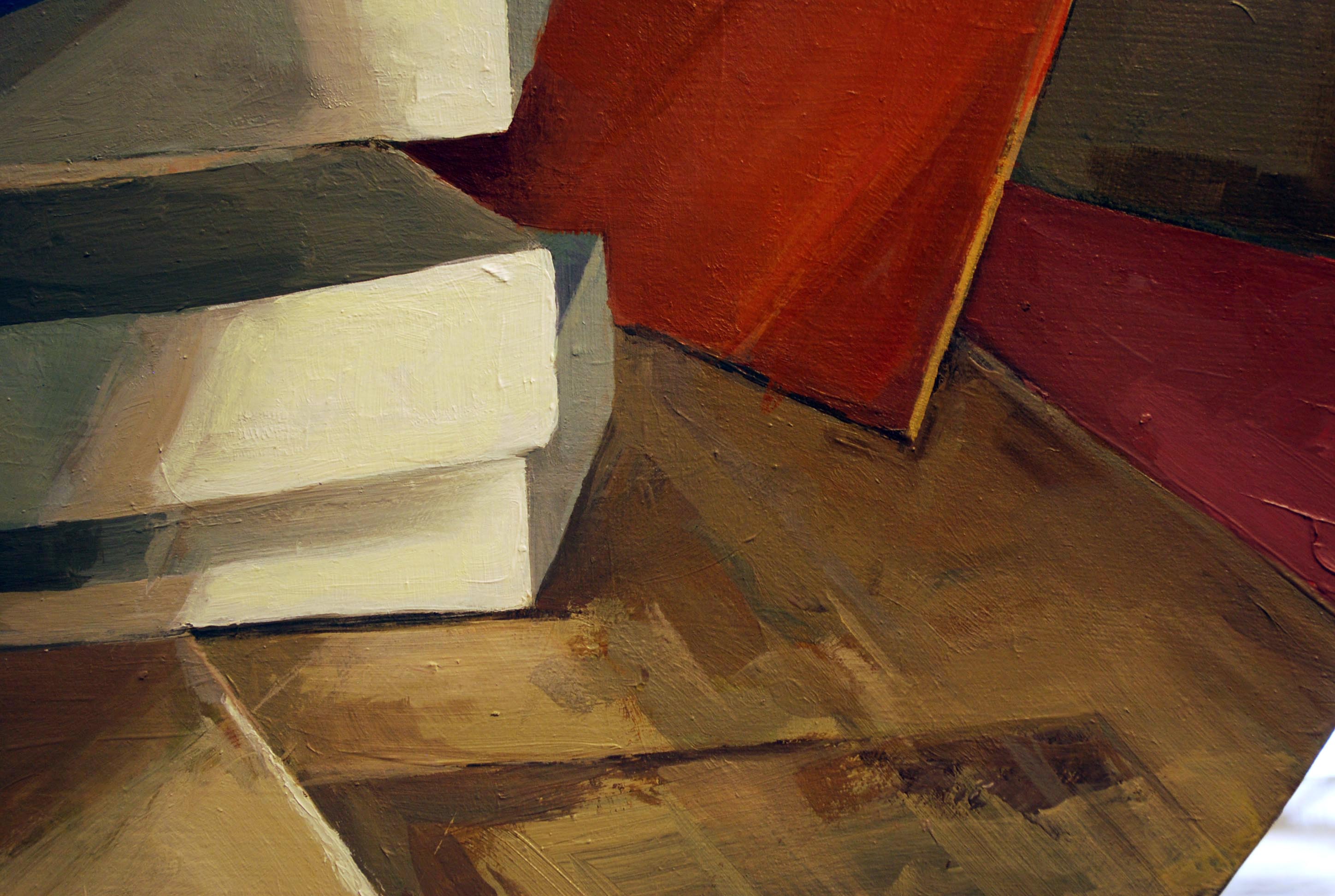
One of my newest paintings – still on the easel – in progress here. Below are a few detail shots. Click for enlargement. Oil on panel, 24 inches in diameter.
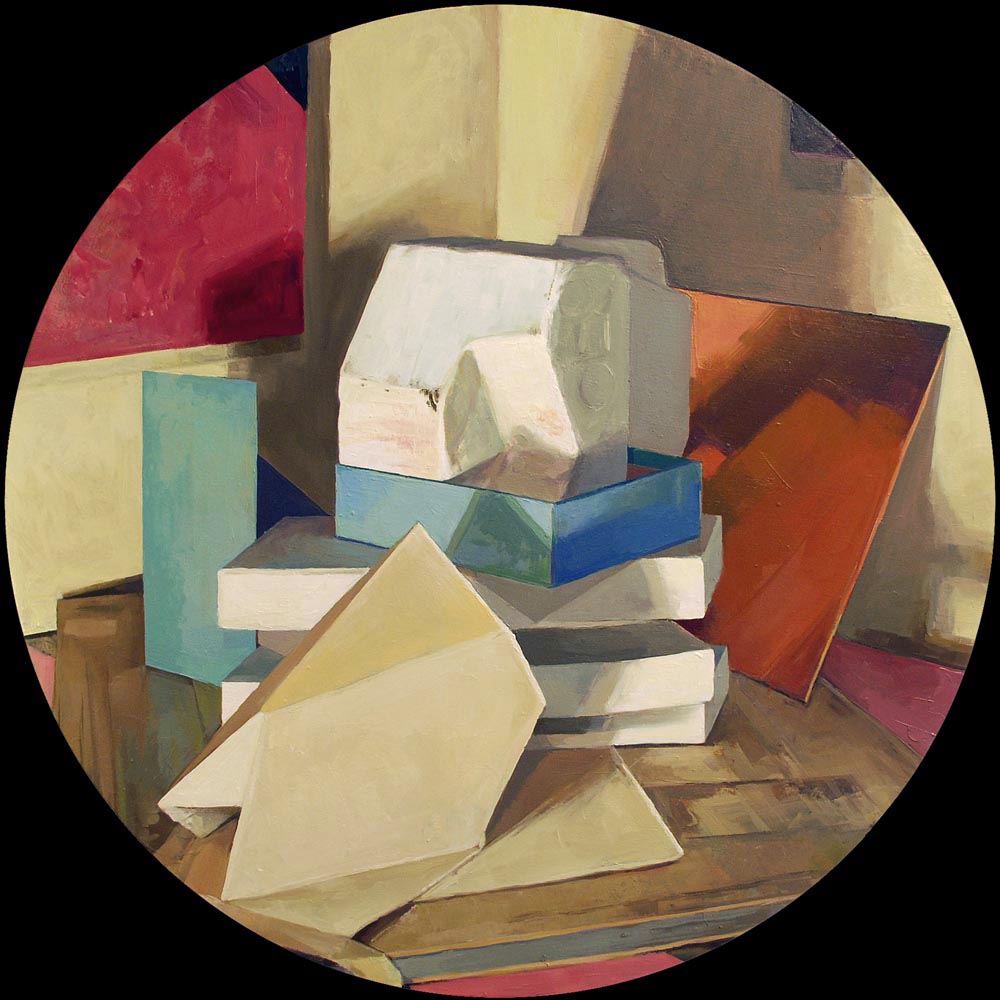


“A constant comfort of that place – apart from the foliage, springing paths, and multitude other charms – was my mug. Handcrafted and ergonomic, it felt then as it does now: a real weight in the hand – substantial, truthful. It declares by its heft the worth of what it holds. It is heat, a vessel security blanket, a confirmation of time. And of course I carry the time with me physically even now as I use the mug emblazoned with the O and the X (hugs and kisses from the past to the future) almost every day. It reminds me of 2am munchie runs and awesome weekend breakfasts, of wind swept evenings and overcast middays. Its circle pleases me and my mouth conforms to it easily – a submission to delights.” – from A Mnemonic of Longing, an unpublished essay, 2002-2009.

On nights like these – remembering Ox-Bow and my mug of that time – I think also of drinking port with Lex up the slope behind the Inn. One late afternoon, both of us moving toward that state of mellow so frequently found that summer, we debated art and ideas. I had my prized Odd Nerdrum book with me and, in a sequence of events not without mystery and malevolence, the tome found itself flipped off the deck and down the hillside. I keep the book broken away from its cover to this day in remembrance of my time with Alex.
Photo: My second Ox-Bow mug today. I got this mug at the same time as the one I speak about in the text above, but that first mug – my primary mug, the one that I had used every day for two years – was stolen from my workplace in 2003. Now I keep the second mug as a commemoration and never drink from it. Both mugs were made by Becky Wehmer, long time Ox-Bow-luminary and an artist/educator at Waterstreet Glassworks.“The public make use of the classics of a country as a means of checking the progress of Art. They degrade the classics into authorities. They use them as bludgeons for preventing the free expression of Beauty in new forms. They are always asking a writer why he does not write like somebody else, or a painter why he does not paint like somebody else, quite oblivious of the fact that if either of them did anything of the kind he would cease to be an artist. A fresh mode of Beauty is absolutely distasteful to them, and whenever it appears they get so angry and bewildered that they always use two stupid expressions—one is that the work of art is grossly unintelligible; the other, that the work of art is grossly immoral. What they mean by these words seems to me to be this. When they say a work is grossly unintelligible, they mean that the artist has said or made a beautiful thing that is new; when they describe a work as grossly immoral, they mean that the artist has said or made a beautiful thing that is true.” – Oscar Wilde, (from this New Yorker article)
Though I don’t believe in “newness” or “originality” I resonate with what Wilde is saying here. What we consider new or original is really just a recombination of the elements and assumptions that underlie our experience and expression of being into a form that is somewhat removed from our well-worn paths of knowing. We are uncomfortable with this reconfiguration, this reconstitution, and so we react by calling it unintelligible or immoral, as Wilde observed. I think Wilde’s greatest contribution is in his knowing and deft agitation of our assumptions about what we know, his precise jostling of our convictions of certainty. He is one of the few artists whose work I seamlessly love.
One of my fondest memories of experiencing Wilde is related to seeing the Tom Stoppard play “The Invention of Love” at the Court Theater of the University of Chicago with my wife and father in law several years ago. In it Wilde makes a striking appearance with the main character of the play A.E. Housman, on the shore of the river Styx. His teeth blackened, condemned by law and society, Wilde is an exuberant yet melancholic figure in death. Still dapper and spouting axioms, dressed in lilac and reading from his own work as Housman comes upon him in the afterlife, Stoppard’s Wilde is a revelation. The scene catalyzed my appreciation for Wilde, so I guess I have Stoppard to thank for that. Here’s a review of the play if you’re interested.
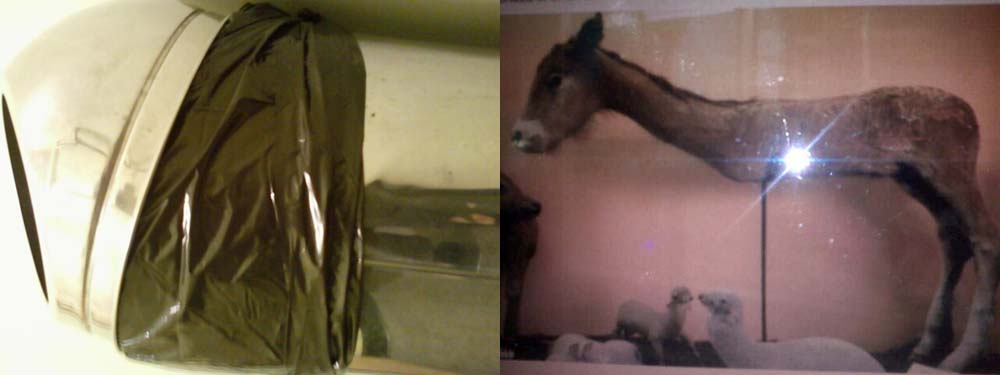
Marcus sends images to me. I send images to Marcus. Often the pairings are glorious.
Here are just a few… Marcus on the left, mine on the right. Click to enlarge.

1

2

3

4

5

6

7
8

9

10
It’s a huge loss. Artists of his stature are so rare. Sleep well in the light of the Divinity you helped reveal.
 “Can I remember it only in some half-form? Can I remember it only as a chimera, made of memory and will and hope? Can I not recall it totally, fully, being in myself as I was? Does no one understand the fullness of the emptying time? Does no one sense it in themselves, that time when they lost the tether? Let it loose again, to feel that it is gone! Alone. This is the deep pit of sensing, where I know the contour of death and dying. Suspended above the abyss. Glory.” – from A Mnemonic of Longing, an unpublished essay, 2002-2009.

“Look… an abyssal missive, a doctrine of smoke… ‘into dust.’
In the end I suppose that I wish for it, (and sometimes still seek it with nervous hope) that confusion. Sweet psychological instability – the wobbly legs of a newly drunken lad – here as the land curves away beneath me. I guess that, at times, the seeking is more interesting to me than the knowing. I’ve seen it here, right here on this land; is there self-loathing? What’s beneath the surface of us all? Did I see myself here for the first time, or was I just revealed anew, from a novel angle and in skewed light? The absolute beauty of being permissive, of stepping aside and watching oneself from the wings – it can’t be beat, though it stays with you in some way I can’t yet fully understand. I don’t think I ever will understand it. Watching others though – there’s the bittersweet fruit. The fallen human trembles and tumbles through life, and even at the lowest point renders to itself the most poetic, romanticized stroke.” – from A Mnemonic of Longing, an unpublished essay, 2002-2009.
Still falling
Breathless and on again
Inside today
Beside me today
A round broken in two
’til your eyes shed into dust
Like two strangers turning into dust
’til my hand shook the way I fear
I could possibly be fading
Or have something more to gain
I could feel myself growing colder
I could feel myself under your face
Under…your face
It was you
breathless and torn
I could feel my eyes turning into dust
And two strangers turning into dust
Turning into dust.
“Into Dust” by Mazzy Star

All images above are from digital photos taken between May and August 2001.
The first class I was a part of teaching at the University of Missouri included three grads – Nancy Brown, Ian Shelly, and Sloane Snure Paullus. These three – and a few others, like Catherine Armbrust, Eric Sweet, and Natalie Hellmann (among others) – have defined my experience as a teacher at MU.

Above: Sloane beading back in 2007.
Over the last year or so I’ve seen each of those first three grads finalize a body of work, refine and defend their thesis writing, organize their thesis exhibition, and move on to new things. This week saw Sloane and her husband move away from Columbia and into a new phase of their lives.

Above: Sloane and her peephole boxes, 2008.
For so long Sloane has been a cornerstone of the Art Department, bringing both intellectual excellence and paroxysms of mirth to each of us. She transformed the culture of the department, raising the bar and shaking things up. There’s really no one like her.

Above: Sloane hanging out with Ian at the Annual “Kinkade Christmas Cottage” viewing, 2009.
She was the perfect grad student; engaging as an artist, thoughtful as a friend, cosmopolitan in her views, expansive in her mentality, and distinctively creative in her sense of humor. I am thankful to have known her.

Above: Sloane Loves Britney! Halloween 2009.
Keep us all updated, Sloane! We love you!
Note: No lens flares were harmed in the making of this blog post.
The talented and dinosaur-loving Keith Montgomery visited my studio last week to shoot some video and take some still images. Keith is a good friend and a former student of mine who has made tremendous strides in his photography over the last couple years. You can see a bunch of his work here, but also click on the images below for larger versions (there are also a number of other shots). You can also see our collaboration piece in The Larry Show, up at the University of Missouri’s George Caleb Bingham Gallery through August.

The Grand Studio
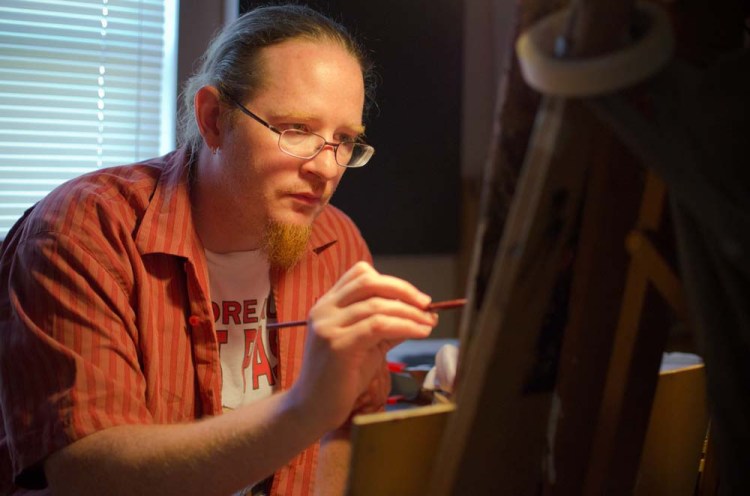
At Work…
Looks like I’ve got some new “at work” shots for my website, eh? Thanks, Keith!
My work has been featured on the Transpositions website.
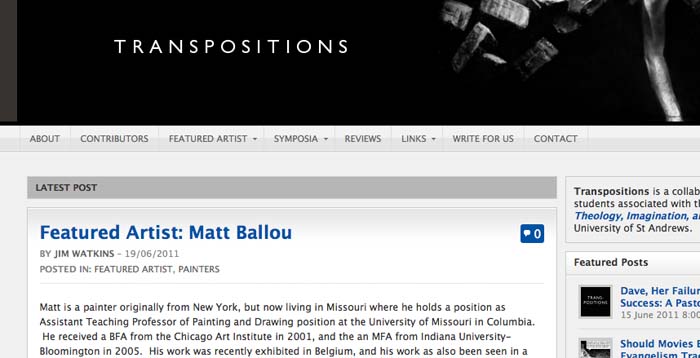
Transpositions is a collaborative effort of students associated with the Institute for Theology, Imagination, and the Arts at the University of St Andrews in Scotland. The site has vibrant discussions going on among PhD students and post-graduate commentators (as well as contributors from around the globe) on a variety of topics. If you’re interested in the intersection of Art, Theology, and intellectual inquiry, I suggest you check them out.

Talk by Matthew Ballou at The 930 Art Center, June 10, 2011
I gave a talk at the 930 Art Center in Louisville, KY last week. If you’d like to listen to it (it’s only 16 minutes long), click above for the mp3 file. To see some of the work I was thinking about in this talk, click here.


 eikonktizo