Remembering the BALLOU/BENNETT: Interference Pattern Exhibition of 2018

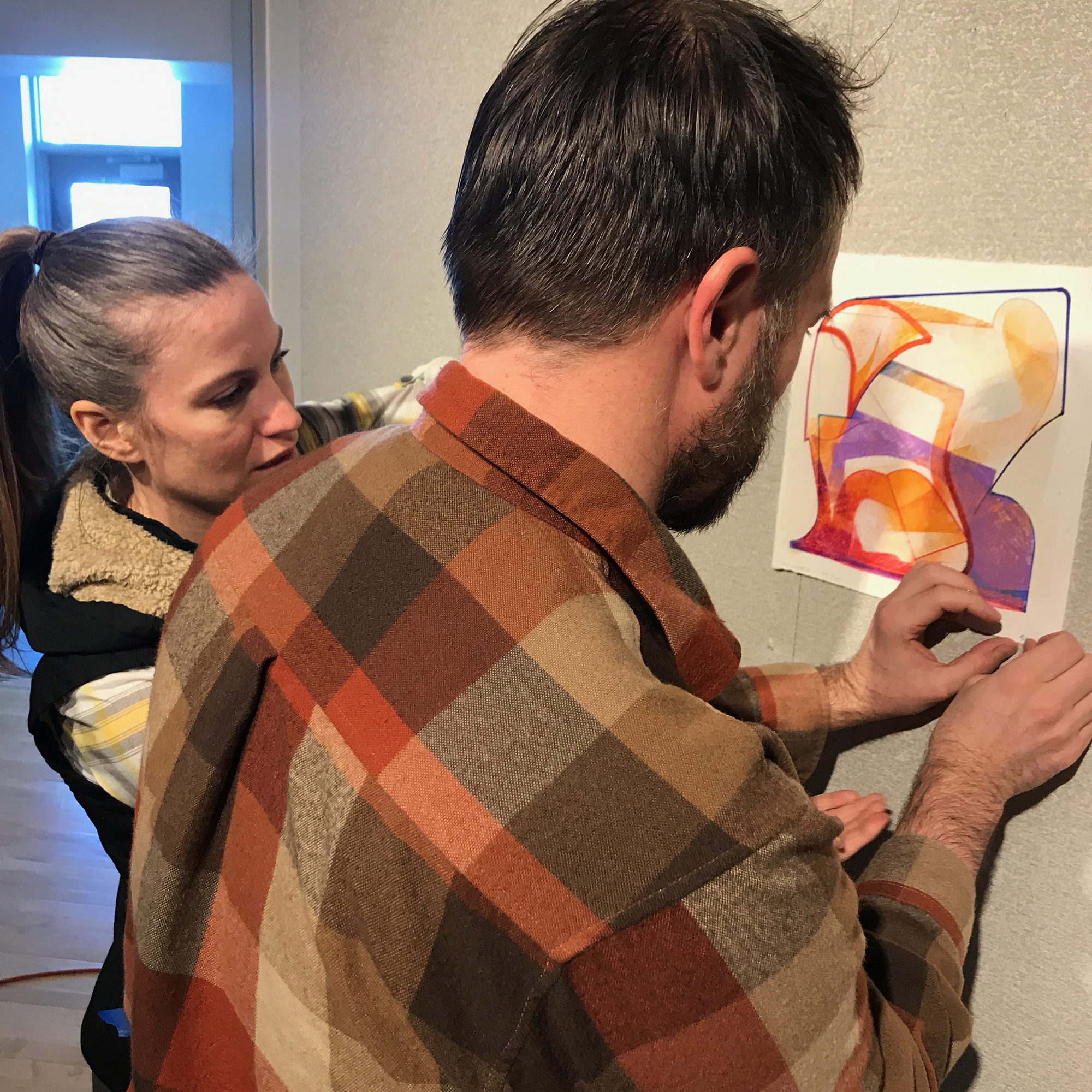
In November and December of 2018, my friend, former grad student, and colleague at Mizzou, Jennifer Schneider and I had a show together at the E. Jorgenson Fine Arts Center Gallery at Moberly Area Community College.

I think back to this show fondly because Jen is awesome and I like having exhibitions with former students (and have done so a number of times, with Jane, Jacob, and most recently with Simon). I took a bunch of images during the installation and recorded some audio of us talking about the work. After listening to it a couple months ago I decided I wanted to celebrate our little show and the work we made there.

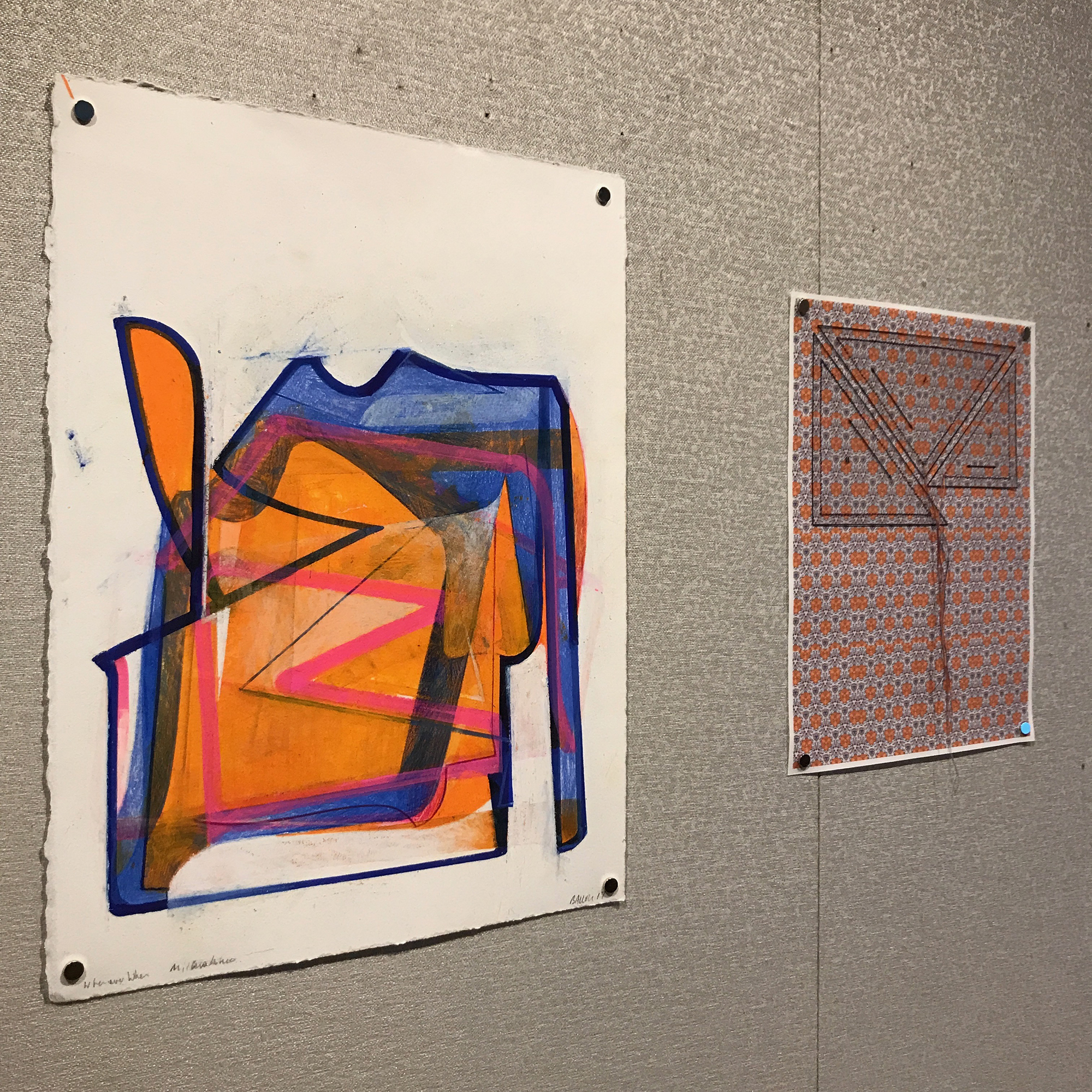
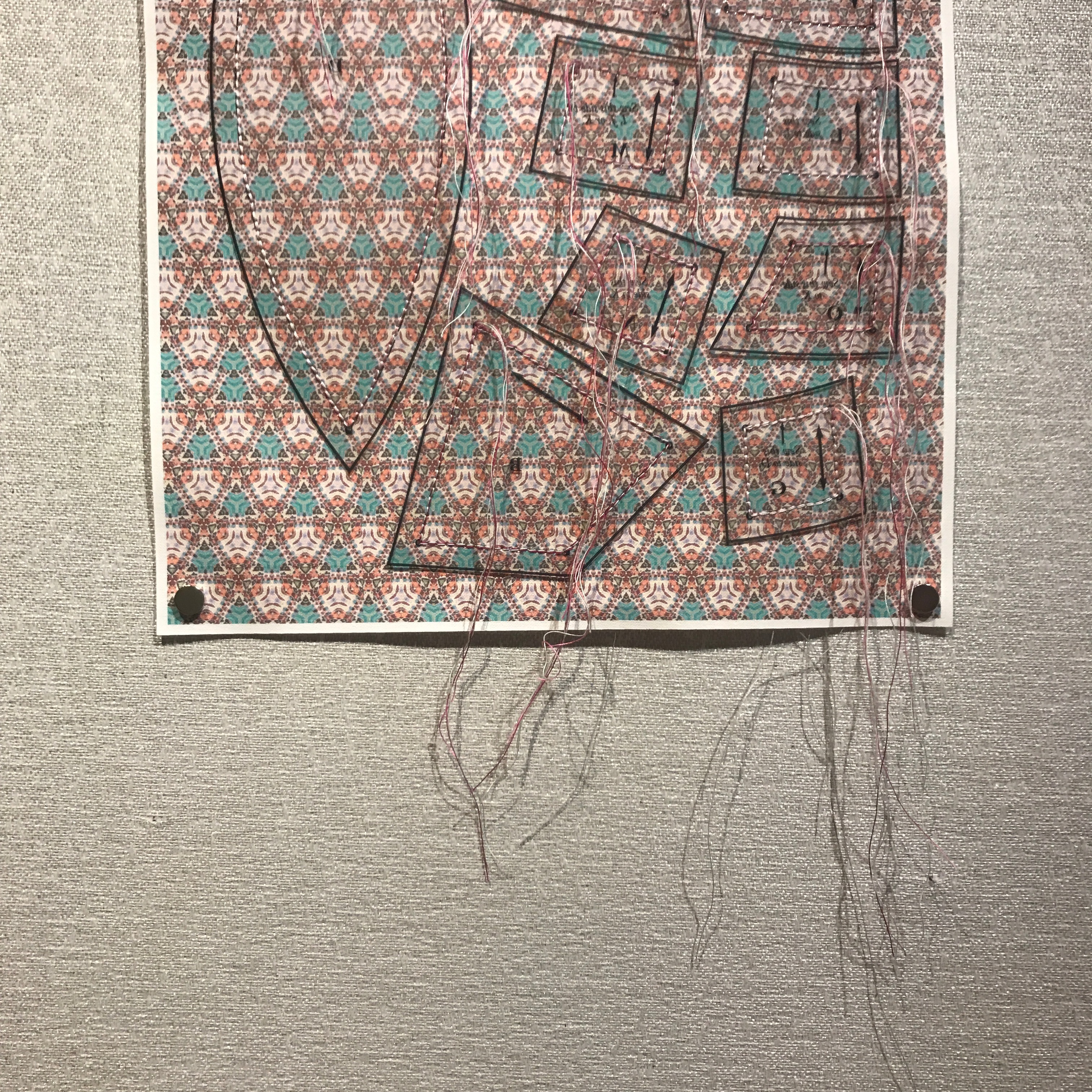
I was making my An Ensign for Miyoko Ito series, and experimenting with drawing robots – at the time very cheap ones that couldn’t make very large pieces. I was taking cues from Ito’s works and, as a response to that, Jen decided to use my artworks as the basis for her pieces. Using my work to create tessellated fields of colorful geometry printed on fabric, she then sewed cutting patterns onto them. The notion of a interference pattern felt particularly resonant to the work we both made for the show. This layering of influences and predilections still feels rich to me, and I wanted to share them with everyone again. Thanks so much for doing this show with me, Jen! Though her MFA was in a Fibers focus, these days she does a lot of dynamic photography, mostly in black and white. Check it out here!

Below you can see some images from our installation session and my statement for the show, as well as see more work and hear us talk about it in the video here:

Statement for BALLOU/BENNETT: INTERFERENCE PATTERN

In my recent body of work, titled An Ensign for Miyoko Ito, I seek out the compacted and the overdrawn; the enclosed and the layered; the transformed and the solidified. I look for shapes, colors, and spaces that go far beyond a simple tension between figuration and abstraction, trying instead to suggest a layered arena of observational and haptic information.

Miyoko Ito (Japanese-American, 1918-1983) – whose work has been a key influence on me over the last 20 years – was able to activate subtle surfaces with the illusion of space and an evocative sense of palpability. This is what I’m investigating: the experience of perception apart from particular, representational depiction. In my exploration, questions arise: Does flat form appear to move away from my angle of view? Will color resolve into both static surface and suggested movement? Can space and color align to reinforce both static structure and an expression of time? Might the poetics of silent, unmoving images actually produce phenomena akin to those found in dreams, memories, ecstatic sensations, and atemporal musings?

By pairing my work with Jen’s extrapolations from that work, I hope to suggest the multiplicity of information that may be gathered from surface, color, and texture. She perceives something of Miyoko Ito through my translations. Beyond this, Jen’s artworks add other layers – of visual logic, of aesthetic influences, and of categories of understanding. In this modest exhibition, Jen and I participate in the ongoing interrogation of received knowledge and sensation.

Receiving anything – taking it into our mind and heart – always changes it. It is what it is and it is what we perceive it to be. We are forever adding our own unique inflection to the language of the world pouring into us. That is why I see my own proclivities in the shapes and patterns that Jen uses… and so I see my heroes, my influences, and my hopes there as well.

Matthew Ballou, November 2018

The Ballou Collection – Auxier, McMurray, Sandbothe

Recently I rotated a bunch of the art in our home, and so I felt that an update to my ongoing series of posts featuring various artworks I’ve collected over the years was in order.

My most recent purchase is this wonderful gouache painting on handmade paper by Mary Sandbothe.

Mary Sandbothe. Mystery Snowball. Gouache on handmade paper. 7x5 inches. 2023.
Mary Sandbothe. Mystery Snowball. Gouache on handmade paper. 7×5 inches. 2023.

Mary is an awesome artist and educator here in Columbia, MO, and has been a pillar of the art community here for many years. She had a wonderful show at the Columbia Art League late in 2023 that really stood out to me. Called “Heritage Unfolded: Gouache Interpretations of Missouri Quilts,” (you can see the works here), the show featured some evocative, intimate works. I knew I needed to jump on one of them, and I’m glad I did.

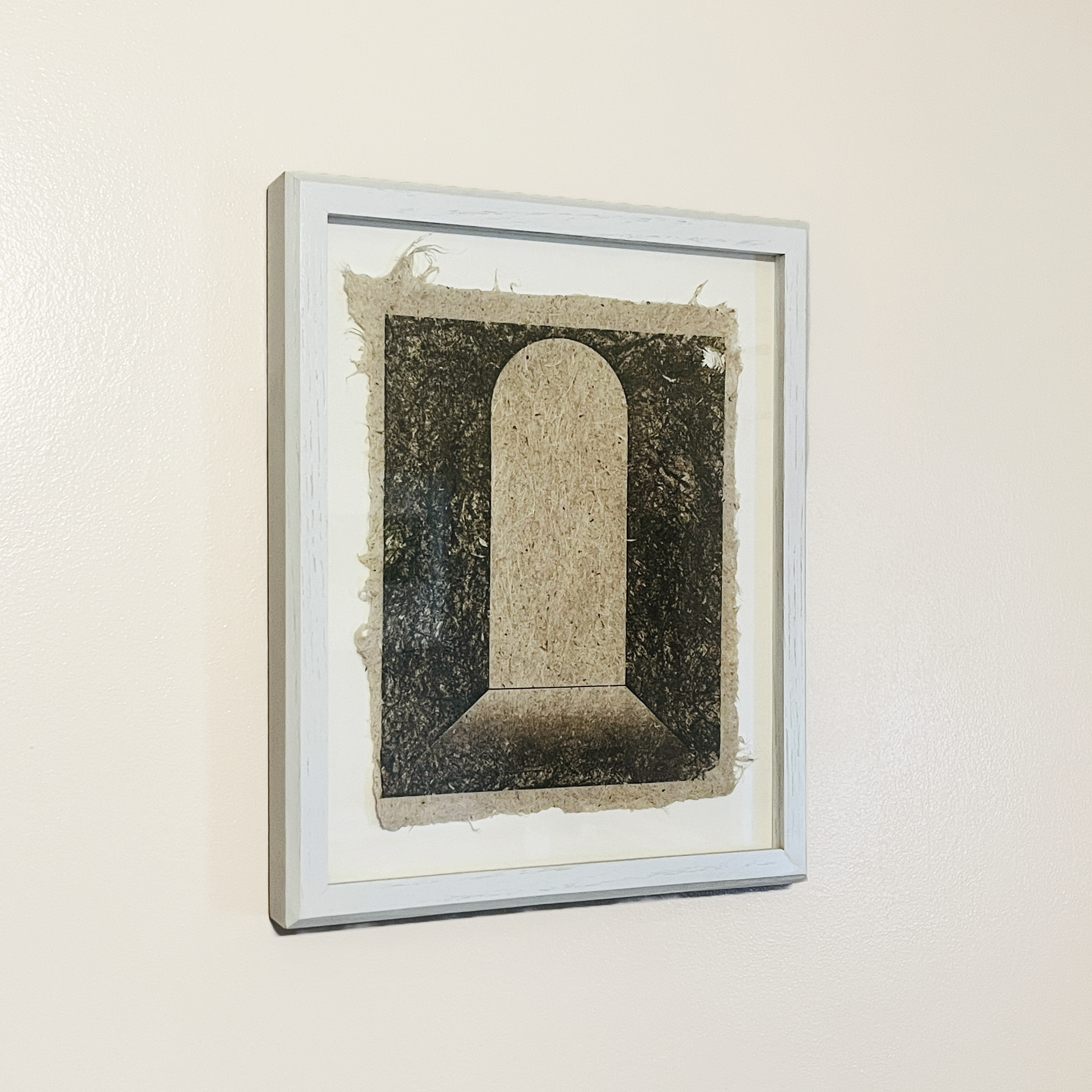
Next to the Sandbothe Mystery Snowball piece is a striking print on handmade Yucca paper by Caleb McMurray. The untitled work features a doorway or aperture, something that McMurray has returned to again and again.

Caleb McMurray. Untitled. Ink on handmade Yucca paper. 10x8 inches. 2014.
Caleb McMurray. Untitled. Ink on handmade Yucca paper. 10×8 inches. 2014.

I also have a sister print to this one, but it features an arching opening that is in the distance rather than up close like this one. Windows, doors, and other passageways are features of many of the works I’ve collected over the years.

Lastly, a small painting by Hayley Auxier‘s shares the wall with the two works I’ve shared above. Hayley was one of my stand out undergraduate students, and I love seeing her carry on her artwork as she has since graduating. This piece is one of a series she made celebrating National Parks and celebrating her experiences of them. Hayley shows a strong affinity for gouache, so I’m glad to have an example of her painting in that medium.

Hayley Auxier. Acadia National Park. Gouache on paper. 4 by 6 inches. 2018.

Acadia National Park is special to me because that’s where my partner and I went on our honeymoon all those years ago, so I like the piece because of it’s connection to my own history. But it’s also got a wonderful note from Hayley on the verso, and so the small work feels like it connects all of these different threads of my life: personal, professional, aspirational, and historical. That synergy of references – those that I bring to the work and those the artist embeds within the piece – is what makes art special.

I’m loving seeing these three works every day as I have a meal or hang out with my family. Art that lives with us is the best kind. Really thankful to have these pieces close to me.

Banality

I’ve had a number of what could be termed crises of faith over the last few years. Given that my life isn’t particularly compartmentalized, arenas slide over and influence one another. This can be for good or ill: A car needing to get fixed shows up on my choice of palette. The sickly child informs my lesson plans. A poorly executed drawing demonstration syncs up with indigestion.

One of the difficulties I have found in teaching the fundamentals of drawing and painting (something I’ve been doing for nearly a decade) is that I have become more and more detached from the epic expansiveness of potential meaning I once saw so easily in everything.

If that seems counter-intuitive, you’re right. On the one hand, I’m opening up this huge world for students and advocating for its meaning-making properties. Sometimes I do a good job at this; sometimes it clicks. On the other hand, however, often I have to break things down so far that they become divested of their mystery. This is probably because I’m not the best teacher – nor the best student – I could be.

But it is also that, amidst the urgency of schedules and diapers and curricula and learning goals and policy committees and trying to eat right and falling off ladders and mowing the lawn and hoping I’m a good dad, the horizon of my universe has shrunk. I can no longer connect to the mysteries. When I look in their direction they seem blank – I seem blank. I look at pictures that used to inspire me and fire me up… I can feel the echoes of what I felt 10 or 20 years ago, yet they seem vague, hollow, incomplete, impotent, and affected attempts. I painfully sense the depths to which I once could swim, but realize I no longer try those fathoms. The shallows, it seems, are the extent of my aesthetic, spiritual, and intellectual submersion these days.

All of the hard-fought attempts I’ve made as an artist and writer seem to, generally, make little or no connection to others. This is not a statement meant to engender pity toward me. I’m not begging for praise. I simply recognize that the average viewer/reader receives perhaps 10% of the passion, reflection, or depth I intended. I am thankful for that 10% of understanding. I’m thankful for every picture I’ve had the honor to show or sell and grateful for every piece of writing I’ve had the privilege to publish into the world. Yet I feel that I can no longer put so much time or energy into these things. It’s not that I don’t want to do it, it’s that I don’t have the depth anymore. Those corridors are closed off. I have shrunk. The extent of my vision has stalled. The infinite chiaroscuro of the universe has fled from me.

I’m not writing this to garner sympathy. I’m just trying to be honest. I think this is part of the life of an artist. Perhaps this too shall pass. I only know that my ability to believe in the value of plumbing the depths is all but gone, and I’m almost not even sad about it. What happens when you no longer feel tethered to what used to be your deepest motivation?

So much of what happened in the best work I’ve made over the last 20 years can be chalked up to faith. I can see passages of paintings and drawings where I had faith, where I had belief in the work. What happened in them was beyond technique and ability, beyond solid ideas or philosophical underpinning. The best ones went far beyond my knowing how to make them. When you lose that faith, how can you ever see or do those things again?

I know I am lucky. I get to teach, get to make paintings and drawings and prints. I get to show my work. But in doing all of that I can see how things atrophy and become stilted. The raging river stagnates. Will I be making tame pictures of flowers in 20 years? I hope not. Yet I feel a domestication growing. When one has a creative itch to scratch but no longer has emotional, spiritual, or intellectual access to the deep things of life the result is often the height of banality.

So artists, pundits, and mass-shooters proliferate. Another day, another war, another hundred thousand more orphans. Google knows what Star Trek-themed trinket I’m most likely to buy (and I actually consider buying it). I remember less and less of the awkward dreams of the 20-year-old me while the 40-year-old me who can no longer run with his kids comes more and more into focus. Perhaps it’s all an episode that would pass with a couple more hours of sleep each night, or with actually cutting red meat out of my diet. Or perhaps it’s just how things are, and I’ll have to figure out how to reach those old depths again after another decade and a second wind.