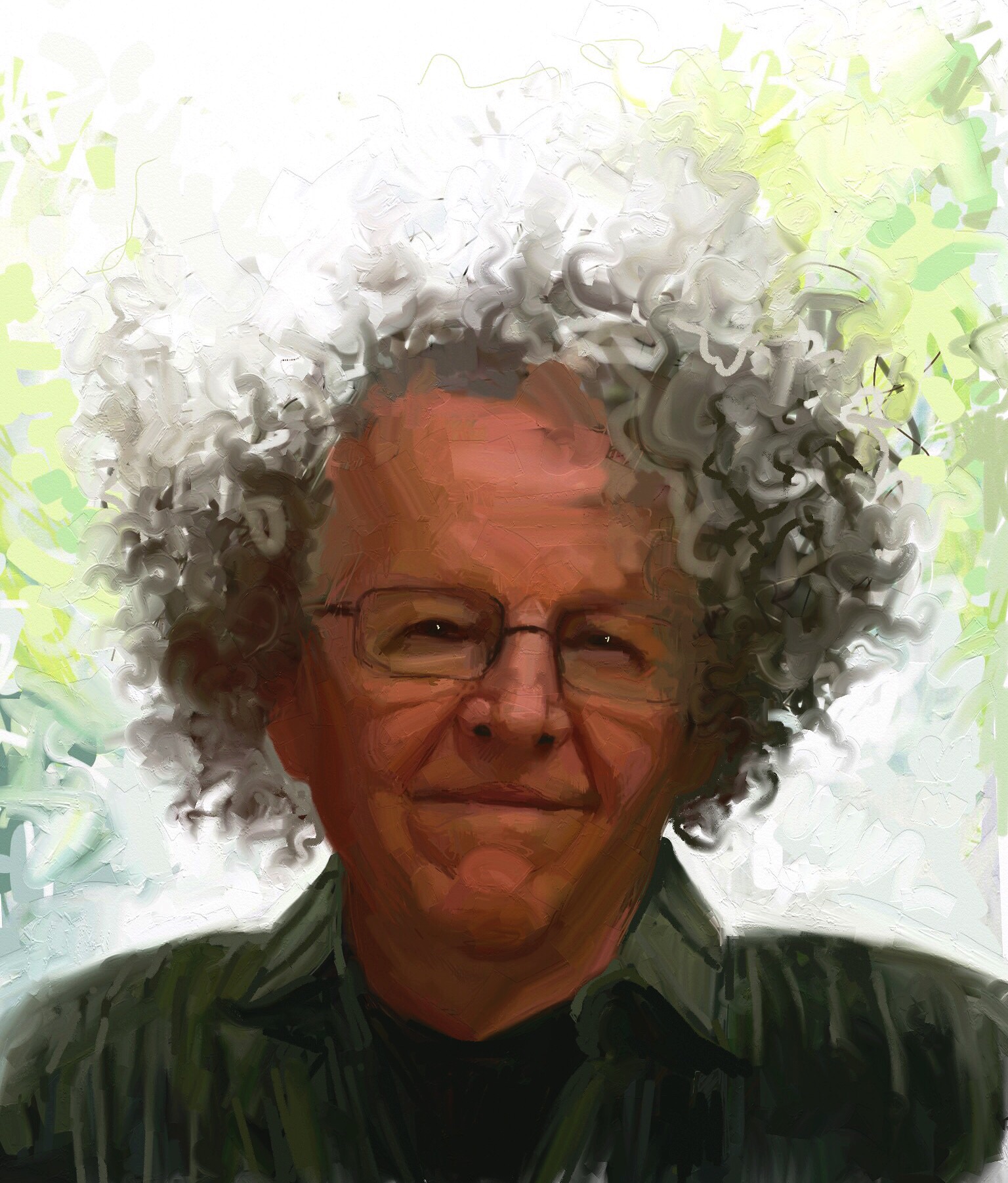
 Professor Graham Higgs Gloriously Lit. Digital painting, dimensions variable, 2014. Click to view LARGE.
In this post, I want Professor Higgs to speak for himself. If you have a few minutes, please read the story below. If you give the narrative time to work, I’m certain that you will sense both the great truths and the gentle spirit that animate Graham’s life.
~
The Cry of the Spirit Leaving
By Graham Higgs. Posted here by permission of the author.
It was one of those blazing hot, dry days at noon in a small village in Southern Africa, where I lived as a child. Not a soul was stirring. The sky shimmered with heat, and the only sound was the empty shush of a dry breeze against the screen on the porch, where I lay on my back, shirtless against the cool concrete floor.
I watched a fly circling in slow motion and finally settling on the floor a few feet from my head. My cheek felt cool against the floor as I watched the fly brushing its wing with one of its six legs.
Suddenly, from a distance in the back yard, I heard a man’s cry, “Nyoka! Nyoka!”
This was truly startling. “Nyoka! Nyoka!” the cry rang out.
In the Swahili language, the word “Nyoka” means snake, but not just any snake. It means dangerous snake. The odd thing about this was that snakes were very rarely seen in the heat of mid-day. I heard the cry again, and I heard the back screen door slam as my father left the house. I jumped up and left the porch at the front of the house and ran around back to see what was going on. When I reached the back yard I could see my dad crossing the field behind the house toward the garden. In the middle of the field, a tall, barefooted man wearing only khaki shorts and carrying a long stick was standing and pointing in the direction of the garden.
My father reached him and stopped. They slowly advanced, and then I saw the big old king cobra that they were watching. It was slowly moving toward the garden. They followed it, and it became aware of them, suddenly rising up high off the ground and displaying its broad, golden neck with two hypnotic dark eye-shaped spots.
My father and the garden man froze. The snake dropped back to the ground and began to move more quickly toward a large pile of brush near the end of the field. Several other men arrived and all began to pursue the snake, which continued toward the brush pile and then disappeared inside. The men surrounded the huge pile of brush. With long sticks they poked into the pile, jumping back, afraid the reptile would attack. King cobras are known to be aggressive when provoked.
While all this commotion was going on, many of the villagers began to come to see what was going on and stood in the shade of the tall eucalyptus trees that lined the field. Women and girls stood and watched while curious boys ran with sticks and threw stones at the pile. Mothers called out at them and tried to get them to be careful. The men stood and watched and pondered what to do next. The day was very hot and dry, and some of the men receded to the shade of the trees. A sentry of 4 or 5 men stood guard around the brush pile watching for any sign of the snake. The crowd of onlookers swelled to include just about everyone in the village. Some of the boys kicked a soccer ball around in the dust, and a dry breeze lifted the fine dust into swirls around their ankles. Sweat ran down the cheeks of the men watching the huge pile of brush.
One of the men walked over to my father, who was standing with me in the shade. I heard him say, “Baba, we could set the brush on fire. That would surely drive the Nyoka out so we can kill it.” No sooner had he suggested this than a man came running from the village fire with a burning stick, and the brush pile was soon a blaze of heat and crackling light. Visible waves of heat radiated away from and above the fire in visible auroras. The intensity drove almost everyone away and back toward the trees and the shade. Even in the shade you could feel the heat of the fire across the field. The fire cracked and popped, but no snake appeared. An hour went by, and no snake had come from the now smoldering fire. People began to mumble, and some began to return to their huts in the village. Women took their children and said they had food to prepare.
About this time, a quiet whistling sound began to be heard coming from the pile of ash. The whistling became louder, and everyone in the near vicinity could hear it. It became louder still and began to sound like a woman crying in a high-pitched tone. Now the sound could be heard throughout the village, and it became an ear-splitting scream. People looked at each other, terrified. The Nyoka was crying! What could this mean?
One wise, elderly woman said that she believed that the men had tried to kill an ancestor spirit. “What Nyoka ever comes out into the heat of the day?” she asked. “It is a sign” she said, “a sign that we did not heed. In our rush to kill this Nyoka, we may have tried to kill an ancestor who was trying to talk with us. See, she does not come from the fire. She waits, and she will certainly take her anger out on us. Just you wait and see.”
This prediction filled the hearts of the villagers with foreboding and fear, and those who had returned to the fire to see what the commotion was fled from the scene, taking their children and mumbling in low, fearful tones. After a few minutes the crying became quieter and slowly died away. A few men stayed with my father and watched the last of the smoldering coals. Then, as the day became long and the sun began to reach the horizon, my father and the other two men began to poke into the ashes with a long stick. At one point near the center of the ash pile, the stick hit a metal object.
With a shovel and a large stick, they found that a sheet of corrugated metal roofing was at the base of the fire. When they turned it over, the Then, as the day became long and the sun began to reach the horizon, my father and the other two men began to poke into the ashes with a long stick. At one point near the center of the ash pile, the stick hit a metal object.
With a shovel and a large stick, they found that a sheet of corrugated metal roofing was at the base of the fire. When they turned it over, they found the king cobra coiled in a circle. Its mouth was open and the fangs exposed. It had been cooked by the fire, roasted under the corrugated roofing. I recall my father thinking for a few minutes after this discovery and then saying to the two men, “It is now clear to me what has happened here. As the snake cooked, it began to boil, and the moisture in the snake steamed out of its mouth and past the fangs, which created a whistling and crying sound, much like a penny whistle does.” The men looked puzzled.
One of the men was horrified. “Oh, no, Baba, this is not the case. This sound was the cry of the ancestor spirit leaving the snake. We have certainly offended one of our ancestors, and this is a very grave thing to have happened.”
He quickly left the field and returned to his family. That night as the village gathered to eat together and drink beer and tell stories around the communal fire, the talk was about whether to consult the Nganga (witch doctor) to see how they could make reparations to the ancestor. They believed that they had ignored a natural sign. They believed they had violated an ancestor, and they would be punished. My father tried to explain that this might not be the case, but the villagers would have nothing of it. They had their animistic beliefs that kept them in balance with nature. It was an evening of low talking and fearful discussion. Many retired to their huts earlier than usual. Only a few of the older men, including my father, sat and talked late into the night.
Early the next morning a 3-week-old infant died mysteriously while she slept. It was then the people knew that they had indeed angered an ancestor. The Nganga and a spirit medium and herbalist would need to be called to perform a ceremony to placate the ancestor. Women were asked to prepare extra beer, and the herbalist retreated to his hut on the outskirts of the village and pulled out his stock of hallucinogenic herbs and tinctures. Men sat around the village fire and talked while the women served beer and food and in their own groups ate and sang and danced. A couple of drummers and mbira (thumb-piano) players worked themselves into a chanting rhythm and flow that began to persuade those who participated to sway and bob with the beat. The Nganga mixed a tincture and filled a pipe that he lit and passed around the group of men, and the tincture was swallowed by the spirit medium, a man who normally was a very odd fellow, said to possess special powers of vision and the ability to talk with the ancestors.
The spirit medium fell into a trance and passed out on the ground under the watchful eye of the Nganga, who bathed his face with cool water. The chanting and singing became more communal, and some men began to get up and dance. The women, including my mother, joined in the chanting and clapping of hands, and pretty soon, everyone was singing mournful and yet energetic songs of placation. Late into the night, the spirit medium began to speak, and the Nganga called for silence.
The spirit medium spoke in a language that no one but the Nganga understood. After listening to the strange sounds coming from the spirit medium, the Nganga conferred with the village chief, who called for a moment of reflection. Then he spoke about what the ancestor had advised. He said that tomorrow we must kill a goat and 7 chickens and prepare a feast in honor of the ancestor. In addition, we must begin to respect each other and to watch out for the children of others as well as we watch out for our own children.
We must work more regularly in the peanut fields, as the crops are almost ready, and we must always treat strangers with caution but respect. After a list of these sorts of things, some directed specifically at a few members of the community, the ancestor related that life would return to normal. Within a few days, the community had come together with a new commitment to work productively and live in peace as the ancestors intended.
~
I broke some of my rules while working on Graham’s portrait. I really wanted it to live up to the power of his story and the quality of his deep, quiet mind… so I spent a lot more than 2 or 4 or 6 hours on it. While drawing him in his office at Columbia College, I had the advantage of seeing him silhouetted against a bright spring scene, the intense near-white greens illuminating his head as if with a halo. I worked this portrait back and fourth in Sketchbook Pro and Art Rage v3, with some editing and shifting in Afterlight, for several months. I used both the Adonit Jot Touch 4 and the fiftythree Pencil to do the work. I’m thankful for the conversations I’ve had with Graham and I hope to have more in the future.


 eikonktizo