Solo Exhibition in Kansas

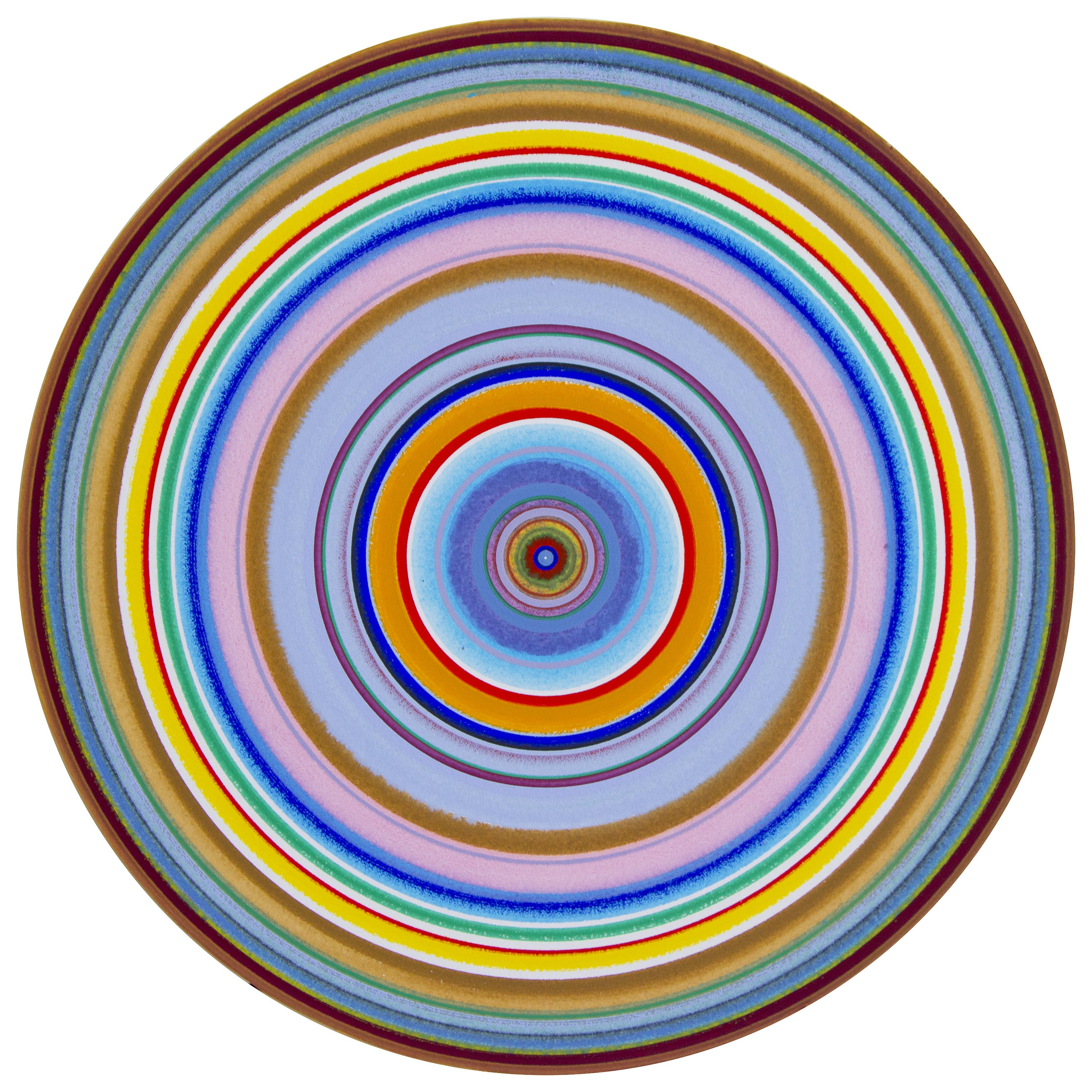
I’ve got a solo exhibition coming up October 5 – October 25, 2013, in Hays, Kansas. The exhibition, titled ASEVENANDAWONADOE* will take place at the Moss-Thorn Gallery of Art on the campus of Fort Hays State University. Featuring thirty new works, the exhibition will unite the representational tondos and abstract mandalas that I have been creating simultaneously over the last few years.

WORKINGSEVENANDAWONADOE copyHere is a brief statement about the show. A longer version will be presented during the closing reception:

ASEVENANDAWONADOE* – Paintings and Prints by Matthew Ballou

This exhibition explores the reality that a vernacular of meaning is constructed through our physical, emotional, and intellectual experiences. These experiences take place in the spaces that surround us, via the ideas that fill our minds, and through the objects that engage us. Meaning is imputed to these spaces, ideas, and objects rather than being necessarily inherent in them. This notion follows from the work of 20th Century Pragmatist philosopher John Dewey, who described how we “fund” our lives with significance through investments of time, emotion, and effort. These, in turn, come together to manifest the wealth of meaning we sense in our world.

By concentrating my artistic contemplation on objects that I have funded over the course of my life, I draw attention to not only their significance but also the modes, methods, and extents to which others have done the same. Conversely, by exploring issues that previous generations have investigated, such as the mandala form and geometric abstraction, I participate in the legacy of their contemplations. In a sense, I have borrowed from the storehouse they built while adding an investment of my own. The works on display here play on the distance between representation and abstraction, between the iconic and symbolic, between the organic and geometric, and between the received and the constructed.

*ASEVENANDAWONADOE is a word my young daughter Miranda invented during the time she was learning “real” words. It combined the structures of the new words she was encountering but was also, to her, connected to abstract concepts such as mathematics, pain, comfort, and security. An entirely made up word – yet one that relied on the received information and influences my daughter experienced – ASEVENANDAWONADOE is an example of something seemingly “meaningless” taking on meaning through experience, context, and subjectivity. In adding to the history and lineage of this word by including it in this exhibition, I further shape the contours of its potential meaning and more deeply connect it to the story of our family.
Enigma

ballou-tealgrill

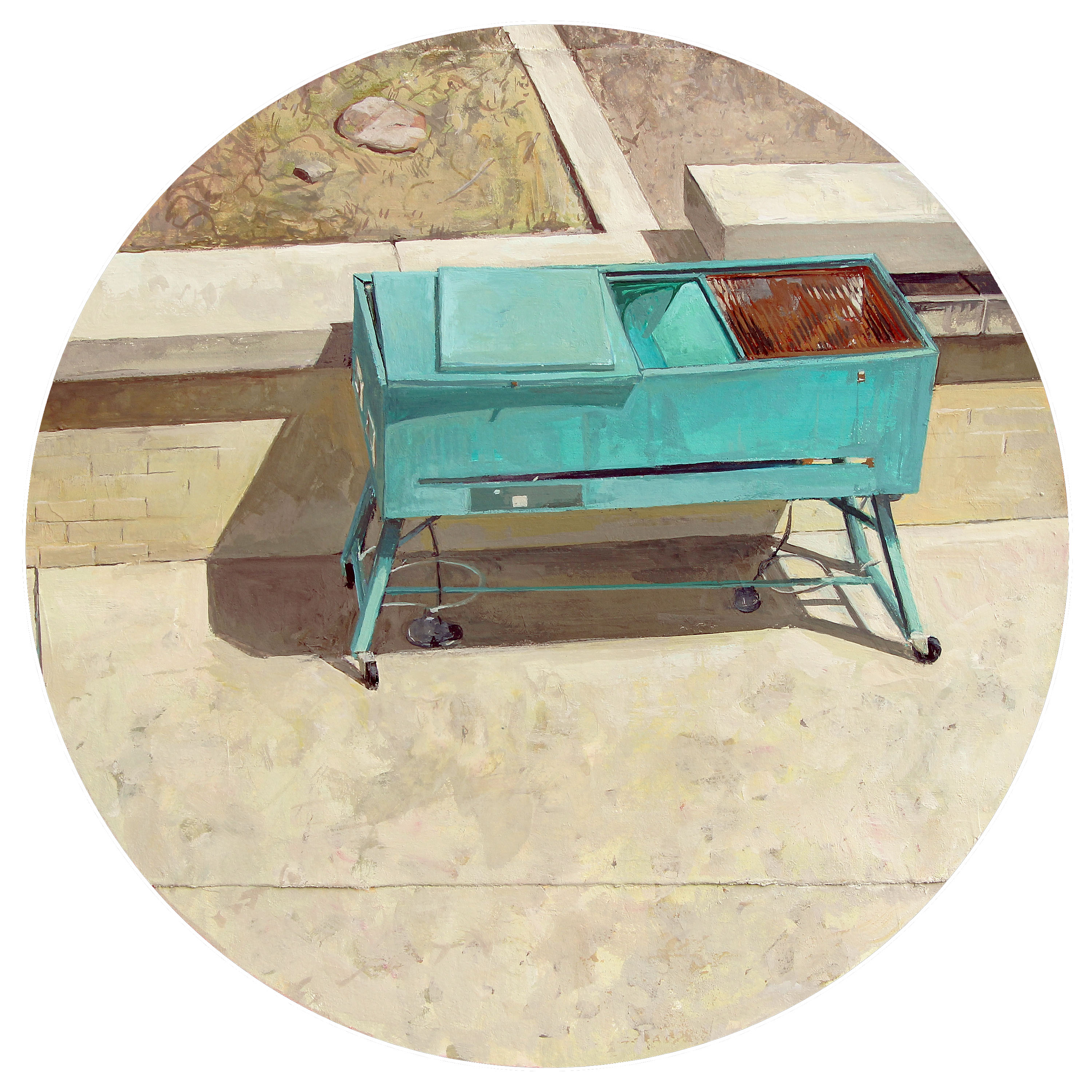
Enigma (Teal Grill), Gouache on paper, 12 inches in diameter. 2013.

I’ve been looking at this teal grill for the last six months or so. It’s situated in a little courtyard common area for students who live in nearby residence towers here at the University of Missouri. A few months ago when I moved into my new office/studio space I became even more enamored with this thing. It’s awkward. It’s got a glorious, alchemical color that changes with the weather. I’ve never seen it being used, and yet it’s got a presence and sort of commands a section of the courtyard wall. Situated on an East-West axis, the sun gives the grill a dramatic polyhedral shadow that tracks out, under, and around its gangly legs. Vaguely alien, dingy and unused, and having physical proportions and angular relationships that allow for formal play, it was only a matter of time until I painted it. The exploration was worth it… I might have to dive right back in.

What Is A Great Image?

On May 22, 2013, I gave a public talk at the Boone County Chambers Room in Columbia, Missouri that addressed the question, “What is a great image?”

Below is audio from that talk synced up with the slide show that I used. If you’ve got an hour and are interested in how art, history, and human experience interconnect, you might appreciate this talk. Obviously it’s by no means exhaustive and has to skim over many issues, but I think it’s got some quality observations. I would greatly appreciate any questions, comments, or observations you might have after watching through.

And here’s a picture of me and my girls during the Q&A session after the talk :)

An Awesome New Diebenkorn Book

IMG_7460

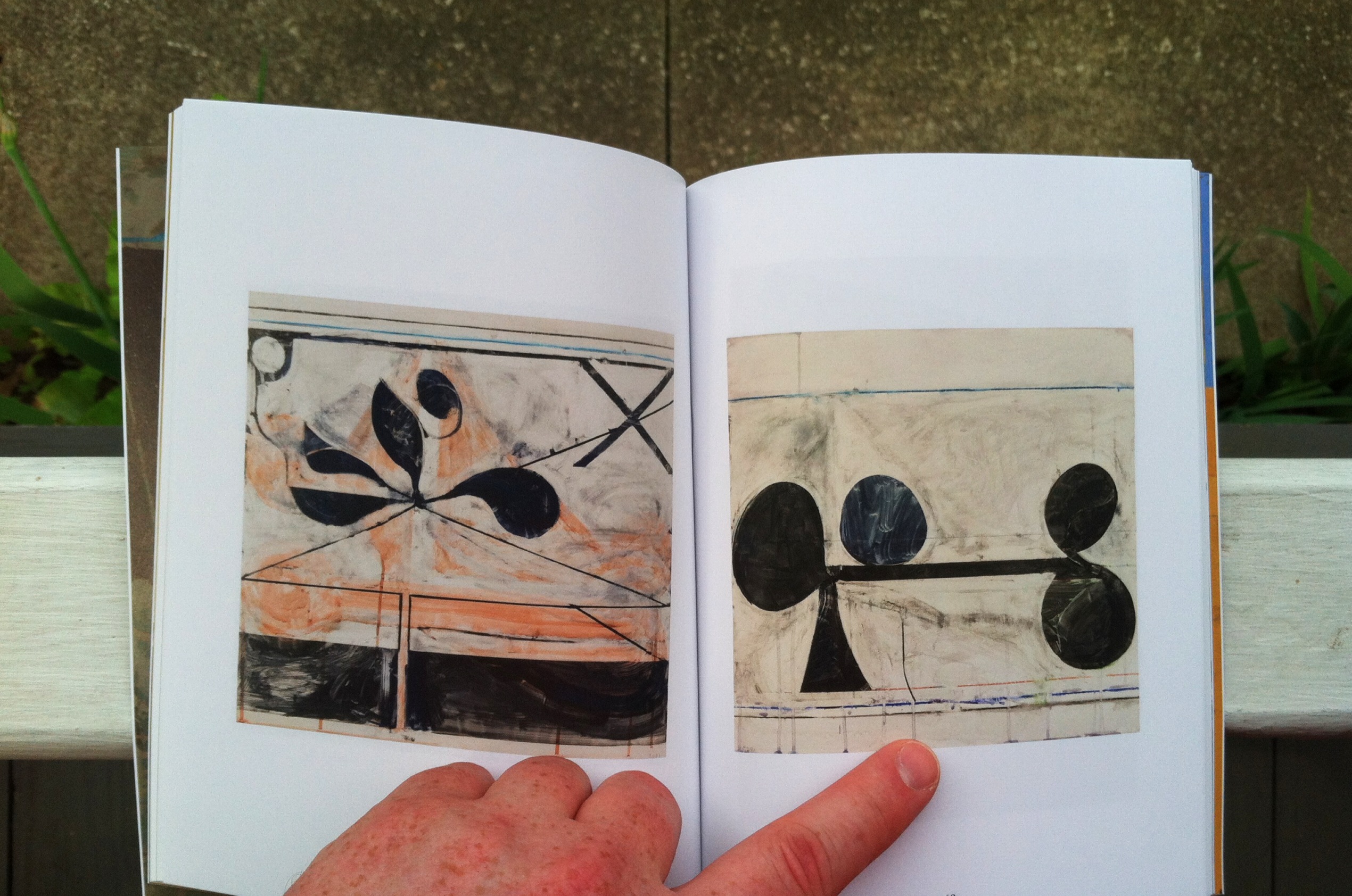
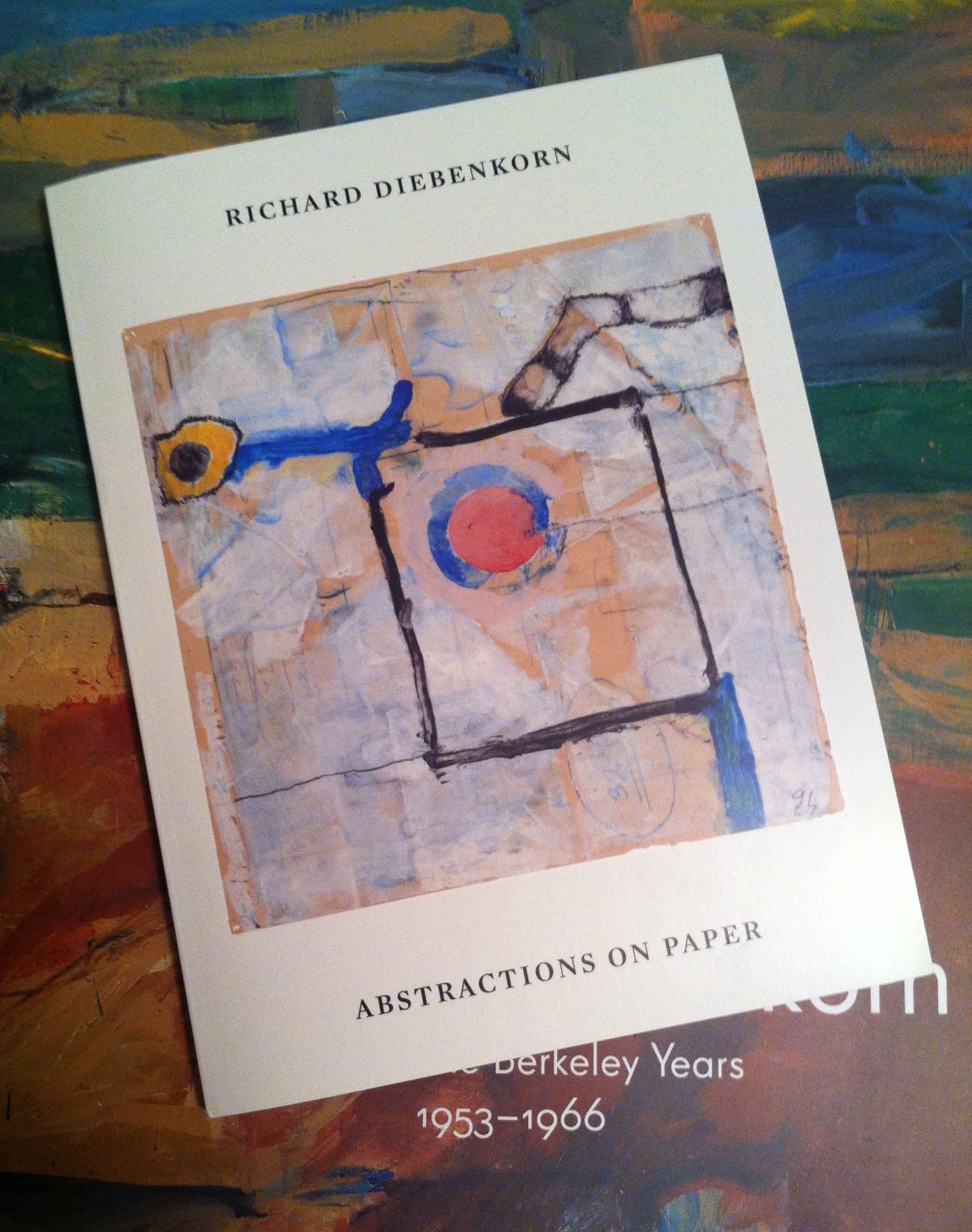
I just recently picked up a fantastic new Diebenkorn book, and it turns out to be very impressive. No, I’m not talking about the new Berkeley Years catalog (though I did buy that a few weeks ago and am enjoying it). This is a volume out of a small California publisher called Kelly’s Cove Press.

The book, Richard Diebenkorn: Abstractions on Paper contains 88 full color images and a few black and white shots of Diebenkorn’s studios. There are a few points that make this paperback book exceptional. First, it contains dozens of works that have never before been published. This isn’t because they were lacking in quality; many of the pieces shown here really display Diebenkorn’s quintessential processes very well. Secondly, the book shows abstractions on paper from all of the major locations where he worked throughout his life: Sausalito, Albuquerque, Urbana, Berkeley, Ocean Park and Healdsburg.

IMG_7457

The Healdsburg works contained in this book make it indispensable for aficionados of Diebenkorn’s work. I’ve followed every Diebenkorn publication, traveled to see his work in many states, and searched widely to find examples of his work. There simply is no other publication that contains as many Healdsburg-era works that I know of.

The book lacks any scholarly essays, which is a virtue. The only words are short quotes from the artist interspersed among the images and a short biography at the end. This gives us nearly 125 pages of beautiful artworks, printed nicely in an 8 by 6 inch format. I’ll definitely be keeping this book close to me for informal browsing. But don’t let the small size fool you – the overall feel and color quality is excellent.

IMG_7458

Authorized by the Richard Diebenkorn Foundation, the book was produced in support of what should be a fantastic traveling exhibition titled The Intimate Diebenkorn: Works on Paper 1949-1992. The exhibition starts at the College of Marin Fine Arts Gallery (Kentfield, CA – 9/28/13-11/21/13) and then moves on to San Jose State University (4/15/14-5/17/14), American University (Washington DC – 11/8/14-12/14/14), Sonoma Valley Museum of Art (6/6/15-8/23/15), and ends at The University of Montana (Missoula, MT – 9/24/15-12/12/15).

IMG_7459

This book is well worth the mere $20 it costs to pick it up. If you’re into Diebenkorn, it’s essential. If you love Abstract Expressionism, works on paper, gestural painting, collage, West Coast art, or the California art traditions, you’ll love this book. Click here to buy it.

~

I’ve had the chance to write about Diebenkorn’s work a few times. My most recent essay about the artist is Diebenkorn’s Ocean Park: Provisional Action, Provisional Vision, and is available to read here.

This Week in 2005

Screen Shot 2013-05-14 at 4.59.04 PM

This week in 2005 Alison and I arrived in Florence, Italy. Above is the path we took almost every day during our stay – from our apartment on Via Ricorboli (right hand of the picture) to the Church of Santa Felicita. (On the left – click the image above to explore the area).

Why did we make the nearly 2 kilometer trek so many times, even if our final destination was in some other part of the city?

Because Pontormo’s epic Deposition resides in that church. Here I am gazing up at the piece:

OLYMPUS DIGITAL CAMERA

I must have spent 6 or 8 hours in front of that painting. I have thought about it, written about it, and taught about it many times over the last 8 years. This painting is ingrained in my life.

I can’t wait to walk once again along the Arno, sidestep the Ponte Vecchio, slip into the cool silence of Santa Felicita, and see it again.

New Router Table Now In Effect

Back in November of last year I did some initial work on my new router table – you can click here to see what my early sketches were. I created this to replace my simple tondo jig system that I made back in 2010 (click here for info on that tool).

Today I finished work on the table – at least enough to make it functional. There are a few cosmetic details to work out, but for now it’s ready to roll. Here are a few images.

table3

table2

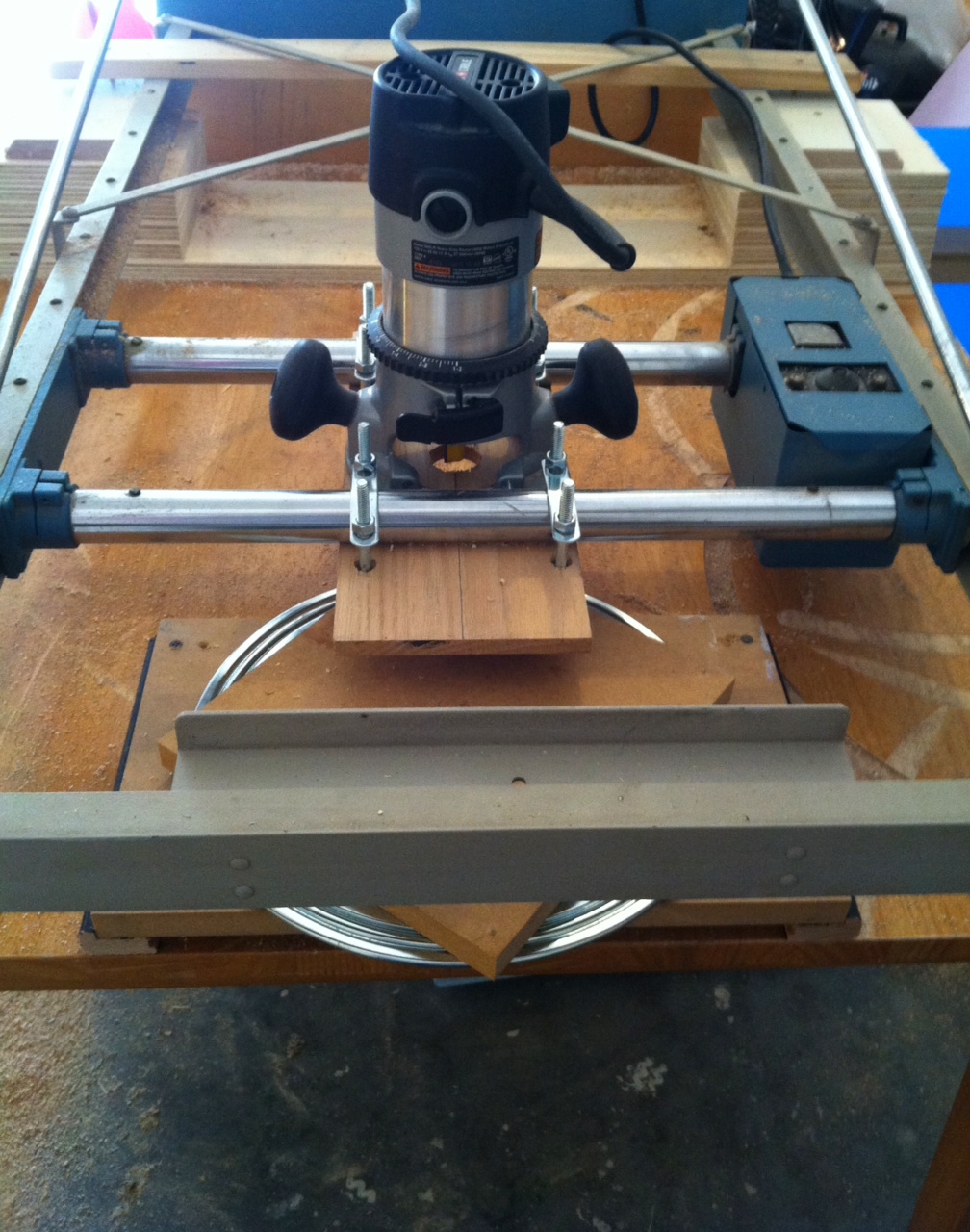
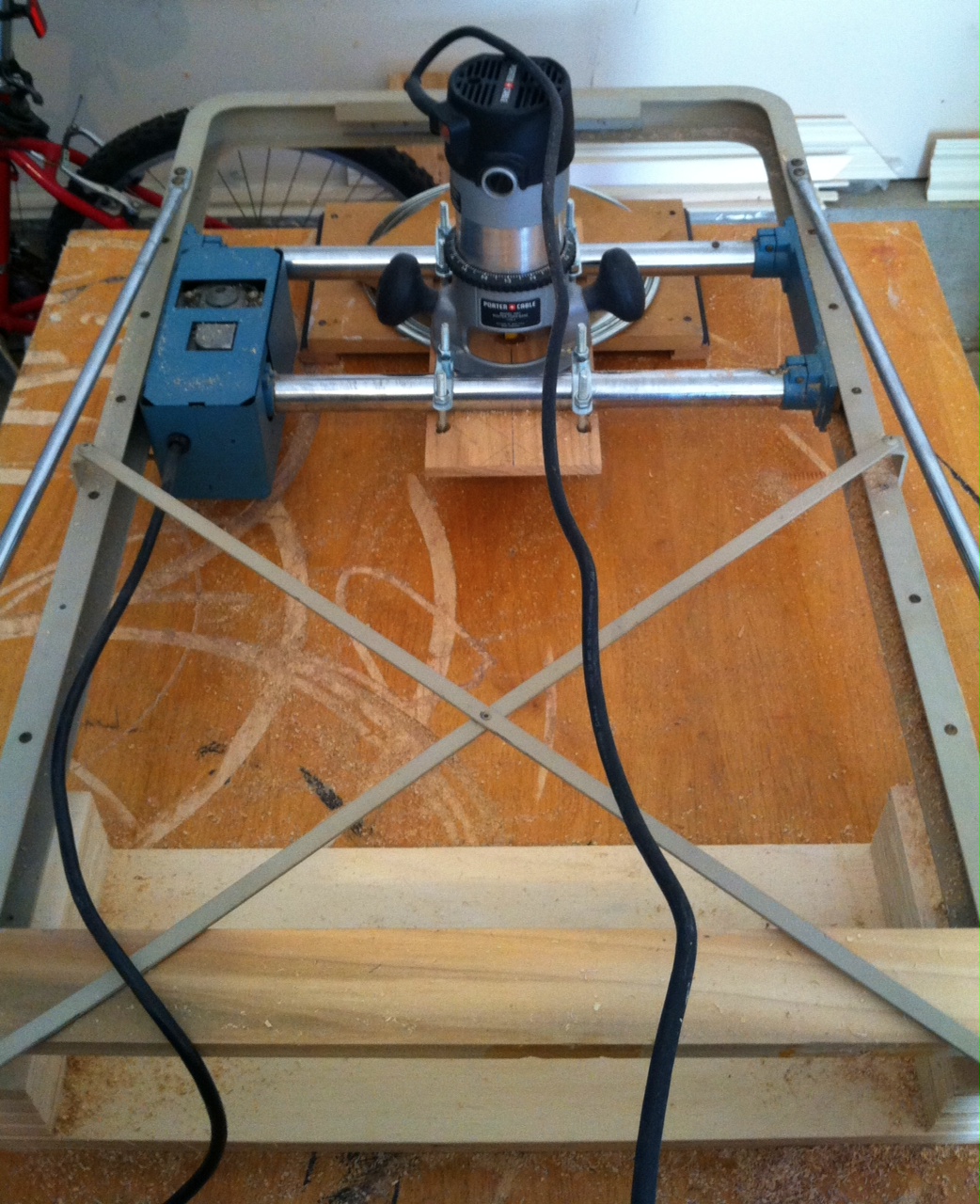
These first two images are fore and aft shots, giving a general overview of the beast. The active ingredient is a mid-range Porter Cable Plunging Router. The router has been attached to a Beseler 45MCRX Photo Enlarger body that I scavenged and hacked last year. The motor still works great, which means that my router can be moved horizontally over the table allowing me to make multiple plunges at different locations on the wood. The whole layout of the table is very close to a sketch I made last year.

table1

Here you can see the underside of the router carriage (top half of image). The bit plunges through the oak carriage deck and into the wood that’s to be cut. The wood is sitting on a “lazy susan” deck that grips the panel and may be easily rotated past the router bit.

table4

This is a shot of the lazy susan rotating deck. You can see the points that protrude through the deck (there are four – one point at each corner) that hold the wood in place as it’s being routed into a circular panel.

The first tondo I cut this afternoon was a resounding success. Here’s hoping for many more. It’s definitely an improvement on my old tondo jig. The big plus to this table is that I will be able to make circular frames for my tondo works. I wanted to have the movable routing deck precisely for this feature, and now we’ve got it. I’ll keep you updated.

Propaganda and Crafting the Self Image of a Nation

The title of this post might seem a little heavy handed… and I guess it is. But after my little adventure today the idea that propaganda has always been a means to shape how people (who are the objects of propaganda’s political and social aims) see themselves stands out to me. It makes sense that propaganda would provide a positive view for people to buy into; it needs to use that angle in order to work at all. I guess I knew all this years ago in the first years of my undergraduate education, but seeing it up close in a major museum in China was interesting.

IMG_5444[1]

I began the day attempting to see two significant art museums in Guangzhou, one of which is close to our hotel and one that’s a 20 minute drive away. I was given advice by a local that I could walk to the first one, but my efforts proved futile. It was an interesting hour and 15 minutes getting myself more and more disoriented and more and more lost in a strange city.

IMG_5449[1]

Eventually I found myself in a large train station with thousands of Chinese people and got into a line at the taxi stand. Once in my cab I gave the driver a slip of paper that a well-meaning woman at the hotel had written out for me in Chinese. After one failed attempt to get to the closer of the two locations, I gave him another line about the more distant museum and we made it there after 35 or 40 minutes.

IMG_5445[1]

The Guangdong Museum of Art on Er-Sha Island is a part of a large museum campus system on a beautiful island in the Pearl River right in downtown Guangzhou. The collection is primarily traditional-based semi-contemporary work. Most of what I saw was painting, printmaking, and large figurative sculpture from the 30s through today. They have significant holdings on display from the 50s, 60s, and 70s.

IMG_5451[1]

Just one aspect that I focused on during my 3.5 hour tour of the museum’s three floors was the way women were depicted in the propaganda era works on display. As you’ve noticed, I’m posting a number of details here to illustrate my point.

IMG_5448[1]

I am by no means an expert in Chinese art during Mao’s time, but I am aware of a variety of aspects of it. Getting to see these works in their country of origin and within their own context was a great experience. There was, to a piece, excellent craftsmanship in the work itself. The woodblock prints and oil paintings in particular were fantastic examples of the genre and time. I am sad to say that they were not all presented well, however. The framing was inconsistent – sometimes downright baffling (dozens of prints were matted with foamcore) – and many of the walls were scuffed and marked. In some rooms the arrangement of works seemed somewhat scattershot. But none of that can make one mistake the energy and physical presence of the best of the works on display.

IMG_5446[1]

These works were designed to present a powerful, healthy, vigorous and virtuous people. Look at the faces of these women I’ve posted: In one a young mother runs out to work in the early morning before dawn, implement in hand, her baby strapped to her back. In another, two women – stern-faced and sharp-eyed, look determined to defend their way of life… machine guns rest against their bodies. In perhaps the most recent example, three young women rest in dappled sunlight beneath the massive tires of some piece of heavy machinery; their labors afford them peaceful – and aesthetic – rest.

IMG_5452[1]

These propagandistic images succeed on a number of levels – they are expertly crafted illustrations, and so it makes sense that they utilize the visual language of illustration so well. They are illustrations of the regime’s aims and means. They functioned as didactic projections; they were the stained-glass window training centers of a new era. Yet they did more, as all propaganda does.

IMG_5450[1]

Artworks such as these offered viewers both a prescribed view they were conditioned to believe and a perspective that plays into what every human being wants for themselves. We want signifigance. We want inclusion. We want meaning. We want to be noble. In spite of the pernicious and sometimes evil ends to which propaganda of all kinds has been used I think we can agree that part of the reason that it works is that it gives an image of self-virtue that the human animal craves. In light of these things, can we blame any people of any time for  buying in? I see the faces of these women and I have to wonder what their lives were – or are, if some of them are still living – really like. I can, at the very least, absolutely affirm that they were valuable, they were meaningful simply as human beings. The lives they lived, their loves, their sorrows, were all knit together into a weaving of the human consciousness in time and space. They were beautiful and strange, and they tried to believe in something beyond themselves that was, in fact, unified with all that they were. We all seek this, and we all want to know that it’s real.

The horror of propaganda is that it uses our own innate desire to be embedded in a broader truth against us.

New Homes

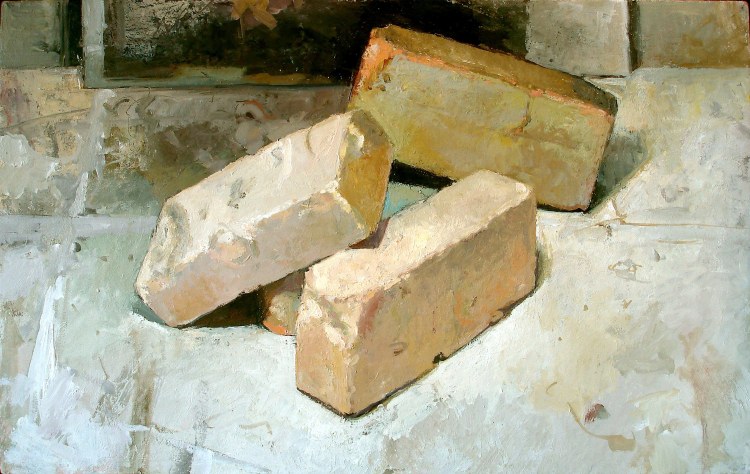
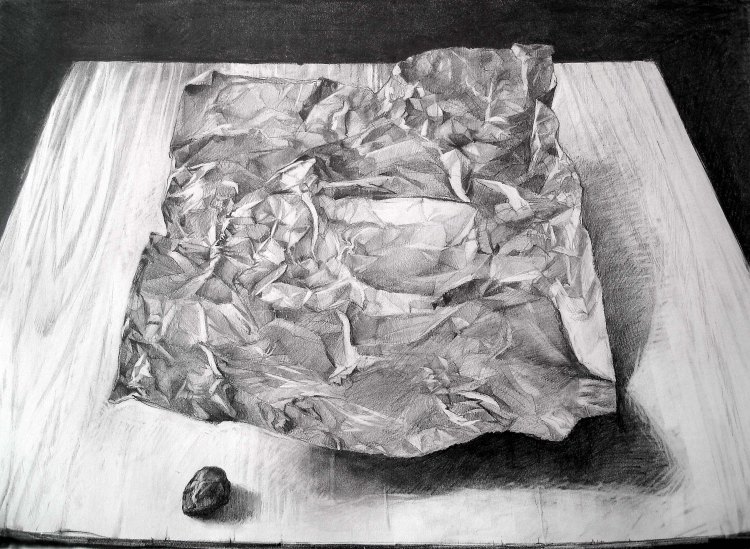
2012 was a good year for selling my work. Many pieces that we’ve lived with for many years are now gone. They live new lives with others. They will, in tandem with these fresh viewers, take on different resonances, build more meanings. Three recent sales in particular are significant to me. What’s interesting to me as an artist is that these works don’t necessarily represent the height of my prowess as a painter or draftsperson (Though I do count Four Pale Bricks as among the most significant paintings I’ve ever made). Nor are these works the end of a particular line of thought or closed, singular achievement. Each was, in some sense, a reaction to different pressures and concerns. They were attempts to understand influences, necessities, desires. They were stepping stones.

11

Untitled Landscape (#1), Acrylic on canvas, 36 x 46 inches, 2000. Private collection, MO. Click to view larger.

They are all about different times in my life. The colorful Untitled Landscape (#1) above was made when I was a junior at SAIC. It wasn’t meant to be my own personal expression. I was trying to understand Diebenkorn and integrate his approach to composition and structure. In spite of the derivative quality (something that’s unavoidable for any artist and something that, when embraced, can spark true development) the work displays my growing sense of color and use of mark and mass.

As I packed it up for delivery to its new owners, I was so pleased with the craftsmanship: the bars are still square; the canvas stretched and primed beautifully; the corners wrapped flat and tight. It was that follow-through with the love for the materials at all levels that, I think, made me develop as an artist. I wasn’t just winging it. I was being thoughtfully engaged all the way through. I’m not saying this just to toot my own horn… I’m just proud of the fact that, in spite of myself, I got something about materials, process, and focus that still rings true and gives the work quality.

ballou-fourpalebricks

Four Pale Bricks, Oil on canvas on panel, 14 by 22 inches, 2006. Private collection, MO. Click to view larger.

The second piece, above, really shows (to me) how my grasp of composition and visual dynamics was affected by combining my early love for Diebenkorn with my research, via Frank Stella’s Working Space, into the formal concerns of the Renaissance. Four Pale Bricks was painted very soon after my return from Italy, a trip that greatly supplemented what I thought I’d learned from Working Space. My encounters there with alchemical pictorial formulas, various numerological/metaphysical theories a la sacred geometry, and the intense formal constructions of everyone from Giotto to Pontormo were extremely influential. In many ways this work was the beginning of my current explorations into two-dimensional shape and angle dynamics as they manifest in illusions of space, air, and light.

ballou18-tinfoilcoal

Still Life With Tinfoil, Coal, and Plywood, Graphite on paper, 18 by 24 inches, 2007. Private collection, MO. Click to view larger.

This last work – something I shipped out to its new owner just this morning – is all about my having become a teacher. One of the things I believe in most strongly as an educator is that I must model the skills, ideas, and values that I teach. I will never make any impression at all if I merely vomit out vague data; I’ve got to believe it and practice it. This work came about as a challenge from my students, who did not believe the processes I was teaching them would yield positive results. As I drew this work, I took photos and from them produced a short video to demonstrate how it all worked. I have used this example every semester since. The piece is very sentimental to me because of how it embodies my own practice of teaching. I was willing to live out the things I talked about, and that made my students trust me.

Having these three works – and all of the others recently sold – go into the hands of people who appreciate them is wonderful for me. It’s also a reminder that gratification (and appreciation) is often very much delayed. I do work today that may only become appreciated decades from now. That is something that is hard for all artists – we are a notoriously insecure and touchy lot, aren’t we? – but having these works go out into the world is special.

It’s all the more special for me because every dollar from every sale I’ve made over the last year has gone directly into bringing Madeleine Cai Qun home. Now when I think of these artworks, I won’t only consider what they were for me or how they have gone to new homes, but I’ll be able to see in them how they gave my daughter a new home.

That’s a value that is transcendent. I’m thankful that my work as an artist can be a part of that even greater work of manifesting love and peace into the world.

There’s still a few more weeks before we head to China. If you’d like to help out in the final stretch by bringing one of my works into your home, check out my etsy site here.


Dream of Light

I attended the opening of Antonio Lopez Garcia‘s retrospective at the Museum of Fine Arts – Boston back in April of 2008. It was a wonderful trip. I was thinking about it today. How momentous it felt to be there. Seeing so many friends from all over the US who were there for it – even Rackstraw Downes was there that day! Tim Lowly was there. Tim Kennedy and Eve Mansdorf were there. David Gracie was there. Sangram Majundar was there. A few low-quality photo pictures are below.

DSC03329

DSC03328

DSC03327

DSC03326

DSC03325

DSC03324

DSC03323

DSC03322

DSC03321

DSC03320

DSC03319

The best part for me was at an early point in the day before the crowds arrived. I found myself standing next to the master, looking together at one of his paintings. It was nice to see him looking closely, finding a contemplative moment in a masterwork he’d painted many years before. There was a leveling there, an equanimity – the master must look, just as the audience must. We both see and take in what is before us. In that space and time of perception we try to understand. In those wavelengths of light we dream of a unity and order and meaning beyond ourselves. We dream of light.