Becoming the Student #7: Tom Seagraves

Tom Seagraves is a man used to procedures and business plans. He’s a man who has worked in both management strategies and the soft logic of human relationships. A few years ago he took his decades of experience and began building a MAC Tools franchise here in Columbia, MO. He is now among the most productive toolmen in the company, ranking at the top in Missouri and in the top 120 nationally. His success is gaining recognition; recently Tom had an editor for Professional Distributor (a trade magazine) ride out with him on his rounds. He’ll be featured in an upcoming edition of the publication.

While drawing him for my Becoming the Student project, I took the opportunity to learn about his perspective on work and community.

IMG_8495Tom Seagraves, Graphite on Stonehenge, 21 by 22 inches. 2014.

On Building His Small Business:

“It’s satisfying to know that I built it from scratch. There was no one before me who handed it off. My customers are my customers. I didn’t acquire them from someone else. That’s been very satisfying.”

On Small Business and the Relationships it Creates:

“Operating a small business is hard. It is very hard. It feels like you get penalized – the better you do, the more taxes are tacked on. That’s the part that’s hard. But relationships make it all worth it. The relationships are the part that I love about it. I’m on a route, so I see the same guys every week. I’ve got those guys I love to see and we’ve got such great relationships. That’s really the fun part of what I get to do. And to have that trust develop; to have those guys to trust me. You know, if I suggest something to them: ‘Hey, this is a new thing, it costs this much, but you really need to have it and here’s why.’ All those guys just say, ‘If that’s what you think, I better have it.’ That trust and connection is huge to me.”

On Competition and Making a Difference:

“Competition is good for everybody. It’s good for the customers and it keeps us on our toes as business owners. I think the big lesson is that you can always learn something and you can always grow. But the other thing is that I’ve had opportunities to be used – I think by God – in other peoples’ lives. In the position I’m in – the relationships I have with a lot of people in this town – I think there have been days I’ve been able to be an encouragement. You get those days where you look at the clock and think, ‘I’ve got to hurry, I’m running late.’ But then there are those days where for some reason I’m ahead of schedule and I don’t know why. It seems like every time, that day, there’s someone who needs me. And then I’m able to have a conversation with someone about something they’re dealing with on a really deep level. It’s not every day, but those times happen. When I’m done with that I’m able say, wow, the Lord really worked that out. I’m so thankful to be used in those situations. Just with one word or in five minutes… that could be important for a guy. It’s easy to look at yourself and think you’re not making a difference in anyone’s life; you’re just making a living, just paying your bills. You get tied up in the mundane and then something happens. God cares about what happens, cares about the people I see.”

Tom and I also talked about the nature of art and portraiture. During our discussion I was able to break down a little bit of what the Becoming the Student project is about:

“It’s more than about making a nice picture for Grandma’s fridge. I mean, for the rest of our lives, when we see this drawing we’re going to think about this time. The drawing gets funded – it’s an investment. It’s an investment in relationship. It’s an investment in friendship and brotherhood. It’s an investment in intellectual history and proximity. It’s an investment in all of those things and, of course, that’s what it’s for. Drawings and paintings – artworks in general – have never merely been for accoutrement. They were always a way to mark time. They were a way to say, ‘We were here; we did this.’ So in that sense, this piece will not mean much to anyone else. But when we look at it, it’ll matter more. It’ll be different. Just in general I think it’s a very basic human urge to say, ‘This has happened and I know it. I have seen this thing, or I have read this passage or I’ve heard this song. It happened.’ I mean, the background of so many great songs is remembering. When you hear the song… you remember. It’s very similar for the makers and subjects of artworks. Learning from the people who sit for me will catalyze meaning in the artworks that result. I want to spend some time parked on that idea.”

I guess that’s a nice segue into the fact that some of the first Becoming the Student works will be on display at PS Gallery here in Columbia, MO! If you’d like to see the works in person, be sure to stop in (click the image below for more info)!

Screen Shot 2014-03-24 at 9.39.13 AM


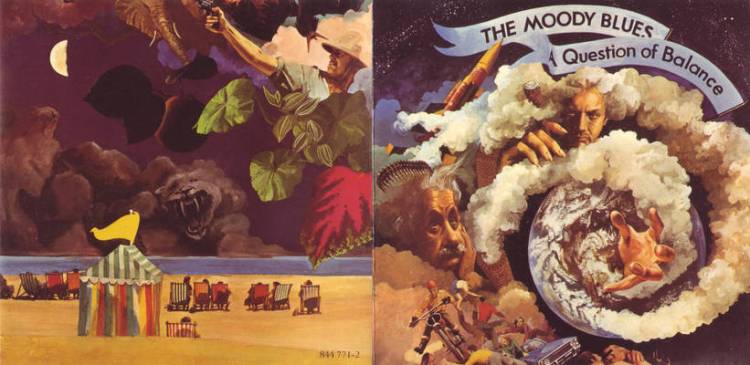
A Question of Balance

Dedicated to George, who introduced me to A Question of Balance in the mid-80s.

~

It is interesting what stays with us from the early years of life. Seemingly banal or incidental elements can mysteriously transmogrify into certain means of grace. And grace is always strange.

It follows then that these grace-laden elements might be loaded with weirdness or saturated with some slow-acting agent of unforeseen change. Of course, that’s part of why the grace that has touched my life is different from the grace that’s touched yours. So often what is tremendously meaningful to one heart seems trivial, shallow, or just plain boring to others. Sometimes what changes me forever would do nothing to the person right next to me.

Nowhere is that fact more apparent than in the music with which we fill our lives. The bands we become attached to, what songs move us, or which albums are soundtracks to our personal transformations are usually radically different for everyone. Everyone seems to have a different constellation of sounds, a different set of aural landmarks. When we do find someone who shares our deep connection to a piece of music there’s instant rapport. When we encounter those who seem unable to grasp the importance of our historical tracklist we can find ourselves incensed.

With that preface let me say that A Question of Balance is one of the major musical touchstones of my life. Released in 1970 by The Moody Blues, Question is, for me, one of the most significant works of art to which I’ve been exposed. It is strange. It is bombastic. It is epic. It is philosophical. It risks existential engagement. It tries to take on everything. It is critical of our default positions. It asks us if this world we’ve made is really what we want. Before I knew much of anything about the wider world, I was connecting with the introspective spiritual and societal quandaries the band was dealing with in this classic concept album.

url

If you are aren’t familiar with the record and want to experience it you can listen to the whole thing here.

Hearing Question as a child was one of the things that would, by the time I was 13 or 14 years old, initiate in me a long-term investigation into the nature of meaning and experience. The sorts of questions the record poses set me off on what has been a lifetime of learning and intellectual exploration. It was a means of grace to me simply because it stimulated me to contemplate those bigger existential concerns that so often get drowned in the machinations of everyday life. Question, along with a number of other factors, created an ongoing state of contemplation in me that helped me avoid many of the pitfalls of adolescence.

There are a thousand things I could say about this record. Like how those jangling guitars at the opening of the album can instantly return me to George’s old golden/mustard/brown Dodge and the smell of propane. Like how the album’s assertions went with Chris and me on our adventures northward so many times. Like how its words were a reminder of the feeling of home as I ventured out across the country in my twenties. The sounds and questions and arguments of A Question of Balance accompanied me on many late nights in the studio, on the road, in contemplation, in worry, in joy.

I could spend time exploring any of those avenues, but there’s one aspect of Question that has really reverberated within me over the years. A major theme of the record amounts to acknowledging the relational consciousness that transcends obsessive, hyper-individualism. This one thread, running throughout the entire record but focused in one particular track, was definitely a seed that found good soil in me.

Below you can read the major content of that single track. Called The Balance (click here to listen to it), it is the last song on the album and is comprised mostly of Mike Pinder’s spoken word recitation of a poem co-written by Graeme Edge and Ray Thomas.

After he had journeyed,

And his feet were sore,

And he was tired…

He came upon an orange grove.


And he rested.


And he lay in the cool.

And while he rested

He took to himself an orange, and tasted it.


And it was good.


And he felt the earth to his spine

And he asked…


And he saw the tree above him…

And the stars… and the veins in the leaf… and the light… and the balance


And he saw

Magnificent Perfection.

Whereon, he thought of himself in balance –

And he knew he was.

~

And he thought of those he angered, for he was not a violent man.

And he thought of those he hurt, for he was not a cruel man.

And he thought of those he frightened, for he was not an evil man.


And he understood…

He understood himself.


Upon this, he saw

That when he was of anger

Or knew hurt

Or felt fear

It was because he was not understanding


And he learned Compassion.

And with his eye of Compassion,

He saw his enemies like unto himself.

And he learned Love.

Then, he was answered.

The tired wayfarer of the poem gains perspective from the Common Grace embedded in the world around him. He relishes the coolness of the orange grove, the simple pleasure of tasting the orange, and – suddenly – the glorious awareness of the Great Order that is before him and beyond him, yet is also permeating him. As he pays attention to the tree, the stars, the leaf, and the light his growing perspective and awareness coalesce into a unifying understanding. The traveler experiences what could be seen as the state of consciousness called Savikalpa Samadhi (something which has more recently been termed The Overview Effect) and he is fundamentally changed in his relationship to other human beings.

Suddenly he’s not obsessing about his rugged individualism any more; he’s thinking of others:

And he thought of those he angered…

And he thought of those he hurt…

And he thought of those he frightened…

Thinking of others – believing that they actually exist and are valuable. Considering others – imagining how your words, actions, or attitudes impact them. Revolutionary ideas, right? But it doesn’t stop there. The journeyman turns his new-found perspective on himself and starts to see that being enslaved to anger and hurt and fear displayed his lack of understanding. In fact, it showed his inability to understand at all apart from a revelation from beyond himself. Realizing this, and sensing his necessary reciprocity with the rest of humanity, our traveler learns compassion. That is, in giving up his self-determined privileged position he can no longer feel superior to or more valuable than those around him. He can, in acknowledging and respecting their value, live out a higher value in himself.

All of this can be passed off as trite, sure. It can be dismissed as sentimental, unrealistic, or melodramatic. It can be ignored as the cheesy platitudes of a bunch of hippies. Sure. But it can also be seen as aligned with the heritage of the great faith and wisdom traditions that have been passed down to us, traditions that certainly inspired the band while creating this album.

I know it’s all more complex than this. I can see how The Balance can come off simplistic and hokey. I know that real change and real meaning require more than a singular experience, more than surge of feeling… but there is something important here, something worth declaring, worth believing. Rejecting sentiments such as those contained in Question seems like such a shallowly postmodern thing to do.  What have cynicism and petty ideological divides gotten us? I guess I’d rather stand in awe with the kitschy hippies than smirk in conceit with those who would disdain words – however sentimental – supporting basic human dignity and value.

~

Post Script:

My experience of A Question of Balance is a demonstration of Joseph Kupfer’s ideas about the inherent moral component of experiencing art. You can read more about this concept here.

The album is certainly worth buying and grappling with. Purchase it at iTunes or Amazon.