This past week I gave a talk for The Honors College at The University of Missouri. The theme this fall was The Art and Science of Living, and they asked me to give a guest lecture about the nature of the body in the context of my work. I chose to focus on a number of artists who have shaped my ideas about the meaning of the body. – from Anne Harris and Robin F. Williams to Kathe Kollwitz and Charles White.
To hear the talk and see all of the artists and images I explore in the presentation, click the link here.
I had the opportunity to sit on a panel at The Columbia Art League on October 12, 2023. Moderated by Diana Moxon and including CAL Executive Director Kelsey Hammond, the wide-ranging talk engaged with a lot of what artists are thinking about in the age of AI. Watch the video below to see a visual presentation of our research, examples, opinions (and humorous asides) as you follow along with the discussion.
Barbara Rossi. “Shep Step II” from 1973. Elmhurst University Art Collection
RIP Barbara Rossi, one of my favorite teachers. One memory:
Her old-school slide shows are legendary. One particular day the class sat in darkness as Professor Rossi went through slide after slide of her travels in India. She had amazing experiences around the world, but I found myself particularly fascinated by her images of street life there. Her eye for design and the presence of design in spaces was sharp and always curious. I’ll never forget the Coca-Cola signs she she showed that day.
They displayed economic/corporate colonization, yes, but also intimated a kind of cultural osmosis; they took on some essential Indian quality in spite of their western origin. It was the kind of thing I’d see personally many years later in China.
Professor Rossi turned my eye on in a real way, and maybe that’s the best thing we can hope for from our teachers. She (like Jim Lutes and Anoka Faruqee from around the same time in my education) is one of the enduring influences on my work and thinking.
PS: Her epic study of Indian painting, “From the Ocean of Painting: India’s Popular Paintings, 1589 to the Present”, was published in 1998 by Oxford University Press. Buy it here.
2023 has been an amazing time of fishing so far this year. We’ve gotten in some great trips in MI and around Mid-Missouri, but the best part – even more than catching the fish and seeing their beauty – has been being out and in nature with my kids. While they don’t all love angling equally (Atticus and MeiMei are PASSIONATE, while Miranda and FangFang aren’t very interested), they have all had some great successes and days of fun.
Favorite Spot
The kids love fishing in Hinkson Creek. It’s a dynamic spot that changes almost daily. Sometimes there are only minnows and small Bluegills there. Other times it’s got decent-sized Bass, Catfish, and Gar. It’s easy to get to, and even pretty accessible for my daughter who uses a wheelchair.
This summer we got to see Hinkson Creek radically transform in a matter of minutes. There have been a number of flash floods in the area this year, but we happened to be fishing during one warning. We watched the sky and checked weather constantly, but other than a short shower, nothing was amiss where we were. But we knew there were high winds and strong rains just miles away to the north. Hinkson Creek runs southward through Columbia, and gathers water from a lot of land in the area. Eventually the creek deposits into Perche Creek, which itself hits the Missouri River several miles south of town.
That day, the storm surge from the north rolled up to our little spot on Hinkson Creek. We first noticed the water picking up speed, then heard a rush in the forest upstream. We turned to look and saw a wall of debris and muddy water heading our way. Within just a few minutes the river rose six feet. Dirt, rocks, and even entire trees blasted through the area. It was awesome to behold, and such a learning experience.
You can see in the images above just what I mean by the creek rising. The concrete bridge my kids are fishing from in the image above is UNDER the water in these three images.
We stood by, watching the raging waters, for a good long time. It was illustrative of the power of even smaller sections of rivers, and it gave us even more appreciation for our proximity to the Missouri.
GAR
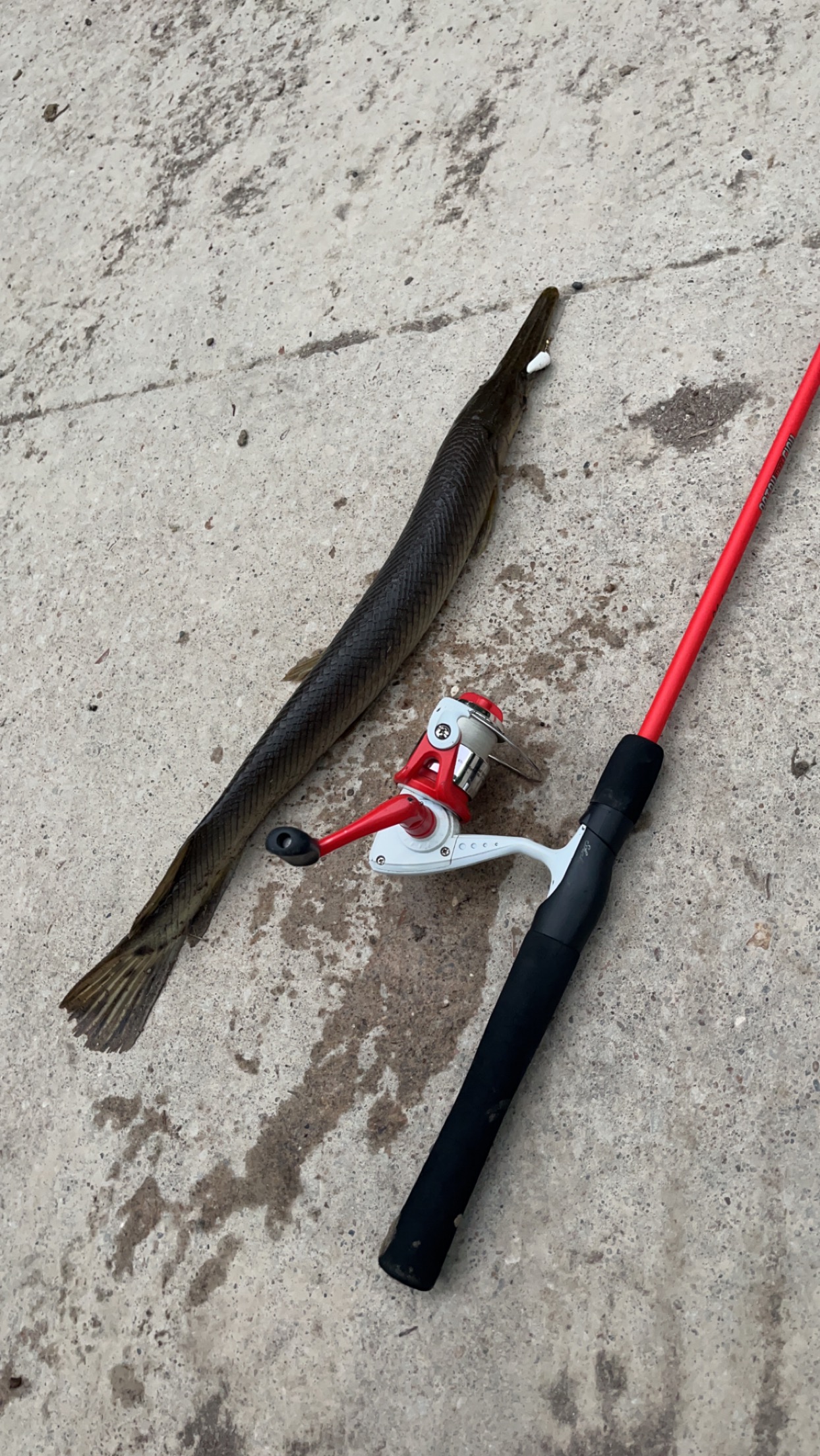
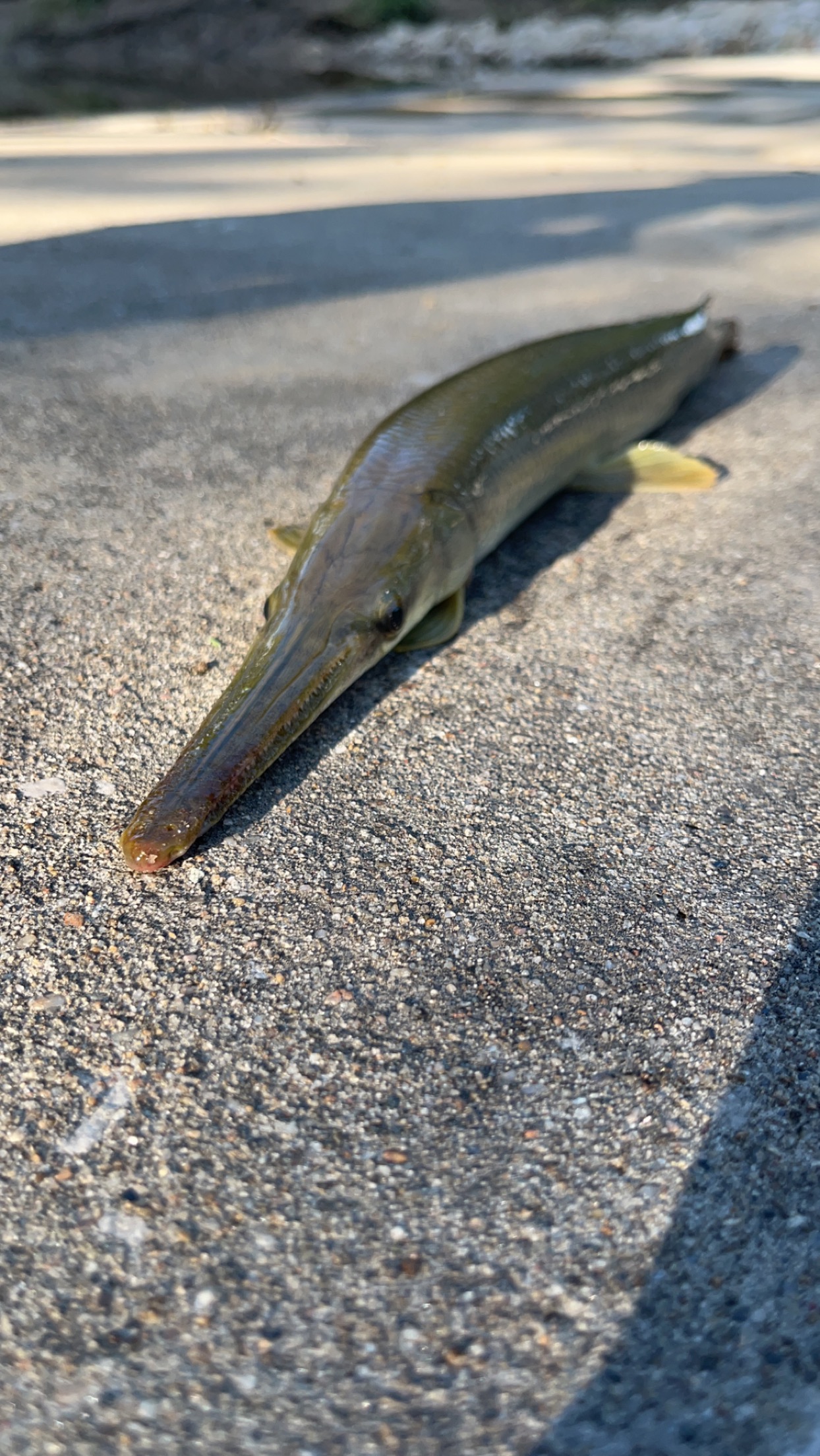
One of our favorite types of fish is Gar. We have Spotted, Longnose, Shortnose, and Alligator Gar varieties. They’re always fun to battle and they come from an ancient lineage of fish that really look almost dinosaur-like. They’ve got serious teeth and definitely don’t want to be caught. Bony and strong, Gar are hard to hold onto and are known for spitting hooks easily because they aren’t very fleshy in the mouth area.
In the creeks and smaller rivers, Gar don’t grow super large, but we do get some that are in the 28-32 inch range at times. We’ve even been able to land them on hook-less rope lures, which is fun.
Beast Bass
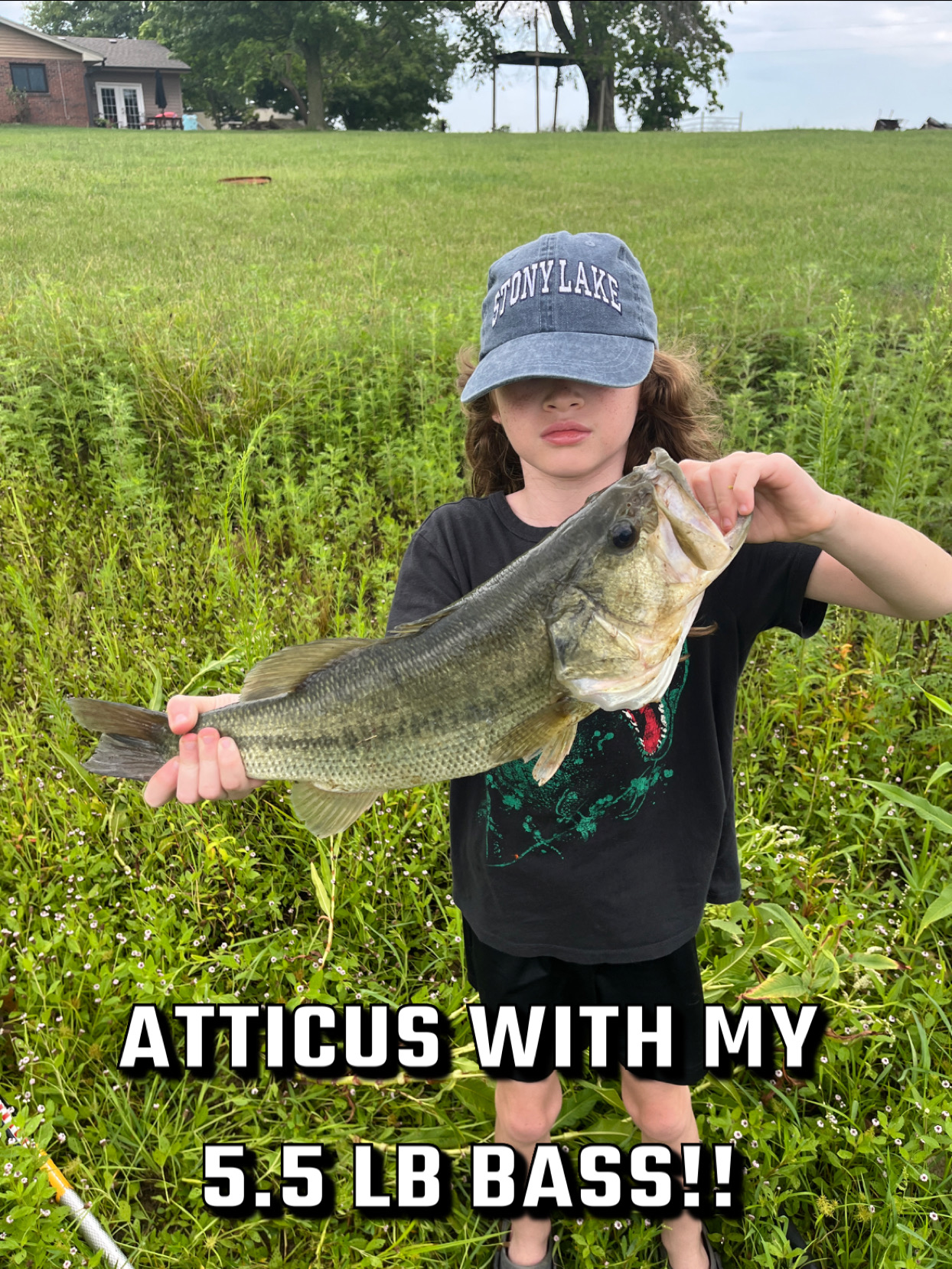
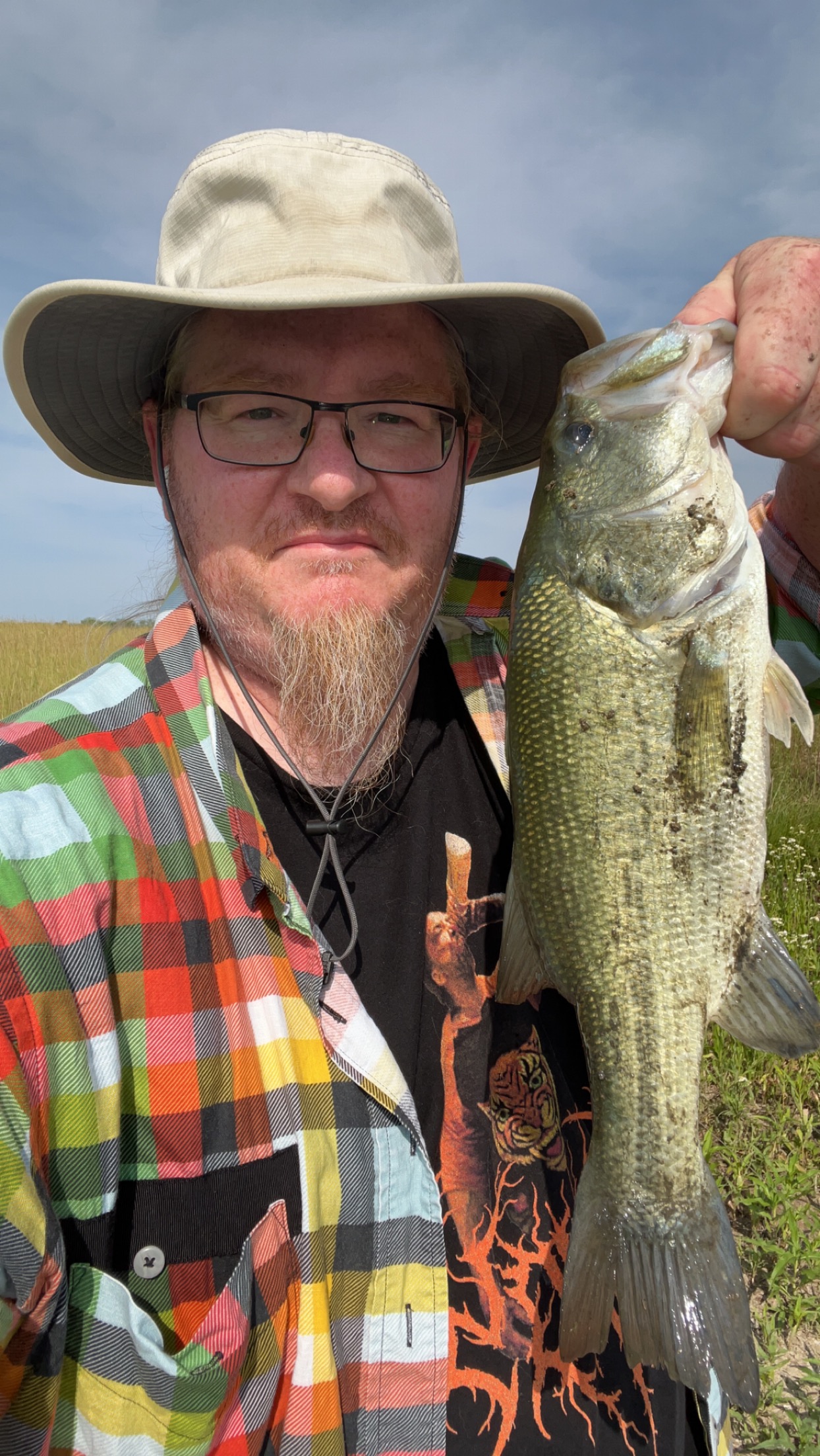
This summer gave us some SERIOUS Bass. The current Smallmouth Bass record in the state of Missouri is 7lbs, 2oz, and two of the fish we caught this summer were pretty close to that size. In May Atticus caught a huge Largemouth coming in over 6lbs (right). Later that month when we went to Michigan he hauled in this beautiful Smallmouth that was 5.8lbs (center). Given that we’d lost so many bigger bass with our lighter line, by June we’d converted over to 15lb test. It wasn’t until late July that I got my 5.5lb Largemouth (right). These personal bests are going to last a while, I think.
Good Lessons
We will continue to fish our favorite spots in the area through the rest of the year, but we’ve also planned to hit one more longer trip before the end of the summer. Meramec Springs, where the state fish hatcheries stock Trout, are not too far away. Though it might be a bit too hot for Trout, we’ll give it a try. I haven’t yet taught the kids how to clean and cook fish; we’ve been catching and releasing everything so far. Given how much they seem to respect the fish, I think they’ll understand and appreciate the circle of life aspect of harvesting some for food. But I think I’ll wait on that until Trout are on the menu.
I’m very proud of the kids in regards to angling. It has been a great way to get them out in nature, yes, but it’s also developed their resilience and patience. They’ve grown in understanding delayed gratification and following through. And they’ve gotten to work on problem-solving, working together toward common goals, and appreciating the efforts and successes that each one reaches. I’m impressed with them.
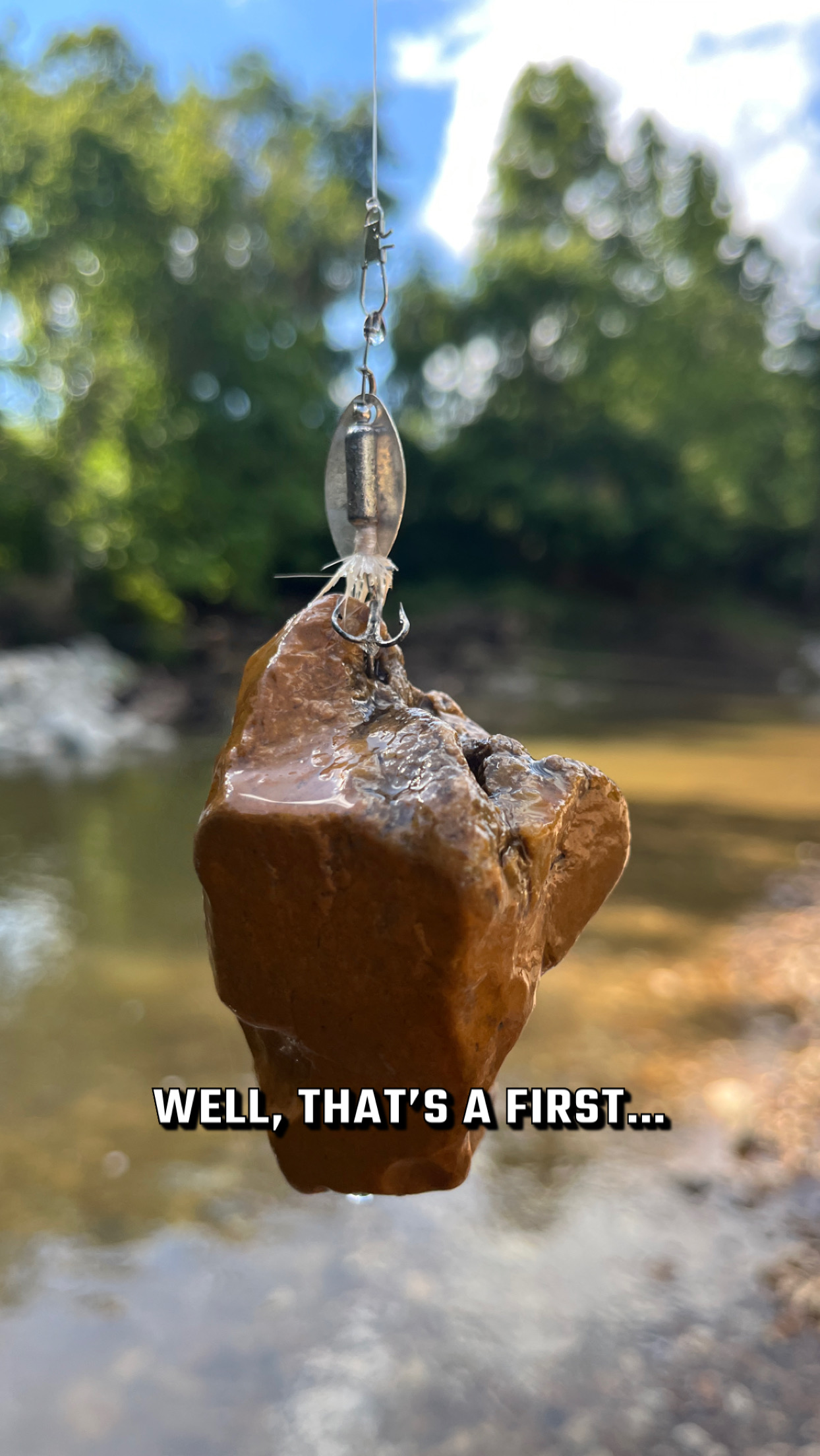
There’s Always a First Time!
Each trip to the creek or river or lake offers chances to learn new things and experience life together. That makes it all worth it.
Late last year I talked about how Geo and I were working back and forth with some artwork/carving/A.I./carving/artwork-type collaborative stuff. The process has continued.
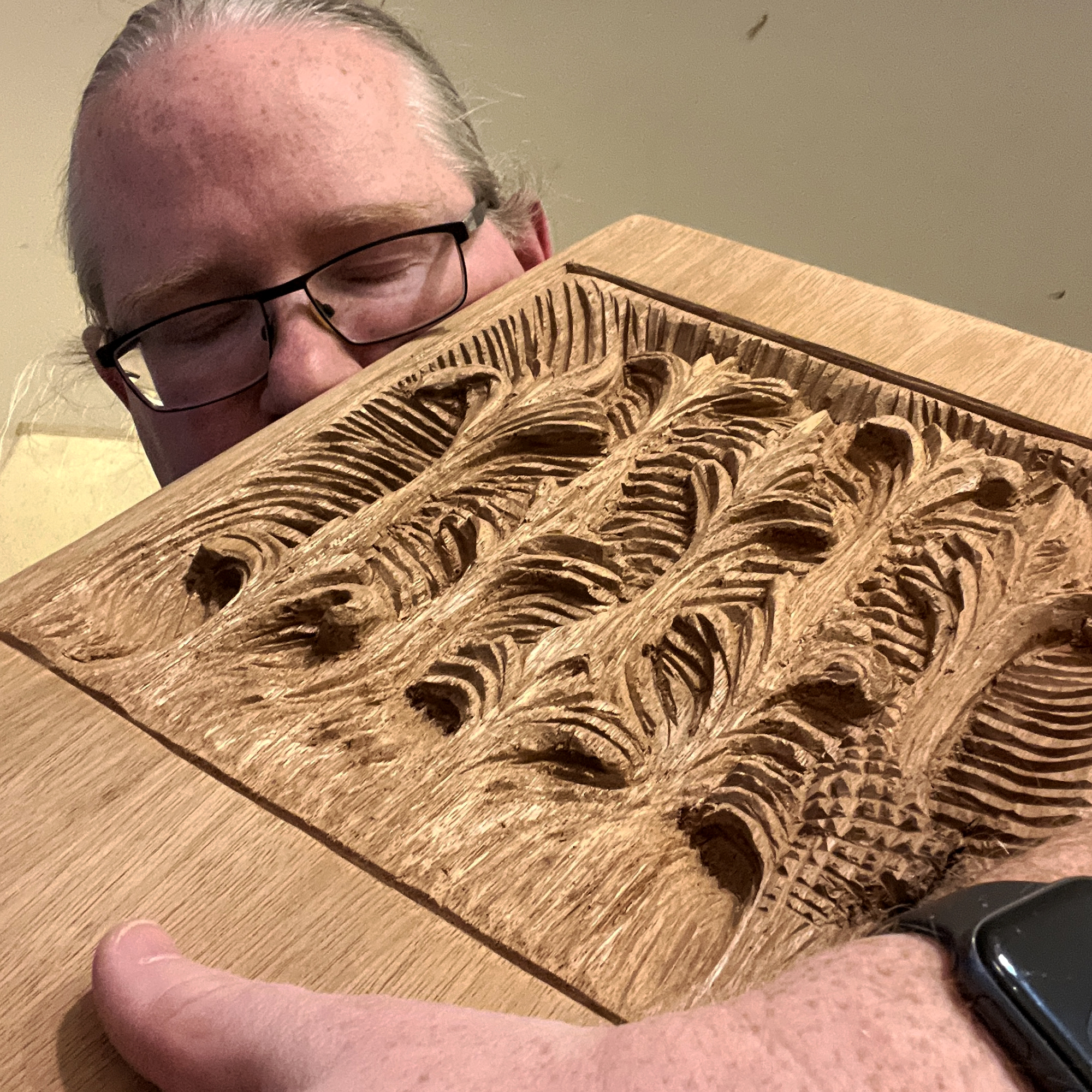
Smelling the newly carved oak from Geo!
I know, I know. You see the initials A.I. and you’re skeptical. As you should be. I’ve been doing a lot of research on A.I. generated images, and while I think the majority of the A.I. space is trashy, there are a few people doing some amazing exploration. Joey Borovicka over in The Timeout Zone is doing quite interesting “synthography” using A.I. models. Wolfe von Lenkiewicz is also making intensive forays into image-making with precision A.I. models.
I have been interested in using image-generation tools in a limited way. Basically, I’ve been incorporating them into the workflow. This means we start with ideas, images that we’ve made ourselves, or carvings that Geo has made. Then, uploading the images as a baseline source for the A.I. generator to use, we add text prompts to encourage various modifications. In this way we use our own images in the A.I. system and calibrate them using the wording we input. Obviously, since the models have been trained on images borrowed from the wider world, we’re viewing this as a limited experiment, but I think it’s worth it.
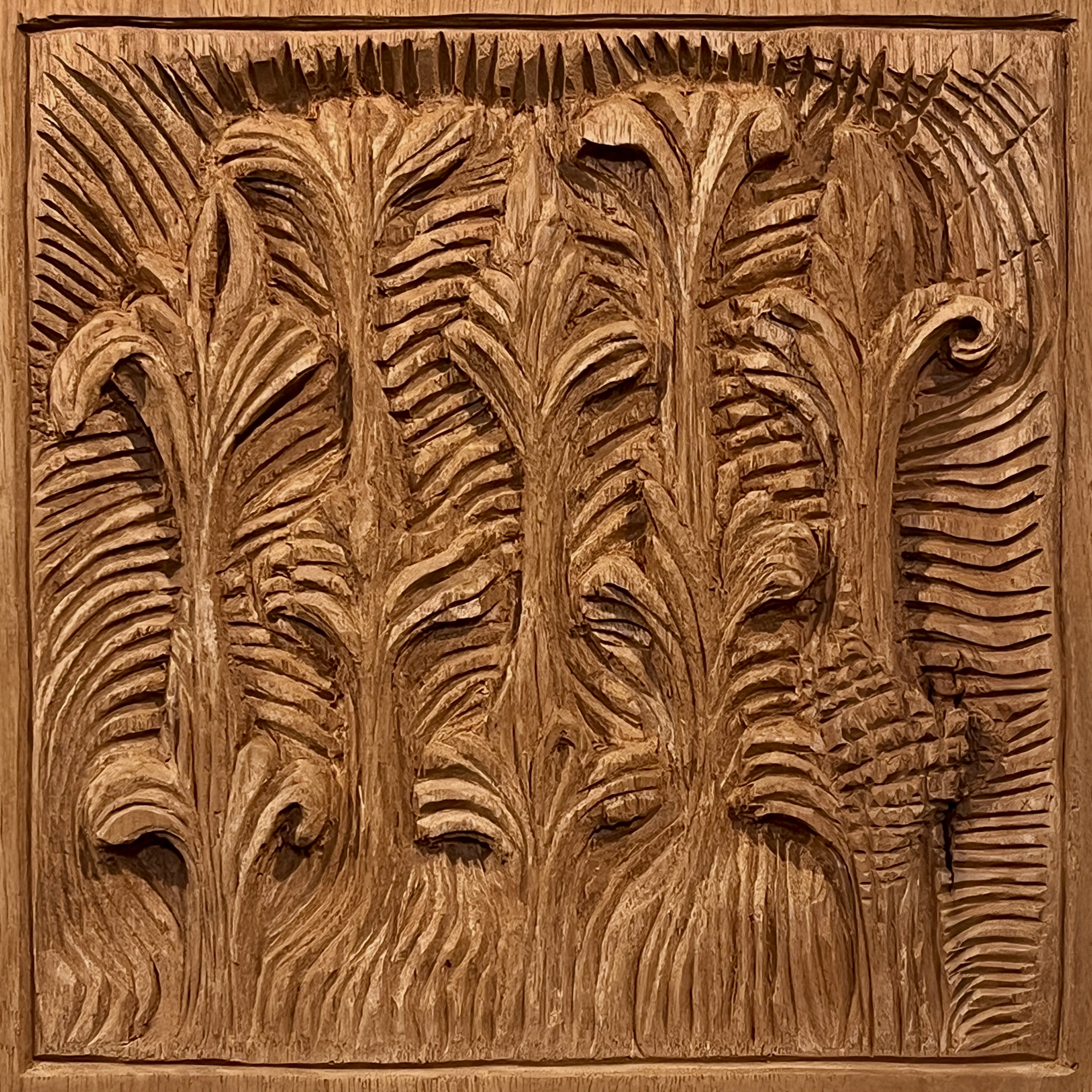
Here’s a sequence of explorations that we’ve done with imagery of the acanthus and my own artwork: first, I used some wording from Geo in the Dream by WOMBO A.I. app, then I loosely drew over the generated images. After making a various edits and selecting one of the versions that I’d drawn, I sent a copy to Geo, who used it as a basis for his carving.
Quilt-form based on acanthus leaves. A.I. generated from Weissler prompt wording. Acanthus Quilt. Geo Weissler. Carved oak. 2022.Drapes. Ballou. Tempera and oil pastel on panel. 2021-2023.Hidden Drapes (After Ballou). Geo Weissler. Carved oak. 2023.
Living Carve. Ballou. 10×10 inches. Ink, colored pencil, gouache on paper mounted on panel. 2023. Private collection.
The image above, Living Carve, was built by using words of Geo Weissler in Midjourney, then modified digitally in Procreate on my iPad. I took that result, printed it on a large format Epson printer using Epson Enhanced Matte paper. I then used colored pencils and gouache to develop the image and enhance the richness of color and depth of surface. Below you can see a shot of the piece framed. You can see some of the surface treatment, the sense of the material accumulating to present the image. I like the chiaroscuro and quality of light. There is a subtle feeling of trompe l’oeil to this piece, which is something I’ve only tried to do a few times before. I may try a composition like this once again. If you’d like to inquire about work like this, visit me on Instagram.
I’ve known Michelle for many years now. She’s been a central part of the local art community for all of that time, and a dedicated student of painting as well. Beyond this, Michelle is someone who always has a kind word, and her encouraging, affirming presence is something everyone in our town knows about.
She also used to be my friend Mike, who I drew for this series here. Obviously, I will not try to tell Michelle’s story. It’s not mine to communicate. But I did think it would be appropriate to place a new portrait here in the Becoming the Student group.
Portrait of Michelle R. Seat. Procreate, iPad Pro. 2022.
Since I’m an educator, I’m sure you can imagine that I come into contact with many LGTBQ+ folx. Particularly in the last decade I’ve worked with trans people in a few different contexts, but most often in the graduate program where I teach. Just like anyone else who is human, the trans people I’ve known have exhibited a wide range of personality and affect.
Everyone comes with their own traumas and triumphs, their own unique inflection on life. And the fact is that simply being human is hard. People have to come to an understanding of themselves for themselves, and my primary obligation to those around me is to be kind. While that strategy hasn’t always worked, I think it’s an important guideline. And it’s framed the way I teach and the way I interact with people. It’s not up to me to define anyone else; it’s up to me to be kind and helpful.
DETAIL of Portrait of Michelle R. Seat. Procreate, iPad Pro. 2022.
(That’s central to how I see education. My teaching philosophy includes the concepts of “facilitation, encouragement, and tact.” It’s important for my interactions with people – especially students – to function as opportunities to support and enliven them. I want to aid their ability to understand themselves and help them develop strategies for building creative points of contact. Art – or really any form of communication – is worthless if it doesn’t offer access points for others.)
So, I offer up this new portrait of Michelle in celebration of her humanity and her winsome, joyful presence in our community. I did interview her for this entry in the Becoming the Student series, but I have decided to let that conversation stay just between the two of us. There are as many ways of being human as there are humans experiencing being.
DETAIL of Portrait of Michelle R. Seat. Procreate, iPad Pro. 2022.
…all is transformed, all is sacred, every room is the center of the world, it’s still the first night, and the first day, the world is born when two people kiss, a drop of light from transparent juices, the room cracks half-open like a fruit or explodes in silence like a star, and the laws chewed away by the rats, the iron bars of the banks and jails, the paper bars, the barbed wire, the rubber stamps, the pricks and goads, the droning one-note sermon on war (…)
the invisible walls, the rotten masks that divide one man from another, one man from himself, they crumble for one enormous moment and we glimpse the unity that we lost, the desolation of being man, and all its glories, sharing bread and sun and death, the forgotten astonishment of being alive;
Pastor’s Kid, a film by Benjamin I. Koppin, must be a labor of love. Billed as being based on a true story, the movie does indeed function with a strong sense of authenticity, at least to my eyes. Viewers follow Riley (Courtney Bandeko), a disaffected and conflicted young woman, in the hours and days after being roofied at a bar. Our perspective trails Riley in moments of reflection and realization that attend her dismay, not only at what happened at the bar, but at the experiences she’s had her whole life. In some sense the entire film is comprised of vignettes of those reflective moments, and we pop back and forth between the present moment and key situations from Riley’s past.
Anchoring the past is young Riley, played with grace and unique presence by Marisol Miranda. The filmmakers struck gold with this actor, who mirrors the pensive inner life that Bandeko gives to older Riley. Both act well with their eyes, and the interiority suggested by their performances allows them truly own their scenes. In many ways, the world of the film orbits them. They become a still point in the midst of the tumultuous realms that surround them.
This is a film that lives in the tension between active seeking and accidental finding, between finding yourself lost and being surprised that you’ve been found. Coming as it does in the midst of a potent moment of spiritual deconstruction among younger Americans, the film is situated to strike a particular chord. It could easily have come off as preachy, or too easy, or – indeed, in one of the strongest lines from the movie – as “a cliché.” I think the filmmakers and actors managed take it beyond those kinds of trite, pedantic resolutions.
Without giving anything away, I think Pastor’s Kid is able to highlight the potential for redemption in the midst of what simply can’t be undone in our lives. We do things that can’t be taken back. Things are done to us that we alone can’t repair. Riley understands that she’s lost something of herself in the attack; that loss is disconcerting and painful. But the event is also a catalyst causing her revaluate her relationship with her estranged mother and – maybe – with her equally-estranged faith. Riley is both a protagonist and an antagonist. Will she return to numbing herself or will she allow herself to open up to past experiences and emotions? Whichever route she chooses will hurt.
Healing wounds requires touching them, and that’s the painful part; sometimes running away is the only response that seems valid. We’re all traumatized, and we all live in various states of fight, flight, or freeze. It makes sense, then, when Riley’s mother, the voice of God, and even Riley herself are left asking, “Are you done yet?” Done with anger, done with fear, done with running, done with dissipation; the viewer is left to parse the potential of that question and any answers that might follow.
Pastor’s Kid is a unique movie with intriguing pacing, strong performances, and solid, memorable characters. It feels like a distant cousin to Rian Johnson’s classic neo-noir film, Brick. Though less stylized than that movie, Pastor’s Kid is a film with a similarly confident perspective. To me, it succeeds most strongly in moments of subtlety and ambivalence. It’s a film worth your time.
On a personal note, I’ve known a lot of PKs. I’ve seen their struggles up close. It feels honorable to provide a particular view into their world in a way that feels honest and heartfelt. Kudos to Koppin and the whole writing and production team for that.
Full disclosure: the featured actor in Pastor’s Kid, Courtney Bandeko, was a model for many of my Drawing classes in the Art Program at The University of Missouri. I’m glad to know she’s gone on to do creative work she loves.
I have known my friend Geo ever since we lived next door to each other in Evanston, Illinois in 2006. Though my adventures took me to Missouri and around the world in subsequent years, Geo made an effort to stay in contact. The man traveled to visit some of my shows, even appearing in Columbia, Missouri for an exhibition in 2009.
Geo surprised me back in 2009. We got Thai food and cocktails.
In more recent times we have taken to writing missives via email and text, sharing books and ideas. Geo has been a woodcarver for many years, and his work has been sought out all over the Chicagoland area since the 80s. I’ve appreciated the friendship Geo has given over the years, and see him as a kind of “future self mentor.” Imagine a version of yourself visiting from some alternative future who gives encouragement? That’s kind of what Geo is for me.
Portrait Demo Sketch (of Geo). Chalk pastel on paper, 24×18 inches, 2013. Created at Evanston Art Center where I gave a portrait workshop.
Through our chats and several visits, we have connected as artists and visual thinkers. Every once in a while Geo would send me small carvings and I started wondering what shared art-making might be for us. Eventually, it seemed natural to start formally collaborating on a group of carved paintings, three of which appear below.
Geo Weissler and Matt Ballou. Untitled (Wedge Interpretation). Relief carving with mixed media color. 2022.Geo Weissler and Matt Ballou. Untitled (Freak Flag). Relief carving with mixed media color. 2022.Geo Weissler and Matt Ballou. Untitled (Ensign). Relief carving with mixed media color. 2022.Click to see the works larger. These three are still in progress and may change.
Geo began these works by creating carvings based on some of my own WHENEVERwhen or Ensigns For Miyoko Ito series works. He owns several of them (in fact, Geo has purchased many of my paintings over the years) and was able to observe them closely. Inspired to bring some carved aesthetics to bear on those visual themes, Geo crafted some really interesting surfaces. One (the “Wedge Interpretation” piece above) he actually painted most of as well. I added chromatic exploration to each of the relief carvings, seeking to transform both Geo’s carved environment an my own formal structures.
I’m feeling excited – and thankful! – for this fresh collaboration. Here’s to many more shared works with Geo.
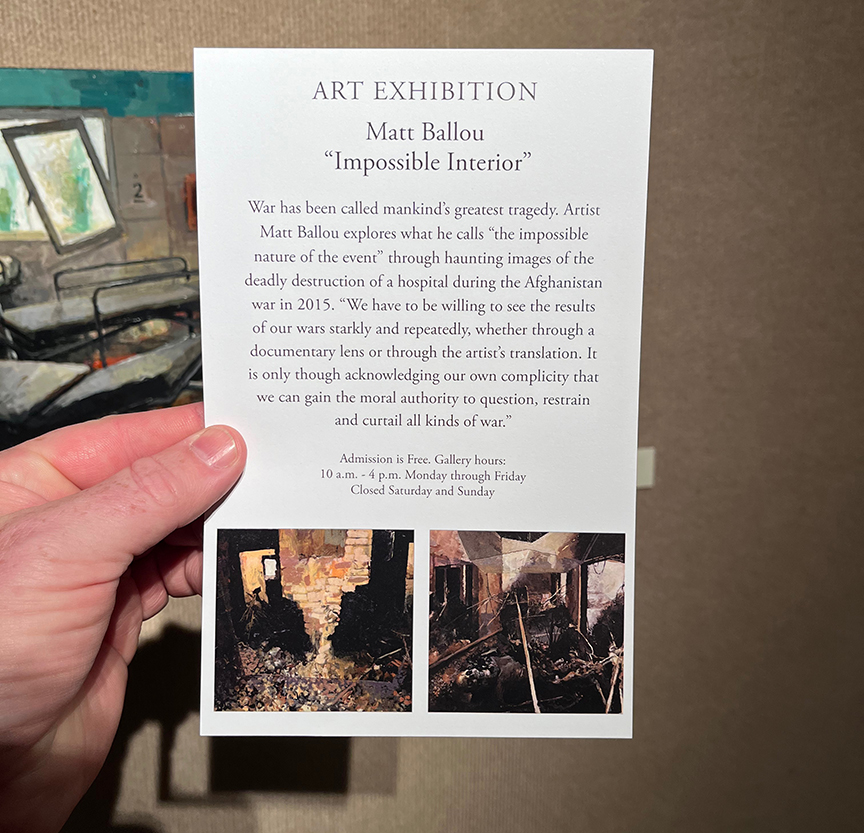
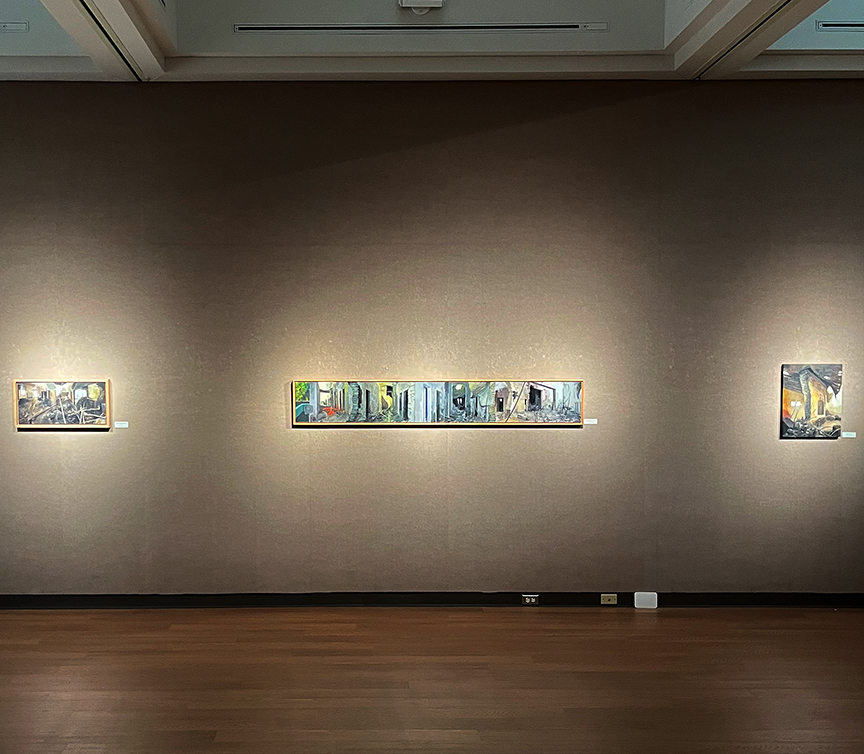
I’ve got a group of works on display at William Woods University in Fulton, Missouri. The show runs through October 6th, and I’ll be giving a talk that evening. For a preview, look below.
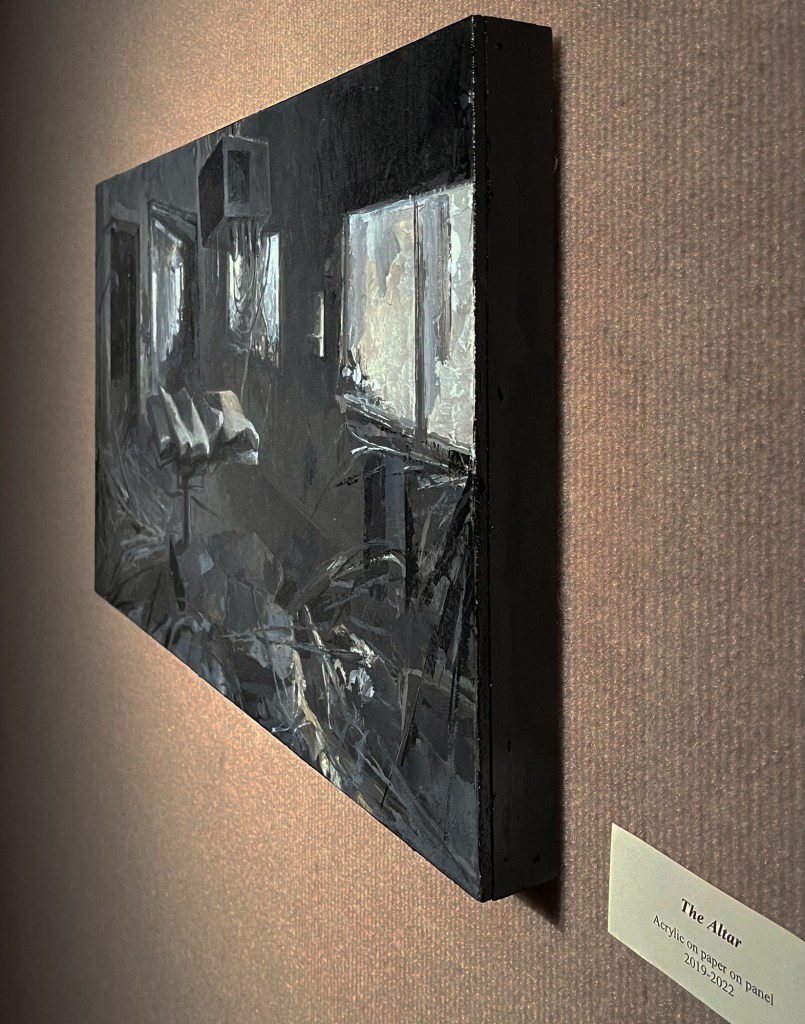
This is the third time I’ve shown this body of work, and I’d like to get the chance to show it again. The subject of the work – a “friendly-fire” bombing of a Doctors Without Borders hospital in Kunduz, Afghanistan. If you’d like to see more about this situation, check out my writing about it here.
The card for the exhibition.Back of the card with description of the show.Here are just a few of the works on display, along with some details. There’s a lot to see, so come on by!
I’m also pleased to have a small group of my collaborations with Joel T Dugan also on display at the gallery. These Phoneme works are some of my favorites, and there are a number of just finished works included.
Many years ago, my Cousin Chris and I were constant companions in the woods around Camden, NY. In particular, we explored the region between our homes. His place was several miles away to the west if you took the old dirt road that emerged onto the highway 50 yards from the house I grew up. We also did a lot of camping and hiking in the woods east of my own home.
Here’s what that area looks like today (well, a few years ago via Google Earth):
I grew up along Route 70 – Wolcott Hill Road – about two miles from the town of Camden. Wolcott Hill Road runs roughly South to North away from Camden, so this view is oriented with East at the top and West at the bottom. You can see the small lake in the lower half of the image; that is a reservoir, and part of Camden’s waterworks system. If you were to walk due West from the South corner of the reservoir, you’d come out on Wolcott Hill Road right next to my childhood home.
From the ages of 12 to 16 or so, I started making maps of our haunts out in this section of land. When I was 19, I decided to make a larger, more refined version of the map, bringing together all of the various places we used to camp and hunt. The result is below.
Watercolor map of area around my home. 24×22 inches. 1996.
There are some obvious mistakes of guesstimation here, most glaringly in the position of Route 85, which we locals know as Skinner Settlement Road. There is also some distortion of the placement of various fields, and a bit of miscalculation of distances, but I’m pretty pleased with my effort since I did not use any proper map as a source.
There are some great memories here.
At Winter’s Night, we camped in -2° weather. In the morning, we were lying in impressions in the hard snow caused by our heat coming through the tent.
At Cowadunga, we cooked venison in beer and used hard, flat cow poop for fuel – hence the name we gave the place.
The Reservoir Cabin Site was a special spot, and we stayed there quite a few times.
One night, at View, we had amazing, super clear skies all night long. It seemed as if we could see forever.
Though we never camped at Lone Tree Hill, we often climbed the massive maple there.
At Earthview we had one of our strangest camping trips ever, when we were accosted by a large number of Woodland Jumping Mice. What seemed like dozens of them came through our area, but the issue was that this was in the wee hours of the morning, so it was very dark, and the rhythm of their jumps through the underbrush sounded like footsteps. Pretty wild.
I’m glad I made documents like this throughout my teenage years. Though most are in a more rough or not so presentable state, they represent my attention to and interest in my surroundings and experiences. I’m glad to have them.

















 eikonktizo
