IU Fine Arts Student Association Submission

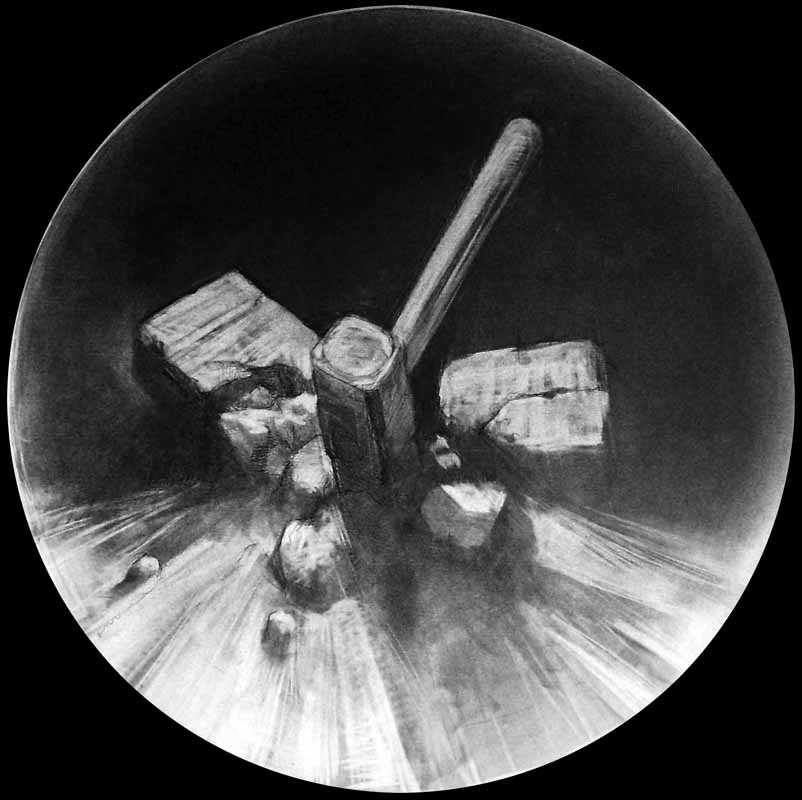
IU’s Fine Arts Student Association recently solicited postcard sized works from alumni, like myself (MFA, Painting, ’05). Below is what I sent them.

Water From a Stone (Ballou, 2011 – For IU), ink on moleskin page.

Here’s a link what a fellow IU alum, Stephen Cefalo, submitted. The whole thing is to support FASA’s “Making Art Work” symposium on careers in the Arts. Click here for more information about it.

Inspiration: Natalie Hellmann

Natalie Hellmann, a wonderful ceramist and person, is holding her MFA Thesis Exhibition this month. She has been an absolute joy to work with over the last three years, and I know I’ve learned much that I would never have known if not for our discussions.

Aarik Danielsen talks to Natalie about her trajectory as an artist in this feature in the Columbia Daily Tribune.

And here’s a link to a shorter article about her and her show.

I was asked a number of questions about Natalie and her work for that short article. Obviously space didn’t permit them to publish all of my thoughts, so I want to include them here as a way to honor Natalie.
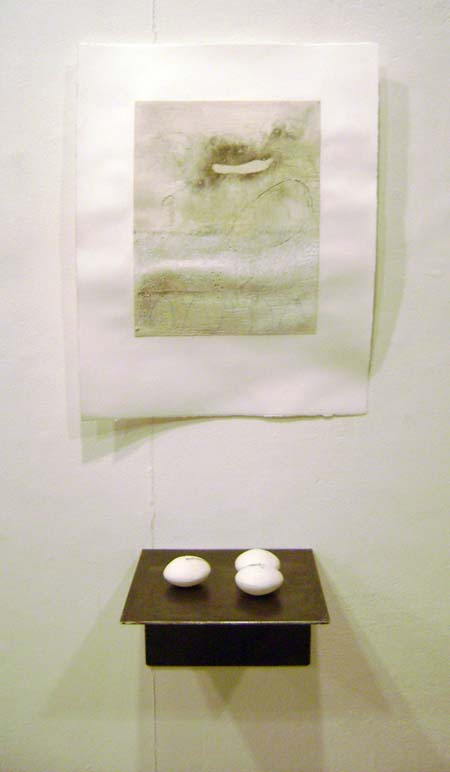

Interview Question: “What do you enjoy most about her growth as an artist since you’ve met her? How has she grown?”

My response: “I am most impressed with how Natalie has held onto the core things she has cared about for many years while at the same time found ways to grow in her understanding of the materials and integrated relationships of form, content, and emotion with which she has worked while in grad school. Practically, this means that she has made numerous attempts to invest her project with fresh investigations, often working with different forms, structures (and orientations of these two) in order to determine what felt right. In many ways what she presents in this Thesis work seems inevitable, as if it all just had to be. But this is not the case. Natalie has studied her own work and intuitive expressions while also looking to other artists, writers, and philosophers who seek poetical understandings of human experience rather than just rational, direct, closed meanings in that experience. Natalie’s work is thus not meant to function as didactic communication first and foremost. Instead, it has grown to become a kind of emotional sounding board, wherein viewers may, if they are inclined, examine themselves via the suggestions of the forms. The work is more about awareness of being than declaring some specific message. I enjoy the fact that I got to participate in her exploration, be around her welcoming spirit, and grow in my own apprehension of what art can do through my time with her. ”
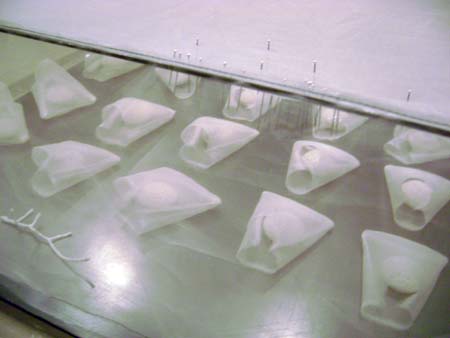
Interview Question: “What do you think her viewers are going to enjoy most from her exhibition this coming week?”

My response: “I think that viewers who allow themselves to intuitively consider the objects and arrangements in Natalie’s show will find a resonance in their own past experiences of feeling, seeing and being. What I mean is that, to me, the strength of Natalie’s work has always been in its gentle invitation to participate in awareness and emotional connection to shapes, colors, and surfaces. Being with Natalie’s artworks is something akin to standing by a stream and looking at the smoothed stones beneath the undulating water – if you’re in the right frame of mind, your emotional and psychological experience can become one of calm awareness. I think that’s the “repose” that Natalie suggests in the title for her exhibition. I hope that viewers will both experience and appreciate that quietude and tenderness; it’s something not often seen in art.”

Thank you, Natalie, for your work, your spirit, and your presence.

On Intuition and Analysis

My latest essay, On Intuition and Analysis, is up over at Neoteric Art. Click HERE to take a look… and leave a comment there if you’ve got thoughts to add to the discussion!

“The ways that the human mind manifests itself in creative activity are vast and various. People have theorized about and argued over modes of creative impetus for millennia. Artists and lovers of art are constantly attempting to plumb these depths, always looking for some elucidation of the mechanisms and maneuvers our minds utilize when we are in that universally recognized but seemingly undefined state that is creation.” Click the link above to read more…

Inspiration – George Tooker

George Tooker died this week. You can read the New York Times obituary here. There’s also a wonderful short documentary that captures his gentle spirit here. And here‘s a short survey about the artist.

His work was evocative, awe inspiring, and it deeply affects those who explore it. He’s a part of the artistic lineage that I claim, particularly since I see myself as a symbolist.

““Symbolism can be limiting and dangerous, but I don’t care for art without it. The kind that appeals to me the most is a symbolism like a heraldic emblem, but never just that alone: the kind practiced by Paolo Uccello and Piero della Francesca.” – George Tooker

Sleep well.

Collage, by Zeinab Chaichi Raghimi

One of my grads has developed a booklet containing a number of her collage works from last year. Please go over to Lulu and check it out by clicking the image below (it’s one of my favorites of the ones she made last summer). The booklet is pretty cheap to purchase (you can download a full-color, 25 page version for a couple bucks) and has some excellent images as well as a statement in English and Farsi. I think Zeinab is doing some great work here at the University of Missouri and I hope a few people will support and encourage her by picking up a copy of the booklet. Just click on the image below to go to the Lulu page where it’s for sale.

Drawing is…

Drawing is the literal manifestation of corrections, adjustments, and negotiations made during its own construction. A drawing (regardless of the manner of the image it displays) is always a representational work depicting the activity by which it was made. As we build a work, we self-correct. As we self-correct, we leave a trace of real observation and negotiation, declaring our willingness to leave behind what has not worked in the service of the total work and in anticipation of something that will work better. The final drawing is not a snapshot, not a slice of time, but a track record of integrations attempted, iterations discovered, and disparate elements syncretized.

Untitled (Beautiful Collision #3), Graphite on paper, 20 inches in diameter, 2008.


Inspiration – Piranesi

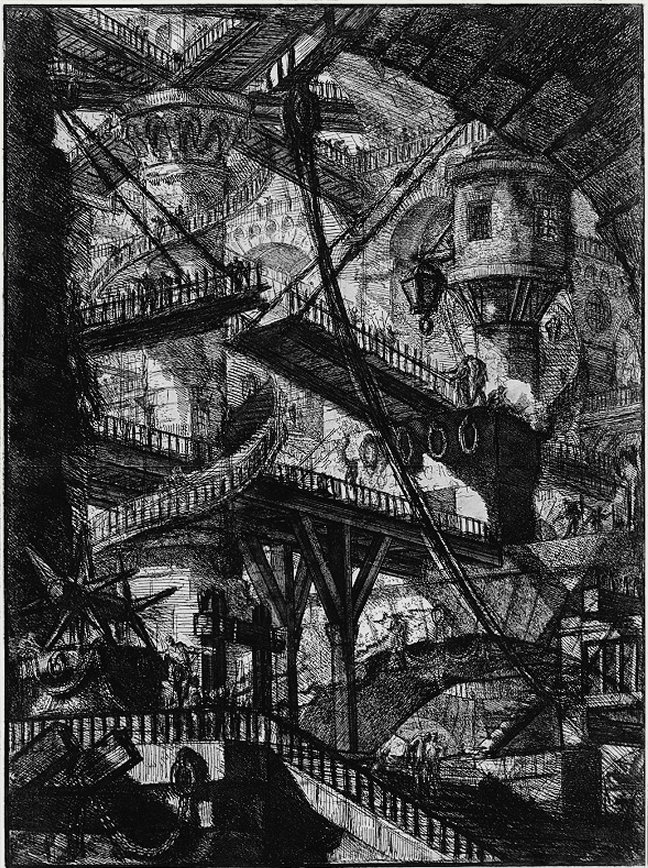
Giovanni Battista Piranesi created an amazing series of prints called Le Carceri (the Prisons). I recently found out that the Saint Louis Public Library has an edition of the prints, so I’ll be over there to see them soon.

The Prisons, Plate VII: The Drawbridge.

In these works the master deftly shows the ability for etchings – and really all of printmaking – to transcend the sense of a single, locked image that is a stereotype of the discipline. Using an inventive, intuitive action, Piranesi works the various states of the prison plates in dramatic fashion, transforming their contents, scale, and mood. The Dover publication of the first and second states of the plates is well worth the price.

I picked that book up in 2004 and it has inspired a great deal of my perspective on line work and current interest in printmaking as a malleable medium – as seen in the image above, titled The Weight (etching and mezzotint, 2008). Click on the image for a larger view.