A Submission to Delights

“A constant comfort of that place – apart from the foliage, springing paths, and multitude other charms – was my mug. Handcrafted and ergonomic, it felt then as it does now: a real weight in the hand – substantial, truthful. It declares by its heft the worth of what it holds. It is heat, a vessel security blanket, a confirmation of time. And of course I carry the time with me physically even now as I use the mug emblazoned with the O and the X (hugs and kisses from the past to the future) almost every day. It reminds me of 2am munchie runs and awesome weekend breakfasts, of wind swept evenings and overcast middays. Its circle pleases me and my mouth conforms to it easily – a submission to delights.” – from A Mnemonic of Longing, an unpublished essay, 2002-2009.

On nights like these – remembering Ox-Bow and my mug of that time – I think also of drinking port with Lex up the slope behind the Inn. One late afternoon, both of us moving toward that state of mellow so frequently found that summer, we debated art and ideas. I had my prized Odd Nerdrum book with me and, in a sequence of events not without mystery and malevolence, the tome found itself flipped off the deck and down the hillside. I keep the book broken away from its cover to this day in remembrance of my time with Alex.

Photo: My second Ox-Bow mug today. I got this mug at the same time as the one I speak about in the text above, but that first mug – my primary mug, the one that I had used every day for two years – was stolen from my workplace in 2003. Now I keep the second mug as a commemoration and never drink from it. Both mugs were made by Becky Wehmer, long time Ox-Bow-luminary and an artist/educator at Waterstreet Glassworks.

A Sound of Being

“Evening often brings contemplation. The paths are quiet and fires smolder in the distance. I’m out behind the Inn again. Some people come and go, moving in the ethereal between-time, but we sit on the steps with a kind, unimposing light glinting out from within. There, the warmth of the air touches my arm as I bring my hand up for another pull on my smoke.

See how poetic that stream of consumption is as it gracefully spreads upward, as smoothly as my eye follows it, as light as my mind. Shared… a cigarette-trust between friends.

And there is just silence, but that is not to say there is no sound. There is a sound that true silence makes, a sound of being. What a precious joy now to sit and feel that silence, having grown accustomed to all the oft-unheard sounds of life embodied in it: there two girls talk quietly down by the lagoon, here the underbrush rustles with some rooting creature. Around us the sounds of the night move in close, the trees and hills settling in. Above, in the near cabins, assignations await. The studio glows, and there’s music trailing through the trees… notice the diffusion. The Inn lights lilt like ghosts greeting that twilight time, that time when the entire world is mother-of-pearl.” – from A Mnemonic of Longing, an unpublished essay, 2002-2009.

Image from a digital photo taken between May and August 2001.

Transpositions Feature: A Short Essay on Faith, Art and Teaching

I was recently invited to present an essay of reflections on teaching and faith by the Institute for Theology, Imagination, and the Arts at the University of Saint Andrews in Scotland. The piece has been made available online, so check it out:

Generosity of Spirit: A Perspective on Faith, Art, and Teaching

And here are a couple shots by Columbia Missourian photographer Michelle Kannan, taken during my Summer Session class this past July. I’ve never had any documentation of myself teaching before (other than audio), so the images that Michelle took are nice for me. I think they capture some of the excitement and passion I try to bring to the classroom.

Inspiration – Oscar Wilde

“The public make use of the classics of a country as a means of checking the progress of Art. They degrade the classics into authorities. They use them as bludgeons for preventing the free expression of Beauty in new forms. They are always asking a writer why he does not write like somebody else, or a painter why he does not paint like somebody else, quite oblivious of the fact that if either of them did anything of the kind he would cease to be an artist. A fresh mode of Beauty is absolutely distasteful to them, and whenever it appears they get so angry and bewildered that they always use two stupid expressions—one is that the work of art is grossly unintelligible; the other, that the work of art is grossly immoral. What they mean by these words seems to me to be this. When they say a work is grossly unintelligible, they mean that the artist has said or made a beautiful thing that is new; when they describe a work as grossly immoral, they mean that the artist has said or made a beautiful thing that is true.” – Oscar Wilde, (from this New Yorker article)

Though I don’t believe in “newness” or “originality” I resonate with what Wilde is saying here. What we consider new or original is really just a recombination of the elements and assumptions that underlie our experience and expression of being into a form that is somewhat removed from our well-worn paths of knowing. We are uncomfortable with this reconfiguration, this reconstitution, and so we react by calling it unintelligible or immoral, as Wilde observed. I think Wilde’s greatest contribution is in his knowing and deft agitation of our assumptions about what we know, his precise jostling of our convictions of certainty. He is one of the few artists whose work I seamlessly love.

One of my fondest memories of experiencing Wilde is related to seeing the Tom Stoppard play “The Invention of Love” at the Court Theater of the University of Chicago with my wife and father in law several years ago. In it Wilde makes a striking appearance with the main character of the play A.E. Housman, on the shore of the river Styx. His teeth blackened, condemned by law and society, Wilde is an exuberant yet melancholic figure in death. Still dapper and spouting axioms, dressed in lilac and reading from his own work as Housman comes upon him in the afterlife, Stoppard’s Wilde is a revelation. The scene catalyzed my appreciation for Wilde, so I guess I have Stoppard to thank for that. Here’s a review of the play if you’re interested.

Ox-Bow as Self-Portrait

“As I reflect on this experience from the mitigating distance of years, I am staggered by the power it still holds within my heart. And by my heart I mean the seat of my emotions as well as that physical member within me. Perhaps this is because, as with all fantasies, I remember it in an idealized form. Yet even the least ideal aspects of the time hold a remarkable glow to me.”

“At the time, I saw that land – that Large Place – as a separate sphere, a space out of time, out of normalcy. It strikes me how, when I am able to recall it very clearly, my heart almost seizes within my chest as I briefly sense again the stinging joys that I felt there.”

“It was an exploration of myself, not simply a holiday from the reality I had always known. Sitting there on the shore of that ancient lake, gazing back west towards the big city that has since become my home, I marveled how it seemed that I was gazing across some chasm of time and space.”

“I was dislocated, thrown, out of my time into another, somehow timeless, yet time-full arena. I was looking backward and forward to that other shore of past experience and an unsure future. I could never be the same.”

“I could never be the same.”

“I could never be the same.”

“I could never be the same.”

All text: from A Mnemonic of Longing, an unpublished essay, 2002-2009.

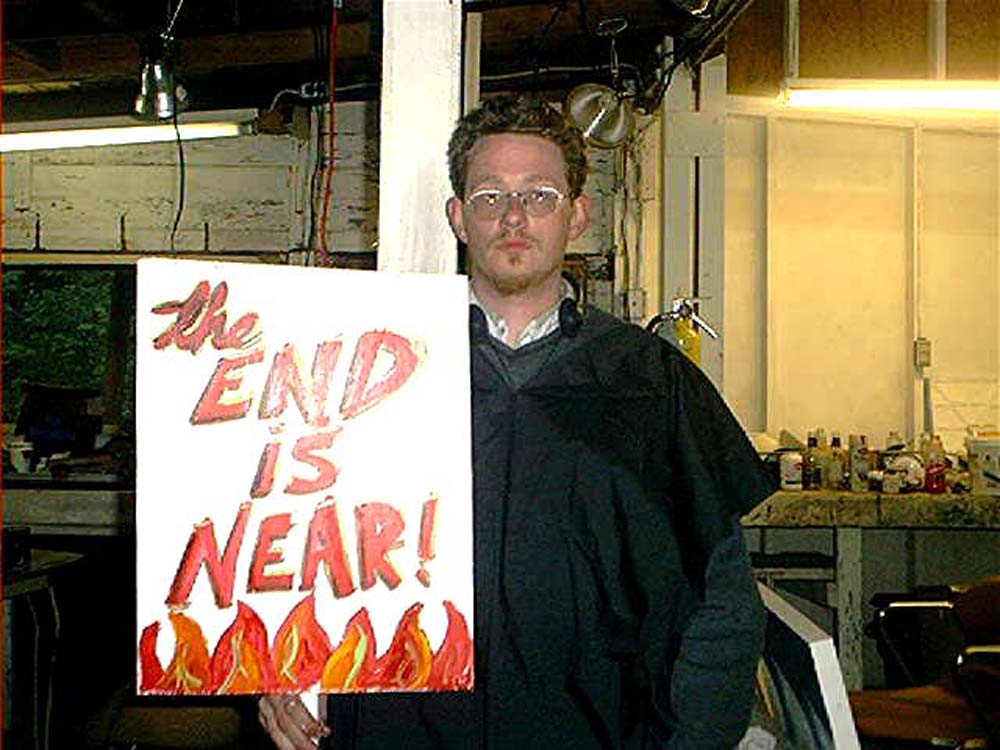
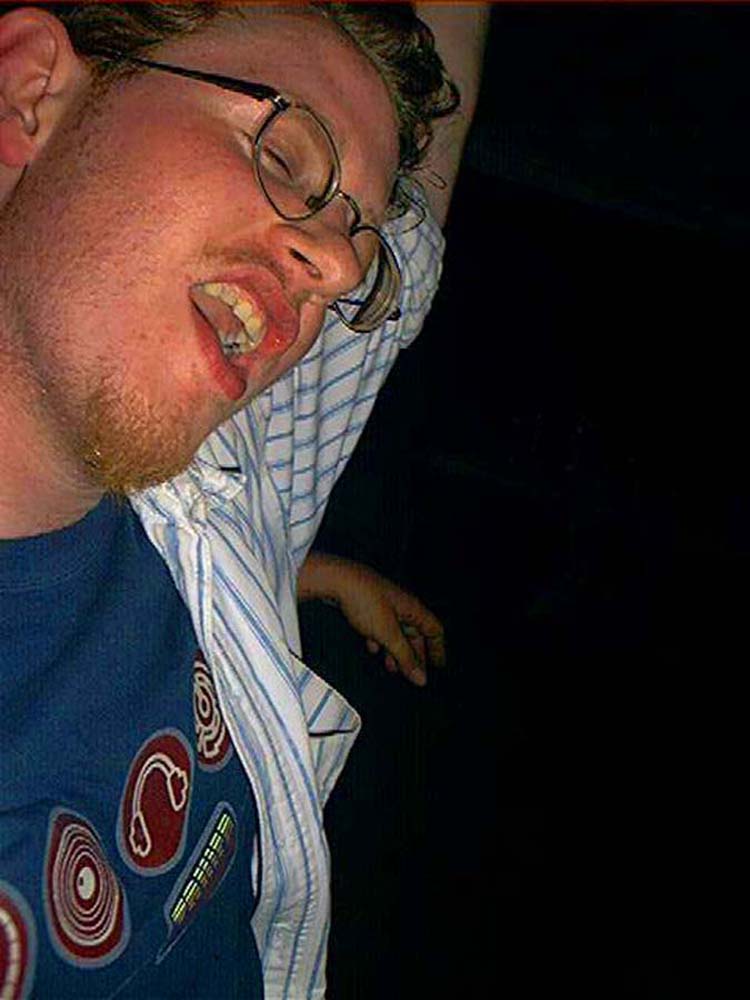
All photos: Self-portraits taken between May 2001 and August 2001, in roughly chronological order.

Drawing: Matt (Hardass). Ink and Sharpie on paper, 11 by 14 inches, 2001, by Reid Thompson and unknown Ox-Bow Fellow (A.G.).

PS: Don’t smoke, kids.

The Ox-Bow Studio

“Image-making in this place seemed axiomatic. You live to make. Or, at least, in living you make. Let us take the ninety-degree turn twice and go back to where we once were, shall we? It was fun, challenging, and worthy; the most worthy and real thing I did that summer. It is the most abiding thing I did, even now. Alas, all the rest is dust, chaff, and stubble – ‘which are burnt and which the wind drives away’ – though it all was so beautiful while strewn on the ash pile there. And we, like the old pagans, went down to color it and cover our nakedness with it.” – from A Mnemonic of Longing, an unpublished essay, 2002-2009.

Above: the studio I used during the Summer of 2001 while at Ox-Bow on a Fellowship Residency. Click for larger view.

Below: a sign one of my fellow Fellows left for me one day. I’ve saved it all these years. I have a feeling who left it on my chair that night, but was never sure. Click for larger view.