Craft Studio Gallery Show, Presenting Context

I’ve got an installation up at the Craft Studio Gallery of the University of Missouri in Columbia.

I proposed the show and brought in the additional artists and their works. See below for more shots of the installations and to read our group statement. Be sure to click on each artist’s name to see more of their excellent work.

The Reception will take place February 19 at 4pm. Hope you can make it. Check back here soon for some details from the installed contexts.

Work and Installation of Context by Nathan Sullivan.

Work and Installation of Context by Derek Frankhouser.

Work and Installation of Context by Sloane Snure Paullus.

Work and Installation of Context by Catherine Armbrust.

Work and Installation of Context by Marcus Miers.

Presenting Context Group Statement

Artworks are almost always presented to viewers far removed from the circumstances of their creation. The inspirations, research, sources, methods, and background information that form the basis for all artworks are usually unavailable to the audience. This amounts to a veil of mystery surrounding the finished work, masking and focusing it. Artworks appear to have simply sprung fully formed into the world, though we know this to be false. This exhibition proposes to change that – at least in some small way – by displaying singular artworks in tandem with the ephemera that lead to their creation. Alongside completed works, artists will show some background to the art: inspiring data, evocative objects, images historical and pop cultural, as well as the more traditional sketches showing trial and error. Taken together, these artifacts will serve to illuminate the experiences artists go through to process their ideas and actions into finalized pieces of art.

Exhibiting Artists

Visiting Assistant Professors Matthew Ballou and Nathan Sullivan
MU Graduate students Catherine Armbrust and Sloane Snure Paullus
MU Undergraduate students Derek Frankhouser and Marcus Miers

Beginning Painting, August 1997

In August of 1997 I began art school at Munson Williams Proctor Institute of Art. At the time the school was transitioning into the upstate extension campus of Pratt Institute. Bright, new facilities (the best I’ve ever had access to, anywhere, any time) were there for us to cut our aesthetic teeth on, and an energetic faculty with a sense of the coming transformation challenged a really great group of students during those transitional years. Recognized artists such as Sam Salisbury and Silas Dilworth, among others, were there in and around the same years I was.

It was during my first weeks there that I was exposed to two images that would define much of the next decade of my artistic life. There, spread out on a table in the large painting room were two books (among many others). Two images – one from each – caught my eye. The first was “Twilight” by Odd Nerdrum, the second was an iconic Ocean Park series piece by Richard Diebenkorn. I clearly remember the paradoxical exclamation that leapt into my mind as I gazed at the two works that seemed separated by a huge gulf: “I want to do THAT!” – meaning both.

I’ve spent the last twelve and a half years working to reconcile them. And though I’ve moved on to deeper and perhaps more legitimate inspirational sources and muses, I find that key moment during one of my first official art classes still hangs with me. I’m grateful for it.

Collograph Prints

I’m beginning a series of collographic prints based on the angles of the pentagonal sides of dodecahedrons. Here are images from the first few.

All are in a range from 6 to 12 inches in diameter. I’m conceiving of them as tondos or ovoids, but haven’t decided on the orientations or how I’ll use light with them, since it’s so important to how they’re seen.

None of these prints have pigment of any kind on them.

Click on each image for a larger view.

Pillars of the Earth

ballou-shoulderAbove: “Shoulder (Grindstone Cliff, Fall 2009)” Click the image for more info.

I love the Grindstone Nature Area here in Columbia, MO. There are a series of cliffs located there, and several of them are within 5 or 10 minutes walk for me. I often go there to draw or read or think.

I’ve gotten some nice drawings out of my time there. One I did a while back can be seen here.

Good stuff.

Dodecahedron Bronze, Part 5

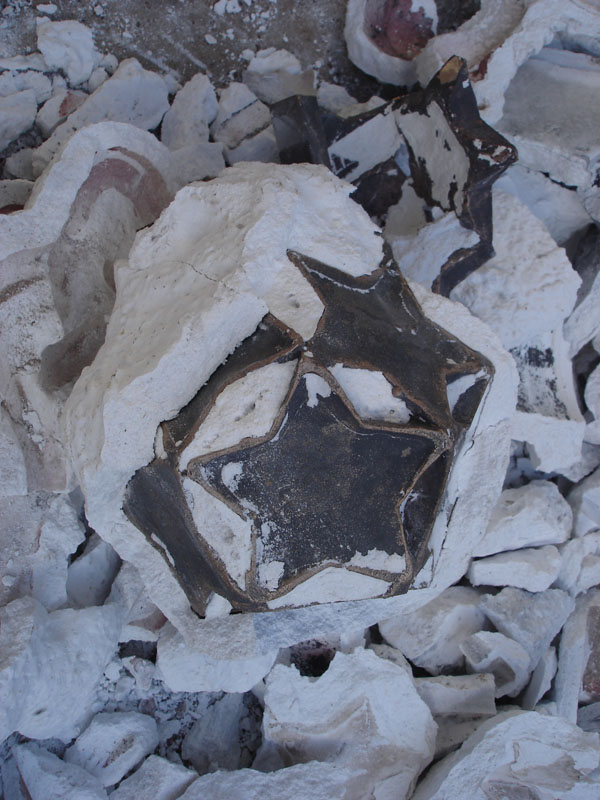
BallouPour02This past week I was able to participate in the actual pouring of the bronze for my sculpture. Above, the small furnace containing the crucible for the small amount of bronze needed for my piece.


BallouPour10


BallouPour20


BallouPour27


The images above show the pour in process – it really was unbelievably hot.


BallouPour32


Love that glow!


BallouPour33


This image shows the beginning of the breakout process…


BallouPour37


Starting to show through…


BallouPour38


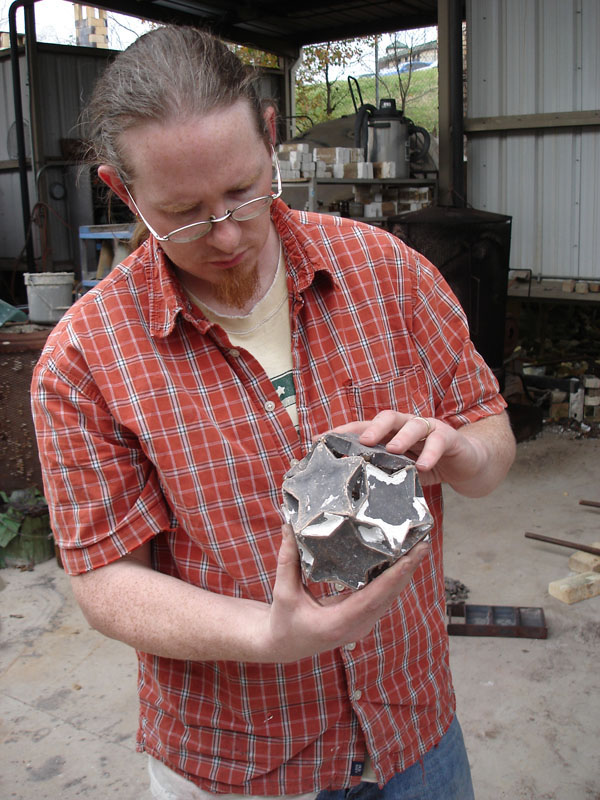
An inspection… The process is nearly complete. After all of the casting material is removed, we’ll sandblast the bronze, then polish to achieve a final look. We’ll also have to do some welding, in order to connect parts that were cast separately. My thanks go out again to Chris Morrey, who has helped out for the entire process, and to Jim Calvin, who stepped in as an experienced hand to actually conduct the pour.

Neil Gavett, Model Extraordinare

The Columbia Daily Tribune is running a feature on Neil Gavett, one of the primary models I’ve used in my work over the last couple of years. He’s a pretty cool guy, has an interesting back story, and a staggering plethora of tales to tell. Neil is also a professional art model; he’s posed for nearly 10,000 hours and has been working consistently for over a decade in the Mid-Missouri area. Below is the first painting I ever did of Neil (Fall 2007).

neil I’ve been honored to get to know the man. In working with him, I have tried to create images worthy of the symbiotic relationship we’ve developed, a relationship that could never happen without his deep intention and purposeful action as a man and a model.

Here’s to many more pictures, Neil!

UPDATE: Here’s a related item from the New York Times today: “In the Altogether.”

“Strive” – An Exhibition of Pastel Work

My show, Strive, opens on November 2, 2009, at Bellevue College Gallery in Bellevue, Washington.

paroxysm

Here are a few links to some of the work that will be in the show:

The Impossible Geometries of Contemplation

Heavy

Current Events

Revealer (Forced #1)

And here is my statement about the works, written for the show:

Strive – Pastel Works by Matthew Ballou

The group of works I present here – each in the tondo format and created in many layers of pastel – is a small contemplation on the gesture or shape of struggle, concern, and distress.

I have created dense surfaces and chromatic environments meant to play in the distance between implied narrative and votive stillness. Though I take cues from the ways bodies move through and react to stress or pain, these are not pictures of actual pain, nor are they meant to address the true physical reality of hurting. They are instead symbolic stylizations of the aches we feel, inspired by an iconography of bodily form and posture. They imagine the machinations we get up to when in states of deep anxiety, whether in our banal daily lives or amid the worrisome questions of intellectual engagement. They are about a kind of conceptual discomfiture distilled through the image of the body.

My desire for each work is two-fold. First, I aim for the artworks to stimulate reflection, creating some key resonance in viewers, perhaps via the memory of past physical or metaphysical tension. Secondly, I want the artwork to function as an argument for the image of the body as a meaningful metaphor beyond the constraints of individual persons or singular moments.

A summation: “Everything takes form, even infinity. We seek to determine being and, in so doing, transcend all situations, to give a situation of all situations. Man’s being is confronted with the world’s being. The being of man is an unsettled being which all expression unsettles.” – Gaston Bachelard, from The Poetics of Space