New essay on Odd Nerdrum’s students – and self-proclaimed followers – here (click the image)
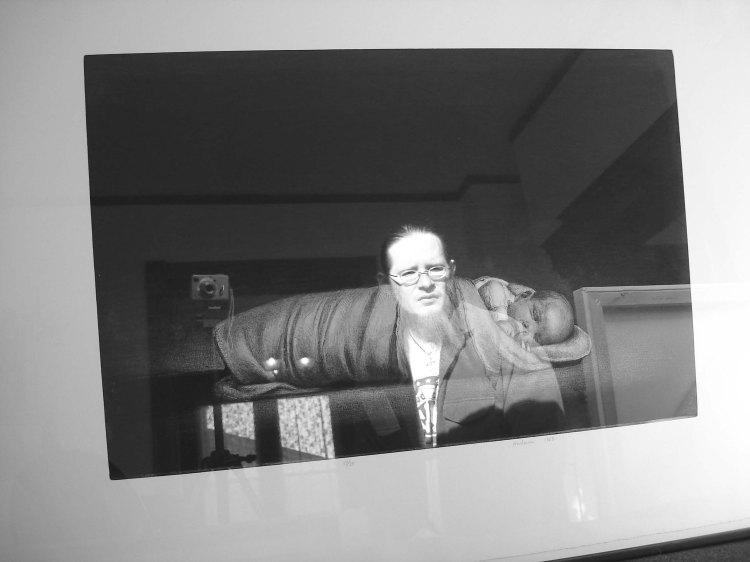
Image: my face reflected in a Nerdrum lithograph owned by a friend of mine.
New essay on Odd Nerdrum’s students – and self-proclaimed followers – here (click the image)
Image: my face reflected in a Nerdrum lithograph owned by a friend of mine.

My work, titled Galaxy (Shell, Fecundity, Emanation), will be seen at the 6th annual MAGNITUDE 7 exhibition at Manifest coming up at the end of this month. The piece is a mezzotint print that has been embossed with a unique collograph print.

And here’s my statement about the work for the show:
Over the last two years I have become increasingly enamored with the mezzotint printmaking process. I have used mezzotint as a way to find new and different access to some of the subject matter I have used for years in my paintings and drawings. Bricks, shells, geometric forms, and bodies have all become part of my mezzotint repertoire. Those geometric forms – specifically the Platonic solid called the dodecahedron – have begun to inform my mezzotints beyond simple representation; I have started using the angles of the dodecahedron and its constituent, the pentagon, as dimensional embossments upon the mezzotint prints.
In the work I present here at MAGNITUDE 7, titled Galaxy (Shell, Fecundity, Emanation), the beautiful gradients and milky consistency mezzotint is known for are used to display a shell, spinning in an amorphous space. Yet a fine tracery of lines and angular counterpoints shifts the surface level of the image itself, creating a bas-relief. The angles are formed using a collograph print over the final mezzotint. This collograph is a unique, one-time embossment; though the edition of mezzotints is all the same, the embossment seen in each print is one of a kind.
By embedding these angles (taken directly from the dodecahedron) onto the image of the spiral form shell, I reintegrate their inherent relationship, since both the spiraling of the shell and the angles of the quintessential Platonic solid display the natural mathematical beauty of Phi, the golden ratio. While the depiction of the shell can be a visual entry point for contemplation, the angles of the subtle embossment encode a physical reality into the artifice of the image. This duality is something I am hoping to develop more and more. I want the image and the icon, the depiction and the object, the picture of the idea and the idea itself, to become manifest in these prints as I continue them.
My latest essay is now up for reading on Neoteric Art. Please check it out.
A lot going on these days.
The show I’m in at MANIFEST in Cincinnati has just released the catalog (cover below, click it to order one – it’s volume 43, bottom of the page).
Also, I’m included in a show at McNeese State University. Click here for more info. If you’re near Lake Charles, LA, go check it out!
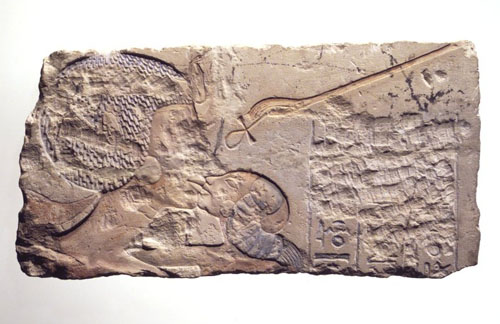
I’ve got an article in the Columbia Daily Tribune up as well (and keep on the lookout over at Neoteric Art for my upcoming essay on Art and Subjectivity!). Click here to check out the Tribune piece. Below is one of the pieces I talk about (click it to see more about the image at the Brooklyn Museum):
My latest essay, Subjectivity and Robert Henri, was published this week over on the Neoteric Art Blog. I’m really proud of the piece. It challenged me while writing it and I think it’s something I’ll go back to again and again.
I have to say that Annie Dillard’s Pilgrim at Tinker Creek and Gaston Bachelard’s The Poetics of Space were major influences in the essay. Here’s to good thoughts and words, ones that reproduce (even if only in some small way) after their own kind.
Andy Goldsworthy functions as an artist in a continuum of what I would call shamanistic principles: permeability, density, liminality, derivation, change, and transformation. That is, he manipulates and transforms the materials of the environment in some dynamic sympathy with them. This sympathetic approach is one that makes him keenly aware of his communication with and orientation toward the world. Because of this the work is in a very real sense suggested by the environment, the work’s parameters of possibility defined by the environment, and the artist’s intuitive making directed by the environment. There is very little “manhandling” going on here, very little ham-fisted, blundering action. His art is not an image of mankind dominating or playing flippantly with the world, but rather one of the sensitive investigator being moved forward by suggestions from within the investigated schema. His message is his articulation to the environment, not in some sort of neo-pagan hippy vagary, but in action, physical touch, biological aesthetics (i.e. basic 2D design and shape dynamics, which extends beyond the 2D into the 3D via his spatial and sensation-based investigations). The message isn’t linear like literacy or mathematics. It’s kinesthetic and alchemical. Zero irony, total being-ness. Awesome.
Get more info on Goldsworthy here and here.

The sketches I post here are ones I made during a visit I and my cousin Chris (a photographer) made to the Storm King Art Center in New York State to see Goldsworthy’s Storm King Wall. The trip was inspirational; I highly recommend making a stop at SKAC if you’re in the area.
 Update (December 17, 2009): There’s a great piece on the ART21 Blog about Storm King that discusses the history of the place, how they think about acquiring/installing new work, and other interesting tidbits. Check it out.
 Andrew Wyeth, Sea Boots, tempera on panel, 29 b y 19.5 inches, 1976.
I’ve got a new short essay up over on Neoteric Art. The piece is called “A Few Days With Wyeth” and is about the trip I made out to Philadelphia for the Wyeth retrospective there in 2006. Read the piece at Neoteric and let me know if I got too sentimental or overzealous.
I’ve got a post up over at Mid West Capacity on a recent painting show at the University of Richmond Museum…
and there’s been some coverage in the local paper of my new show at Perlow-Stevens Gallery. Cool.
In celebration of the show here’s a shot of one of the woodblocks used to make the Quintessence Series…

I’m a contributor to Neoteric Art, a brainchild of William Dolan and Norbert Marszalek. Good guys, both of ’em. Check out my latest short text about Richard Diebenkorn and my older piece on Cecily Brown and Linda Nochlin at the Des Moines Art Center.
Short Thoughts on Loving Diebenkorn’s Work
Visions of Violence and Pleasure: Cecily Brown and Linda Nochlin at the Des Moines Art Center
I’m looking forward to future writings appearing at Neoteric Art.
People are just as convinced that they are having a true experience of art when they see a work in reproduction as they are of believing that verisimilitude is the ultimate measure of value in a work of art.
Can’t we see this insanity for what it is?
It’s a circular logic meant to establish the mechanical and the processed over the physically experienced and subjective. Find me someone who thinks a good work of art is something that “looks just like!” something else and I’ll show you a person who is satisfied with mere reproduction, divorced sensation, advertisement, and disengagement.
Being with objects or people or places is NOTHING like mere pictures of objects or people or places. representational art has to go beyond mere depiction if it wants to be anything like reality since reality is nothing like mere depiction.


