One of my grads has developed a booklet containing a number of her collage works from last year. Please go over to Lulu and check it out by clicking the image below (it’s one of my favorites of the ones she made last summer). The booklet is pretty cheap to purchase (you can download a full-color, 25 page version for a couple bucks) and has some excellent images as well as a statement in English and Farsi. I think Zeinab is doing some great work here at the University of Missouri and I hope a few people will support and encourage her by picking up a copy of the booklet. Just click on the image below to go to the Lulu page where it’s for sale.
Drawing is…
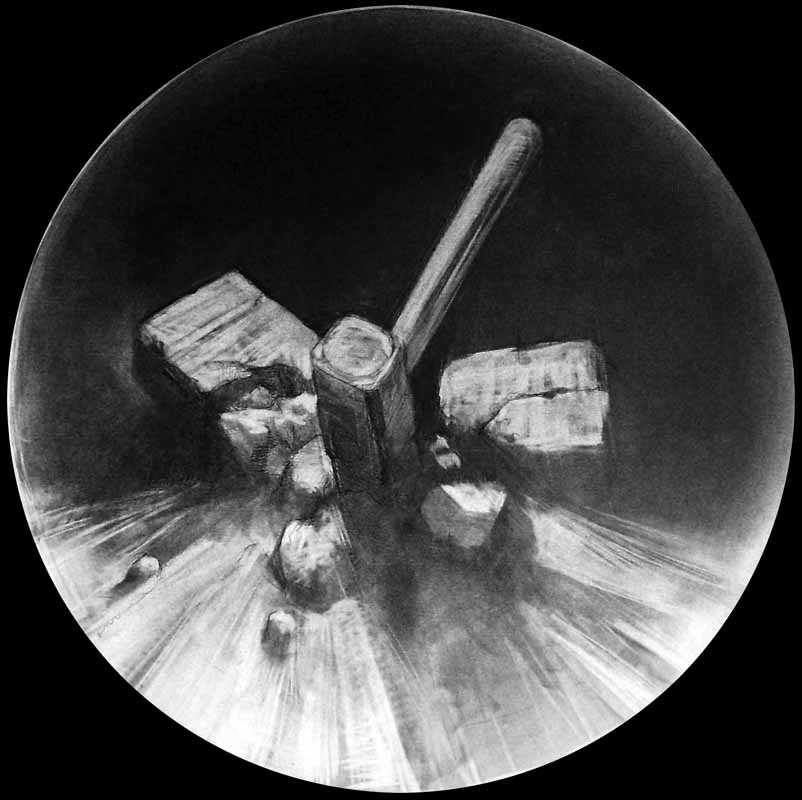
Drawing is the literal manifestation of corrections, adjustments, and negotiations made during its own construction. A drawing (regardless of the manner of the image it displays) is always a representational work depicting the activity by which it was made. As we build a work, we self-correct. As we self-correct, we leave a trace of real observation and negotiation, declaring our willingness to leave behind what has not worked in the service of the total work and in anticipation of something that will work better. The final drawing is not a snapshot, not a slice of time, but a track record of integrations attempted, iterations discovered, and disparate elements syncretized.
Untitled (Beautiful Collision #3), Graphite on paper, 20 inches in diameter, 2008.
Inspiration – Piranesi
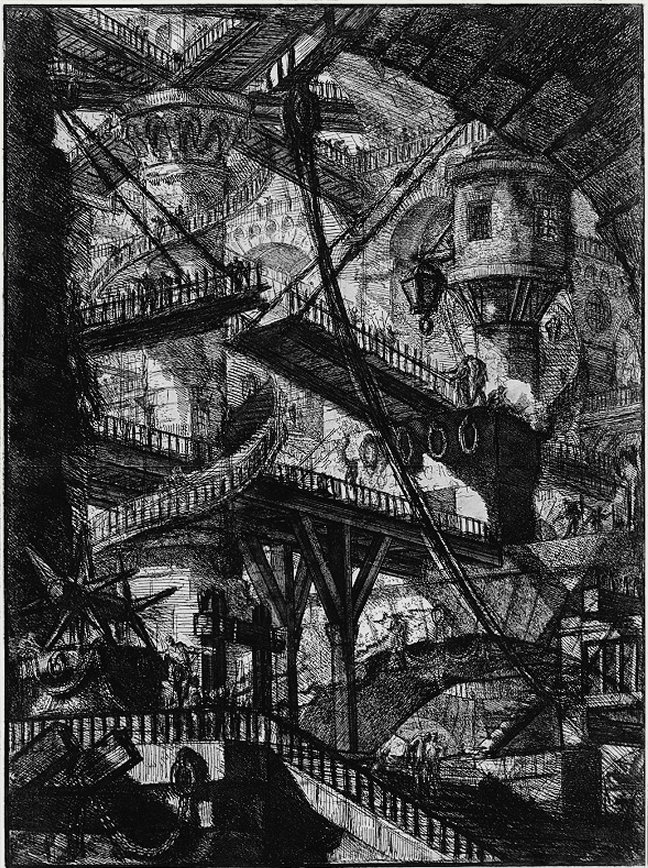
Giovanni Battista Piranesi created an amazing series of prints called Le Carceri (the Prisons). I recently found out that the Saint Louis Public Library has an edition of the prints, so I’ll be over there to see them soon.
The Prisons, Plate VII: The Drawbridge.
In these works the master deftly shows the ability for etchings – and really all of printmaking – to transcend the sense of a single, locked image that is a stereotype of the discipline. Using an inventive, intuitive action, Piranesi works the various states of the prison plates in dramatic fashion, transforming their contents, scale, and mood. The Dover publication of the first and second states of the plates is well worth the price.
I picked that book up in 2004 and it has inspired a great deal of my perspective on line work and current interest in printmaking as a malleable medium – as seen in the image above, titled The Weight (etching and mezzotint, 2008). Click on the image for a larger view.
If You Take My Color Drawing Class…
Unicorn Horn Scrapings
Inspiration: Ian Shelly
Ian Shelly was a graduate student at the University of Missouri in ceramics, working with the great Bede Clarke. He was among the first grads I taught and eventually developed good relationships with. His work, balanced in an evocative place between technical precision and playfulness, utilizes a modular methodology to arrive at installations that are unique and impressive. I sense dualities in his work: it’s emotional and flippant, gentle and muscled, intentional and intuitive. But it is in the continuum between those poles that deep meaning is conveyed. His project while at MU was impressive, and he’s continued that during his long-term residency at Hub-Bub in South Carolina. His work is now featured on the accessCeramics website.
The Most Beautiful Sounds
At 7 seconds and 22 seconds into this short clip you can hear my daughter Miranda make the cutest lip vibrations ever. Around 24 seconds in she starts laughing. It’s like the Music of the Spheres: angelic, transcendent, excellent.
Photo above by our friend, Janelle. My shoes, Miranda’s teeth: perfect.
Another Semester, Another Round of Glory
Yes, it’s Beginning Color Drawing time again… Once again it’s been a great start to the semester. I feel pretty astounded at the talent of my Beginning Color students; even though they’ve all taken Drawing 1, and some have had other studio courses as well, they’re all making big strides. It’s fantastic work. Take a look:
Andrew Vincent “Grid #1” Chalk Pastel, 24 by 18 inches, 2011.
Melissa Hoefer “Grid #2 Colored Pencil, 18 by 18 inches, 2011.
Emily Armstrong “Two Colored Pencil Object Group Studies” Colored Pencil, 24 by 18 inches, 2011.
Lauren Roberts “Grid #1” Chalk Pastel, 18 by 24 inches, 2011.
Mitchell Baggett “Colored Pencil Object Group Study” Colored Pencil, 12 by 18 inches, 2011.
I know I’ll be posting more work from this group…
Experiences, Not Products
There’s a great piece up on the Guardian UK website showing a film of famed painter Sean Scully talking about working, being a father, and other topics. Though I’m not a huge fan of his work, I love what he says here:
“You’re trying to, in a sense, imitate God because you’re trying to be creative. And I can never make anything better than Oisin (his son). That’s my greatest creation.”
and here:
“I’m not sure that I have a destination in mind. I’m on a journey. I don’t expect to arrive.”
and here:
“If you’re plotting art, and trying to make something to get something, you’re not in a state of creative innocence. You’re not making art. You’re doing something else.”
This last bit is fantastic. I find it quirky for an artist like Scully – who has exhibited such consistency and clearly defined formatting for decades – to make that statement. But it is really something I believe in. I tell my students constantly: I couldn’t care less about products – I want experiences. I think that’s part of what Scully is saying there.
I don’t want my students to merely execute skills or master techniques; I want them to live out the sense of being that’s wrapped up in obtaining those skills or using those techniques. Making artwork is physical philosophy… it’s a musing on what it means to be miraculously conscious, purposefully aware, intuitively engaged and intellectually stimulated by a range of actions and tremendously important conditions of the human body/mind.
Above: Sketchbook drawing from 2006… it keeps coming back to me. Some day it’ll resolve into an image.
I saw the Scully story via Two Coats of Paint. Check out that blog.