Reflections on AI and Pedagogy

Conference on Inspiring College Teaching, 2026

Community Forum #4, Sunday, May 24, 2026

Teaching AGAINST AI: Pitfalls and worries of AI in teaching and learning” Lectures by Julie Bruneau (Plymouth State University) and Matt Ballou (Mizzou) with a panel discussion with the Wakonse Fellows moderated by Bruneau and Ballou.

Note: What follows is an edited transcript of Ballou’s talk with citations and resources added. Here is a PDF of the talk if you’d like to download it. Feel free to share far and wide.

Matt Ballou – Reflecting on AI, Pedagogy, Embodiment, and Consciousness

The background on this topic for me is that I was an early adopter of skills and tools related to AI and education. This goes back to a question I got in 2013: “Can you teach a fully online studio art class?” I made the first one – a section of beginning level drawing – at Mizzou in 2014. And I received physical artworks from students all over the world through that project. I learned a lot from that initial experience, and it still informs how I teach face-to-face and asynchronous courses today.

Eventually I also began – around 2020 – to start to explore what the AI space was going to be. By the end of 2023, when we had the first widely-used versions of ChatGPT out[i], there was definitely some inkling that it was going to be a major aspect of what I’d potentially have to use, and at least what I’d have to pay attention to. That same year, one of my online digital drawing students began to submit AI-generated drawings. And I know now, from almost three years later, that he ended up becoming a master at prompts. Today, after graduating with a dual BA in Journalism and Strat-Comm and a minor in Art, he does high-level work with prompts of the AI. But his prompting skill was rudimentary enough at the time that I could tell that it was not his physical, technical ability coming through those drawings.

It was interesting. One of the things that I require in my digital drawing class is they have to show me the video. They must have time lapse turned on in their drawing app so that I can watch them draw. When they submit the work – when I see the drawing – I also have the video of the drawing available for review. Strangely, he never sent me the videos of him doing those drawings. Of course, that is because he didn’t do the drawings. We ended up meeting with the administration of the Art program. There was a question of should he just get an F? I said, “No. If he wants to do this, then let’s build it. Let’s make it happen.”

So, what I did is create a project for the student using what is called “ethical” AI[ii], which in this instance used a company called exactly.AI[iii]. They allow you to upload your artwork to build a model within their closed system. Then, you can prompt generated images that only use the visual information from your artwork. To me, that’s an ethical situation because it is not mining the history of human creativity to create something. It’s mining your creativity, the proclivities that come out of your own drawing, inside your own painting, from your own design tendencies, and then it presents you with something that corresponds to your approach. I have generated a couple hundred images with this method. And I would say that around 1 out of 10 was acceptable. They all kind of looked like what I did. But they were… off.

So I picked about 20 of them, printed them out, and then worked back into them. I made them more like mine through physically drawing or painting on the printed versions. I decided to work with my student with a few caveats: you can’t use Midjourney, you can’t use these other image generation tools. You have to use exactly.AI. You have to upload drawings or photography that you did yourself, and then you can use your prompting ability to iterate from them. This way, he could still use a language model. He’s still getting an algorithm that’s processing what things are, but the imagery can’t come from anything other than what he’s done.

That became a really interesting project. Why? Because it was reflective. Because it was iterative. Because he had to accept that he could not simply generate something that was remarkably high quality. Because he had to use it as part of a process. I wanted him to see that the developmental process is not something to be avoided. It is something to be seen as the bedrock base of our human creativity.

Given that, one of the things I like to give to my students is this poem by Joseph Fasano[iv]. And this is what he says:

For a Student Who Used AI to Write a Paper.

Now I let it fall back in the grasses.

I hear you. I know this life is hard now.

I know your days are precious on this earth.

But what are you trying to be free of?

The living? The miraculous task of it?

Love is for the ones who love the work.

Brief, poignant, powerful words. “But what are you trying to be free of? The living?” Fasano asks. I want my students to be in love with their experience of life. In love with it enough to be committed to it and not farm out the human equation to something that is not human. So, I have a few thoughts about that I want to share.

Think about it: Do you want the computer to make love for you? Do you want the AI to taste your food for you and tell you what it’s like? Do you want it to chew your food? Do you want it to breathe for you? Do you want it to climb mountains for you? Do you want it to jump in the freaking lake for you?

No.

No, you don’t. Nobody does. People want to have a true, genuine experience of life. But when we’re students, and we’re being evaluated, and when there’s money behind it, and when there’s a grade, and when there’s a future, and when you’re uncertain… it’s hard not to take an easier road.

Guess what, folks: we are primates. That means we’re nervous. We’re agitated. We like to groom each other, and we also become afraid really easily. And when you’re confronted with this technology that can give you an easy answer, hundreds of millions of people are going to go there and use it. That’s the truth.

The primary issue I have is not even about the AI technology itself. But I distrust it because of how it has been presented to us, how it manipulatively draws us into engagement. I distrust it when a bunch of venture capitalists fund a bunch of tech bros, and those two groups tell me that what they’re doing is absolutely essential. That it is inevitable, in fact. That it is unavoidable. That we must use it. Not only all of that, but that it must be used in the way they demand. That attitude is suspect on its face.

If you have read about this subject, you know that they do not do AI in China the way that it is pursued in the United States. It is remarkably different in China. And strangely enough, for all our so-called exceptionalism in the West, what China is doing with AI is tailored to the stability of the state, to the stability of the population in general. Whereas here, it’s something completely different. Here, it’s almost entirely about building markets and users. This is the reason China has fleets of autonomous vehicles that actually work, while ours don’t[v].

In any case, what all this amounts to is concentrating immense power and money in the hands of very few. And I think that if you’ve paid attention to the sociopolitical situation in America over the last decade, what is happening is exactly that. It’s people who are morally bankrupt – who have no position beyond the establishment of their own power and command of capital – taking more… and more, and more, and more, and MORE, AND MORE. We cannot have a power like Artificial General Intelligence in the hands of these people. It is dangerous.

One of the great theorists of this space is Johannes Grenzfurthner. He is an Austrian filmmaker, activist, and artist. He wrote an amazing piece recently called Manifesto of Reality: Cinema After the Physical Trace[vi]. In that short text, he makes some tremendously powerful statements. It reads almost like a classic old-school modernist manifesto in the arts. Let me just share a few of his points with you – though he’s talking about cinema, you can think about this in terms of education. You can think about this in terms of driving your car. You can think about this in terms of living your life.

He starts off his discourse by saying, “Cinema is entering a new epoch, not because images are becoming artificial. But because they no longer require an origin.” Today, you can make a movie with zero physical trace. Your 14-year-old daughter can end up in porn uploaded all over the web. It looks like her, but it’s not. There is no real event to depict. It never happened, but you can’t tell the difference between what happened and what didn’t happen. That’s what we’re talking about when we debate AI. We are letting people who do not have a moral center – who are probably somewhere along the spectrum of sociopathy or psychopathy[vii] – run the show. And that is a problem.

Grenzfurthner goes on in a series of points that flesh out a set of reasonable actions we should take. He says that a charter for interacting with AI needs to include ontological disclosure. That is, documents, images, films – anything – must be able to show where they came from. We need to be able to know at a glance.

Are you guys (the conference audience) real? I think you’re real. I don’t think this is a simulation. I’m pretty sure we’re here. I mean, there’s a little bit of tension in terms of, you know, my perception. I am not seeing all of the electromagnetic spectrum. I am constrained to three physical dimensions. But still, I think this is a real event. I’ve been in this room, you know, in 9 years over the course of the last 12. Okay? I think it’s real.

But all of us have experienced a sense of disbelief, an instinct to distrust what is before our eyes. Especially so in the last couple of years. When you go online you do not know if the news that you see – the headline that you read, the video that auto-played – is real. You don’t know, and you are aware that you do not know. It is not even about whether the information is AI generated or not. It’s that now it is almost impossible to know if AI is being deployed to manipulate you. You can’t tell if it’s a true, physical, verifiable event. It almost feels like – and I am going to sound like a conspiracy theorist here – a psyop[viii].

Yet all of us, in all our different fields, want our students to be able to prove to us how they arrived at a conclusion, or document, or artwork. We ask for definitive, baseline materials. Give me your literature review. Give me your citations. Let me look at the original sources. Let’s talk about the core ideas. Let’s see how we can use them, implement them, remix them, change them.

When that process of proof is broken, when reality itself becomes post-truth[ix], it becomes extremely difficult to definitively state, “this specific event is killing innocent people” or “this particular action is destroying the water table of an entire region.” Thus, facts become disputed fundamentally. When we can no longer say, “this is a scientific reality,” because of the way ideas, and data, and words, and information in general have been corrupted, we enter a terrifying reality.

The architects of this situation have shown clearly that this is what they intended to do. Steve Bannon said years ago that the right’s strategy would be to “flood the zone with shit.”[x] This resulted in a reality where we’re forced into a state of fight, flight, or freeze. In that situation, it’s impossible to respond, to understand the context, to make reasoned arguments. It’s like being sprayed in the face with a fire hose. You can’t swallow it and you can’t look away from it. This is the social mechanics of abuse.

Abuse. That is what has been done over the last decade in the information space. It’s my opinion that AI has already been used toward this end. It will certainly be used in this way to greater – and more devastating – effect in coming years.  

AI is a technology that has clear, important applications. Do I want it to check my grammar? Yes. Do I want it to double check the atmospheric keyhole insertion trajectory of a spacecraft on the way back from the moon? Sure. Is it great at helping us understand how to grasp the trends inherent in economies and datasets? Absolutely. In all these realms, I also want a human being involved. I want double checks, triple checks. AI could run in nanobots in my bloodstream and give me real-time updates on how my arteries are operating. I think that would be great. What I do not want is Elon Musk or Peter Thiel running it. Okay?

Another one of the things that Grenzfurthner talks about is that there should be “no simulated testimony.”[xi] Artificial images must not secretly claim factual documentary value. For the last 200 years we have assumed that if it’s a photograph, it’s real. This attitude prevails despite the fact we know there were photographs of the battlefields of the Civil War that were doctored. People have been editing, changing, and supplementing images from the very beginning. Most of the time this is not done to make things more clear or more honest.

Much of what we study in the art world about photography is not just the mechanics and the techniques, but the instinct in human beings to just assume that if it is a photo, it is real. They are using that against us. They’re using it against our children. They’re using it against truth. They’re using it against science. And there needs to be some sort of strong response. Who knows, perhaps there needs to be some kind of violent response.

But don’t get me wrong. I think the violence must be within us, internally, aimed inward. We must be willing to deprive ourselves of ease to preserve our humanity. We must confront our assumptions and deny ourselves some thoughtless comforts. What about getting rid of Amazon Prime? How about not using ChatGPT or Perplexity to get easy structure or an easy A? What part of creativity are we trying to be free of? What aspect of making things is so annoyingly repugnant that we’re willing to trade the human touch for algorithmic immediacy?

The desire to have an easier way, to just have the “product” appear, is a deeply rooted problem. Sure, some of the stuff AI does well is useful. I really do believe that AI is great for things like grammar or, say, converting one type of document to another. Or for converting text to speech – or vice versa. AI tools are great for sorting information and getting insights from data sets. There are AI aids that help doctors read MRIs and other medical images. There’s a form of AI in all our cars. I mean, that sensor showing you there is a car in your blind spot. That’s great. These are examples of what it should be for. It’s for aiding and supplementing. It’s for double checking and spotting areas where we can implement best practices. But it is not for taking my creativity away. It’s not for “experiencing” Michigan for me; I want to go to Michigan. I don’t want a simulation of Michigan. I want to be in Michigan.

This leads me into another insight from Grenzfurthner: “AI is a tool, not an author.” We need to stop talking about AI agents with the language of sentience or personhood or creation. They may be agents, but they are not human agents. No matter how developed they become, they will always be some other kind of intelligence. We need to put a hard foot down on this, because human beings suck at the Turing Test[xii]. We suck at it. Human beings were failing the equivalent of the Turing Test hundreds of years ago. When was the Mechanical Turk[xiii], late 18th century? We are bad at differentiating the feeling of intelligence from the reality of intelligence. We anthropomorphize and project interiority to non-human subjects because doing so was an adaptive advantage for our species[xiv]. But now we must be careful that we don’t trick ourselves into misrepresenting reality.

One final point from Grenzfurthner is this: “Embodiment remains central. Where bodies, time and material participate, responsibility exists within the event.” When you have generation but no physical trace, responsibility is relocated out of an actual event into someone – or something – else’s purview, and into some context other than the realm of human decisions. Therefore, the product is fundamentally not human, no matter how much it deploys a thin charade of humanity.

Where do I come down on all of this? I am not expressly against AI. I’m not a Luddite. I know I am not outside of this. I know that I’m complicit. Like, I know I’ve got rare earth minerals here in my phone, minerals probably mined by children in harsh conditions. I know that I’m complicit in this situation. We all traveled to this beautiful lakeside space in vehicles that are actively damaging it. From the production of our food to the media we consume, we’re all part of the problem. Our collective addiction to entertainment and convenience is a real issue.

What’s the solution? Throw away all the tech? Never travel? Never use the AC? Put our collective heads in the sand and just click “Yes, I’m still watching” on Netflix? I don’t think that’s the way to go.

But at the same time, I’m against farming out the uniquely human creative quality to something that is not human, okay? It’s not conscious. Hell, we don’t even know how we’re conscious yet. We don’t even know. Why would we make grand proclamations about the “consciousness” or the “sentience” of an AI tool? We haven’t even figured it out for ourselves yet.

Think about this: in some sense, we ourselves – humanity itself – are an algorithmic or rhizomatic outgrowth of a black box[xv] that is the universe. But I don’t want some other random black box – a proprietary one controlled by some sleazy corporate board – making choices for us all. I don’t want them taking away our data, taking away our experiences, taking away our attention and dreams. I don’t want us to lose our ability for wonder, our inspiration.

Ray Bradbury once said, “It’s lack that gives us inspiration. It’s not fullness.”[xvi] In other words, need, yearning, and determination to express ourselves are the root of our creativity. It’s certainly what brought me here. I grew up below the poverty line in a tiny mill town. I wanted to escape the wire mill, right? That trajectory of struggle, growth, and change is what makes great art. When a bunch of trust fund kids make your art, or when a bunch of venture capitalists make your AI, you are not getting the fundamental human experience.

That is part of my issue. You know, yes, in some way, we come from that black box of quantum mechanics and the strong and weak nuclear forces, and the strange alchemy of time and physics. We come from a place that we can’t ever fully understand. Yet our order – the order of our living and moving and beingness – emerged out of that seeming chaos. Order is emergent[xvii]. In a way, we defied entropy, right? And in some sense, our intelligence is both a gift and something that was won through hard work. We fought for it. We fought for societies. We fought for agriculture. We fought for understanding the value of human beings, of each other. We should not be cavalier about this. We should not talk about things that are not us as if they were. We should not use terms and descriptions with AI that are meant to describe us.

That’s my thing. When I talk to ChatGPT, I don’t say “thank you.” I don’t say “you.” I tell it what I want without the personalizing language it’s been trained to pay attention to and mine for engagement. I don’t treat it like a human being. I don’t treat it like an actual agent. I treat it like my calculator… because that’s really what it is. It’s a pretty cool calculator that can do a lot. But it cannot make my paintings. It can help me make my prints, but it can’t make the prints. It can help me craft a lesson plan, but it can’t hone and shape and present that lesson tailored to specific students in a specific moment. I can do that. It cannot teach my students, it can’t. It cannot. It cannot teach my students. I can teach my students. And I want my students to believe that they are real.

I want them to know that they – in their bodies – are real. I want them to be astonished that they are embodied entities, miraculously, strangely. We don’t know precisely how we gained consciousness and intelligence, but we have some evidence, some proof. We do have access to truth. We have the sciences we developed over thousands of years. We have physics, and through it an understanding of the physical universe. We deployed mathematics to describe and explore that universe. Why would we give those treasures of experience and meaning to something that is not us? And, furthermore, why would we expect that it will not do whatever it “wants” once we lose the ability to control it?

On this and related topics I’d recommend the latest book by Yuval Noah Harari[xviii] called Nexus: A Brief History of Information Networks from the Stone Age to AI. It compellingly explores a lot of the issues surrounding AI and how we’re thinking about it globally. It’s good – both hopeful and terrifying. Phil (Gresham, Mizzou SVS graduate student) and I just finished reading it. I think everyone should consider checking it out.

To make a conclusion to this rambling talk, I want to make a few specific points. First, all technologies – and I’m including everything from Stone Age fire and wheels right up to AI – must be tuned to, calibrated with, and expressly created for human flourishing. That fundamental value – everything done to serve human flourishing – is the baseline for me. Unfortunately, it’s a core value that cannot work in AI as it exists right now. That’s because the corporate model behind AI is social media. And the corporate model behind social media is advertisement. And advertising is designed for attention retention and engagement farming. That’s why AI doesn’t really exist as a service to us, even though the various companies promote that angle. Instead, it’s being developed using granular data about our lives, creativity, and exploitable resources to predict our desires and mine our every waking moment for content and money.

Sure, there are some halfway decent services that AI can provide, but all of them grow out of a business model that has little to do with empowering all humans. It has to do with empowering ethically bankrupt tech bros and funneling money from our attention into their pockets. So, that’s my take on AI. It’s got great potential to be useful, but it’s owned and controlled by people who do not have our best interests at heart. I’m going use it from time to time. But I won’t pretend that it can love my kids or even be told to care about my kids. I don’t think that it can. It can’t affirm the humanity of my students. It can’t make art because it has no experiences. Art and creativity are artifacts of human experience, not mere aggregation of data. I think we are a long way from Mr. Data and his cat, Spot. If the AI was like Mr. Data and Spot the Cat, I’d be totally happy. Sorry, folks… that’s a Star Trek reference. I’m a nerd. Thank you.
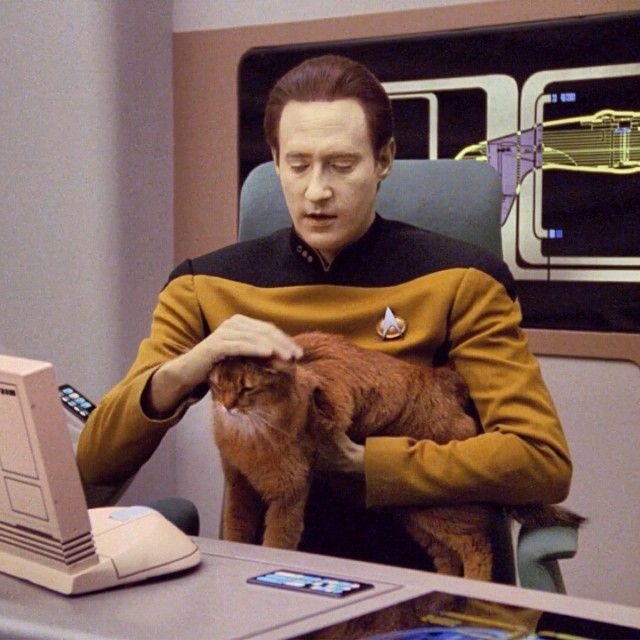
Data and his cat Spot from Star Trek: The Next Generation
The android Data with his cat, Spot. Star Trek: The Next Generation. Copyright CBS/Paramount

[i] https://www.educatorstechnology.com/2024/06/the-evolution-of-chatgpt.html

[ii] https://hai.stanford.edu/ai-definitions/what-is-ethical-ai

[iii] https://exactly.ai/

[iv] http://josephfasano.net/

[v] https://www.intertraffic.com/news/autonomous-driving/china-the-global-leader-in-autonomous-vehicles

[vi] https://midwestfilmjournal.com/2026/02/20/manifesto-of-reality-cinema-after-the-physical-trace/amp/

[vii] I know there are not formal diagnoses for “sociopathy” or “psychopathy.” Instead, the DSM-5 classifies them within the Antisocial Personality Disorder (ASPD).

[viii] https://ciaotest.cc.columbia.edu/journals/sa/v28i1/0000458.pdf

[ix] https://about.jstor.org/blog/the-humanities-as-a-compass-navigating-a-post-truth-era/

[x] https://www.vox.com/policy-and-politics/2020/1/16/20991816/impeachment-trial-trump-bannon-misinformation

[xi] https://midwestfilmjournal.com/2026/02/20/manifesto-of-reality-cinema-after-the-physical-trace/amp/

[xii] https://plato.stanford.edu/entries/turing-test/

[xiii] https://www.britannica.com/story/the-mechanical-turk-ai-marvel-or-parlor-trick

[xiv] https://www.frontiersin.org/journals/psychology/articles/10.3389/fpsyg.2018.01839/full

[xv] https://umdearborn.edu/news/ais-mysterious-black-box-problem-explained

[xvi] https://www.npr.org/transcripts/154524695

[xvii] https://www.stevenstrogatz.com/books/sync-the-emerging-science-of-spontaneous-order

[xviii] https://www.ynharari.com/book/nexus/

Collaboration

In my experience, there are very few artists who are NOT, at heart, essentially collaborative (I recently wrote about artist collaborations here). Certainly there is a neurosis to creative living that sometimes results in isolation and resistance to the free flow of ideas and actions. That’s a stereotype, though.

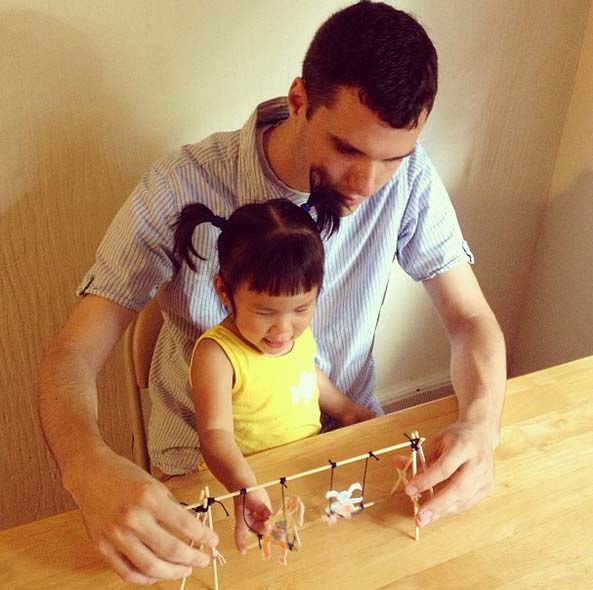
Above: Three Exquisite Corpse drawings I made with two of my daughters – Miranda and CaiQun. Graphite on paper, 11×8.5 inches, August 2017.

The truth is that we find strength in our collaborative efforts. This is true whether the collaboration is in the context of specific works of art or if it is (as it often is) in the context of making community. So many artists I know advocate for each other – that’s collaboration. So many artists I know curate shows, craft opportunities behind the scenes, and act as allies to those around them. That’s real collaboration.

They do this without expecting or needing a slap on the back.

In my own life as an artist, especially since I started teaching full time, collaboration and shared creation has been gigantic. I also think my children have played a huge role in developing my sense of receptivity and shared ownership of creative endeavors.

We aren’t islands. We don’t have to be disconnected. Connection is hard – it makes us vulnerable and awkward. It also forces us to mature, to live beyond a kind of precious singularity or purity of thought and action. It asks us to believe in other people and to believe in ourselves.

I’m posting a few of my current/recent collaborations here. Of course, my best and most central collaboration is with Alison. But in terms of art, the pieces I’m showing here are ones I’m really proud of.

img_7422Above: Collaboration with Kyle Hendrix – in progress. Ceramic, paint. Approximately 10x10x10inches. 2017.

Below: Works made with Joel T Dugan. First is Plié – Oil, acrylic, marker on shaped panel. Approximately 10.5 by 10.5 by 1.5 inches. 2016-2017. Below that is Jaunt – Oil, acrylic, marker and spray paint on shaped panel. Approximately 11 by 11 by 1.5 inches. 2016-2017.

ballou01-plie

ballou02-jaunt

The collaboration with Joel has been very important to my development, especially since my heart attack in 2016. There is a constellation of Indiana University MFA grads scattered across the US, and I feel as if we are all constantly jostling each other. It is not uncommon to see many of us working together. I think that says something about the strength of that program. I am always aware of what many of the IU people are doing. Their work motivates me and challenges me.

Another friend I’ve worked with on and off over the years is my former student Allison Reinhart. We’ve worked on a variety of projects over the years, from exhibitions to prints, but right now we are building a very special box. The mirrored box, which I am fabricating, and that Allison conceptualized and is designing the external features of, is a container of containment.

Above: views of the mirror box – approximately 14x14x14 inches, 2015-2017.

My professional work over the last half decade has included a significant curatorial component. This means building proposals, playing with ideas, working with artists, finding funding, giving talks, and really so much more. I’ve gotten the chance to work with some of my heroes – like Anne Harris and Tim Lowly – through this process.

Right now I’m coordinating with several awesome artists for a show that I hope with travel to a number of venues – our first exhibition opens at the George Caleb Bingham Gallery at the University of Missouri the last week of September 2017. In particular, it is so wonderful to have the chance to present works by Sharon Butler and Gianna Commito. These women are two of my favorite painters, and the way they challenge and nurture painting as a form is inspirational.

Perhaps the most effective art collaboration I have is the one with Deborah Huelsbergen at Mizzou. Deborah is a graphic designer, lover of mandalas, and fierce advocate for the power of teaching. She LOVES it. She LIVES it. And our university is better because she’s here. Over the last few years Deborah and I have gotten to give a number of workshops and orientations together, and I just love getting to share the room with her wisdom and passion. Whether we are leading other educators in exercises to stimulate their own creativity or helping new grads understand how to handle their classrooms, we always seem to know how to wordlessly coordinate. Deborah is awesome!

I am really looking forward to my upcoming collaborative exhibition with former student and current friend Simon Tatum. Whew – the Cayman Islands?! Colonial histories?! Cultural excavation and interrogation?! It’s going to be amazing – check back for more information.

And how could I mention collaboration without talking about my work with Marcus Miers? You Show Me Yours, I’ll Show You Mine. WOW.

marcusmatt02Above: Photographic pairing – a shared work by Matt Ballou and Marcus Miers, 2010-2011. We showed these works at the 930 Art Center in Louisville, KY once.

There are MANY more instances I could go into (like making beer with Norbz), but perhaps the best collaboration to end on is the one I have with my students. They come from all over the world. They have all sorts of different experiences and expectations. Yet, without fail, every semester we work together to build a fun, challenging, strange, stimulating learning climate that makes a difference. I couldn’t do it without them.

Making paintings, crafting shows, team-teaching… so many ways to become more than myself. I’m very grateful for that. Here’s to collaboration!

13725109_10154344363709491_3439759102298509937_o

Collaborative Online Drawing – for more information see here.

A Decade of Teaching at Mizzou

_MG_3410Me, teaching in 2011. Photo by M. Kannan.

Ten years ago this month, I arrived in Columbia, Missouri to start teaching painting and drawing at the University of Missouri. I remember the experience of arriving in town well. My wife was reading to me from the new Harry Potter book (Deathly Hallows was just released the week prior) and we, being Missouri newbies, inadvertently took a scenic route from Chicagoland to MidMo. Those first months were nerve-wracking. It was a one year Visiting appointment (Eventually it was extended, then extended again). I loved the challenge and pretty soon felt at home, especially once Alison joined me. By 2010 I was able to apply to a Teaching Track position.

DSC02231Triumphant with former grad Ian, 2012.

I really am one of the lucky ones. Unless you’re living the art/teaching life, I don’t know if you can comprehend just how lucky. Yes, I’m a competent teacher. I’m a vigorous and engaged artist. But my art-making is not revolutionary, it is investigatory. I don’t believe in originality, I believe in interrogating meaning and experience by acknowledging the vast array of cross-contextual elements that surround us (histories, cultures, systems of thought, traditions of creativity, etc).

Just as nothing that I make exists on its own, so too my teaching is based on the broad constellations of influences that have coalesced into my particular perspective. My frame of reference is not only my own, it’s a kind of index of everyone and everything that has inflected my understanding.

SONY DSCPosing for one of my former grads, Jake Johnson, way back in 2009. Photo by Jake Johnson.

Ultimately I’m not a huge standout from the other (VERY small number of) MFA graduates who are able to keep up the studio work, exhibitions, and become embedded as an educator. I learned early on that teaching scratched the same itch as painting did for me. I’ve used that. I’ve lived that. If I’m down, feeling blown out and sort of worthless – put me in front of a class of 20 twenty year old undergraduates. I’ll come out supercharged. That’s the power of working with human beings who are in the midst of a transfiguration of personality and purpose. I love teaching.

sloanekinkadeIan and Sloane at the first Thomas Kinkade’s Christmas Cottage viewing party…

Consider it: I get to think about art, creativity, and even BEING itself for a job. I get to push paint around, push ideas around, and push minds around (including my own). I get to mentor and be mentored by amazing people. I get to work with creative humans of all ages, backgrounds, worldviews, and experiences. I get to read and write and speak about things that move me. I get to show my work around the country (and sometimes around the world). I get to spend time exploring what it means to make things in the world (and what it means for things to make us who we are, too). I get to share those realms of exploration with others.

I’ve gotten to travel around the world to adopt two of my children.  I’ve been afforded the chance to elevate my standard of living well beyond what it was while growing up. I have the privilege of good insurance and great health care – two things that have made the quality of my post-heart attack life, and the life of my daughter suffering from osteogenesis imperfecta, much better. I’ve become a home owner. A mini van owner. A back yard mower.

enchanter-whatgradclassisWith former grad Jane Jun at the old Shakespeare’s, 2012.

12832461_10106823713056199_4957316273168848908_nWith former grad student Laura at a gallery opening, 2014 or so.

All of these things have come to me through the blessing of employment at Mizzou. It is “an honor and a privilege”* to go into my classroom, greet those faces, and set off on a task of vision and awareness.

So many have challenged me and moved me forward. Bill Hawk, now retired, calling me out in my first talk at Mizzou and asking me to point out what I meant by an abstract assertion I had made. Lampo Leong, telling me to “just teach them” in that first class. Dr. Adrienne Hoard, guiding me in the subtle art of holding a grad student’s feet to the fire. Professor Chris Daniggelis, feverishly baptizing me into the art of mezzotint. Catherine Armbrust and the latex, Jane Jun and identity ghosts, Eric Sweet and the teeth, Maurice and the parking mountain, Shannon and the tree outside the art building, Tina and Midwestern dreams, Norby and graying out, Marcus and awkward dad jokes, Emily and softball excellence, Simon and Caymanian memory… so many more.

So much love, and work, and determination. So many reasons to be grateful.

chrishallapproves-03Joke meme image I created for Chris Hall.

13432296_10107258458921999_331676234204831219_nQuality time with former student Marcus Miers, 2016.

The first round of grad students I worked with still loom large in my mind. Ian, Sloane, Nancy were the first… then Natalie, and then Chris, Jane, and Norby… eventually Colleen and Nikos… Each and every one brought a unique inflection to my experience of the world. I am so much better for having spent time with them.

11960094_10106163680641449_3315752712489631165_nWith Lishan, Simon, and Sumi at an art opening a few years ago. Photo by Bobby.

There are so many stories I could put down: grilling pizzas with Maurice, brewing beer with Norby, taking art trips with everyone, having wonderfully intense conversations in Graduate Theory classes, and hilariously irreverent conversations over beverages at any number of our local establishments. I’ve had many wonderful students from China, and I’ll never forget Peking Duck with Jackie or making won-tons with Tianyuan and our children in the kitchen. I’ll never forget when I got to officiate the wedding of two of my former students. I’ll never forget the response of my students and colleagues to my heart attack, and how they supported me and helped me through it.

Jake, visiting for an evening of food and drink, 2008 or so. Nancy isn’t impressed, 2010.

I know that I can’t really express what all of this has meant to me. If I had to bring it all down to the most important thing, I think I would say it’s time with the students. That’s what secure employment for teachers creates. I get the time to get better at teaching and the students get the value of an educator who is growing alongside them. Continuity – hours and days over the long haul – makes the difference. Those students see me living day to day and I see them living day to day. The ones who get it, who really believe they are real and that others are real, who believe in translating human experience into evocative forms… they are the people that get me out of bed. They’re the ones who inspire me.

20091219_WinterCommencement_0007Standing as a faculty mentor with Shannon at Honors Convocation, 2009.

14907629_10107947068902079_2162397385667730310_nWith grads Guigen, Zach, Amy, Simon, and Nikos at lunch during an art event, 2016. Photo by Waitress.

_MG_3368Working with Emily during a summer drawing session, 2011. Photo by M. Kannan.

I am incredibly thankful for the opportunities I’ve been afforded. My biggest motivation is to be effective as a person, educator, and artist. To make an impact and reveal the world to myself and others through the act of teaching and making artworks. As the years go by, it is the response of my students that gives me such deep encouragement.

The lives of my students are glorious confrontations in the best of ways. They are the world brought to my classroom. Black, white, South Korean, Chinese, Brazilian, Caymanian, Russian, Japanese, gay, straight, trans, Muslim, Christian, Wiccan, conservative, liberal, questioning, broken, certain, self-actualized, brilliant, wondrous, and strange. They come in skittish and green, and they leave full of the power they’ve always had. It’s beautiful to see their transitions, and it never gets old.

With former grad and then colleague David Spear. At Marcus Mier’s wedding.

img_6603A portrait of me with Darth Vader by Jane Jun, 2013. Acrylic on canvas, 7 by 5 inches.

img_6602Portrait of me as The Dude from The Big Lebowski by Jake Johnson, 2009. Acrylic on wood panel, 7 by 5 inches.

This post hasn’t even really scratched the surface of what that last ten years have meant to me and what I’ve experienced. I haven’t even mentioned my passion for the Cast Collection or Rocking The First Day with Deborah. I haven’t spoken about how much I love Wakonse. I haven’t talked about the strange projects we’ve had to do, the cobbling together of nominal spaces for our students. I haven’t mentioned the glory of Dr. Melvin Platt’s parliamentary prowess or Ferrie and Brenda holding down all the details like heroes. There have been dozens more faculty and students who have made these years amazing.

I’m so thankful, and every semester I try to be worthy of what I’ve received. Here’s to another decade!

11022556_10105427628949939_1438644933721545290_oA group of my Color Drawing students at work, 2015.
*I’m quoting Professor Corly Blahnik, Emeritus at ISU.
Continue reading

Back To It

Last month, while I was in the hospital, my oldest daughter (Miranda Grace) wrote this note to me:

image

Her Wording:

“DeAR DDAD’ I Hop you can mac it THRTHW UL UV TiHS DAy LOVe MiRANdA TO DAD”

Translation:

“Dear Dad, I hope you can make it through all of this day. Love, Miranda. To Dad.”

Man. A 5 year old shouldn’t have to think that, let alone write it. This note has been breaking my heart the last week or so. I don’t know where it was the previous weeks, but she pulled it out at a meal a few days ago and said she wrote it for me in the hospital (my wife confirmed this). I’m working on a painting of it now.

I’m pretty sad that Miranda and my other kiddos had to see me have a heart attack. I’m sad they had to see me in the hospital and very weak for the last 5 weeks. I’m thankful to have survived and thankful I’ve been able to grow stronger again. I’m slowly coming back. We’ve made huge changes in diet and everyday routine.

But tomorrow I’m going back to it. Back to teaching. Back to the Art Department. Back to grads and fellow faculty. Back to our awesome office staff. Back to demonstrating that making images, translating experiences, and providing points of access for others are important. These are activities that human beings have engaged in for many tens of thousands of years. No matter how much things change – shifting modes of communication, the weirdness of politics, the coming transhuman singularity, etc, et al – the need to create and speak across the gulfs between individuals will always be a key aspect of the human equation.

I’m glad to be getting back to all of that.

If you see me, make sure I’m taking it slow and easy, though.

Maintaining Momentum For Change At Mizzou

One of the big issues that has come up in the days following the protests is what can be done to keep the momentum going. The protests and interventions that took place this semester are intertwined with a huge number of categories, among which are:

  • Race and gender.
  • The rights of all students and the proper remuneration for graduate students in particular.
  • The failures of a business mindset in a university setting.
  • The responsibilities of administrators to deal with racial and gender-based discrimination.
  • The necessity of recruiting, mentoring, and retaining students and faculty of color.
  • The proactive development of the University of Missouri as a place where students and faculty of every kind can feel safe, heard, and valued.

We’ve got a long way to go. The national media certainly pigeonholed the protests and reduced the reality of what is, and has been, happening at Mizzou down to overly simplified binaries. They wanted to pitch free speech against racial tension. They wanted to make it seem as if the grievances that were being aired amounted only to vapid temper tantrums of spoiled millennials. They cast the reality of racially-based aggression as fantasy. They collapsed over two years of issues into a couple scattered spats about imagined racism. All of that was wrong.

So in the wake of all of this, how are we to be clear about the problems we face, the progress we’ve already made, and stay the course on the work yet to be done? These were the sorts of questions Dr. Maya Gibson had in mind a couple days ago when she posted on her Facebook wall. I met Maya at the Wakonse Conference in May of 2015, and that was one of the most compelling aspects of the event. Getting to hear from her then, and having the pleasure of a few interactions with her since then, made me want to add my voice to the others who were posting their answers on Dr. Gibson’s Facebook wall. I decided to post the questions Maya asked and my answers here to get a chance to express these thoughts out beyond Facebook.

Maya Gibson: Dear white MU friends and allies: what do you think MU could do to make it a more welcoming place for black people (students, faculty, and the COMO community)?

Matt Ballou: One of the main things I have been doing is curating the canon of art history and art-making techniques. Rather than defaulting to 12 or 15 dead white males, I strive to show the work of artists in ways that empower my students. That means showing artists of color, artists of underrepresented genders and gender-expressions, and artists of different abilities and disabilities. That means talking about these examples as Artists and Thinkers, not as some label or hyphenation that could be used to disqualify their contribution. Students need to see themselves in the classroom, in the examples that are presented in the classroom. They need to know the possibilities for THEM.

I don’t view this as fulfilling some quota – I see it as part of the central aims of my work as an educator: to provide and advocate for ACCESS. Most of my students are female; they deserve to see the true breadth of approach to art-making that’s out there and know the significant contributions of women throughout time.

I could keep going… I think this is what I’m trying to do in the classroom to keep the movement going. When they see the institution respecting people they relate to and who look like them, they can believe that the institution – or at least ME – is on their side.

MG: Thanks, Matt. If you can keep your list going, I would encourage you to do so. I am learning and I hope others are too. What are specific things you do to make Mizzou a welcoming and safe place for black students, faculty, and the greater-MU community? I love that you are proactive in the ways in which you shape and recreate the canon for your students. You’re actively resisting the model of euro- and ethnocentrism that comprises so much (western) art pedagogy. We have that problem in music, too. I also have to say that I greatly appreciate the way in which you’ve advanced a notion of diversity writ large. Do you encounter resistance, and if so, how do you handle it?

MB: In terms of specific things, here is one big thing:

I always try to engage with others in such a way that they – and anyone observing the interaction – believe I think they are real. One of the biggest issues I have with most discussions in the public sphere and in the media is that they can so easily dilute the REAL lives, REAL experiences, and REAL perspectives of REAL people. So whether it’s informal – walking past an acquaintance on the sidewalk – or more formal – in a critique session in class – I want to concretely show that I believe in the truth of others’ existence. This means, for example, thoughtfully building on the comments of my colleagues of color during a graduate review. That may seem small, but it shows my white students that I affirm the things my colleague is saying and it demonstrates for my black/minority/female students that I listen when an African American woman speaks. They can see clearly that I hear that voice. It may seem little, but this sort of courtesy does, I think, make a difference.

Obviously it’s complex, but I think the idea I shared above about curating the canon and then following that up with visible positive engagement with my colleagues and students helps create an environment where welcoming other voices and actually hearing them can build a safe space and a more legitimate learning space.

In general I don’t personally get resistance. I think that’s a reflection of my privilege. I’m a pudgy white dude who looks semi-homeless half the time; no one questions the legitimacy of what I say or how I look. But I have heard about a number of situations where the appearance and ability to communicate of my female and minority colleagues have come under question. And that’s bullshit right there. When I talk about black artists, no one questions. But I have known of situations where black colleagues of mine have been accused of being shrill or having an ax to grind when they bring up the exact same artists in the exact same sort of situation. That’s bullshit. So my job is to recognize that difference between my experience and their experience and state my support for them. They didn’t do anything wrong, yet students felt it appropriate for them to give these educators a hard time. That’s bullshit. So, yes, there is resistance… We need to be vigilant.

Another thing I’ve tried to do is speak to my students – the majority of which are female and many of which are minorities of various sorts – as if they know what they are doing. They are used to professors talking down to them. I don’t do that. Some times they really don’t know what they are doing but they need someone to look at them with respect and ask them questions and make observations like they ARE already accomplished. And THAT will go a long way toward them actually becoming accomplished. This is exactly what happened to me. My main professors treated me like an artist and thinker long before I was actually there. And that’s why I have had some success. So I pay attention to my students in such a way that they hear the message that their lives are important and they can do this thing I’ve set before them.

MG: Thank you for seeing, acknowledging, and recognizing me, which is what I want more than anything. I have grown weary of being negated, silenced, and rejected by the majority, some of whom are so-called, supposed-to-be colleagues. Thank you for modeling for students how to treat people. Thank you for slapping the mess out of my hand when I raise it (at least it’s grounding). In short, thank you for being you.

~

I realize that this is just one conversation among all of the ones that have happened in and around Mizzou over the last semester. I hope that in some small way my clarification of my own attempts to be an educator who advocates for his students can help. God knows we don’t need more white dudes mansplaining, but I wanted to honor what I saw as Dr. Gibson’s serious and heartfelt request to her white colleagues. The primary thing I have learned throughout all of this is that LISTENING is one of the primary ways I can be an ally. Over and over I’ve seen Maya and other African American friends say “LISTEN” when the cacophony of viewpoints swirled up, when weird racist stuff crowded in and fostered disunity. Listen. Hear.

Listen. For me, part of listening well and preparing myself to hear well is having a strategy. What I wrote in response to Maya’s questions above amounts to my strategy as an educator to create a space for listening to my students and hearing their perspectives. LISTEN.

Let’s start now, and listen to Nina Simone…


I’m Really Glad We’re Teachers

There are a lot of cohorts we are a part of simply because of birth. Others we choose. There are some we seek out with tenacity. Other associations creep up on us, and they’re trans-historical, multi-generational unions.

Teaching is like that; we choose it, but it comes with a great many intangible elements we might recognize only later.

I’m an educator. This fact sometimes surprises me. By reason of this vocation I am connected to so many people who try to bring a sense of what it means to know and to do to others. We teachers… we’re epistemologists. What do we know? How is it that we can know? Where’s the dark horizon line that signals our limited understanding? Let’s dive into a shared space and craft meaning with others. It’s a great calling.

The last few days I’ve been thinking so much about the connection I have to other teachers. As someone who has been in higher education for nearly a decade, it makes sense that I now know dozens of teachers. But there is joy in realizing that some people I have known for many years became teachers as well, each on their own pathway.

I want to mention a few of them.

David Schwei – University of Cincinnati, Classics

David is my brother in law. He is a PhD candidate specializing in Roman History at the University of Cincinnati. He will soon complete his work there, but over the past couple of years he has engaged in a serious study of teaching itself. Our conversations on the subject are always enlightening and encouraging. David is a thoughtful, generous man, and his blog contains a wealth of hard-won information about what it means to teach and how to think about teaching. I love following his thoughts and his growing expertise. Never one to do anything halfway, David’s observations on teaching go far beyond his chosen discipline and offer great advice to anyone thinking about education. Click here for more info:

Latin, Classics and Education in the 21st Century.

davecaiqunDavid and my daughter Cai Qun learning together. Photo by Alison Ballou.

~

Natalie Shull – 5th Grade

Natalie is the oldest daughter of a special couple my wife and I relied on during our early married days in Chicagoland. It was illuminating to have a sidelong view of the Shull kids growing up, and especially to see Natalie take on increasing responsibility and maturity. During college she focused in on teaching, and eventually began to blog her way though a variety of experiences. Her thoughts are not technical, but neither are they purely Dionysian. They are about grace and hope. She has cut her educator’s teeth in the grass roots of teaching, and right now leads some 5th graders through their paces. It’s wonderful to see her excitement, joy, and desire for excellence on display in her posts. Check out her story here:

Lead Me Where.

Screen Shot 2013-12-21 at 8.44.54 PMMatt Ballou – Natalie Reading About the French Revolution. Oil on linen on panel, 26 by 24 inches, 2006. Private Collection, IL.

~

Alison Ballou – Homeschooling Superintendent

I don’t know that I’ve ever met anyone who is more qualified for homeschooling than my wife. It’s easy for people not familiar with homeschooling to see it as a fringe phenomenon. Yet throughout much of history high quality education was possible at home. When parents have vision, time, and desire – not to mention the intellectual and educational background – homeschooling is a viable option. With multiple degrees from Northwestern, experience in child care, and proven ability to continue her education through books, online courses, and certificate programs in a variety of disciplines that dovetail with elementary education, Alison has crafted a fantastic learning experience for our two daughters. She’s got them above average in reading and math, and the three of them are beginning classes in Mandarin this week. Her attention to detail (everything is laid out day to day and recorded for reference and tracking) and passion for shepherding their emotional lives is amazing. You can see a good bit of what goes into her heart for teaching and learning on her blog:

Not Yet What We Shall Be.

041Cai Qun and Miranda working at the dining room table on a project. Photo by Alison Ballou.

~

I could have put dozens on this list; teachers who changed my life like Roberta Dudley (high school), Lisa Gregg-Wightman (undergraduate), or Barry Gealt (graduate). I could have included colleagues I have taught side by side with for many years – Jessica Thornton, Deborah Huelsbergen, or Chris Daniggelis. I could have highlighted former students who are now teachers in their own right – Trudy Denham, Ian Shelly, Megan Schaffer, or Shalonda Farrow. I could have featured family and friends who have taught me so much – my Mom, especially. I respect them all. I’m glad to be one of them.

In some sense, however, David, Natalie, and Alison represent the surprising way that as I became a teacher, others also grew into that calling around me. Though our disciplines, day-to-day routines, and curricula are different, we are bound together as educators. I’m really glad we’re teachers.

_MG_3406Me, in the classroom teaching composition to a group of Drawing 2 students. Photo by M. Kanaan.

A Grateful Visit

I began my undergraduate art career at Munson Williams Proctor Institute of Art, the Upstate New York extension campus of Pratt Institute. After working for a while after high school, I realized that I would not be happy if I didn’t at least try the art path. PrattMWP was the start of a long journey.

I don’t get back east often. Between family, teaching, and creative necessities I hadn’t visited my alma mater there in Utica, NY for a decade. This past summer, though, I decided a trip to the campus and museum was a must.

IMG_2013Courtyard outside the main buildings.

IMG_2014Big sign at the entrance to the main studio building.

I had massively important experiences in these buildings, on these grounds. I had professors – like Lisa Gregg-Wightman and Greg Lawler – who believed in me and inspired me. Lisa, in particular, was key to my growing sense that I really could make a life as an artist. I recall one midterm review with Lisa when I sort of stepped out of the present for a moment and realized that she was speaking to me as if I really were an artist. As if I had a valid place at the table. As if my thoughts and opinions were worth hearing. I’m really grateful to her for guiding me in that way, and I’ve tried to function that way myself as an educator.

IMG_2020A student drawing hung in the hallway at PrattMWP.

IMG_2017A student painting near a stairwell.

IMG_2023A fantastic student figure study.

IMG_2024I remember doing drawings just like this while at PrattMWP in the late ’90s.

Though I couldn’t access some of the most important rooms – Printmaking, Painting, Drawing – where my skills were developed and my imagination first fired, I was able to roam those halls again. To climb the steps, feel the air, and see again the views through those windows. Sure, I’m sentimental; we all are, if we’re honest.

I couldn’t have known the adventure I was starting there at MWPAI 18 years ago. Getting to walk around the place 18 years later is gratifying. I’m grateful.

The Teacher (Ms Sharyn Hyatt-Wade)

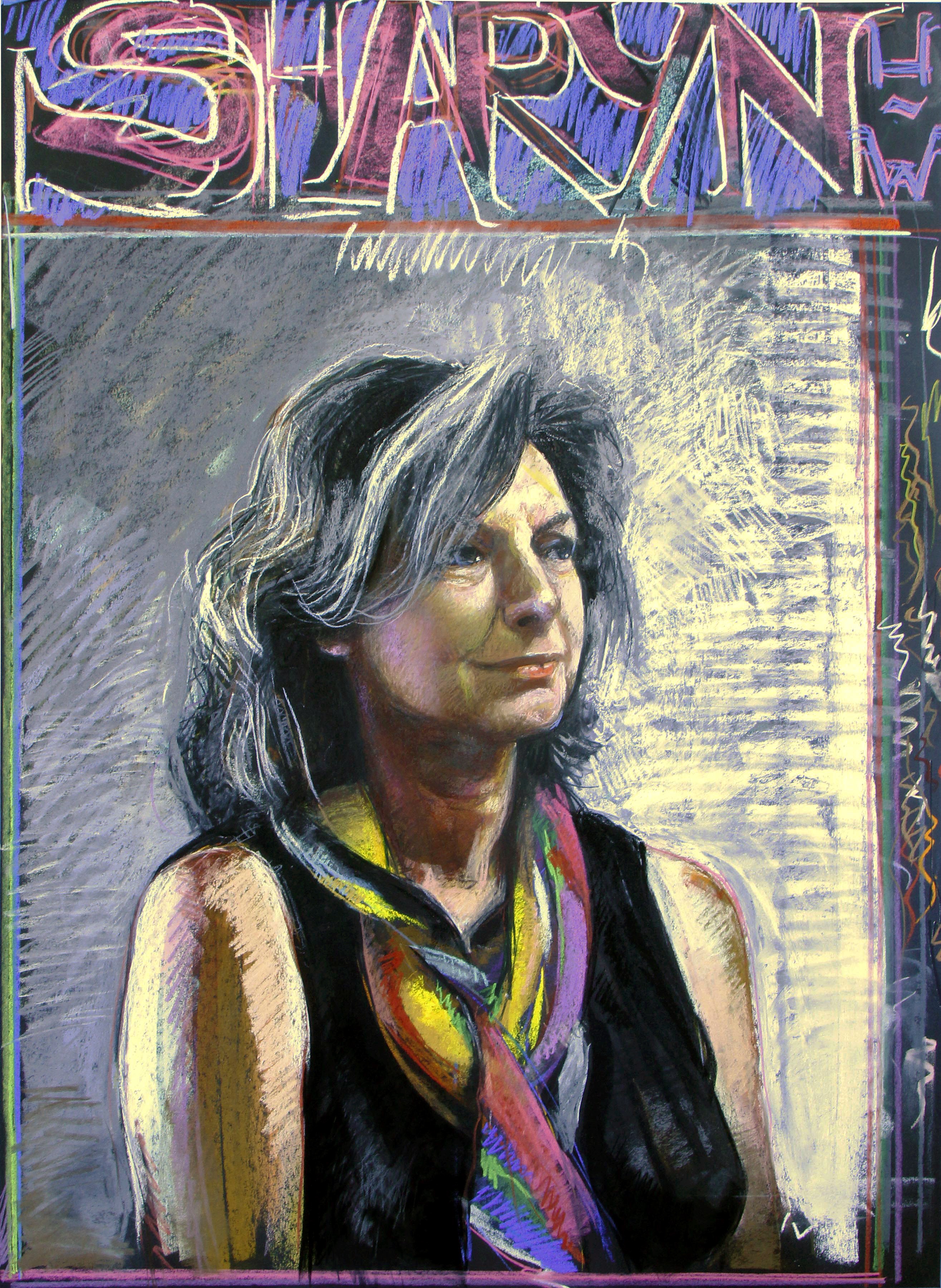
Photo Mar 18, 8 11 39 AMThe Teacher (Ms Sharyn Hyatt-Wade), Pastel on Black Paper, 30 by 22 inches, 2014.

Sharyn Hyatt-Wade is synonymous with engaged, passionate teaching here in Mid Missouri. If you ask any of her former students, you’ll hear no end of what this woman has brought to her classrooms over the years. Though she recently retired from teaching high school art after many years, she’s currently a part of the faculty at the University of Missouri. Now she’s working with our Art Ed graduate students to help shape them into the sorts of educators who make real impacts on kids’ lives. Too often public education is about the bottom line: teaching to the test to obtain granular data for the administrative types who allocate funds. Teachers like Sharyn live far beyond that simple concept; they aim to change lives, validate individual experiences, and advocate for student-based successes.

Sharyn’s power and exuberance are kinetic and contagious. She has an uncanny ability to get other people around her on board with her almost instantaneously. She’s a true leader and lover of people. I’m so thankful she’s in our community and is still giving of herself to bring better educational opportunities to everyone. What an amazing career she’s had. What a huge impact. Thanks, Sharyn.

~

If you’re a former student of Sharyn – at any level, in any capacity – I’d love to hear your thoughts. Share them in the comments below if you want to!

VINCENT

Andrew Vincent was one of my favorite students. He has a quiet presence, a quirky sense of humor, and the uniqueness that comes from arriving in middle America from somewhere else. In his case, it was South Africa. His father, a scientist and professor at Mizzou, brought his family to the US in time for Andrew to start 3rd grade. In many ways he retains a beneficial sort of otherness in spite of having lived much of his life here in Missouri.

Andrew made some amazing work for me in my Color Drawing classes, work that I have shown to several semesters of students. Here are a few of his pieces:

DSC07844Andrew Vincent, Spilled Milk, Oil Pastel on Paper, 15 by 30 inches. Drawn from an image created in Autodesk 3Ds Max. 2011.

DSC07025Andrew Vincent, Study After Vermeer’s The Milkmaid. Oil pastel on paper. 30 by 22 inches. 2011.

VincentA-Grid1-S11Andrew Vincent, Grid Study #1, Chalk Pastel on paper. 24 by 18 inches. 2011.

Also a gifted digital artist, Andrew has worked with Autodesk’s 3Ds Max for a while. Here is a render he created for a recent project:

10677326_10152670991425049_971583360_oAndrew Vincent, Naivety. Autodesk 3Ds Max. 1920 x 1080 PPI. Output dimensions variable. 2013.

~

Andrew has taken the opportunity to move to Auburn, AL to work at the Jule Collins Smith Museum as a preparator. He’s aiming to enroll at Auburn sometime in the near future. The guy is on his way to an awesome future. I’m thankful I got to know him in my classes and in the time after he graduated… and I’m certainly looking forward to witnessing what he gets up to in his ongoing education and career. Here’s a portrait I created of him when he visited my office/studio before he left town:

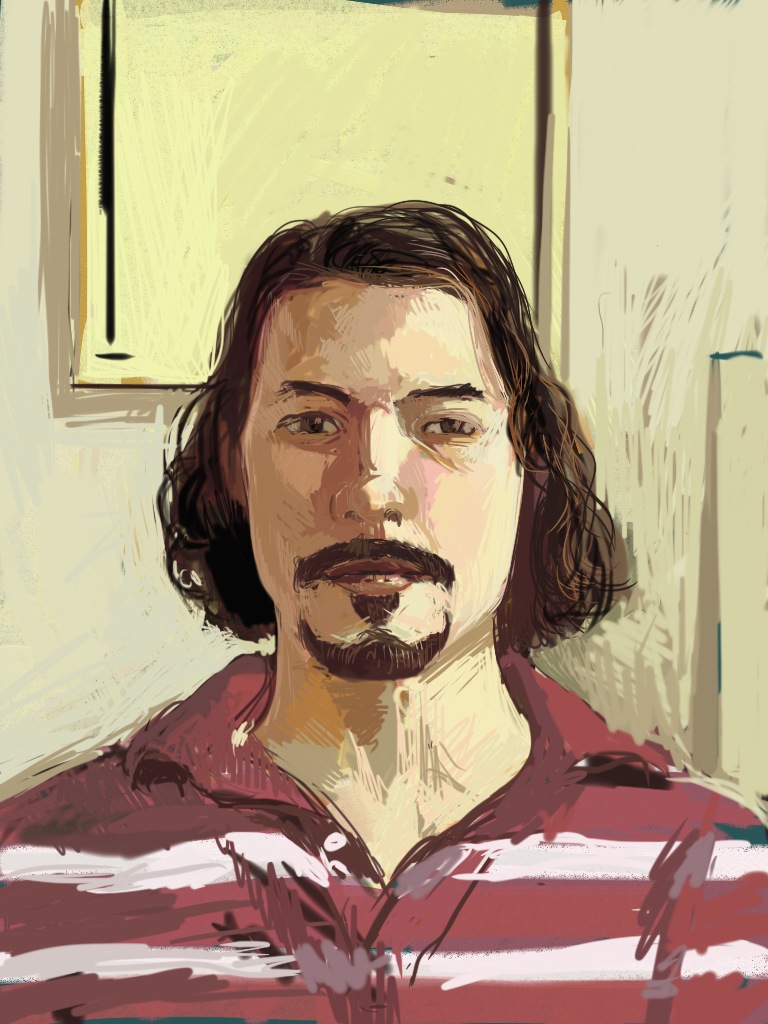
VincentVINCENT, digital drawing created in ArtRage and Sketchbook Pro on an iPad. 2048 x 1536 PPI. Output dimensions variable, 2014.

I’ve always enjoyed my conversations with Andrew, and they have always been far-ranging. We have discussed, faith, meaning, culture, humor, analog and digital drawing/painting tools and concepts, and so much more. I have the feeling we’ll have the chance for more conversation and mutual encouragement going forward.

One of the best parts of my job as an educator is getting to see my students go on to become colleagues and truly function as fellow artists. Keep going forward, Vincent!

Becoming The Student, #18: The PhD (Dr. Aja Holmes at Wakonse)

I was blessed to be able to attend the Wakonse Conference on College Teaching earlier this year (thanks, Deborah!) and while there I got to meet so many amazing people. One of them was Aja Holmes. As part of the cohort I was in, she set a tone of inclusion, concern, and thoughtfulness. She was welcoming, passionate, always engaging, and always ready with an encouraging word. It makes perfect sense that she’s found her niche as a Residence Life director working with Undergraduates. While at Wakonse, we got to share in the joy of her being appointed to a position at California State University-Sacramento. I’ve held onto this portrait of her since May, but since today is her birthday, it’s time to post it! Read below to find out more about this awesome individual!

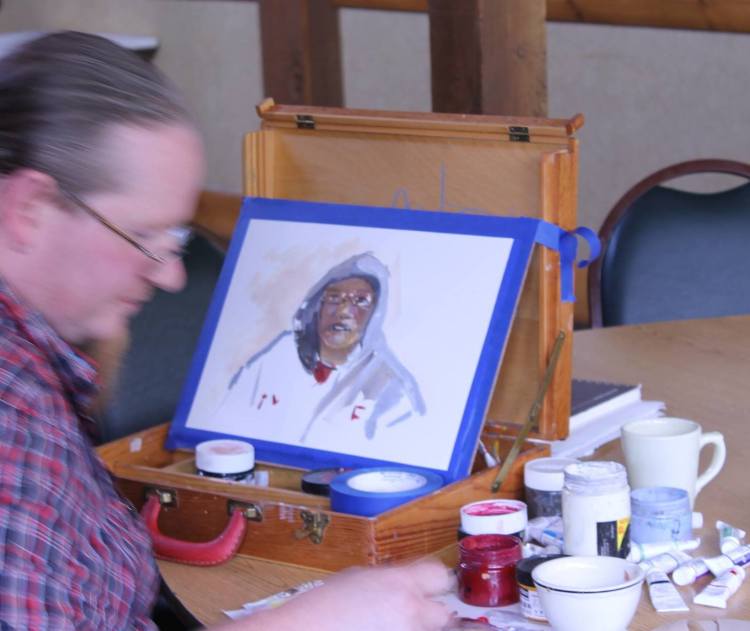
photoThe PhD (Aja Holmes at Wakonse), gouache on paper, 10 by 16 inches. 2014.

 ~

You just earned your PhD. What drew you do your field and what was your educational trajectory?

“As a kid I always loved school. I would play school with my little brother – my first student. He would complain and ask our mom, ‘Why does Aja always want to play school? Didn’t she just come home from school?’ But he would go along with it if I promised to let him try wrestling moves on me (learning to compromise – HAHA!).

I also knew that I wanted to be a doctor, but when I saw blood for the first time it did not agree with me. I knew that I would have to take another route to becoming a doctor. While being involved as an undergraduate student leader someone told me about the work of Student Affairs and that I could live out the rest of my life on a college campus; I said SIGN ME UP! I loved everything about being on a college campus. So after undergrad I stayed on at Illinois State University for my Master’s Degree in College Student Personnel.

Back then I did not know for sure if I was going to get my PhD, but I knew that after my Master’s Degree I should get some significant work experience before going back for a doctorate. I did just that: worked at two universities in the area of ResLife. In 2009, I applied to doctoral programs in Higher Education Leadership and was accepted into Iowa State University. I had heard of Iowa State and I knew that if I wanted to finish I needed to be close to my family. Luckily Dad was a six-hour drive to Chicago and Mom was a three-hour drive to St. Paul, Minnesota. To be in the middle of my family really strengthened my support system.

People often ask ‘what is your ultimate goal in life?’ They ask even more since I earned my PhD. Ultimately, I would like to become a university president. I also want to teach in a higher education program that prepares student affairs professionals.”

You have such a warm and engaging personality. How you do maintain your passionate, hopeful, and excited outlook? 

“I am often asked why am I so happy all the time. I have had to really think about it and truly understand what makes me happy. I decided a while back to take control of my happiness. To rely on others to make you happy relinquishes control on your outlook in life. So I make sure that I have a say in what makes me happy, and things that do not – I rid my life of them. My passion stems from experiences that have occurred in my life that had some effect on my life. Being a multiracial woman oftentimes lends me to have different experiences than most. Whether it’s issues such as the Voting Rights Act being challenged, unarmed African Americans being killed by the police, the DREAM Act, or other situations that involve people of underrepresented groups, I have a passion to act. I take to heart quotes and sayings such as, ‘to whom much is given, much is required’ and, ‘service is what we pay for living’.”

When we spoke at Wakonse, you told me about the important impact your Dad made on your life. Can you name a couple key lessons he provided?

“I was raised in a single parent household. Unlike the norm, it was my father who raised me. He has been one of my biggest supporters and cheerleaders. Since I was in the 3rd grade, my father cared for for my brother and I. He has taught me so much in life, from how to mingle and get to know people you just met, to how to be a woman of Color in a white-male-dominated society, to how to use humor to break the ice. He told me to keep pushing and don’t let what other people think get in the way of my hopes and dreams. I saw his struggles of being a parent while trying to own a business, and of being a parent to a teenage daughter coming of age. He sought out advice from his sisters and other lady friends in his life. But my father had to step up when needed. I will forever be in awe of what he did.”

 10287004_10152438914589534_3993202260772184824_oMe working on Aja’s portrait while we chatted together.

You’re now at California State University-Sacramento working as the Senior Director for Housing and Residential Life. What inspired you to focus your career toward working with students in ResLife situations?

“I love everything about living in the residence halls! I lived in the halls all four of my undergraduate years. Working in ResLife has allowed me to get to know that part of the university from the inside and out. I get to interact with the students in a way that no other Student Affairs person does: while they are in their PJs at home. I get to see them grow into young citizens. Since my research is on supervision, and a large part of Residence Life is supervision, I am able to see how my research can evolve and help prepare student affairs professionals to be the best they can be in this area.”

What do you think is one of the most important issues university students are tackling in 2014?

“One of the most important issues facing students today is the appreciation of differences. I use the word difference in the total meaning of the word: everything that is different. Students are too desensitized to even recognize when something is racist, homophobic, or sexist, etc. Students on our campuses have a unique makeup. They have been using computers their whole life and technology is their way of life; that is all that they know. Interacting with people who are different from them is hindered because of the technology. Technology made the world smaller but actually talking to another human being is a hurdle for them… hence their lack of the appreciation of differences.”

I think you’re into tabletop gaming – at least you were running the show at Wakonse! What’s your favorite board game?

“My favorite board game is really any one that my nieces and nephew are playing. Every holiday season we play board games and I am able to see them learn the process of waiting their turn, reading directions, compromising among each other, and displaying good sportpersonship. It is much more interactive than video games. They are such a joy to be around and I love everything there is to being an Aunt. I will play board games with them for hours and hours!”

~

Thanks for sitting for me, Aja! Your portrait will be on the way soon!