The Wreck of the ELLA Fitzgerald??

When I was young – perhaps five years old – I caught on to the notion that you could call in to the radio station and request songs. I enjoyed listening to the oldies stations and wondering what song might come up next. This was in the era of Casey Kasem and the power of the Billboard Top 100, and music was a little more of a communal cultural situation.

In any case, I was a radio person back then and I liked the idea that you could influence what was going to be played. One day at the age of 8 or so I decided that I wanted to call in to request the Gordon Lightfoot song The Wreck of the Edmund Fitzgerald. I got the number. I (kind of) worked out what I was going to say. But when I got on the air to make the request, I made a fundamental mistake.

You have to understand that my father had a large record collection, and I knew about a lot of different music from my older siblings, so I had heard a lot of names. It was an easy mistake for a kid to make, damn it! When the DJ asked me what I wanted to hear, I was a little flustered and blurted out:

“Can you please play The Wreck of the Ella Fitzgerald by Gordon Lightfoot?!”

This faux-pas got quite a laugh, and not only from the DJ, but also from my family. In the aftermath of this flub I can state I have known the difference between the Edmund Fitzgerald and the great singer Ella Fitzgerald since that very day.

In all seriousness, though, given that I was so interested in the song it was only natural that not so many years later I would start reading books and articles about the events surrounding this notorious loss of the Edmund Fitzgerald. Gordon Lightfoot was one of the first singer-songwriters who captured and fired my imagination. He (among some others) caused me to think about time and experience in a different way; as something within me and happening alongside me, not just random stuff apart from my life. Perhaps it’s a testament to the very idea of songwriting and musicianship as artforms. For me, Lightfoot embodied that troubadour tradition. These artists sing the tales of history, document it in personal ways, and help shape a democratic view of history itself.

Of course, everyone knows most famously Bob Dylan as one of these history-singers. But there were many others. I would include people like Sister Rosetta Tharpe, Billie Holiday, Utah Phillips, and Natalie Merchant amongst that group. So many… From Woodie Guthrie and Townes Van Zandt to Tracy Chapman and Ani DiFranco and P.J. Harvey. It’s such a rich – and necessary – tradition.

I find it fitting that my interest in the event of the wreck of the Edmund Fitzgerald and learning about the history surrounding it – not to mention becoming curious about the whole Great Lakes region – is all connected to the art of singing out moments of collective experience. This, like so many other things, I owe to art and artists. This is the richness of life: Not in things, but in awareness. Not in owning, but in being.

The SS Edmund Fitzgerald as seen from the Ambassador Bridge in 1965.
Detroit Historical Society

Today is the 50th anniversary of that ship sinking on Lake Superior. There are many interesting articles currently available from the days and weeks leading up to today (including this one from the Smithsonian and this one from Popular Science). So read about the ship. Read about the song, and listen to it (here’s the first version, but I’ve always been partial to the 1988 re-recording Lightfoot made – it’s a tad longer and has a slight mood adjustment that feels symbolic and mystical to me).

Then take at least 29 seconds – one “for each man on the Edmund Fitzgerald” – and may those moments of silent remembrance of them cause you to consider what human commerce, ingenuity, and hubris can do in the face of Nature’s power.

Mix CD Era Glory

I make playlists every semester for my classes. These collections of songs are largely built from the ice-breaker/introduction discussion assignment I give to my students on the first day. I want to know what they listen to, what moves them, inspires them, sticks with them. And then I want to serve up songs during focused working time. With studio art classes at Mizzou lasting about 2 hours and 20 minutes, there’s plenty of time to get a vibe going. This way they can be both exposed to the things their peers love but also get the excitement of hearing their own personal deep cuts. I love the feeling of sharing some of my favorites with them, as well as discovering what “the youth” like today.

My interests in music are very eclectic, and that’s down to my exposure to so much variety through my students. But it didn’t start there. Below I am featuring a few of the most iconic Mix CDs I’ve been given over the last 25 years. I’m including Spotify playlists for each one. Go! Listen to them! In situations where the original song is not available on that platform I’m linking to YouTube videos.

I also want to shout out the amazing people who shared these four mixes with me. They are creative people and much cooler than I ever could be. I will link to some of their current projects. I’ll also talk about some of the tracks in each section and give some background on how these united groups of songs have stayed with me for a quarter century.

Ox-Bow 2001: DANCE, DANCE, DANCE – Eric May*

Created in 2001. Spotify link to this playlist.

  1. Armand Van Helden – You Don’t Know Me
  2. Folk Implosion – Nothing Gonna Stop The Flow
  3. Outkast – So Fresh And So Clean
  4. Outkast – Ms. Jackson
  5. Stardust – Music Sounds Better With You
  6. Beck – Beercan
  7. Beastie Boys – Sabotage
  8. Deee-lite – Groove Is In The Heart
  9. Daft Punk – Around The World
  10. Fatboy Slim – The Rockafeller Skank
  11. Madonna – Ray Of Light
  12. Groove Armada – I See You, Baby (featuring Gramma Funk) – Fat Boy Slim Edit
  13. Daft Punk – One More Time

I had a fellowship at Ox-Bow for three months in the summer of 2001. It was a very important time for me. A lot changed in me. You can read about my experiences here.

Ox-Bow is a lot more institutionalized now. Back then, it was a true bohemian type situation. What happened at Ox-Bow, stayed at Ox-Bow. The vibe there was a hold over from the 60s and 70s in a lot of ways, and this was before the world was really turned on its head by the US response to 911. The internet was still new and slow, there was practically no social media, and almost no one I knew had a cell phone. It was just a different time. There was room to go a little wild as well as room to explore your own thoughts and perspectives.

One of the best things that we did at Ox-Bow was have intense, blow-out parties every weekend. The cohort of fellowship residents did work during the main part of the week (maintenance, housekeeping, kitchen duties, etc), so when we partied, we went hard. A large meeting tent would be raised in the central field, a few turntables would be installed, and speakers deployed. Then our resident DJ, Eric May (with help from others) would spin records and CDs deep into the Michigan night.

I discovered a lot of great music that summer (The Beta Band, AIR, Massive Attack) and fell more in love with acts I’d always liked (Mazzy Star, Radiohead, PJ Harvey, Cat Stevens). Most of that stuff wasn’t being played at the parties, though, as they’re a bit too contemplative and musically less conducive to drunken dancing and themed costumes. Hence, the mix we all left with was something closer to late-90s college party than artsy hipster fare.

We definitely burned some calories to these songs…

*Eric checked in with me about this mix – he mentioned in the comments that Mikey H. and Reid T. had a larger hand in crafting it than he did! Shout out to Mikey and Reid! Reid has gone on to an amazing career as a scenic designer and has an amazing portfolio of exceptional design work. Go check him out!

FHS’s Mix – Fred Sturkey

Created in 2002. Spotify link to this playlist.

  1. Archers of Loaf – Scenic Pastures
  2. Kitchens of Distinction – Railwayed
  3. Drop Nineteens – Winona
  4. Gang of Four – Cheeseburger
  5. Gang of Four – Paralyzed
  6. Talk Talk – Eden
  7. Television – Marquee Moon
  8. Kitchens of Distinction – Gorgeous Love
  9. Kitchens of Distinction – Drive That Fast
  10. King Crimson – Larks’ Tongues in Aspic, Part 1
  11. Talk Talk – It’s My Life
  12. Butch Walker – Hot Girls in Good Moods
  13. HUM – Green to Me
  14. HUM – The Inuit Promise
  15. Kitchens of Distinction – Polaroids
  16. Drop Nineteens – Kick The Tragedy
  17. Drop Nineteens – My Aquarium
  18. Kitchens of Distinction – Under the Sea, Inside the Sky

Fred Sturkey worked with me at Good’s of Evanston. I started overseeing shipping and receiving for the art and frame store a couple weeks after 911 and about 4 weeks after the end of my Ox-Bow residency. I’ve written about Fred a bit before, and was very sad when he died in 2019. He was a high quality human, and was always happy to hold forth about music or politics, history or philosophy. Just a gentle, sweet guy.

This mix CD is one of the greatest gifts anyone has given me. This introduced me to HUM and Talk Talk and Kitchens of Distinction, three bands that have been in my life ever since. So different from one another, but totally unique and important. KoD is particularly interesting as a group from the late 80s/early 90s that championed the expression of queer relationships and perspectives. They did it in a matter-of-fact way, with a sense of imagery and poetry that draws the listener into shared human experience. I really love the texture of the guitar sound and the soaring vocals.

Structurally, the mix isn’t tracked perfectly, but it stands out for me purely because of the music it introduced me to. I’ll be forever grateful, Fred. RIP, sir.

The Art is Hard Mix – by Nikki Maloof

Created in 2004. Spotify link to this playlist.

  1. The Starlight Mints – Submarine #3
  2. Wilco – She’s A Jar
  3. Appleseed Cast – Fishing The Sky
  4. The Shins – They’ll Soon Discover
  5. Mike Doughty – The Rising Sign
  6. Rilo Kiley – It’s A Hit
  7. Nick Drake – Northern Sky
  8. Spoon – Anything You Want
  9. The Long Winters – Scent Of Lime
  10. Phoenix – Run, Run, Run
  11. Owen – The Ghost Of What Should Have Been
  12. The Smiths – Cemetery Gates
  13. Badly Drawn Boy – Once Around The Block
  14. Clem Snide – Better
  15. Modest Mouse – Paper Thin Walls
  16. Paul Simon – Mother and Child Reunion

Nikki is a successful artist who was also in the first drawing class I taught while in graduate school at Indiana University. She was dedicated, confident, and effortlessly cool. Those qualities have stayed with her as she built her career, had kids, and mounted major international shows of her work. She gave me this CD after we compared notes on music in that class, and she really got me hooked on The Shins, Spoon, and Nick Drake. An interesting combination of indie rock and mainstream(-ish) alt-pop, this mix is just a rich, comfortable listen. There are some great gems here, like Soul Coughing’s singer/creative engine Mike Doughty’s solo work in The Rising Sign.

The Close to Totality Mix – Tina Casagrand-Foss

Created in 2008. Spotify link to this playlist.

  1. Yeasayer – 2080
  2. Blitzen Trapper – Black River Killer
  3. Spoon – Bring it on Home to Me
  4. Donovan – Celia of the Seals
  5. Old Crow Medicine Show – Cocaine Habit
  6. McLusky – Day of the Deadringers
  7. The Pixies – Down to the Well (Peel Session)
  8. Queens of the Stone Age – Someone’s in the Wolf
  9. Sigur Ros – Fonklogi
  10. Serge Franklin – KKK
  11. Saul Williams – List of Demands (Reparations)
  12. Blur – Out Of Time
  13. Ugly Casanova – Spilled Milk Factory
  14. Modern Lovers – Pablo Picasso
  15. Ima Robot – Paint the Town Red
  16. Kings of Leon – Pistol of Fire
  17. Johnny Greenwood – Proven Lands
  18. Tom Vek – That Can be Arranged
  19. The Black Keys – Till I Get My Way
  20. Radiohead – Idioteque
  21. Miwa Gemini – Traveling Man
  22. Foo Fighters – Stacked Actors

Tina has an amazing energy. She’s a true go-getter, someone who is actively working to make the world better. As the founder and managing editor of The New Territory, she’s forging a space for the stories of the people and places that make up the Midwest to shine. She was a stand-out in my classes way back when, and she’s always a treat to collaborate with. I have written for The New Territory and made artworks for the magazine, as well as spoken at the Missouri Scholars Academy, which is one of Tina’s favorite annual summer projects.

This mix is highlighted by driving, raging, bloody tracks like the Peel Session version of Down to the Well by The Pixies, Saul Williams’s – List of Demands (Reparations), Ima Robot’s intensely violent Paint the Town Red, and Pistol of Fire by Kings of Leon. There’s definitely some serial killer vibes going on in this mix, but interesting moments of calm are interspersed throughout (Donovan’s Celia of the Seals or Blur’s Out of Time). There’s a variety of attitude in this mix – some of it is very serious, or even anxiety-producing (Greenwood’s Proven Lands or Williams’s List of Demands) – while other songs are tongue-in-cheek or just hilarious (Modern Lovers – Pablo Picasso or Miwa Gemini’s Traveling Man) I like the range of time across the tracks, as well as the tension between related genres/styles.

It’s loaded with bangers, all-time classics, and deeper cuts that stand the test of time. I’ve kept bringing these songs into my classroom since the day Tina handed the CD to me!

For some reason, the track order that was burned onto the CD itself is not the order that Tina wrote on sleeve – I ended up listening to it wrong for all these years…

The best part about these mixes is that they are palpable, physical artifacts made for me. Sure, we can listen to the music without the object, but the object is proof of something. It was there with me, and it was there with the people I mentioned. It shared space and time with us, and it travels along with us. The meaning is not only in the music, it’s in the fact of human interaction and sharing deeply human concerns.

The Flying Circus Flies Again

Growing up, one of my favorite things to do was to spend time down in the musty basement at my childhood home on Wolcott Hill Road outside of Camden, NY.

Down there, in old moldering boxes, were piled my Dad’s World War 1 model airplanes: Sopwith, SPAD, Neiuport, Fokker… All were there. As a 4 year old I was so excited to explore down there and imagine them in flight. Later on, I spent a good deal of time making my own model aircraft, and went through the enjoyment and frustration of the hobby modeler (that glue, those paints!!). But it all started in that cellar.

My father is an amateur World War 1 historian. He has fabric from Zeppelins, shell art from the trenches, original War Bonds posters, and THOUSANDS of books. Those small plastic planes, though. I loved those most of all. If I could have anything from my childhood, I think it would be those.

Last week I took my son to a local art store and decided to pick up a little Fokker Dr 1 Triplane model. A couple days later we sat and put to together. Now it is hanging above my desk in my studio, cruising above the ephemera. We watched some videos about World War 1, looked at pictures of Manfred von Richthofen, and watched the classic Peanuts cartoon about Snoopy dogfighting in his Sopwith Camel/Doghouse. It was a good day.

I might have to get another one for my son as he is a little incensed that I would mount the bright red plane out of his reach…

The Protests at The University of Missouri

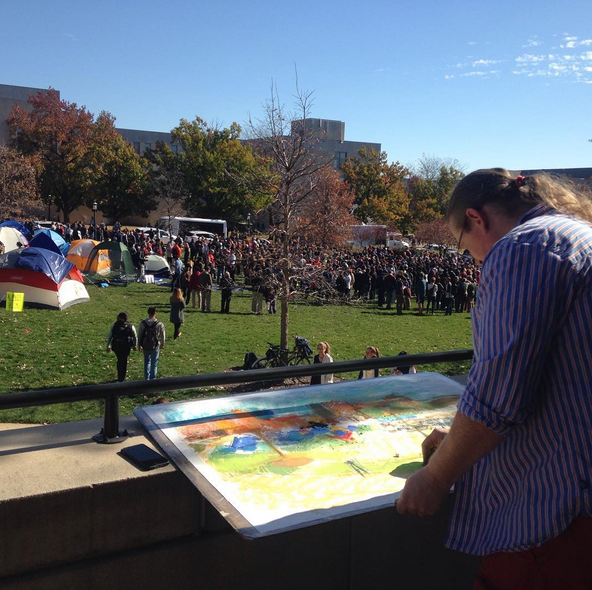
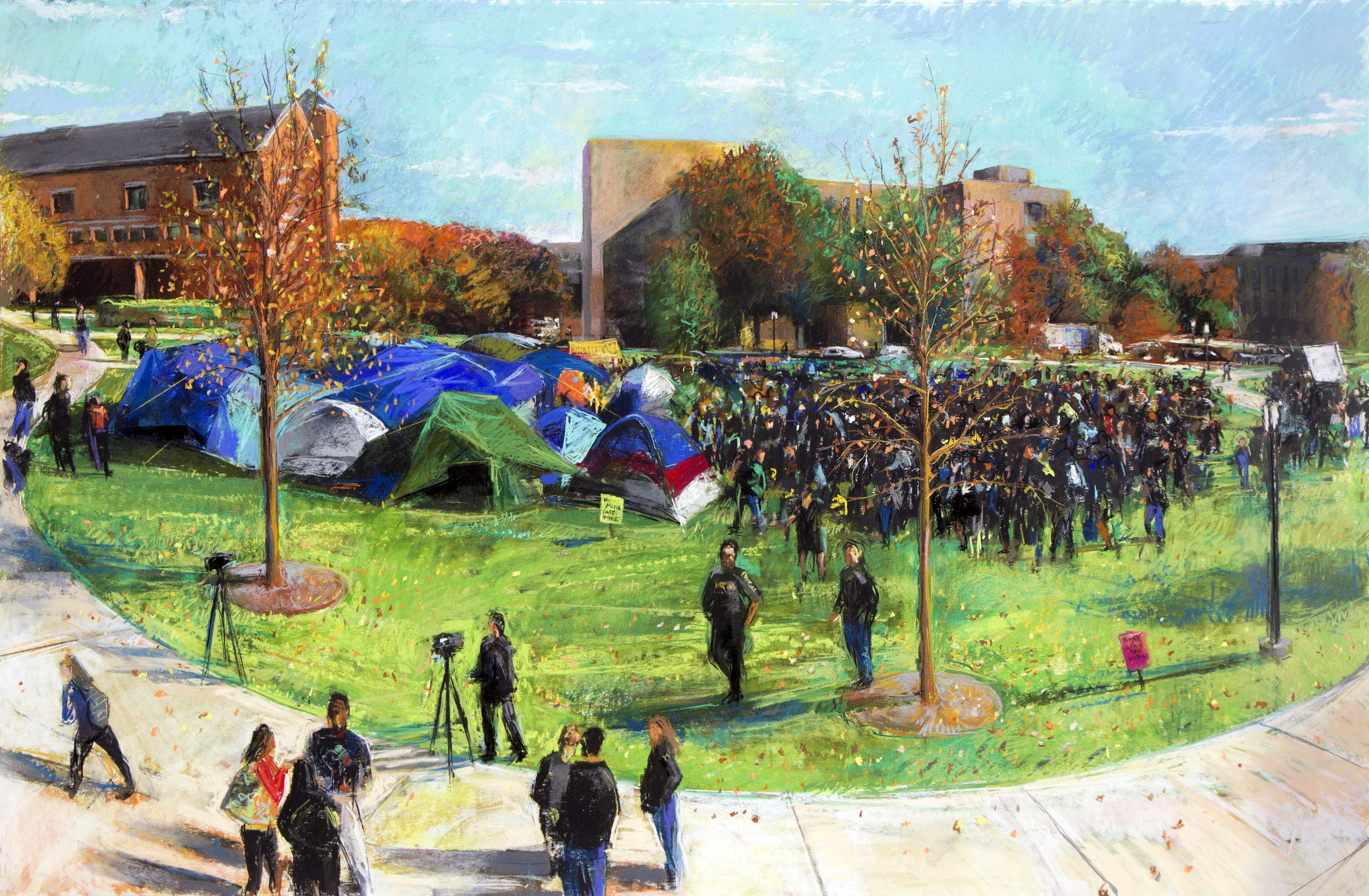
As many around the country and around the world are aware, this past week at Mizzou has been harrowing. It was a week that culminated in the ouster of both the MU System President and the Chancellor. On Monday, before the strange, terrifying days that followed, many classes were let out in solidarity with #ConcernedStudent1950 and Jonathan Butler. I told my students that I’d be down on Mel Carnahan Quadrangle to witness the events. I decided that I would undertake a drawing to commemorate the day.

Screen Shot 2015-11-13 at 6.06.51 PM Screen Shot 2015-11-13 at 6.06.46 PMAbove are two shots of me at work, the first by my colleague and former student Jacob Maurice Crook (Adjunct Professor at Mizzou), the second by one of my graduate students, Jeff Markworth (MFA Candidate, 2016). I was also photographed by local media, and one of those shots can be seen here.

I’ll leave the commentary to other voices. My purpose in all of this is to remain an ally for my students while representing Mizzou well and encouraging the change it needs to see.

Here’s the drawing I made. It’s not as refined as I’d like, nor is it my normal thing to do subject matter like this. But it was a good exercise, and a good day to be present and aware.

November92015“An Historic Day on Carnahan Quad: November 9, 2015.” Pastel on paper, 28 by 44 inches. Click for enlargement.

I’m Really Glad We’re Teachers

There are a lot of cohorts we are a part of simply because of birth. Others we choose. There are some we seek out with tenacity. Other associations creep up on us, and they’re trans-historical, multi-generational unions.

Teaching is like that; we choose it, but it comes with a great many intangible elements we might recognize only later.

I’m an educator. This fact sometimes surprises me. By reason of this vocation I am connected to so many people who try to bring a sense of what it means to know and to do to others. We teachers… we’re epistemologists. What do we know? How is it that we can know? Where’s the dark horizon line that signals our limited understanding? Let’s dive into a shared space and craft meaning with others. It’s a great calling.

The last few days I’ve been thinking so much about the connection I have to other teachers. As someone who has been in higher education for nearly a decade, it makes sense that I now know dozens of teachers. But there is joy in realizing that some people I have known for many years became teachers as well, each on their own pathway.

I want to mention a few of them.

David Schwei – University of Cincinnati, Classics

David is my brother in law. He is a PhD candidate specializing in Roman History at the University of Cincinnati. He will soon complete his work there, but over the past couple of years he has engaged in a serious study of teaching itself. Our conversations on the subject are always enlightening and encouraging. David is a thoughtful, generous man, and his blog contains a wealth of hard-won information about what it means to teach and how to think about teaching. I love following his thoughts and his growing expertise. Never one to do anything halfway, David’s observations on teaching go far beyond his chosen discipline and offer great advice to anyone thinking about education. Click here for more info:

Latin, Classics and Education in the 21st Century.

davecaiqunDavid and my daughter Cai Qun learning together. Photo by Alison Ballou.

~

Natalie Shull – 5th Grade

Natalie is the oldest daughter of a special couple my wife and I relied on during our early married days in Chicagoland. It was illuminating to have a sidelong view of the Shull kids growing up, and especially to see Natalie take on increasing responsibility and maturity. During college she focused in on teaching, and eventually began to blog her way though a variety of experiences. Her thoughts are not technical, but neither are they purely Dionysian. They are about grace and hope. She has cut her educator’s teeth in the grass roots of teaching, and right now leads some 5th graders through their paces. It’s wonderful to see her excitement, joy, and desire for excellence on display in her posts. Check out her story here:

Lead Me Where.

Screen Shot 2013-12-21 at 8.44.54 PMMatt Ballou – Natalie Reading About the French Revolution. Oil on linen on panel, 26 by 24 inches, 2006. Private Collection, IL.

~

Alison Ballou – Homeschooling Superintendent

I don’t know that I’ve ever met anyone who is more qualified for homeschooling than my wife. It’s easy for people not familiar with homeschooling to see it as a fringe phenomenon. Yet throughout much of history high quality education was possible at home. When parents have vision, time, and desire – not to mention the intellectual and educational background – homeschooling is a viable option. With multiple degrees from Northwestern, experience in child care, and proven ability to continue her education through books, online courses, and certificate programs in a variety of disciplines that dovetail with elementary education, Alison has crafted a fantastic learning experience for our two daughters. She’s got them above average in reading and math, and the three of them are beginning classes in Mandarin this week. Her attention to detail (everything is laid out day to day and recorded for reference and tracking) and passion for shepherding their emotional lives is amazing. You can see a good bit of what goes into her heart for teaching and learning on her blog:

Not Yet What We Shall Be.

041Cai Qun and Miranda working at the dining room table on a project. Photo by Alison Ballou.

~

I could have put dozens on this list; teachers who changed my life like Roberta Dudley (high school), Lisa Gregg-Wightman (undergraduate), or Barry Gealt (graduate). I could have included colleagues I have taught side by side with for many years – Jessica Thornton, Deborah Huelsbergen, or Chris Daniggelis. I could have highlighted former students who are now teachers in their own right – Trudy Denham, Ian Shelly, Megan Schaffer, or Shalonda Farrow. I could have featured family and friends who have taught me so much – my Mom, especially. I respect them all. I’m glad to be one of them.

In some sense, however, David, Natalie, and Alison represent the surprising way that as I became a teacher, others also grew into that calling around me. Though our disciplines, day-to-day routines, and curricula are different, we are bound together as educators. I’m really glad we’re teachers.

_MG_3406Me, in the classroom teaching composition to a group of Drawing 2 students. Photo by M. Kanaan.

In Which I Recount Ten (Well, Fourteen […Fifteen]) Texts Of Some Importance To My Life

There are a number of my friends posting their versions of this list to Facebook these days. Lists such as these always fail in some way. Of course, I also fail at writing them. It’s so easy to come off either pretentious or flippant (or both). I prefer to share my true, deeply-held likes and dislikes in direct conversation. Preferably along with good bourbon or a nice beer.

But I decided to go ahead and try this one. I think that I’m in a stage of my life where my motivations and interests are shifting (yet again), and in times such as these it’s good to take stock and see what remains influential. And so I’ll add my own ten-plus to the never-ending generator that is human activity on the internet. I will present a main list – with commentary – in no particular order.

The criterion I used to gather this collection was simple: did the book initiate some transformation in me, either immediately or upon reflection? I read quite a lot, but I wanted to be careful to choose only the works that have really stuck with me. That’s why there are all sorts of different types of book here (I have intentionally left out the expressly Art and Art Theory books that have been important to me, as there are so many). There are comics, theology, grand adventure, memoir, philosophy, and most of those arenas all mixed together. I’m surprised (and pleased) how many of them I actually experienced in very early childhood. I know there are some big names and obvious choices… that’s just how it is. This selection is not meant to be exhaustive or exceptional in any universal sense; I know there are better and, perhaps, more notable pieces of writing. For each I’ve included there are many more that could have been present. These are just pieces of writing that I know have shaped my life. I felt like sharing them. Enjoy.

~

SPACE, TIME, and INCARNATION by Thomas F Torrance

Thomas F Torrance took on an enormous task in this slim text. Published in 1969, Torrance wrote the book in an attempt to explain Divine interaction in space and time in the light of contemporary scientific developments in theoretical physics and cosmology. Rather than allowing theology a trump card to get out of any exchange with science, Torrance drives deep into the epistemological questions that arise when one seriously examines spatial and temporal ideas involved in theological conceptions. I discovered the book in an old, disused inn library in 2001, and went on to fill my copy with outbursts of marginalia. It remains dear to me.

THE ANNOTATED LOLITA by Vladimir Nabokov (Annotations by Alfred Appel Jr.)

From its tip-of-the-tongue beginning to its devastating denouement, Lolita is one of those books lauded as a masterwork generation after generation that actually lives up to the hype. Alfred Appel’s annotations of the history and meaning behind Nabokov’s astounding and astute prose helped provide access to me as a Nabokov neophyte. The next Nabokov novels I read – Invitation to a Beheading, King, Queen, Knave, and Glory – were all immensely enhanced by the background The Annotated Lolita provided. “I shall be dumped where the weed decays, and the rest is rust and stardust.” (Page 257)
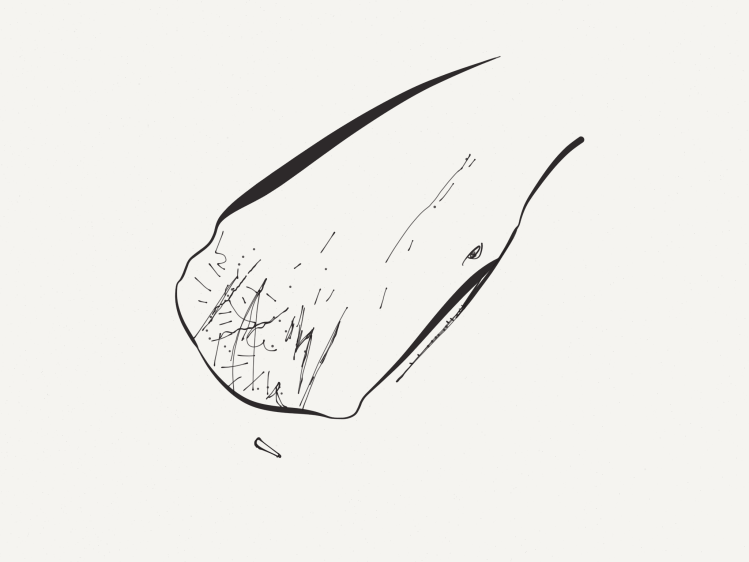
text-mobydickThe Leg and The Whale – Illustration for Moby Dick. Created in Paper with Pencil. 2014.

MOBY DICK by Herman Melville

In Summer 2013 I completed my third journey through this book. Each time it has become more subtle and significant to me. I know that Moby Dick is popular, and that it is popularly unread. This is unfortunate. Its dense passages offer much to submissive, receptive readers. The pugnaciousness, humor, and visual presence of this book make it one I know I’ll keep returning to over and over throughout my life. I even love the endless chapters on Cetology.

EPISTLE to the ROMANS by Saint Paul

Romans is, perhaps, the ultimate biblical text… maybe even more than the gospels themselves. It integrates the disparately organized theological concepts of the early Christian writers into an organized legalese. Though it contains many key chapters (One, Five, and Eight in particular) it is Chapter Five that has, for me, held an intensely disruptive power. Hundreds of readings and years of study have done nothing to dissipate its existential shock.
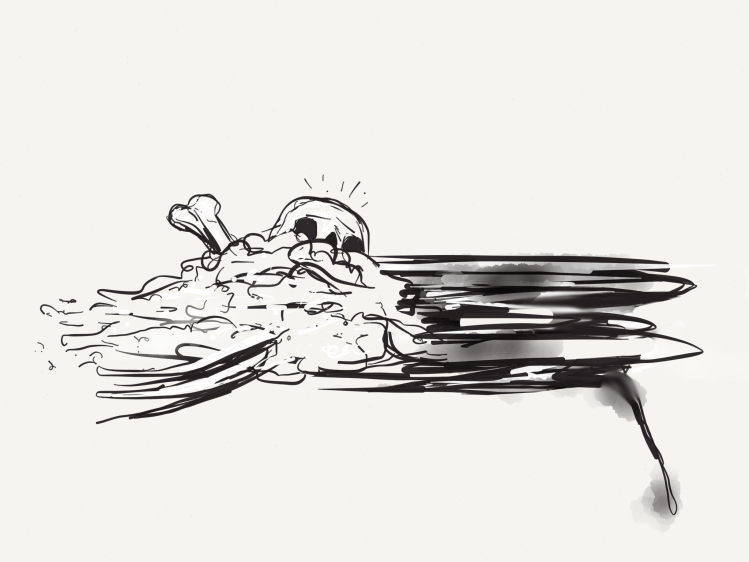
text-romansDirt and Blood – Illustration for Romans. Created in Paper with Pencil. 2014.

THE LIFE HISTORY of the UNITED STATES (Volumes 1, 2, and 3 of 12) by Henry Graff and Time/LIFE

As a young boy I loved to dive into these books. They were among my first exposure to “fine” art, not to mention the wild and wooly early history of America. I especially enjoyed the first three volumes of this set and, after a while, never really looked beyond them. They were extremely key to my life-long interests. The reproductions they contained of colonial era political cartoons have never left my mind’s eye.

ADA, or ARDOR: A FAMILY CHRONICLE by Vladimir Nabokov

Passionate, sweeping, and strange, Ada is a killer of a novel. Deeper and more powerful than its more famous sister (Lolita), Ada is one of the few books that have stopped me in my tracks. I mean this quite literally. On several occasions – my mind obsessed with the story – I pulled my car over (during my commute to and from school) to continue reading. It is a crushing emotional journey, one that forces consideration of not only the motivations of protagonists Van and Ada but also those that rumble within the reader. This book happened to be the first book my wife (then my girlfriend) and I read in tandem, sharing our thoughts and insights as we read.

GHOST in the SHELL by Masamune Shirow

The best of Masamune Shirow is on display in this, his magnum opus effort. In it he leaps beyond the dregs of manga cyberpunk and erotica to grasp higher ground. He asks huge questions: what is life, consciousness, and person-hood? Sociopolitical wrangling, heavy weaponry, and seamy underground characters collide in a richly imagined post-apocalyptic world on the rebound. His central character, Major Motoko Kusanagi, transcends her sex appeal to deliver existential queries that rock attentive readers. Unfortunately, Ghost in the Shell, along with earlier projects Appleseed and Orion, were Shirow’s only truly deep works. It’s too bad that he has never again turned his considerable artistic skill toward more redeeming themes.

THE ALPHABET VERSUS the GODDESS: THE CONFLICT BETWEEN WORD and IMAGE by Leonard Shlain

Though only a very cursory survey of the historical struggles contained within its pages, this book served as a major jumping off point for me to explore a variety of issues that have altered the course of my life as an artist and educator. Some of my greatest joys in teaching have come from discussions born of this text.

DIRK GENTLY’S HOLISTIC DETECTIVE AGENCY by Douglas Adams

Over the years, Douglas Adams‘ two Dirk Gently novels (the one above and The Long Dark Tea-Time of the Soul) have become my favorites among his various writings. In Holistic Detective Agency, Douglas weaves a tale of trans-historical curiosity, tying together his trademark humor, dual love of Bach and computers, the politics of vanity publishing, and just where exactly Coleridge came up with his vision of Kubla Khan‘s pleasure dome. The book is an epic, joyful trip. It finds ways to explain the strange, ridiculous nature of history so that the reader can laugh and weep with the realization. Adams was a genius.

PILGRIM at TINKER CREEK by Annie Dillard

No dilettante to Thoreau, Dillard finds a way to make her words – written as a 27 year old – take on majestic and epoch-encompassing power. Perhaps I was prepared to love it by my readings of theology and some of the American Transcendentalists, but Pilgrim at Tinker Creek does feel like a singular expression. I love her 20th century version of perception and awareness. A huge influence.
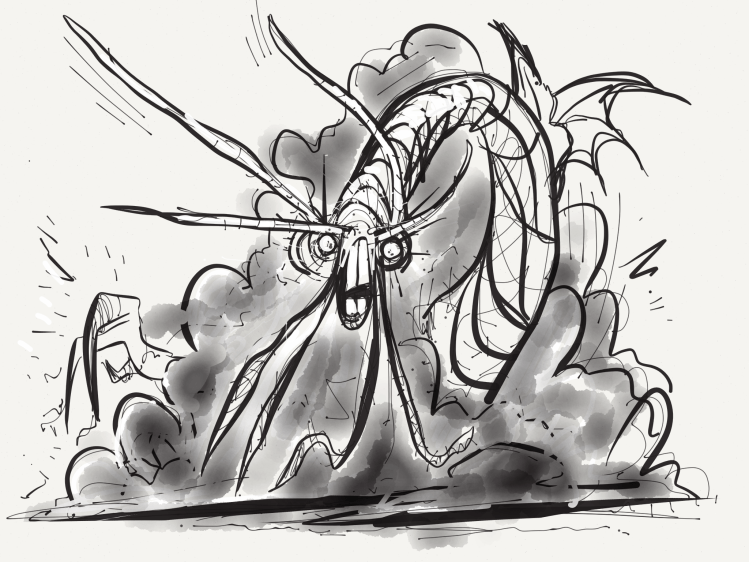
text-jabberwockyThe Jub-Jub Bird – Illustration for The Annotated Alice. Created in Paper with Pencil. 2014.

THE ANNOTATED ALICE: ALICE’S ADVENTURES in WONDERLAND and THROUGH the LOOKING GLASS by Lewis Carroll

This book has stayed with me since early childhood. It was my first inkling that something else may be going on under the surface subject matter of a story. The layering of concepts beyond the directly obvious – logic, mathematics, socio-political and theological suggestions – created a backbone to this text making it live far beyond its Victorian and children’s genre roots. If you visit my classroom you may hear me break into a dramatic recitation of The Jabberwocky for my undergraduates from time to time…

SCIENTIFIC PROGRESS GOES ‘BOINK’ by Bill Watterson

Calvin and Hobbes. Childhood and Imagination. Dreams and Awareness. Play and Learning. What else do I need to say?

INTERPRETATION and OVERINTERPRETATION by Umberto Eco and Richard Rorty

A roiling debate between Eco and Rorty forms the basis of this text and underpins so much of my own thoughts on how meaning is shaped. I routinely share it with my own graduate students in the spirit it was shared with me – with excitement and engagement. I was originally exposed to both Eco and Rorty by my fellow MFA grads at Indiana University. Fellow grad Matthew Choberka stimulated many of us in the program, and pushed our dialogue beyond the common complaints. Kudos to him.

SKETCHES IN CRUDE OIL: SOME ACCIDENTS and INCIDENTS of the PETROLEUM DEVELOPMENT in ALL PARTS of the GLOBE, CHAPTER XVII: SOME NITRO-GLYCERINE in THIS (Pages 383-406) by John J McLaurin

This chapter of a book published in 1898 loomed large in my imagination as an 8 year old in Grove City, PA. My then step-father George was studying at Grove City College under Austrian School economist Hans Sennholz. The college served as my initial exposure to academia and was a central catalyst in my intellectual imagination. I was allowed to roam the grounds and halls of Grove City; I’m certain that it provided the push that eventually led me to my current vocation as an educator. Sketches in Crude Oil was a book that George had been looking at and he read from the nitroglycerine chapter many times. The stories of wagons exploded into nothingness, men blown to atoms, flesh and bones thrown hundreds of yards, and single drops of the explosive hit with hammers have stuck with me for 30 years. That library, those books, and the pages of this volume permeated my conception of history, education, and life for the better.

text-bigbangThe Big Bang – Illustration for The Elegant Universe. Created in Paper with Pencil. 2014.

THE ELEGANT UNIVERSE by Brian Greene

Another popular science survey, but a good one. Reading Brian Greene‘s book, though certainly secular, was one of the most spiritual experiences I’ve had. His description of the various phase transitions taking place in the first millionths of a second after the Big Bang became nothing short of a transcendent sight to my inner eye. Making enormously complex ideas understandable is Greene’s business, and this book addresses many of those issues in direct, accessible language. Good stuff.

~

TEXTS (I have recently read) WHICH MAY EVENTUALLY WORM THEIR WAY ONTO THIS LIST…

CLOUD ATLAS by David Mitchell

BRIEF INTERVIEWS WITH HIDEOUS MEN by David Foster Wallace

BLOOD MERIDIAN: OR the EVENING REDNESS in the WEST by Cormac McCarthy

THE DUNWICH HORROR by H.P. Lovecraft

ABSENCE OF MIND: THE DISPELLING of INWARDNESS FROM the MODERN MYTH of the SELF by Marilynne Robinson

AN ETHICS FOR TODAY: FINDING COMMON GROUND BETWEEN PHILOSOPHY and RELIGION by Richard Rorty

PARADOX IN CHRISTIAN THEOLOGY: AN ANALYSIS of its PRESENCE, CHARACTER, and EPISTEMIC STATUS by James Anderson

THE POETICS OF SPACE and THE POETICS OF REVERIE by Gaston Bachelard

~

BOOKS WHICH HAVE BEEN INFLUENTIAL BY DEFAULT (And thus require no comment)

THE CHRONICLES OF NARNIA by C.S. Lewis

THE LORD OF THE RINGS by J.R.R. Tolkien

THE WIND IN THE WILLOWS by Kenneth Grahame

THE PSALMS

PROVERBS

The Books of THORNTON BURGESS

The Books of LAURA INGALLS WILDER

TO KILL A MOCKINGBIRD by Harper Lee

~

Thanks to Jill for tagging me in this one:)

What Is A Great Image?

On May 22, 2013, I gave a public talk at the Boone County Chambers Room in Columbia, Missouri that addressed the question, “What is a great image?”

Below is audio from that talk synced up with the slide show that I used. If you’ve got an hour and are interested in how art, history, and human experience interconnect, you might appreciate this talk. Obviously it’s by no means exhaustive and has to skim over many issues, but I think it’s got some quality observations. I would greatly appreciate any questions, comments, or observations you might have after watching through.

And here’s a picture of me and my girls during the Q&A session after the talk :)