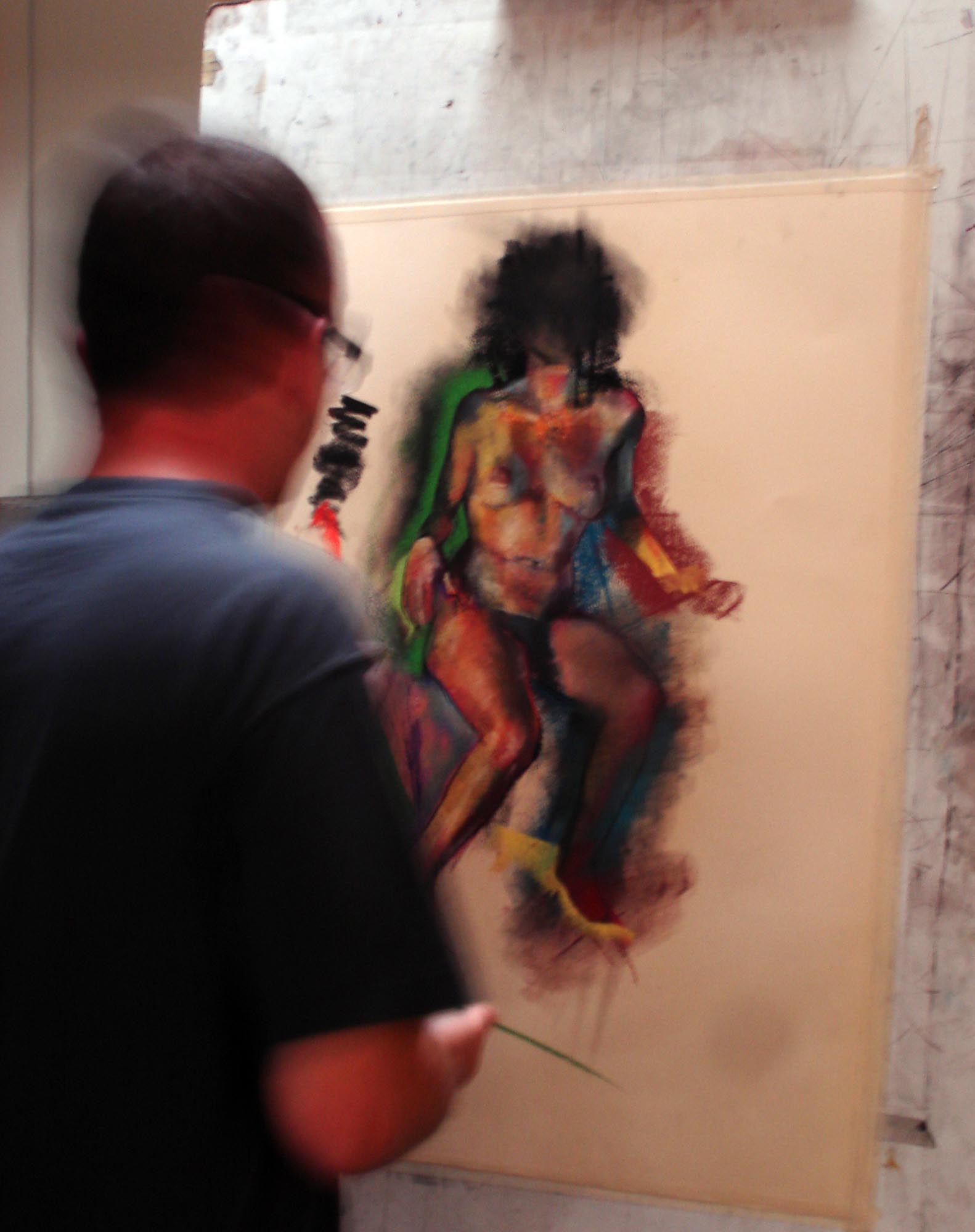
Marcus Miers is a current Color Drawing 3 student of mine. I’ll post work by my other students soon.
Marcus Miers is a current Color Drawing 3 student of mine. I’ll post work by my other students soon.
I took a group of my students (from the University of Missouri at Columbia) over to Kansas City to see a bit of art this past weekend. The main attraction was the Martha Macleish show at Longview Community College. One of the things I found so interesting about her work is the fact that the shadows they cast – being illuminated by the syncopated lamps of a gallery lighting system – are at least as physically striking and necessary to the experience of the art as the objects themselves are. These shadows seem to extend each work in that they transfer the structure and form of the piece into space and onto the surrounding walls and floor. While this seems obvious – it’s what all shadows do – in this case it’s much more significant. This is because the laminated, layered construction of the work is mirrored in the stratified step gradients of the multi-vectored shadows and the negotiated, sometimes grungy, sometimes glossy finish of the materials is echoed in the distended, bending atmospherics created as light falls over their spaces and shapes. The effect is mesmerizing and stimulating, leading viewers to shift their perspective again and again, bobbing and weaving around each piece to see the secrets they hold in their multi-faceted alignments and angles. The work is very much worth seeing if you get the chance. Martha granted me permission to post some images of the shadows her work created at the Longview show. Click on each to enjoy them larger.


New essay on Odd Nerdrum’s students – and self-proclaimed followers – here (click the image)
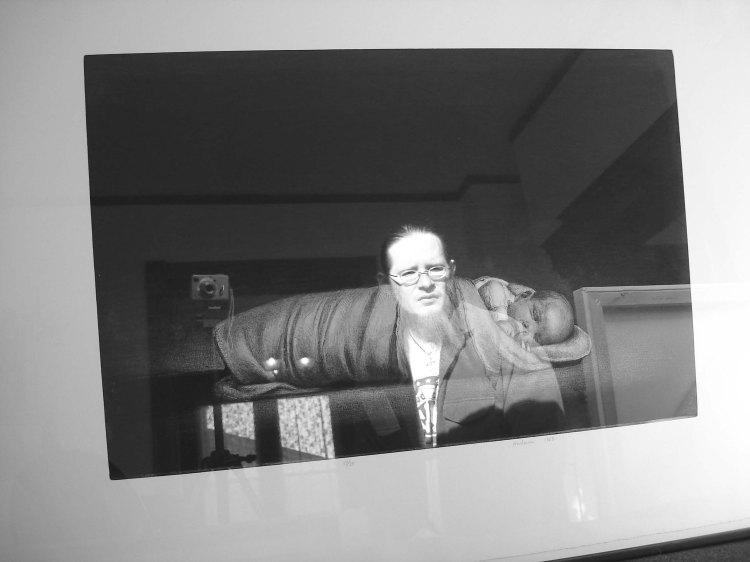
Image: my face reflected in a Nerdrum lithograph owned by a friend of mine.
I’ve finally gotten to set up my tondo making jig in my new woodshop. Here’s a run down of how it looks and an example of what it can do.

Here you can see the basic layout. I’ve created the body of the jig on a nice piece of half inch by 6 inch by 3 foot oak. Being a hard, strong wood, the oak will hold the mounted router well. The router itself (a nice mid-range Porter Cable model) is attached by removing its base plate and mounting it to the oak board as shown. The screws are recessed to assure good connection to the router.

Then I mounted a small “lazy susan” type ball bearing swivel deck to the other end of the board. I’ve measured and pre-drilled stations for the swivel deck in my standard tondo sizes – 12 inches (to give me a 24 inch tondo), 20 inches (40 inch tondo) and 24 inchs (48 inch tondo). I set it up to move the swivel deck to reduce wear and tear on the router mount area. I don’t want to take the router off at all. You can see how I’ve put some base plates along each edge of the board on the router end so the swivel deck and router approach are level when placed on the board to be cut.

To cut a tondo, I select my size (in this case, I want a 24 inch tondo) and put the swivel deck there (above). Then I screw down the other side of the swivel deck to the board to be cut so things are nice and secure (below).
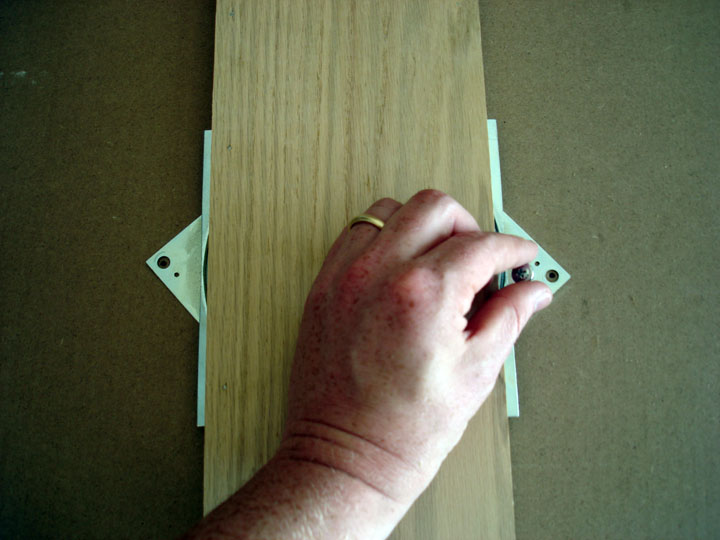

Then – with the bit still recessed up into the body – I will start the router and slowly plunge the bit about halfway into my wood. I learned in my previous experience with cutting tondos to take it slow and cut in a few passes to ensure a good, smooth cut but also to protect the router. The harder the wood, the more wear on the router – obviously with this piece of MDF the router could have done the entire cut in one pass, but I feel more comfortable taking a few extra minutes to keep the tool nice.

After the first pass – and each subsequent one – I use my compressor to blow out the dust. This increases the ease of the next pass and keeps the risk of charring or actual combustion down. I also make sure to blow out the vents of the router since the sparking within the motor can ignite dust that collects there.

In the above picture you can see the bit being adjusted down for the final pass.

After the final cut I remove the excess wood and blow off the dust (above), then remove the swivel deck and start to sand any burrs (below)
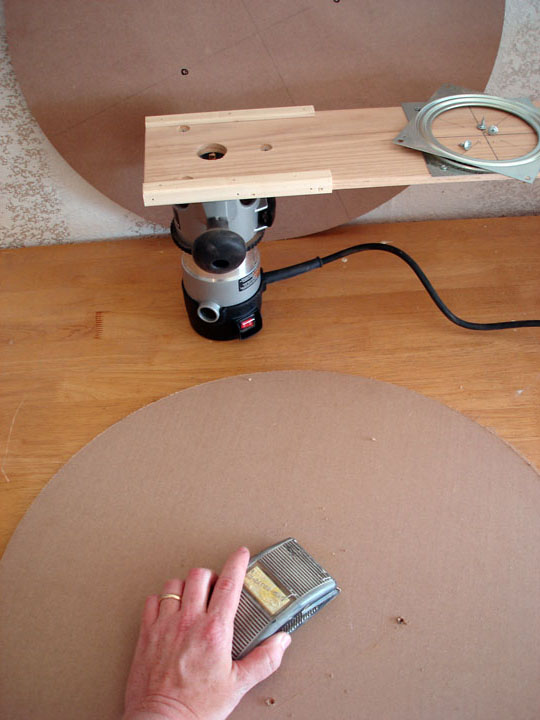

Here’s a look at the edge of the tondo – pretty smooth cut!

And the final products!

On July 21, 2010, I gave a talk at the University of Missouri. I’m posting the audio and my slide show as a 47 minute video for people who are interested. This isn’t a highly detailed academic type discourse at all – it is a very general overview of my interests/inspirations and a discussion of where my work has been going over the last few years. The video is embedded below – give it a few seconds to appear:
Feel free to email me or post comments of you have questions or thoughts.
I interviewed for a position at the University of Missouri this week. I gave a talk about my recent work – I’ll post a video containing the slides and audio soon – and a member of the audience, Sloane Snure Paullus (of ArtFagCity fame) took some notes on my talk. I present one page of her notes as completely indicative of my discourse.

Thanks, Sloane! :)
I graduated from SAIC nearly 10 years ago, and I’ve got a lot of memories from there. At first, right after I graduated, I was pretty negative about my experience. I felt as if they’d denied me some aspect of my education necessary to my future, that they’d tried to indoctrinate me, that they’d treated me like a number, not an artist.
In ways I was right, but in a lot of ways I was wrong. I’ve since gotten over it and look back with fondness, thankful that I grew so much during those years. One of the ways in which I grew was in my attention to the things that drew my eye. I began to document heavily, shooting thousands of photographs in the last couple years of my undergraduate career. Below I’ve posted some of those images. These are all from SAIC hallways and environs circa 1999/2000. I was obsessed with the angles, passages of light, and transitioning spaces in the places I saw every day.
Above, looking through the peep hole of my dorm door, 112 South Michigan Ave, 9th floor. This space no longer exists. Below, the elevator I took so many times.


Dead birds (they constantly flew headlong into the bank of windows on that facade, then fell, in droves, into the water below), dead leaves, and my shadow in a pool outside the lake side of the Art Institute of Chicago.
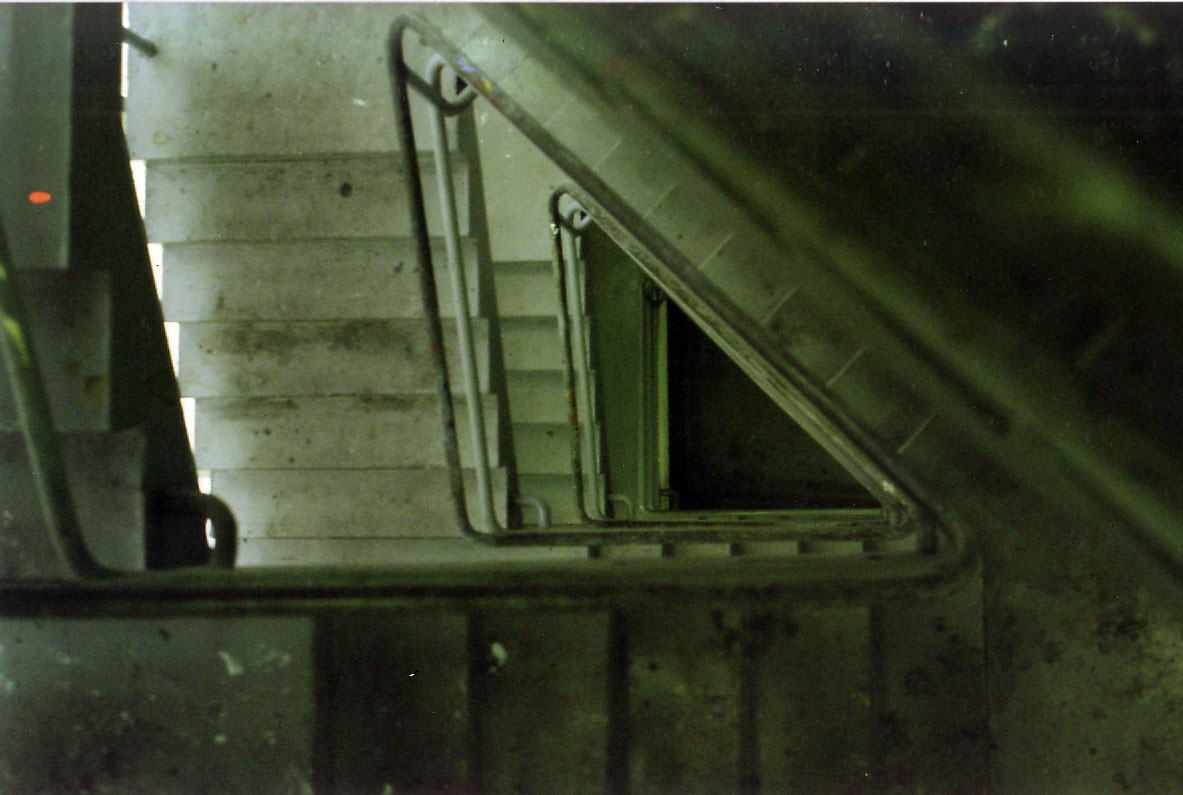
Two stairwell views on the way to the Advanced Painting studios (above and below).


Another stairwell view, light on the landing.

Glass and light, looking up toward the Advanced Painting studios.
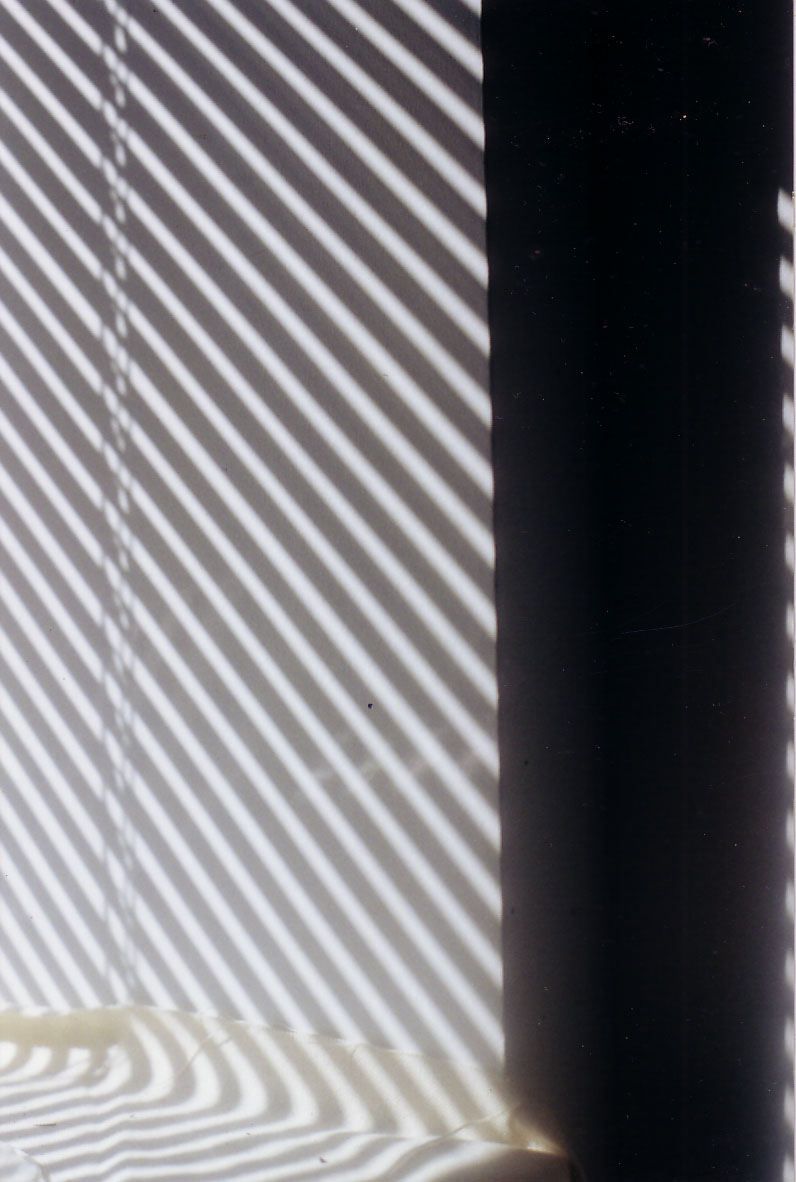
Sunlight glances through the shades of my 13th floor (the smoking floor) dorm at 162 North State Street.
Sharon Butler‘s great blog, Two Coats of Paint, carried an interesting piece today about how artists sign their work and what that might mean.
I’m a verso, pretty much always signing the back or in a place where it won’t be seen when prepped for display. It’s a specific choice… the signature is a formal element and a conceptually potent one at that. Putting mine on the verso sets identification but lets the image be image. It’s not a conceit of preciousness or faux-humility; I just don’t want the text of my name in the way of a picture I’ve constructed for certain reasons. Click each image to see the front side.


And here you can see a short review of one of my paintings Ms. Butler wrote, via the Thinking About Art blog. Thinking About Art was a project of J.T. Kirkland, a fantastic artist in his own right. Check out his site here.


 eikonktizo