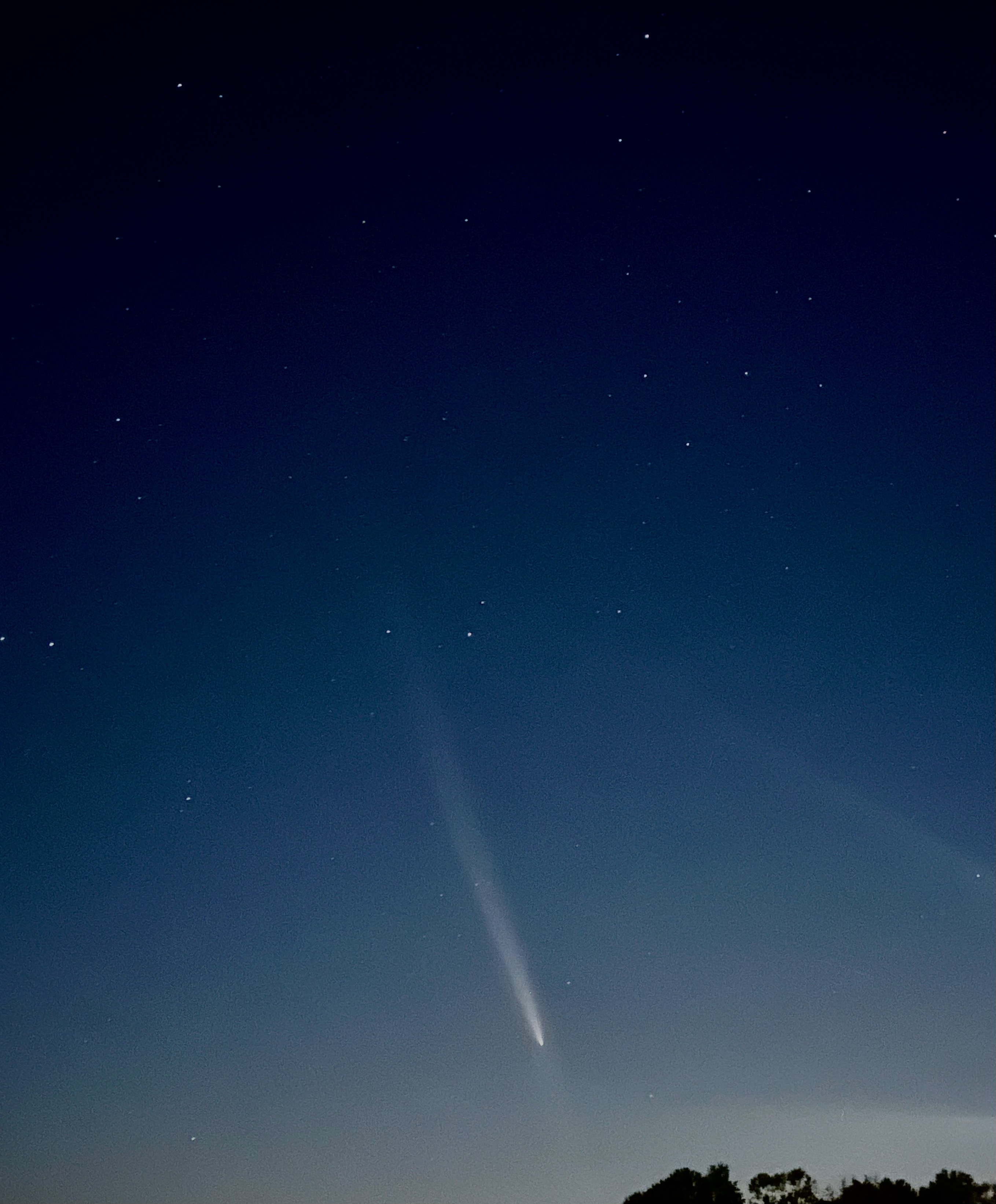
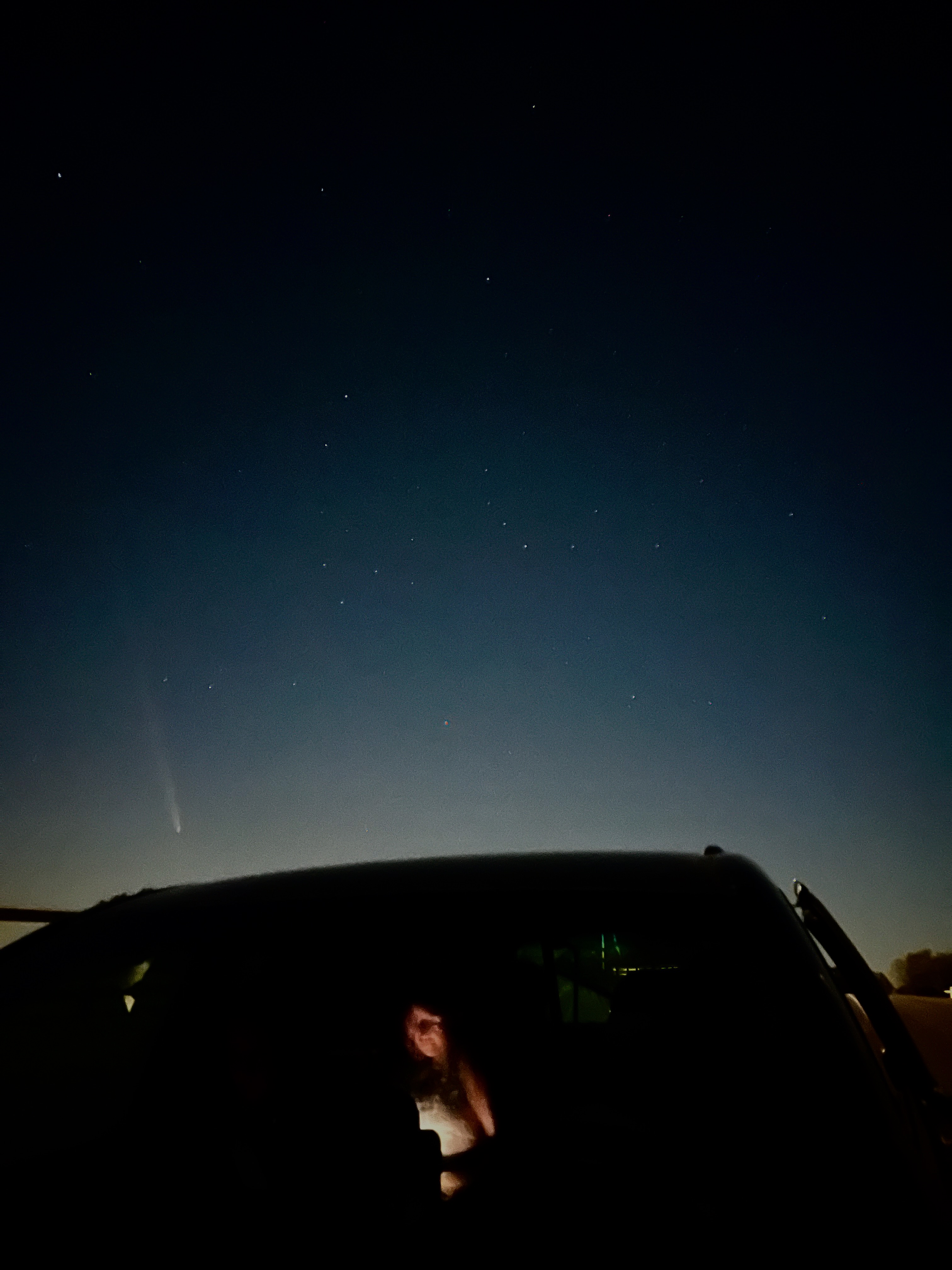
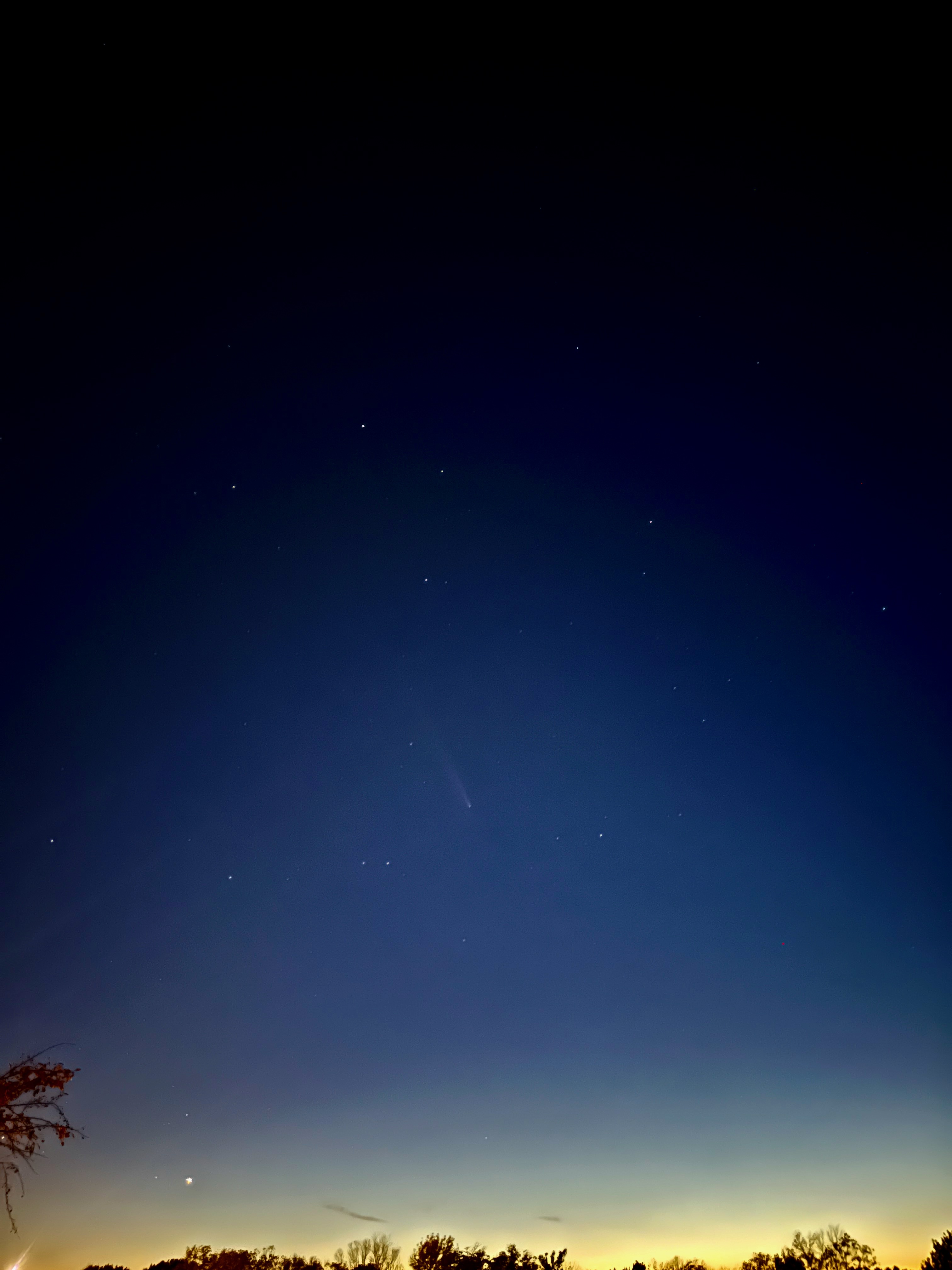
The beginning of the third week of the month was best, with some striking observations made possible with a short exposure time. Each night the viewing has been a little more difficult, and the tail a little shorter, so it may be beyond easy spotting very soon. It’s worth it, though. Once in a lifetime event here, folx.
I’ve gone out each night just to put my eyes on this ancient thing. Perspective is a quality that exhorts and propels the human heart. Seeing our conflicts and passions in the light of cosmic time and distance offers us the chance for true reflection.
One of the weirdest objects that used to exist in Columbia, Missouri is pictured below.
Benjamin Franklin in a tub shaped like a shoe, conducting a meeting, all the while stoking a fire beneath his own ass. Just look at it. AMAZING.
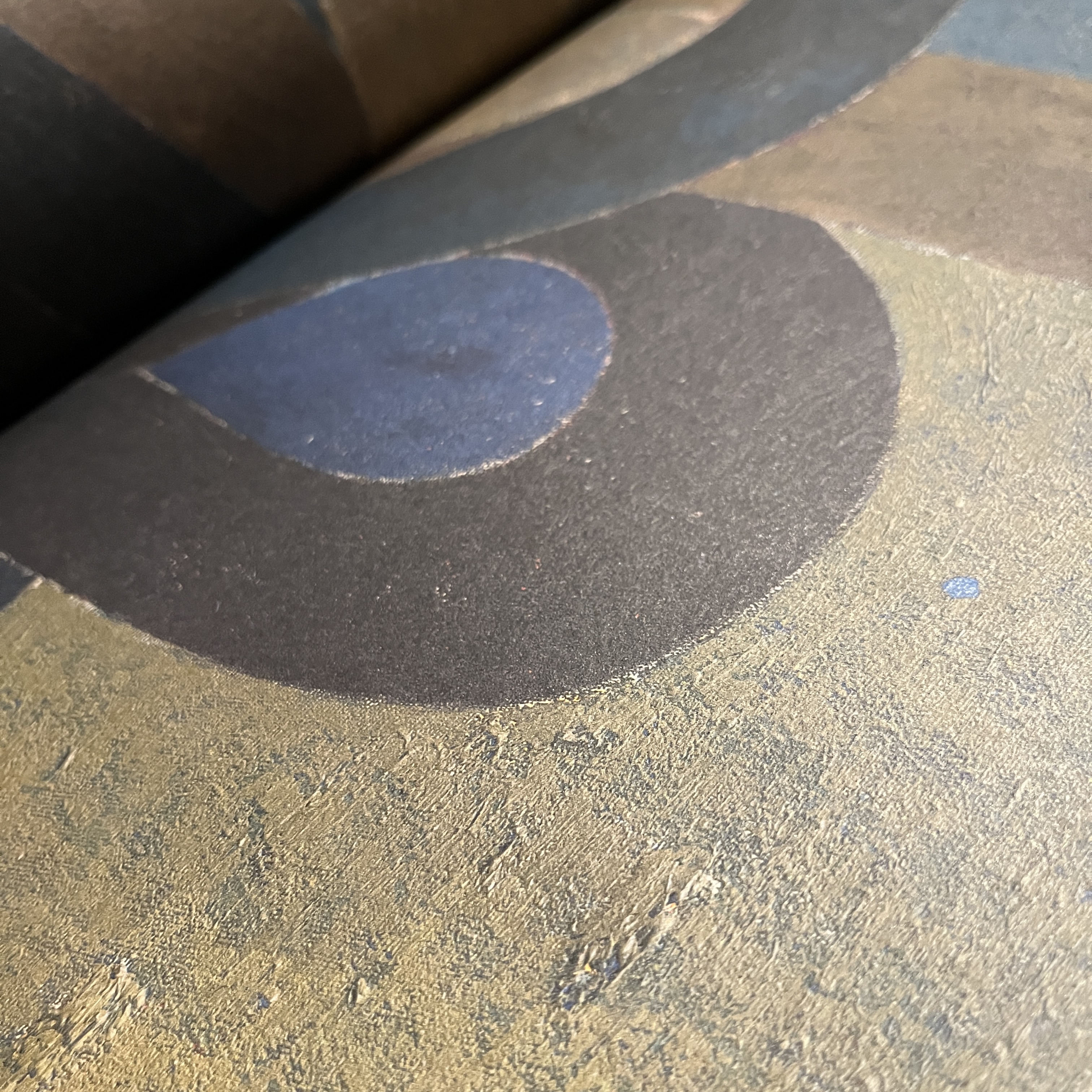
Sadly, the painting is now destroyed. I took pictures of it in 2013 when I did some art conservation work for Riback Pipe and Steel Company. The image below is a digital collage of shots because it was so hard to get the right angle on the work (there was a large, north-facing window opposite the painting.
My understanding is that the tub DID NOT ACTUALLY look like a slipper, but was what is called a “slipper tub” and was fairly common. I can find no reference to a tub shaped exactly like a shoe/slipper anywhere. I think Larson was taking some creative license here.
“France, Late 18th Century” by Sidney Larson
Missouri painter Sidney Larson completed this painting entitled “France, Late 18th Century” in 1969 as part of the “The Riback Mural,” commissioned by Harold H. Riback for the Riback Pipe and Steel Company building, which is situated at the east end of Business Loop 70 in Columbia, Missouri.
The Ribacks sold the business to Plumb Supply Company in 2015. Eventually, the building housing the mural was remodeled and the paintings were destroyed. According to the State Historical Society of Missouri’s Art Collections Manager Greig Thompson, the mural couldn’t be preserved due to the methods by which it was installed.
Notley Hawkins took photographs of the mural in December 2021, at the request of Vicky Riback-Wilson to preserve a record of the paintings. Hawkins studied painting and drawing with Sidney Larson at Columbia College in the 1980s.
In 1980, Larson published a booklet entitled “The Riback Mural” which included the following description of painting:
“Benjamin Franklin landed in France in December of 1776 and soon after set up quarters at Passy outside of Paris. His purpose was to solicit aid from the French toward the defeat of the British during the American Revolution. He proved to be a very popular man and was in great demand. He did suffer from attacks of gout for which his doctor recommended hot baths. For this, Franklin had the slipper tub, pictured above, built for him. He took hot baths twice a week, each one lasting as long as two hours. Hence the occasional meeting held while in his tub.”
Top left quarter: Marie Antoinette prior to losing her head. Top right quarter: Empress Josephine looking a bit like “The Death of Marat” in her bath. Bottom half: Franklin taking a meeting in the shoe tub. So weird.
Since 2019 I’ve worked as a portrait painter celebrating Mizzou student athletes. This last year was a high mark for Mizzou Football, with four of the squad being named All-American.
The University has a posh facility located in the south end zone area of the stadium where they hang all of the All-American portraits, stretching back into the 1930s. The great illustrator Ted Watts (1942-2015) created most of the portraits over the course of more than three decades, so I’ve got a big act to follow.
The All-American portrait wall at Mizzou Football’s South End Zone facility.
The display is pretty cool, and it’s cool to have my work extend that tradition. Portraits of Kentrell Brothers and Harrison Mevis are two of my works currently on display, and four new ones will appear soon (Fall 2024).
When I began to create my paintings, I went on a tour to see the previous works up close and to evaluate the aesthetic through-lines (format of names, dates, poses, backgrounds, etc), as well as the techniques prior artists used.
I take a central role in the design process, creating digital mockups which are approved at Mizzou Football before I begin the paintings. I generally work with ink on paper, which is mounted on panel and sealed, then painted over with layers of acrylic. I try to maintain a painterly quality, with texture and dynamic brushwork on display. I also attempt to bring the digital effects which naturally appear in the preliminary studies into a physical realm with semi-transparent washes of paint.
Working on the portrait of Cody Schrader.
As the projects have developed I’ve found my own approach to the portraits. I want them to have kinship with the portraits of Watts and other previous artists, but I make sure to give the works my own unique inflection.
I’m excited for the new crop to go on display. Kris Abrams-Draine, Luther Burden III, Javon Foster, and Cody Schrader are the 2023 All-Americans for Mizzou Football. See images of the works below, but also be sure to stop by the All-American wall if you ever get into the South End Zone building!
MF DOOM (keep caps on that name!) was a highly skilled and influential British rapper. Throughout the years, fans have been drawn to creating various artistic interpretations of his famous mask, behind which the artist almost always appeared/performed.
My good friend Jesse Slade, proprietor of KING THEODORE RECORDS, got me more interested in MF DOOM years ago. I’ve created representations of the mask in the past for illustrations/artworks using in Jesse’s record shop, but I wanted to make a move into a Lego version (or two) after I saw some folx creating them online.
Shout out to The Canvas Don and u/vonaudy for their versions of a building block/Lego MF DOOM mask. Both are awesome. I also like the “blockheadz” versions here and here. These examples served as inspirations, but mostly I just played around with what I’ve got in the old Lego vault.
I created the two versions below in standard light blue-gray, dark gray, and white, but then spray painted them with a chrome silver for proper effect. Take a look and enjoy. The smaller one is 4x5x2 inches and the larger is 5x6x2.5 inches.
Smaller MF DOOM Lego Mask. Click to see larger versions.
Larger MF DOOM Lego Mask. Click to see larger versions.
As 2023 rolls toward an ending, I want to share with you something I’ve been keeping to myself for a few years now.
Go back to the beginning of the pandemic. Schools closed. Information and misinformation flew back and forth. Of course everything was a political dumpster fire; a pervasive heaviness spread over the land. And don’t even get me started on the ritual of using disinfecting wipes on every square centimeter of grocery item delivered to our front door. Even on nature trails and in wild spaces we were warned to keep spectacular distance from each other.
It was the weirdness of being told we shouldn’t use the nature trails for hiking or triking that caused me to consider using the Hitt Street Garage as a place to get my miles each day. School had closed in March, and after finishing up that semester remotely I began to spend time in the garage. There were no cars there, and often my children got some out-of-doors time in by riding their bikes around the middle levels while I walked (click here to see evidence of one of my first workouts in the garage).
By the time May ended I was going to the garage several times each week. It was then that I took special notice of a denizen of that forsaken building: the cheese. That’s right: a slice of processed cheese product cheekily flung off a take out burger and – somehow – perfectly caught on the concrete wall. It was THE garage cheese.
I had seen it earlier in the year – perhaps the first week of March. I had no solid idea how long it had been there, but it was leathery and tough (yes, I touched it). It might have been there a month or two. It still had the strong, unnatural hue I’d come to expect from cheese like this. At first it was just a funny bit of ephemera living in the garage, much like the plethora of unused .223 bullets, spent CO2 cartridges, or carcasses of baby birds that hadn’t made it through the summer heat. But as I passed the cheese over and over again in my rounds up and down the floors of the parking garage, it began to take on more and more importance.
Crazy, right?
I shared my observation of the cheese only with family and a few close friends; I didn’t want it to be disturbed. Being early in our collective quarantine, I felt sure the cheese would be safe. But I was keenly aware that once things went “back to normal” there would be some frat-bros carousing in the garage. There was no way the cheese could survive the onslaught of undergraduates! I just wanted to see how long it would last, and I didn’t want any human intervention. There was an alchemy taking place between the cheese and the garage, a synergy that must be allowed to continue! I was committed to no engagement other than photographic documentation.
The Garage Cheese on September 12, 2020. Ballou.
I began taking periodic shots of the cheese, with my first one from September 2020. I know I took earlier images, but I didn’t see the cheese as anything more than a humorous curiosity then, and so didn’t save them. It wasn’t until March 2021 that I made the decision to document the state of the cheese monthly, as well as make periodic check-ins every other week or so. I viewed the month of March as the anniversary of the installation of the cheese, and it felt right since that was when Mizzou closed down. In a way, the cheese was a physical artifact of the many ways in which COVID altered our experiences of life.
Over time, the cheese itself began to change. Flexing with the heat and humidity, cracking under the pressures fighting against its preservative-laced body, the cheese maintained its grip on the concrete. Something in the material nature of the porous wall and the glue-like substance of the cheese made their union not only possible, but hearty. By March 2022 the cheese was gnarly and swarthy, hung all over with dust and the debris of generations of spider webs. The darker coloration made me feel more secure that people wouldn’t see it.
This was important, because life was returning to the campus. The garage was being used more and more. By the fall semester, most people felt safe teaching and learning in masks. This was a tense time for me. I began to check on the cheese several times a week, certain that it would be gone one day. I took to obtaining photos of the cheese only when I would not be observed. I didn’t want my attention to a seemingly nondescript section of the garage to draw others near.
The Garage Cheese on March 14, 2023. Ballou.
I got a bit more intentional with the photography in 2023. The shot from March that year is particularly nice. I began to think the cheese really would make it to the four year mark. People encouraged me to post about the cheese, to make an Instagram account for it, even to mark it on maps. But I knew there would be time later to show folks where it had been. I wanted it to make four – maybe even five – years! As Thanksgiving passed, I felt more confident than ever. After the first day of graduate reviews on December 1st, 2023, I made a pass by the cheese for my December check-up. It looked robust, confident. It was ready to press on toward another anniversary upon the wall. So it was that when the second day of grad reviews concluded on December 8th, I took one of my grad students over to see the cheese. I figured I could share the glory with more people. Surely that would be okay.
THE CHEESE WAS GONE.
Astonished, I rushed out to investigate the scene. There, amid a thick mass of trash and various organic detritus, rested the cheese. It was in a gap between the wall and the floor, and it seemed to be intact. No one had abused this artifact; it had let go of the wall on its own. Its time was up. The race was won.
I carefully rescued the cheese. It was rough and hard, as dense as holding a fragment of bone. Yet, like bone, I perceived it would be brittle. Maybe it had been the dusty garage trash that provided a soft enough landing to save the cheese from breaking against the concrete. Whatever the reason, after nearly 45 months on the wall, the garage cheese was now mine!
The Garage Cheese, framed in a shadowbox on December 26, 2023. Ballou.
I quickly collated my photos of the cheese and obtained a simple shadowbox frame for it. Now safely transferred to the wall of my studio, the cheese can exist in perpetuity, assured the status of a protected relic. As part of the process of documenting and celebrating the garage cheese, I have created the GIF below. I did a modicum of image adjustment so that you can get a sense of the changes that happened over the course of the years. Of course, it’s not perfectly color-corrected, nor entirely aligned for precision, but you can definitely get the sense of how the cheese transformed.
While the cheese itself has left the Hitt Street Garage, there is something that remains behind: a kind of oily stain is still quite visible on the wall of the garage. If you look in this wide shot below, you can see it just a bit left of center. Follow the inner vertical line of the leftmost column downward, and you’ll notice the apostrophe-like arcing shape. That’s a ghostly shadow of the cheese, somehow still clinging to that precarious perch.
The location of the Garage Cheese, photo taken on December 26, 2023. Ballou.
Click below to take a look at a curated selection of the cheese. If you’d like to purchase a print of one of these images, send me $20 on Venmo (here), and I’ll mail it out to you. Just be sure to tell me which one you’d like.
The Cheese Garage, September 2020The Cheese Garage, July 2022The Cheese Garage, November 2022The Cheese Garage, March 2023The Cheese Garage, April 2023The Cheese Garage, August 2023
The distance between months and years, and all that we did and saw and felt… in one image. Maybe I should do some risograph prints of these, too… On to 2024!
A final thought, as I sit here with family and smile at my cheese…
Here’s hoping your ’24 is joyful, safe, and peaceful. We know it probably won’t be, though. At least not for most of us. So why do I offer the above trifle about faux fromage? Why present some cast off cheese as a visual metaphor or point of access for meaning? Well, I think the greatest part of our human experience is in the realm of attention. I teach my students this, and I try to teach my own children it as well. When we are attentive to the world around us, when we believe in the value of observation and awareness, then we are most able to be both realistic and hopeful. It is willful ignorance or chosen obfuscation that breaks the social contract, that causes us to care less about each other and the world.
We are living in times of serious violence against not only people but against our ability to apprehend true things. We desire to be told what we want to hear, rather than what we ought to hear. We ignore what should be seen straight on, seeking instead things that distract us from beingness. These are our great sins, particularly in America. We have allowed our politicians to be criminals. We enable them and they stroke our egos in return. Our domestic and foreign policies – for all of our posturing to the contrary – are not “pro-life.” We have become the arm of death. We resist over and over the chance to do what is right, because we know that will make us feel a little uncomfortable. Our comfort is our chief aim, and it’s obvious.
In light of all of that, perhaps everyone would do better to pay close attention to their own version of garage cheese. I hope we can get started on putting our collective house back in order in 2024.
I have mentioned the importance of Miyoko Ito many times before (here, here, and here), but there’s a little more to celebrate this Christmas day: I just received the new book Miyoko Ito: Heart of Hearts hot off the press.
Published by Pre-Echo Press, and featuring the research and writing of Jordan Stein, Heart of Hearts is the major publication that Miyoko Ito and her work deserve. Jordan Stein is an active and insightful curator who has developed a major presence nationally over the last decade. His research into and presentations on Ito are extremely significant, adding great depth to what is available on the artist.
Detail of Orange Cloud from 1977 by Miyoko Ito as shown in Heart of Hearts.
Loaded with chromatically accurate images, Heart of Hearts is the most complete compendium of Ito’s work available. Beyond this, the book provides a single place from which students and admirers of her painting can find all pertinent information about her life and process. Stein’s essay provides key context, deftly connecting Ito to not only her roots in the Chicago art scene but the broader aesthetic superstructure to which she belonged.
Detail of Susquehanna (The River) from 1959 by Miyoko Ito as shown in Heart of Hearts.
These two arenas – solid text and quality images – really set this publication apart. From the beautiful debossed cover (front AND back) to the matte surfaces of the large full color spreads, this book delivers. The sense of texture and painted action is wonderfully realized in these pages. I kept being surprised by the surfaces of the paintings coming to life. This is an ESSENTIAL book for anyone interested in mid-20th century painting generally, or Miyoko Ito in particular. To finally have one volume that really pulls it all together is just wonderful.
Front and back covers of Heart of Hearts.
This book is an appropriate celebration of Miyoko Ito as a person and as an artist. It includes nearly all of her work, some of which have been lost. While not technically a catalogue raisonne, it might be the next best thing, as it provides the most complete picture of her work that we’ve ever had. For this, we can thank Jordan Stein and Pre-Echo Press.
In my opinion Miyoko Ito: Heart of Hearts is the most important publication dealing with American painting since Yale’s four-volume catalogue raisonne of the work of Richard Diebenkorn. Go buy it.
I watched Poltergeist again this year, and am still so impressed with it. There are a lot of reasons, but a few things really stand out.
It’s not just the expertly crafted and paced music (Jerry Goldsmith).
It’s not just the practical, in-camera, optical effects (Richard Edlund, John Bruno, Nilo Rodis-Jamero).
It’s not just the fantastic physical and emotional presence of JoBeth Williams (an absolute classic performance that should have been rewarded).
JoBeth Willams as Diane Freeling
It’s not just the introduction of one of the most compelling characters in all of cinema (Zelda Rubinstein as eccentric medium Tangina Barrons).
Zelda Rubinstein in Poltergeist.
All of that is great and worthy of note.
But it’s also that the children and women are centered. They’re not “hysterical” nor are they “irrational.” They see and know deep realities, even if they can’t understand or entirely describe them (a theme borrowed from Spielberg’s Close Encounters of the Third Kind). These characters are the central interpreters. They stand in for the viewer. We don’t dismiss the father as a moron, but neither do we have to make him the hero. Furthermore, we don’t have to MANUFACTURE the heroism of the Carol Anne, mom Diane, or mystic Tangina. The film naturally makes them function in ways that stimulate the narrative arc without BS or montage-based tropes. They don’t miraculously and instantaneously become triumphant; they live through a trajectory of growth. They don’t automatically know everything; they use their innate characteristics to attend to the film-reality in specific and logical ways.
Heather O’Rourke, JoBeth Williams, and Craig T. Nelson in Poltergeist.
Sure, there are other examples of these qualities in popular (and more niche) media. But an average suburbanite mom coming into contact with a situation so physically and conceptually counter-intuitive gives this movie a sense of genuine humanity. Its influence is still palpable in the the horror genre some forty years on, and it’s an experience always worth a revisit.
See it if you haven’t yet (it’s available on MAX)!
This past week I gave a talk for The Honors College at The University of Missouri. The theme this fall was The Art and Science of Living, and they asked me to give a guest lecture about the nature of the body in the context of my work. I chose to focus on a number of artists who have shaped my ideas about the meaning of the body. – from Anne Harris and Robin F. Williams to Kathe Kollwitz and Charles White.
To hear the talk and see all of the artists and images I explore in the presentation, click the link here.
I had the opportunity to sit on a panel at The Columbia Art League on October 12, 2023. Moderated by Diana Moxon and including CAL Executive Director Kelsey Hammond, the wide-ranging talk engaged with a lot of what artists are thinking about in the age of AI. Watch the video below to see a visual presentation of our research, examples, opinions (and humorous asides) as you follow along with the discussion.
I’ve got a group of works on display at William Woods University in Fulton, Missouri. The show runs through October 6th, and I’ll be giving a talk that evening. For a preview, look below.
This is the third time I’ve shown this body of work, and I’d like to get the chance to show it again. The subject of the work – a “friendly-fire” bombing of a Doctors Without Borders hospital in Kunduz, Afghanistan. If you’d like to see more about this situation, check out my writing about it here.
The card for the exhibition.Back of the card with description of the show.Here are just a few of the works on display, along with some details. There’s a lot to see, so come on by!
I’m also pleased to have a small group of my collaborations with Joel T Dugan also on display at the gallery. These Phoneme works are some of my favorites, and there are a number of just finished works included.