The Huffington Post Includes my Work in a “Top 10 Best” List

I was gratified to learn that The Huffington Post included my recent essay on Richard Diebenkorn, written for neotericART, in a “Top 10 Best” listing! The piece, written by Brett Baker of Painters’ Table, cited my work immediately after Raphael Rubinstein’s “Provisional Painting, Part 2.” This was excited to me, as Rubinstein’s original text on provisional painting was a catalyst to my thinking in my piece. Here’s the takeaway quote:

“Artist Matthew Ballou’s piece “Diebenkorn: Provisional Action, Provisional Vision” finds surprising and convincing connections to this kind of provisional approach in Richard Diebenkorn’s Ocean Park paintings” – Brett Baker for The Huffington Post.

Thanks, Mr. Baker! Painters’ Table is awesome! Read my essay at neotericART here!

Diebenkorn, Painting, and Contemplation

My most recent essay is now available to read on neotericART. The piece was written after an October 2011 trip to Texas that was funded partially by the University of Missouri (where I teach). It is a long contemplation on the experience of seeing Diebenkorn’s work in significant number and in appropriate surroundings, but also reflects the long-time presence the great artist’s work has held in my mind. I also see the text as a lateral critique of Raphael Rubinstein’s (part 1, part 2) and Sharon Butler‘s writings about provisionalist/casualist painting. I hope you enjoy the piece and would welcome any comments you have.

Statement, January 2012

     I create paintings, drawings and prints in an attempt to address – through archetypal themes and symbols – the fundamental questions, ideas, hopes, and concerns I have about being in the world. I write texts in an attempt to integrate rational conceptions and reflections with my passionate, sometimes illogical, image making. In tandem, these avenues of expression form a multifaceted arena of investigation and inquiry that I use every day to – hopefully – understand and make sensible the miraculous reality of being.

     The statement above relies on the fact that I am deeply interested in three main aspects of the human condition: being, symbol, and body.

     I am intrigued by the state of evocative subjective experience that Gaston Bachelard described as “the astonishment of being.” Thus, though I am interested art of all kinds, I take particularly to those forms that connect with our embodiment or sense of being. This means the physical world, the objects we use and love, and the bodies we inhabit are particularly important to the sort of art I want to see and make.

     It follows then that I find the expression of meaning through symbol – that is, the potential for objects to accumulate and resonate with meaning – to be a central interest of my art-making practice.  Anything containing meaning has been, as John Dewey wrote, “funded” with importance through the physical interaction and intellectual contemplation human beings have invested in it over time.

     The body is the zone of incident where being-ness and the structures of significance coalesce. Therefore, I foster a deep appreciation for the human body as a container for and calibrator of meaning and knowledge. As a maker of images – be they painted, drawn, or printed – I function as a symbolist in the traditional sense; I create tableaus for the relational contemplation of that which is beyond the facts of appearance. In doing so I hope to stimulate an evocative, transformative experience in my fellow human beings.

What I’ve been musing on recently

I’ve been thinking about overtly shifting the direction of my work for a while now – perhaps a year. I don’t know that this shift would be easily discernible from the outside, but it represents a significant change of focus for me. As I look back over the last year of my practice and then cross-reference what I’m seeing there with some of the artists and artworks I’ve been looking at during that time, I can really see some connections forming.

For instance, check out these recent pieces:

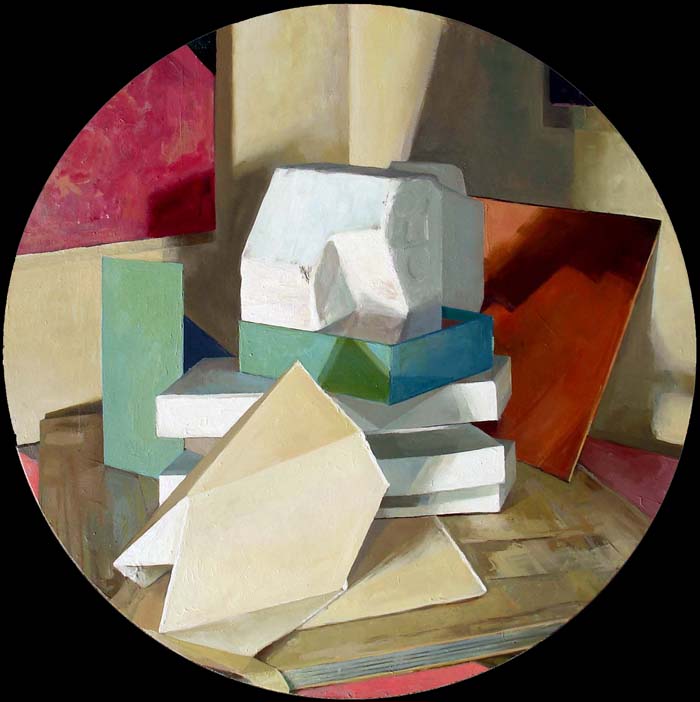
The Teachers, Mandala for the Murky History of Beginnings and Endings #1, Portrait of Miranda at Thirteen Months, Two Bells, and The Seedbed #1.

Then compare their compositional formatting with aspects of the works of artists I’m looking at here:

Richard Diebenkorn, Miyoko Ito, Barry Le Va, Nicholas Byrne, David Rabinowitch, Julian Stanczak, Bernd and Hilla Becher, Marcelo Bonevardi, Frank Nitsche, Sharon Butler, and Vincent Fecteau.

It seems to me that my previous forays into more formal explorations – such as with the Locus Series (book here), and the conceptually interconnected Quintessence Series and Dodecahedron Series – are becoming more and more deeply apparent in my main body of work. In some ways I’m finding myself less drawn to the figure as a necessity and more drawn to the composition itself. I’m deeply interested in the perception of formal dynamics and the sense of haptic maneuvering that can take place within two-dimensional forces.
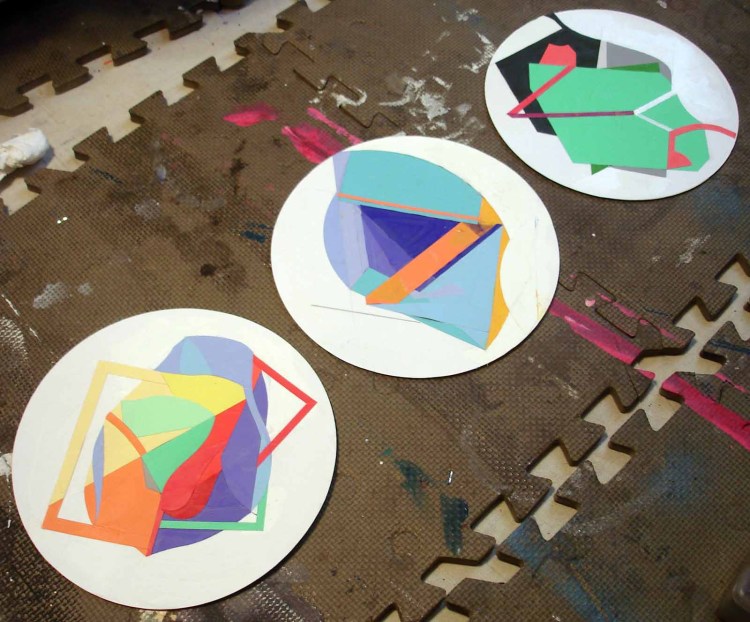
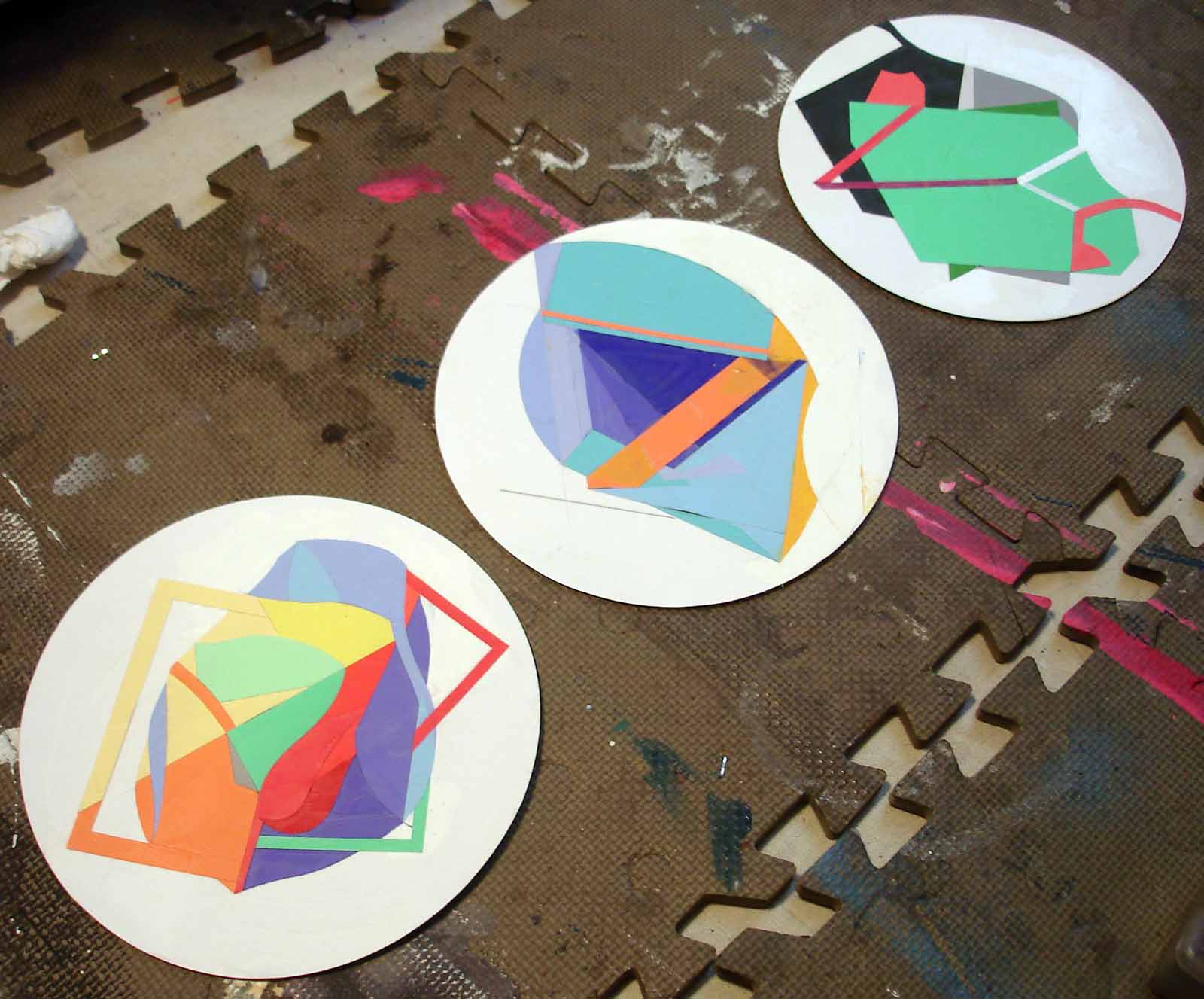
So it is that my recent miniseries, three of which are shown above in progress (9 inches in diameter, collage, gouache, acrylic and graphite on paper), have come about. They call back to previous works, such as this one from 2005, which was part of a side project I did while finishing up grad school (I needed a break from my thesis paintings):
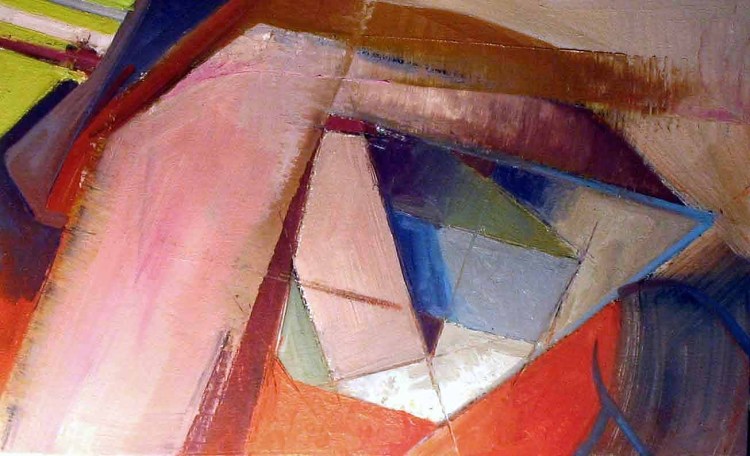
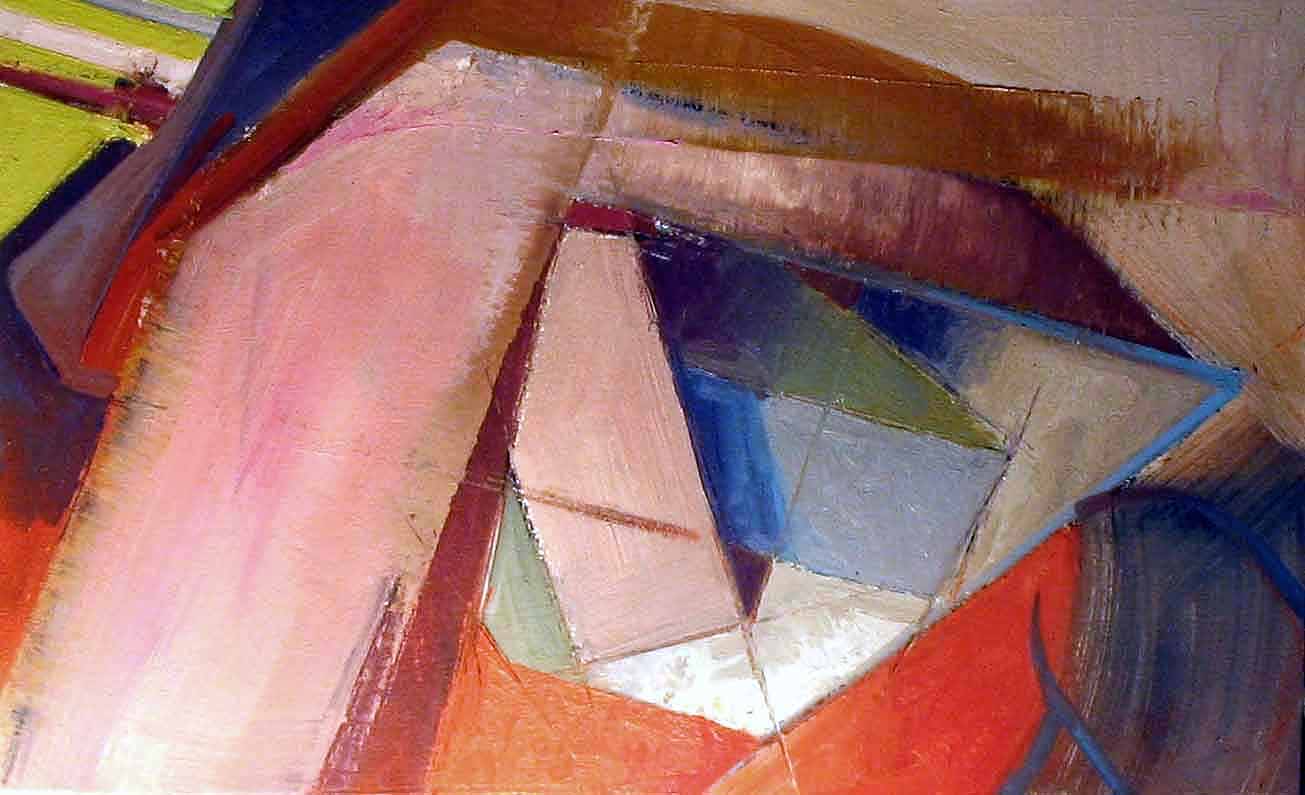
First Bend, Oil on Canvas on Panel, 14 by 23 inches, 2005. Destroyed. Click to enlarge.

Anyway, who knows? We’re all moved and pressed and pushed, often by things we don’t entirely recognize. That’s why painting is so much more like getting lost in the woods than it is like jumping in a car and driving to the store for milk. It’s not meant to be that simple.

If it were that way there would be no discovery, no evocation beyond what we already know… and what good would that be?

Visiting Ocean Park

Recently I visited Fort Worth to experience the retrospective of Richard Diebenkorn‘s Ocean Park paintings. I have spent the last two weeks trying to process what I saw and what I think about what I saw. I’ve loved Diebenkorn’s work since my first encounter with it. I had to wait nearly 15 years to get the chance to really see the work in context. I’m in the midst of writing my reflections; they’ll appear over at Neoteric Art sometime in the next month or so. For now, check out some pictures of me and Marcus taking in the majesty of Ocean Park.

Marcus sketching from Ocean Park #30.

Marcus scrutinzing Ocean Park #135 – that’s the corner of Ocean Park #93 above his pencil.

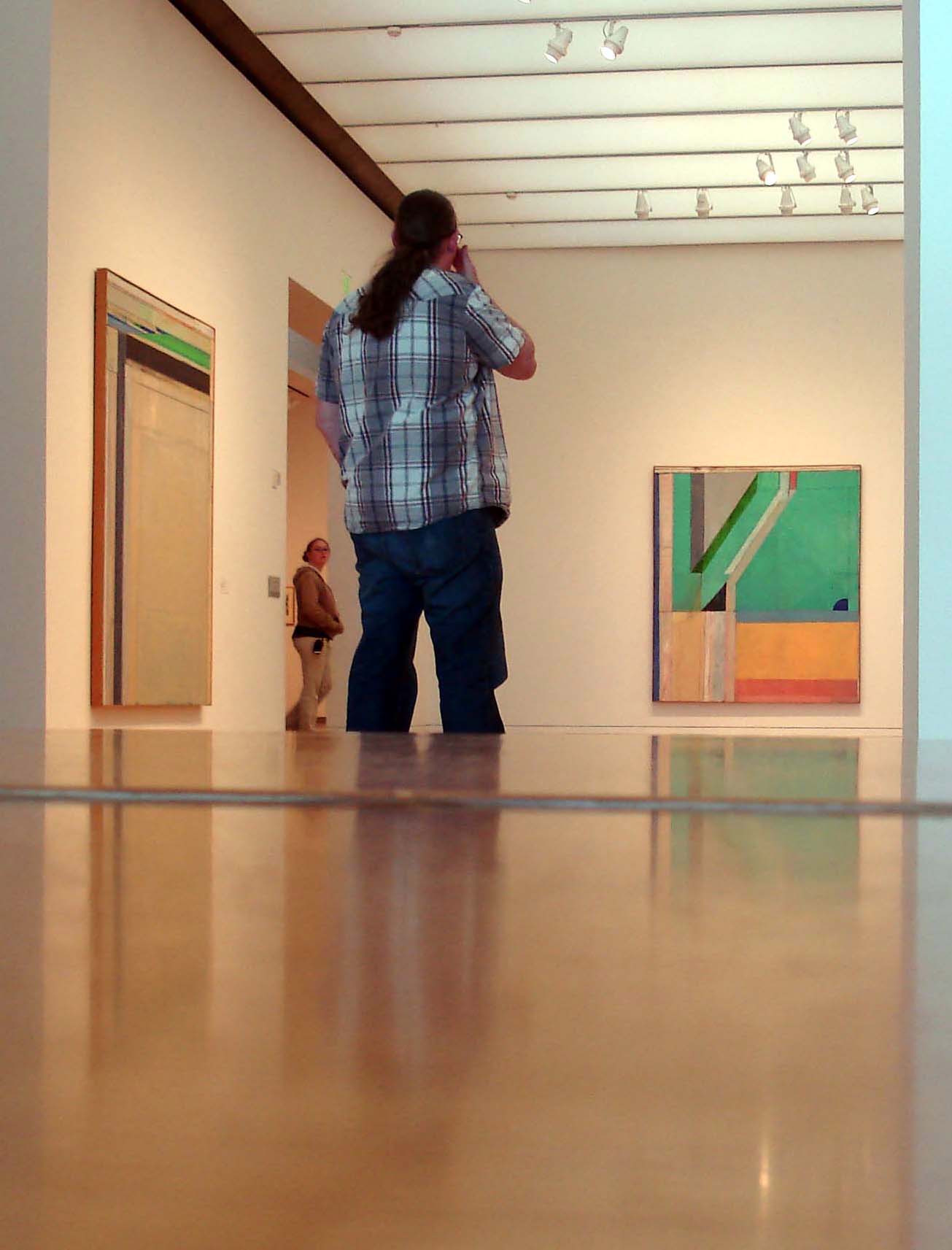
Me taking in the glory of Ocean Park #40 from across the gallery.

Here I am considering Ocean Park #79.

And jump here and here to see some pages from my notebook written/scribbled during my time in the exhibition.

If you can’t make it to the venues the show will travel to over the next year, be sure to see this nice photo essay from the current iteration of the show.

Transient Geometries at Antelope Valley College

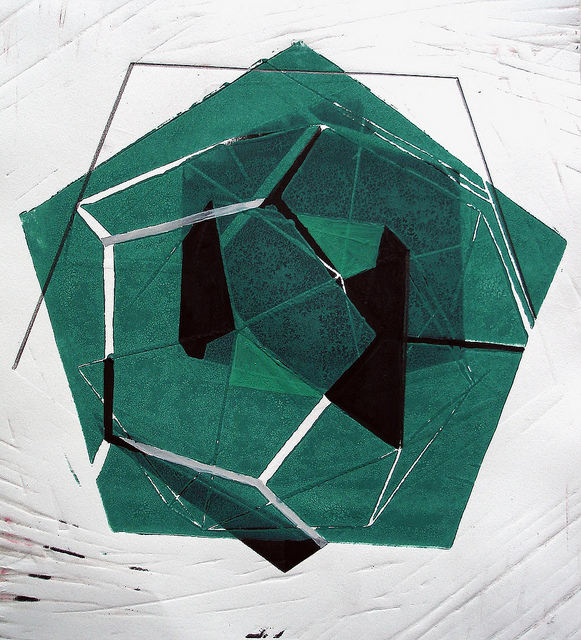
Quintessence #10, multiple monotype and woodblock prints, with acrylic, graphite and gouache on paper, 2009. Click to enlarge.

I’ve been included in a small group show at Antelope Valley College, which was organized and curated by AVC Professor Christine Mugnolo. I’m honored and excited by my fellow exhibitors: J. Jordan Bruns, David Eddington, and Lisa C. Soto. Click here for the AVC Gallery page describing the show!

Full disclosure: I went to grad school with Christine and she was the subject of one of the shows I worked with Gillock Gallery to organize back in 2006. I wrote an essay about Christine’s drawings and Gillock published a small catalog for the exhibition containing the text and a selection of her work. I’m really proud of that entire project and hope you’ll take a look here.

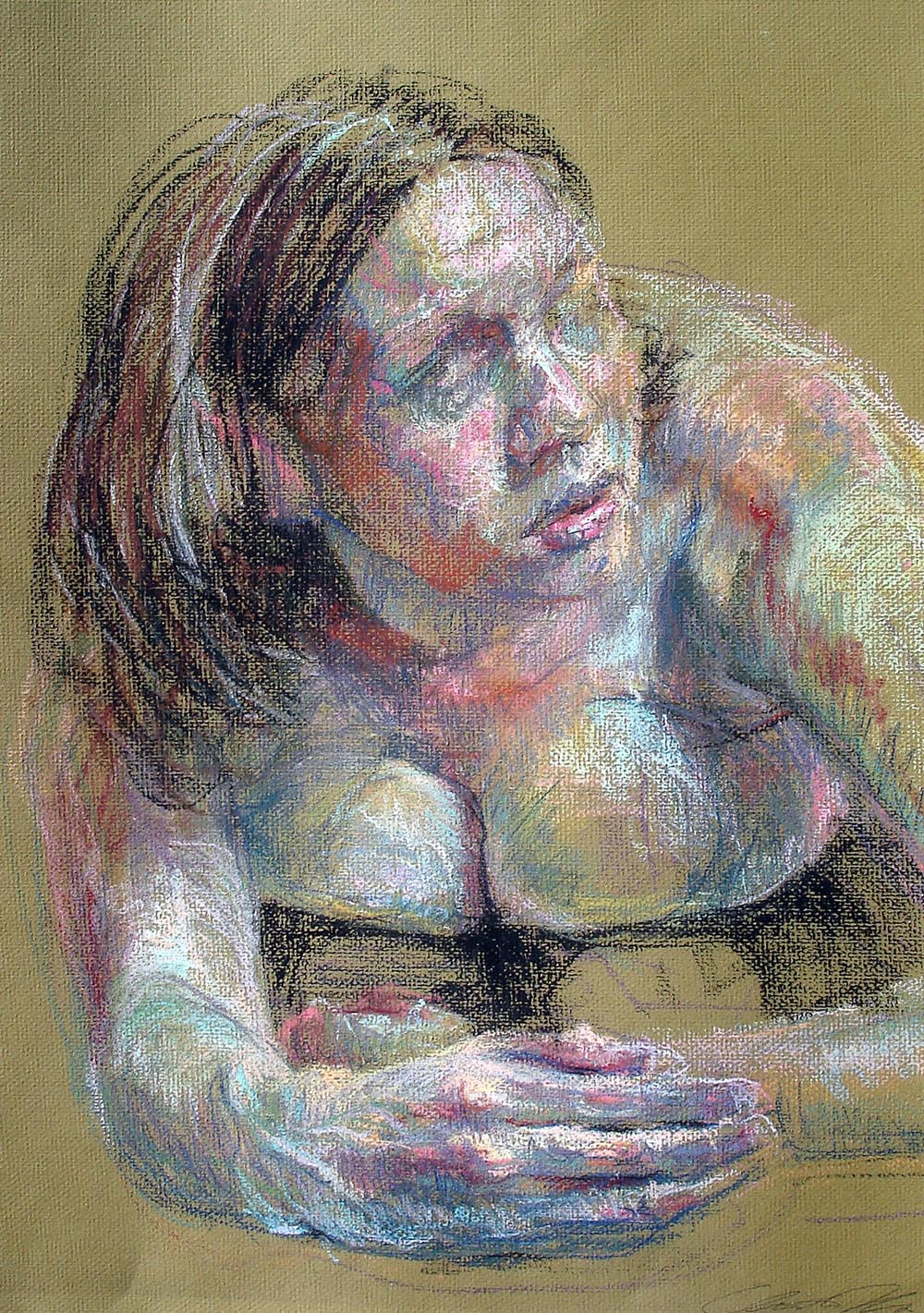
Here’s one of the drawings from the show – Self Portrait on Olive Ground, Pastel on toned paper, 24 by 18 inches. Click to enlarge.

Two New Books

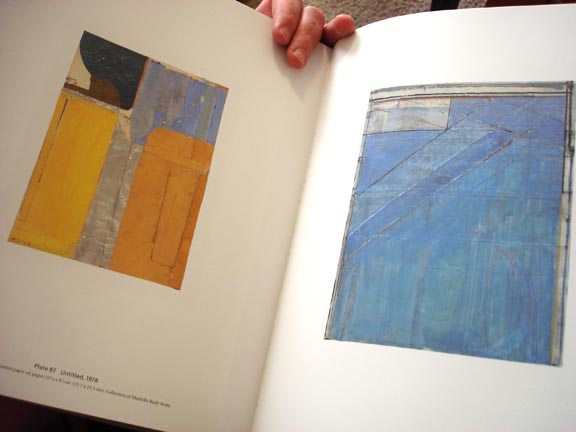
First off, I received my new Diebenkorn book this week. Richard Diebenkorn: The Ocean Park Series is lush (in design), expansive (it contains many reproductions), and – best of all – it’s full of never before seen (in broadly-published form) paintings, prints and drawings. I’m doubly charged up by this book since I (and one of my students, Marcus Miers) are heading down to Fort Worth to see the Diebenkorn show next week!

Also, my own slim tome – 62 pages, 9 essays – just came out, published by Neoteric Art in Chicago.

It’s available in standard paperback version and in an ereader version. It should be up on Amazon in a few weeks as well.