Andrew Glenn in Moberly, Mo

Printmaker and teacher Andrew Glenn has a show, entitled Standardized Diversity, up at Moberly Area Community College in Moberly, Missouri through December 3. I visited the show last week and enjoyed a number of the works. Below are a few images from the show. You can find out more here.

1 Installation (Pig Storefront) with printed newsprint, light, and wood.

2 Detail from Summer (Pallet of Watermelons), Marker on foamcore.

3 Detail from Fall (Pallet of Pumpkins), Marker on foamcore.

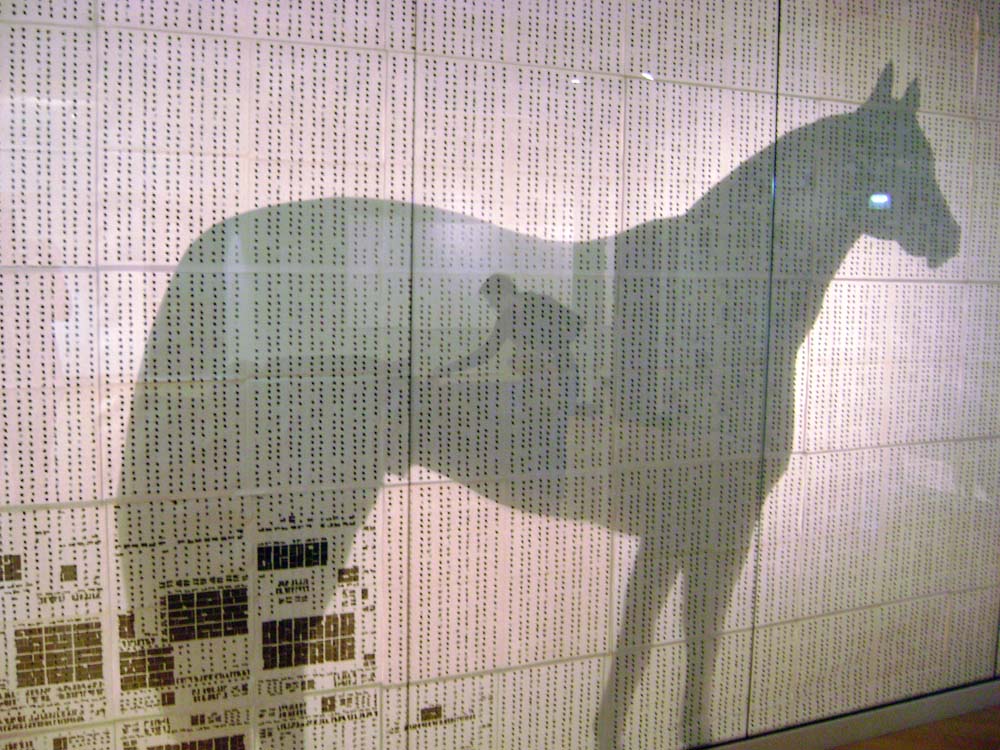
4 Installation (Horse Storefront) with printed newsprint, light, and wood.

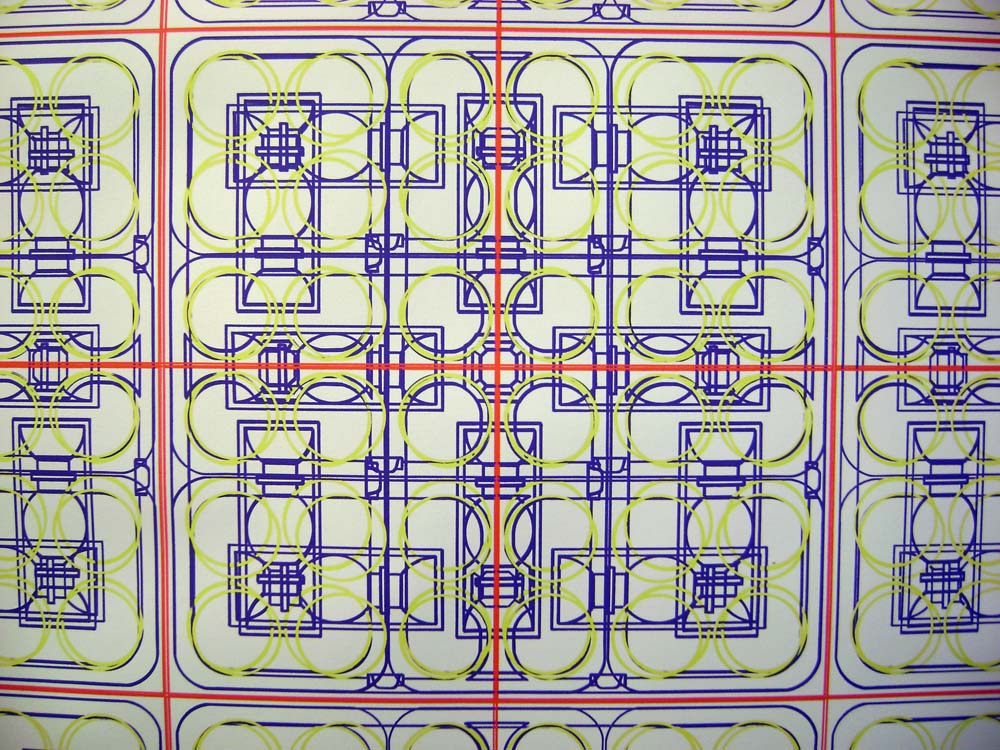
5 Pallet of Eggs (Dozen Cartons), Digital print.

6 Detail of Pallet of Eggs (Dozen Cartons), Digital print.

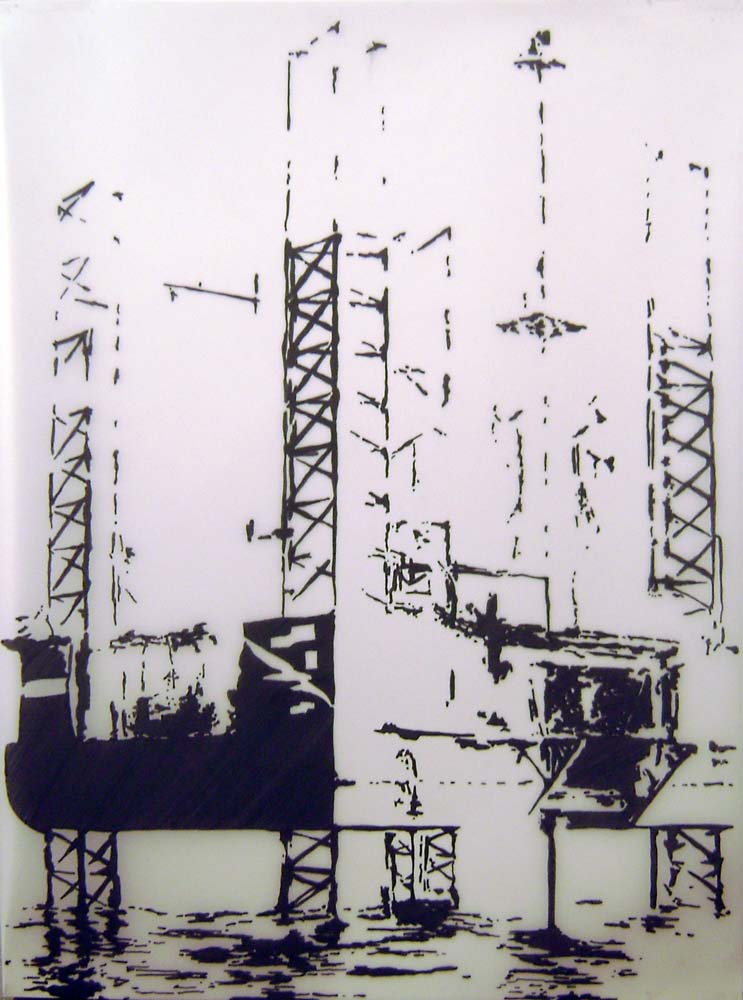
7 Fire (Offshore Oil Rig), Marker on frosted mylar.

8 Portrait, Marker on monotype prints.

Andrew is a fellow MFA graduate from Indiana University in Bloomington, Indiana. He was there studying Printmaking while I was working on a Painting degree. It’s always nice to see a fellow IU grad continuing to work and make a path in the world. My best to Andrew and his family!

Ideal Forms

As if I didn’t have enough to do (60 piece solo show to prep for, summer teaching, fall teaching, writing, shows, reading, service to students and church, loving my wife and being a new dad, seamlessly integrating the domestic and the transmundane, all the while calling out to others on the mythic quest for a transcendent evocative intersubjectivity), I’ve also started a new series of works; guess I’m a glutton for punishment. I actually think it all keeps me on point…

In any case, I’m contemplating the notion of ideal forms. Some of this springs from my interest in the trans-historic and very influential Platonic Solids, which I’ve talked about a lot in the past. With these works, I’ve taken physical shapes I’ve created for my painting and drawing students to work from and begun investigating why I have my students focus on them. In the future I’ll enumerate some of the reasons why I’m (somewhat tongue-in-cheek) calling them “ideal.”

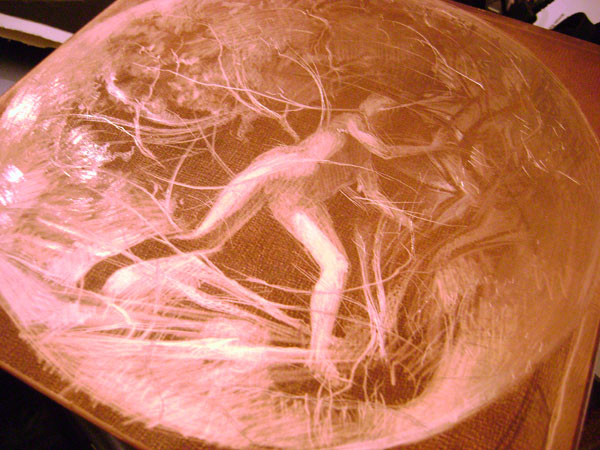
Ideal Form 02 (Mixed Media Variant), Mezzotint print and gouache on Hahnemuhle paper, 7 inches in diameter, 2010. Click to see large version.

Ideal Form 01, Mezzotint print on Hahnemuhle paper, 5 inches in diameter, 2010. Click to see large version.

Some Current Projects

A (detail of a) commission in graphite…

A (detail of a) commission in charcoal…

Continuing my Lamentations 3 series of mezzotints… Verse 4 is above (reversed to show how it’ll print).

And framing a drawing for friends; I created the drawing (in 2008) as an illustration for a poem.

MAGNITUDE 7 at Manifest

My work, titled Galaxy (Shell, Fecundity, Emanation), will be seen at the 6th annual MAGNITUDE 7 exhibition at Manifest coming up at the end of this month. The piece is a mezzotint print that has been embossed with a unique collograph print.

And here’s my statement about the work for the show:

Over the last two years I have become increasingly enamored with the mezzotint printmaking process. I have used mezzotint as a way to find new and different access to some of the subject matter I have used for years in my paintings and drawings. Bricks, shells, geometric forms, and bodies have all become part of my mezzotint repertoire. Those geometric forms – specifically the Platonic solid called the dodecahedron – have begun to inform my mezzotints beyond simple representation; I have started using the angles of the dodecahedron and its constituent, the pentagon, as dimensional embossments upon the mezzotint prints.

In the work I present here at MAGNITUDE 7, titled Galaxy (Shell, Fecundity, Emanation), the beautiful gradients and milky consistency mezzotint is known for are used to display a shell, spinning in an amorphous space. Yet a fine tracery of lines and angular counterpoints shifts the surface level of the image itself, creating a bas-relief. The angles are formed using a collograph print over the final mezzotint. This collograph is a unique, one-time embossment; though the edition of mezzotints is all the same, the embossment seen in each print is one of a kind.

By embedding these angles (taken directly from the dodecahedron) onto the image of the spiral form shell, I reintegrate their inherent relationship, since both the spiraling of the shell and the angles of the quintessential Platonic solid display the natural mathematical beauty of Phi, the golden ratio. While the depiction of the shell can be a visual entry point for contemplation, the angles of the subtle embossment encode a physical reality into the artifice of the image. This duality is something I am hoping to develop more and more. I want the image and the icon, the depiction and the object, the picture of the idea and the idea itself, to become manifest in these prints as I continue them.

Mezzotint Rocking Deck

I’ve been working on an apparatus to help me streamline and control my mezzotint copper plate preparation. In moving toward the incarnation you see in this post I built 3 other models, each one becoming more and more refined and tweaking elements that didn’t seem to work.

Ultimately what I wanted was a rotating deck that would keep the copper plate stable and offer ease of movement through the different angles one has to use to rock the plate properly.

The rocking deck would also need a secure place for the rocker itself, and a place to keep the blade protected when not in use. The sheath I built on the forward end of the deck holds the rocking blade without contacting the serrated edge of the blade at all.

Learn more about mezzotint here. See some of my mezzotint work here. Two really great mezzotint artists are Michelle Rozic and Stewart Duffin. Check them out.

New Lamentations Mezzotints on the Way

I’ve got a show coming up next Spring at Gordon College in Wenham, MA. Though I’ll be presenting 50 or more works, a good portion of them will consist of mezzotint prints. I’m well on my way to completing the group I want to exhibit; the prints will follow the imagery from Lamentations chapter 3, verses 1 – 20. Below I’m posting some shots of the newer plates – click the title to read the verse.

Verse 1

Verse 7

Verse 9

Collograph Prints

I’m beginning a series of collographic prints based on the angles of the pentagonal sides of dodecahedrons. Here are images from the first few.

All are in a range from 6 to 12 inches in diameter. I’m conceiving of them as tondos or ovoids, but haven’t decided on the orientations or how I’ll use light with them, since it’s so important to how they’re seen.

None of these prints have pigment of any kind on them.

Click on each image for a larger view.