Matt Ballou: RANGE – Reception at William Woods University

02

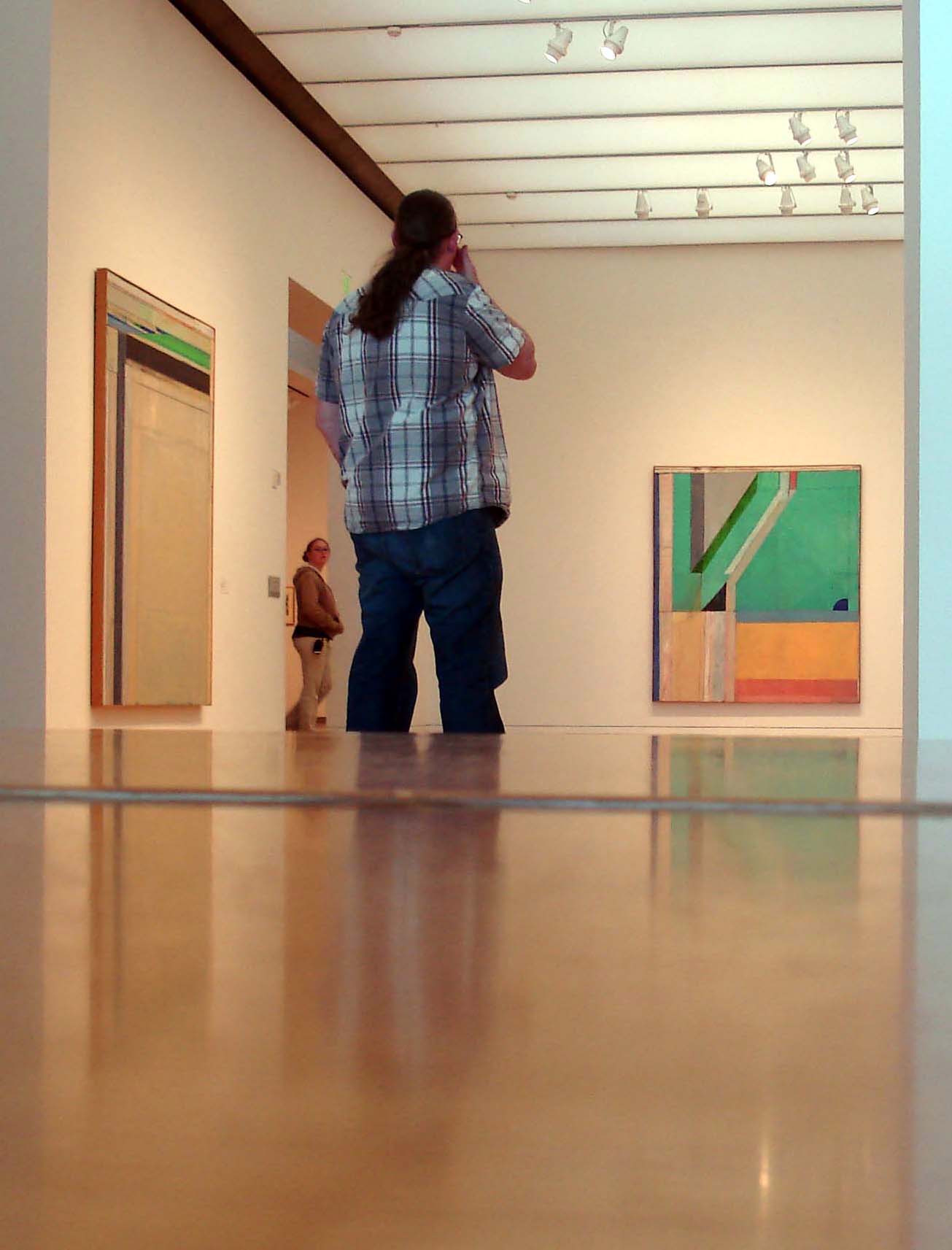
My exhibition – Matt Ballou: RANGE – is still up at William Woods University until December 16, 2012. I hope you can go see it if you haven’t yet. Below are some photos of the space, both after the installation and during the reception. I want to thank everyone who came out – friends, students (graduate and undergrad, current and former), and colleagues – and especially Jennifer Sain for her help in making the exhibition happen. Special thanks to Jane Mudd for encouraging William Woods to host this show.
01

Installation, back on November 12, 2012.

04

05

06

Three panoramas of the installed work.

03

Two of my all-time favorite works… Locus #77 and #78

09

10

07

Beautiful angles and shapes during the reception…

At the reception I gave a brief impromptu talk that led into some interesting questions from the audience and my own musing on the work.

11

Me during my talk – Photo by Kevin Larson.

Click here to download the talk and Q+A session (42 MB MP3 format, 50 minutes long).

Some notes about the talk:

12

Photo of me at the talk – Photo by Eric Norby.
Exploring Possibility

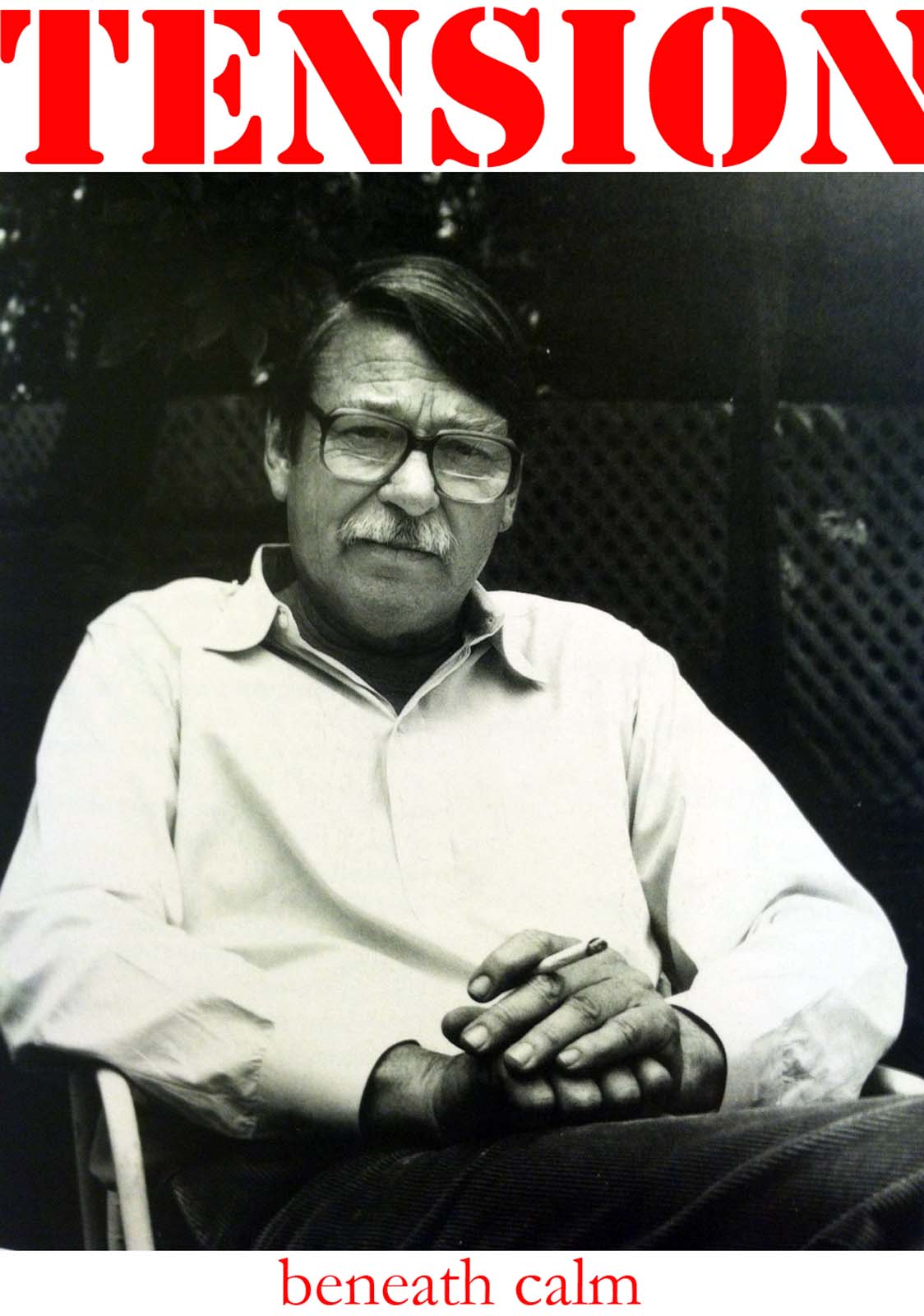
Jill Hicks of the Columbia Daily Tribune wrote a piece titled “Exploring Possibility” that ran on Sunday, March 18, 2012. The article follows Allison Reinhart, a student who’s been a major presence in the Art Department here at Mizzou. She’s currently taking an independent study with me. We’ve worked together in the past – most notably on this film by the inimitable Keith Montgomery – and she’s one of my favorite people at MU.

Jill quoted quite a bit of my thoughts on working with Allison. It’s really nice to find that you’ve said something that really rings true and you have to work to live up to it. I feel that way about this particular passage: “…making accommodations for my students isn’t an area of ‘special’ or ‘additional’ effort — it’s the way it ought to be,” […] “All culture-making is about access. When we — as institutions or individuals — legitimize the denial of access to those who wish to participate, we’re functioning as gatekeepers and operating in illegitimate systems of refusal. As an educator and person who deeply believes in the value of university-level teaching, I don’t want to be a part of that.”

Thanks to Jill for the great article and to Allison (and Gina, and others!) for being thoughtful, dedicated students. No, I didn’t say inspirational… Allison wouldn’t like that. :)

The Huffington Post Includes my Work in a “Top 10 Best” List

I was gratified to learn that The Huffington Post included my recent essay on Richard Diebenkorn, written for neotericART, in a “Top 10 Best” listing! The piece, written by Brett Baker of Painters’ Table, cited my work immediately after Raphael Rubinstein’s “Provisional Painting, Part 2.” This was excited to me, as Rubinstein’s original text on provisional painting was a catalyst to my thinking in my piece. Here’s the takeaway quote:

“Artist Matthew Ballou’s piece “Diebenkorn: Provisional Action, Provisional Vision” finds surprising and convincing connections to this kind of provisional approach in Richard Diebenkorn’s Ocean Park paintings” – Brett Baker for The Huffington Post.

Thanks, Mr. Baker! Painters’ Table is awesome! Read my essay at neotericART here!

Diebenkorn, Painting, and Contemplation

My most recent essay is now available to read on neotericART. The piece was written after an October 2011 trip to Texas that was funded partially by the University of Missouri (where I teach). It is a long contemplation on the experience of seeing Diebenkorn’s work in significant number and in appropriate surroundings, but also reflects the long-time presence the great artist’s work has held in my mind. I also see the text as a lateral critique of Raphael Rubinstein’s (part 1, part 2) and Sharon Butler‘s writings about provisionalist/casualist painting. I hope you enjoy the piece and would welcome any comments you have.

Statement, January 2012

     I create paintings, drawings and prints in an attempt to address – through archetypal themes and symbols – the fundamental questions, ideas, hopes, and concerns I have about being in the world. I write texts in an attempt to integrate rational conceptions and reflections with my passionate, sometimes illogical, image making. In tandem, these avenues of expression form a multifaceted arena of investigation and inquiry that I use every day to – hopefully – understand and make sensible the miraculous reality of being.

     The statement above relies on the fact that I am deeply interested in three main aspects of the human condition: being, symbol, and body.

     I am intrigued by the state of evocative subjective experience that Gaston Bachelard described as “the astonishment of being.” Thus, though I am interested art of all kinds, I take particularly to those forms that connect with our embodiment or sense of being. This means the physical world, the objects we use and love, and the bodies we inhabit are particularly important to the sort of art I want to see and make.

     It follows then that I find the expression of meaning through symbol – that is, the potential for objects to accumulate and resonate with meaning – to be a central interest of my art-making practice.  Anything containing meaning has been, as John Dewey wrote, “funded” with importance through the physical interaction and intellectual contemplation human beings have invested in it over time.

     The body is the zone of incident where being-ness and the structures of significance coalesce. Therefore, I foster a deep appreciation for the human body as a container for and calibrator of meaning and knowledge. As a maker of images – be they painted, drawn, or printed – I function as a symbolist in the traditional sense; I create tableaus for the relational contemplation of that which is beyond the facts of appearance. In doing so I hope to stimulate an evocative, transformative experience in my fellow human beings.

Visiting Ocean Park

Recently I visited Fort Worth to experience the retrospective of Richard Diebenkorn‘s Ocean Park paintings. I have spent the last two weeks trying to process what I saw and what I think about what I saw. I’ve loved Diebenkorn’s work since my first encounter with it. I had to wait nearly 15 years to get the chance to really see the work in context. I’m in the midst of writing my reflections; they’ll appear over at Neoteric Art sometime in the next month or so. For now, check out some pictures of me and Marcus taking in the majesty of Ocean Park.

Marcus sketching from Ocean Park #30.

Marcus scrutinzing Ocean Park #135 – that’s the corner of Ocean Park #93 above his pencil.

Me taking in the glory of Ocean Park #40 from across the gallery.

Here I am considering Ocean Park #79.

And jump here and here to see some pages from my notebook written/scribbled during my time in the exhibition.

If you can’t make it to the venues the show will travel to over the next year, be sure to see this nice photo essay from the current iteration of the show.

Two New Books

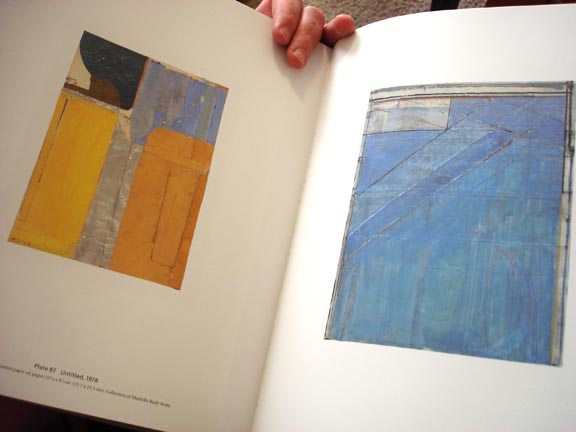
First off, I received my new Diebenkorn book this week. Richard Diebenkorn: The Ocean Park Series is lush (in design), expansive (it contains many reproductions), and – best of all – it’s full of never before seen (in broadly-published form) paintings, prints and drawings. I’m doubly charged up by this book since I (and one of my students, Marcus Miers) are heading down to Fort Worth to see the Diebenkorn show next week!

Also, my own slim tome – 62 pages, 9 essays – just came out, published by Neoteric Art in Chicago.

It’s available in standard paperback version and in an ereader version. It should be up on Amazon in a few weeks as well.

Some New Things

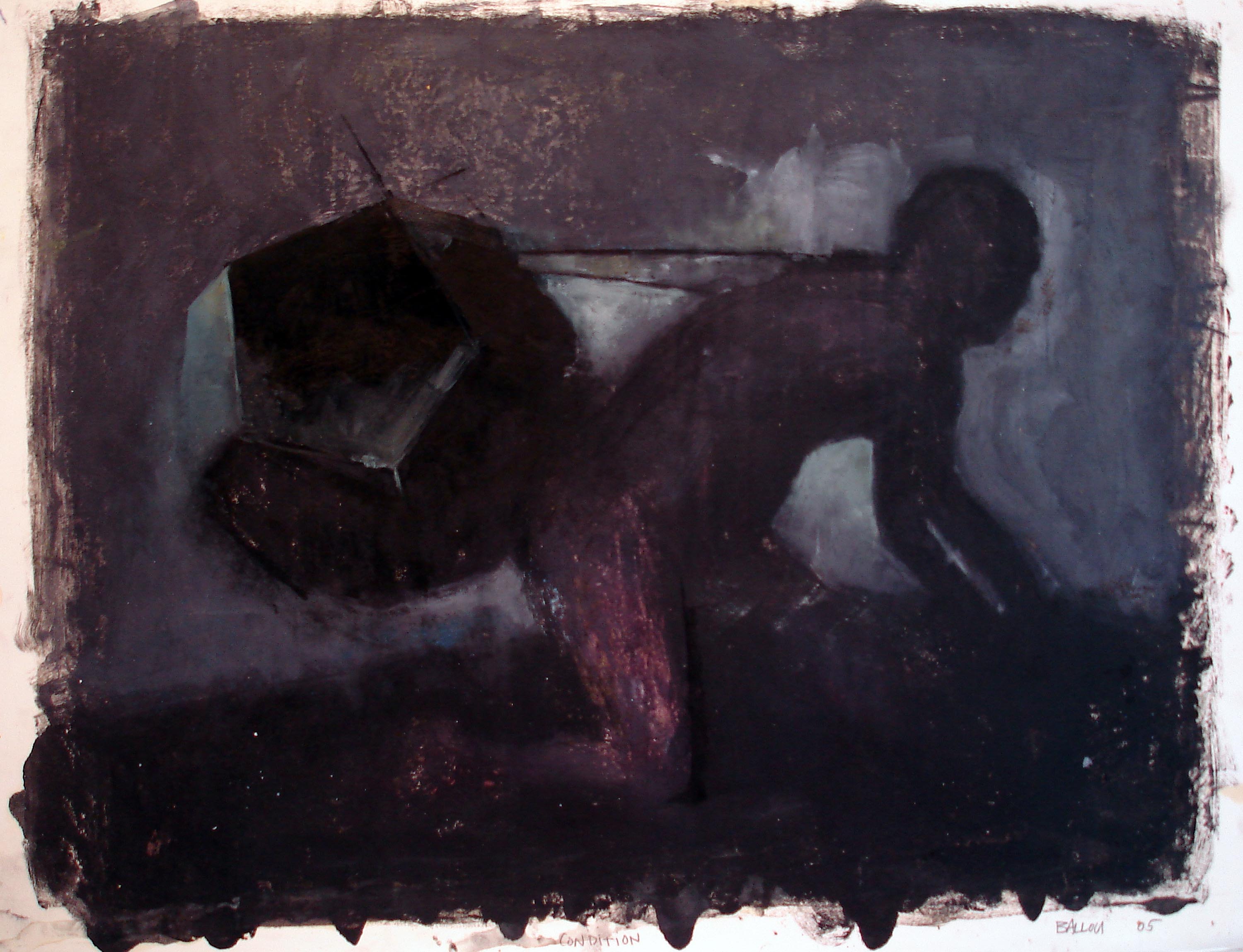
My latest bit of writing, “Our Weights” is up at Neoteric Art. Check it out HERE. Above – Condition, multiple layer monotype in oil on paper, 2005.

Also, there is short and sweet review of my show at Orr Street Studios Gallery by Shea Boresi, HERE. If you’re in Columbia, Missouri, please come by the closing reception for the show on October 7th at 6pm.

And above is one of my best birthday gifts – a pair of glass tumblers, handmade by Ox-Bow awesome-lady Becky Wehmer! Thanks to my wife for getting them (a sort of end-of-Ox-Bow-decade-remembrance gift)!

Here’s a shot of the inside one of them – awesome!

All These Remainders

“The creation of legend is never known at the time of its genesis. Only displacement can imbue the past with the aura of sentimentality. Oh, to yearn, to stretch back with every fiber! To feel again that desire; the shrouded figures that play still on those lost, faded shores. Seeing ever so faintly the afternoon sunlight through old windows and recalling the impression of newfound knowledge in those dusty old books. Oh, to squeeze the eyes tightly, if only to glimpse for one moment that gone-ness – to feel it in the pit, to be in that pit, to stay: impossible. Knowing that it all exists only because I can’t stay there. Oh, to regress into my own idealization, to see myself again as I did then…”

“All these remainders have a keening tonality, a tinnitus of sounds, which we are unable to hear outwardly but which our hearts intuit. They are the silent sirens of what has gone before, and they call to us with accolades and accusations.” – from A Mnemonic of Longing, an unpublished essay, 2002-2009.

So ends my remembrance of Ox-Bow, ten years after. So much more could be said, be shown. I’ll leave it at this for now. The text I have shared in these posts is, perhaps (if only to me), my best artwork. It evokes for me the feeling of remembering and the instances that remembrance serves equally well. The words I’ve shared are as present to me as the times they transform and recreate. In turning them over, reading and re-reading them again and again, I sense anew so many true things. In them I know again the many secrets I held all those years ago. The creaking of the Inn, the internal affects of grasses and trees, and the whispers of the wind – which even now (this VERY second!) are stealing across the Lagoon and through the meadow, past the Mary K and over the dunes – are all as true now in these mnemonic words as they were when I wrote those words down. And they rest in me, speaking in me as to one who has glimpsed a deep but unnameable majesty. Darkness sits near (deathly close to) light.

– Matt Ballou, September 1, 2011.

Images from digital photos taken between May and August 2001.

Half-light – the time of soul-sense

“Later on, again I saw the stars rushing in that great sky-arc, their pathways subtly changing over time, subtly changing tonight even as I gaze upward. I think of my place along those paths, and as I think I understand that it is no wonder that the ancients thought the earth was the center of all things. Even when one’s thoughts consider those things farthest from the self, those things impose themselves upon the self in a very physical way – an implication, an assertion. No other beings but us can know these things… To lie on the dock at 1am, the water lapping (piles softly swaying) at languid fingers, touching them with such immediacy even as light a billion years old breaks the plane of these wet eyes. A prayer offered to God. No, it is no wonder to me that the ancients thought themselves the center of all things.”

“Half-light – the time of soul-sense. It is muted sense, muted movement, and muted knowledge. When the world falls away to an edge; we are on it and in it, but at a moment of unknowing. How can we yet remain? Oh, to strain, to stretch! To allow that great letting occur, where our selves, our identities of self, are removed from our references, from our knowing. This is the pure spirit. What has happened?” – from A Mnemonic of Longing, an unpublished essay, 2002-2009.

Images from digital photos taken between May and August 2001.