Atticus Arrives

967896_10104965202870509_452403013_n My son arrived about 36 hours ago. He is healthy, beautiful, and strong. I’m thankful and awed. A few hours after he came, I posted the following image and words: 10454386_10104960823950899_6612423471633883460_n “I nominate Atticus Garrett Ballou to eventually take awesome color pictures, or paint wonders, or write down glories, or sing high praises, or dream strange dreams, or tread with golden feet on far flung vistas, or wheel through the galaxy on spatiotemporal-controlling power… Or at the very least to act justly, love mercy, and walk humbly. 11/29/14, 3:01am”

My friend Frank (a great educator and thoughtful dad himself) commented, “With a name like Atticus, how can he help it?”

Well, here’s hoping that when my son reads about his namesake he will feel empowered. That we, as his parents, will believe that we’ve done something to impart the thread of grace and understanding that makes Atticus a worthy name to hold.

With a name like Atticus, how can we help it?

~

In the hours that have passed, I’ve had the chance to reflect on the epic person my wife is. I’ve now watched her through two pregnancies and one adoption (processes that are surprisingly equivalent and strenuous, believe me). She is someone who exudes a quality of character and force of will I’ve never had the chance to really know in anyone else. When Miranda was born, I got to see Alison’s movement through labor and delivery with eyes of terror and amazement. This weekend, however, I got to be a calmer, more aware viewer. I was much more keyed into what she needed and what she was doing. Seeing her come into full alignment with her body and her second-by-second progression through the final hours of pregnancy was inspirational. Screen Shot 2014-11-30 at 10.52.29 PMAbove Left: Alison just toward the end of heavy labor, around 2am, less than an hour before Atticus was born. I was putting counter-pressure on her lower back and calling out the peaks and troughs of each contraction. Above Right: Alison, exhausted but calm, less than 5 minutes after giving birth. Often during labor she looked like this; totally within herself and focused on the event.

momandboy1

 …and just a minute or so later, Atticus got that precious skin-to-skin contact with his momma.

~

I was pleased to get some wonderful down time with the two of them after the delivery. We were, I think, able to enjoy that first day in a way we were too blown away to when we had Miranda or came home with CaiQun. Something tells me that ease will be a hallmark of our experience of Atticus. He’s such a relaxed yet alert baby. I think those qualities are something we are all hoping to manifest.

~

I got to draw a portrait of him in the early hours today. I love this first little document of looking at my boy. I hope you do, too.

~

Last, but not least, here are those new big sisters. They’re enjoying (and being generally confused by) their new baby brother. Glory. Thanksgiving.

IMG_1285

“Making something is one way to say ‘I love you'” – Daniel Tiger

My kids love Daniel Tiger. One of his ditties has a line they love to sing to themselves (and anyone else who’ll listen) that says “Making something is one way to say ‘I love you’.”

It’s obvious, but also something that we all need to be reminded of. It’s been on my mind as little Mr. Atticus is set to arrive soon… and as Alison is so, SO, SO ready to have that kiddo out. My wife tends to feel loved much more by actions than by words. Living out love is way more believable and significant to her than merely saying some words or going through some trite motions. For her, making something really is one good say to say ‘I love you’ to her.

We have been planning to have some fairly significant home projects/repairs and upgrading done before Atticus arrives. At first it was as simple as taking off some 30 year old wallpaper and painting the dining room, making a bunch of freezer meals to have during the first couple months post-Atticus-birth, and a few other general upkeep items. Once we got into those projects I started getting a head of steam going… I felt like hitting one of our dream projects: Built-In Bookshelves.

Alison and I have wanted to DIY some built-in bookshelves for over a decade. I decided we should go for it. I wanted it to be my pre-Atticus ‘thanks for all the hard work’ gift to Alison.

So I made some plans and even a balsa wood model…

Photo Nov 06, 11 30 11 PM

Thus prepared, the work began…

IMG_5475 IMG_5477 copy


IMG_5490 copy

Alison contributed painting and oversight skills.

Photo Nov 11, 9 10 39 PM

Almost complete…

Photo Nov 19, 10 07 54 AM

BOOOM! Finished. Made of Birch Plywood (a bit of mounting substructure), Oak (main, weight bearing horizontals), Poplar (vertical attachments), and Aspen wood (main shelves) with pre-fab crown and  base molding. Eight feet high, thirteen feet wide, and one foot deep. Took us about 2.5 weeks from start to finish, but combined with our other projects we’ve put in about 6 weeks of effort. In some ways this was hard stuff to do, work that required serious thought and follow-through.

It’s good to do hard things for the ones you love.

But I don’t want to over-romanticize this. It’s just a bookshelf. We have access to so much more than most of the world. We have a place to live and love in. We live in a safe area. We have jobs that help us have an historically unprecedented quality of life. So much of the world can’t say this. But given what we’ve got we need to live honorably. Whether that’s through adoption or committing to the vocation of a teacher – or through taking 6 weeks out of my own work to do work for my wife (who has put in 39 weeks on building a son for us!) – then I want to do that with passion and thanksgiving.

Photo Nov 19, 10 10 17 AM

Doing this project reminded me of how concentrated effort can translate into love. When I took a week to paint the interior of my mother in law’s home, that work catalyzed my love for her. When I create a painting for a family who is starting out on the adventure of adoption, that’s a way to know my own love for them. When I look at my built-in bookshelves, I’ll always think about the work my wife does and how hugely important she is, how lovely she is, how worthy she is.

And I’ll be thankful.

Museum Show!

10727750_760661254004316_310602584_n

I’ll be giving a talk today at an event for the Mizzou Interdisciplinary Center on Aging at the Museum of Art and Archeology. This talk is on the subject of mediated attention and the ways I try to teach (and learn) through the various technologies that surround us (Click HERE if you’re interested in attending the event – it’s November 4, 2014 at 4PM).

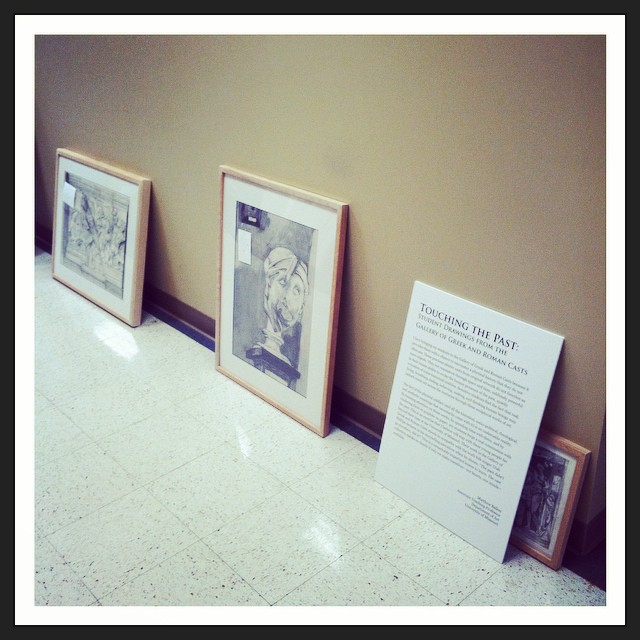
The wonderful thing about this event today is that it’s the first public viewing of an exhibition I have guest-curated at the Museum. This show, called Touching the Past: Student Drawings From the Gallery of Greek and Roman Casts, will be up throughout the month of November and into December. It features 22 artworks by my former students. Student drawings from the likes of Jacob Maurice Crook, Kate Miers, and Allison Jacqueline Reinhart feature prominently. The Museum is open 10am until 4pm Monday through Friday, so come visit the show any time!

S2012_DRW1_CastGalleryStudents working in the Cast Gallery a few semesters ago.

Working in the Gallery of Greek and Roman Casts is one of the most important experiences I can give to my students. I hope you’ll stop by and see works like the ones shown below.

drw1-2013-02Hannah Wallace, Wide Angle Study of Figures in the Cast Collection. 18 by 24 inches, graphite on paper.

DSC07052Kate Miers, Study of Artemis. 24 by 18 inches, graphite on paper.

One special guest I invited to have work in this exhibition is fellow teacher and artist Chris Fletcher. His sensitive, searching drawings from the Mizzou Casts seem deceptively simple. But having spent the last 25+ years studying drawing and painting, I can tell you that they are masterworks of human subjectivity and focused engagement. I love the little marginalia notes he leaves for himself on the edges of the works, and the inquisitive-yet-firm nature of his working. Don’t pass by this small pieces when you visit the show. Really, really great stuff.

List of artists in the Touching the Past exhibition:

Olaia Chivite Amigo

Matthew Ballou

Maggie Berg

Amanda Bradley

Jacob Maurice Crook

Chris Fletcher

Emily Gogel

Terisia Hicks

Rachael Liberty

Kate Miers

Aubrey Miller

Delia Rainey

Allison Reinhart

Tianyuan Ren

David Spear

Andi Tockstein

Duy Tran

Hannah Wallace

 ~

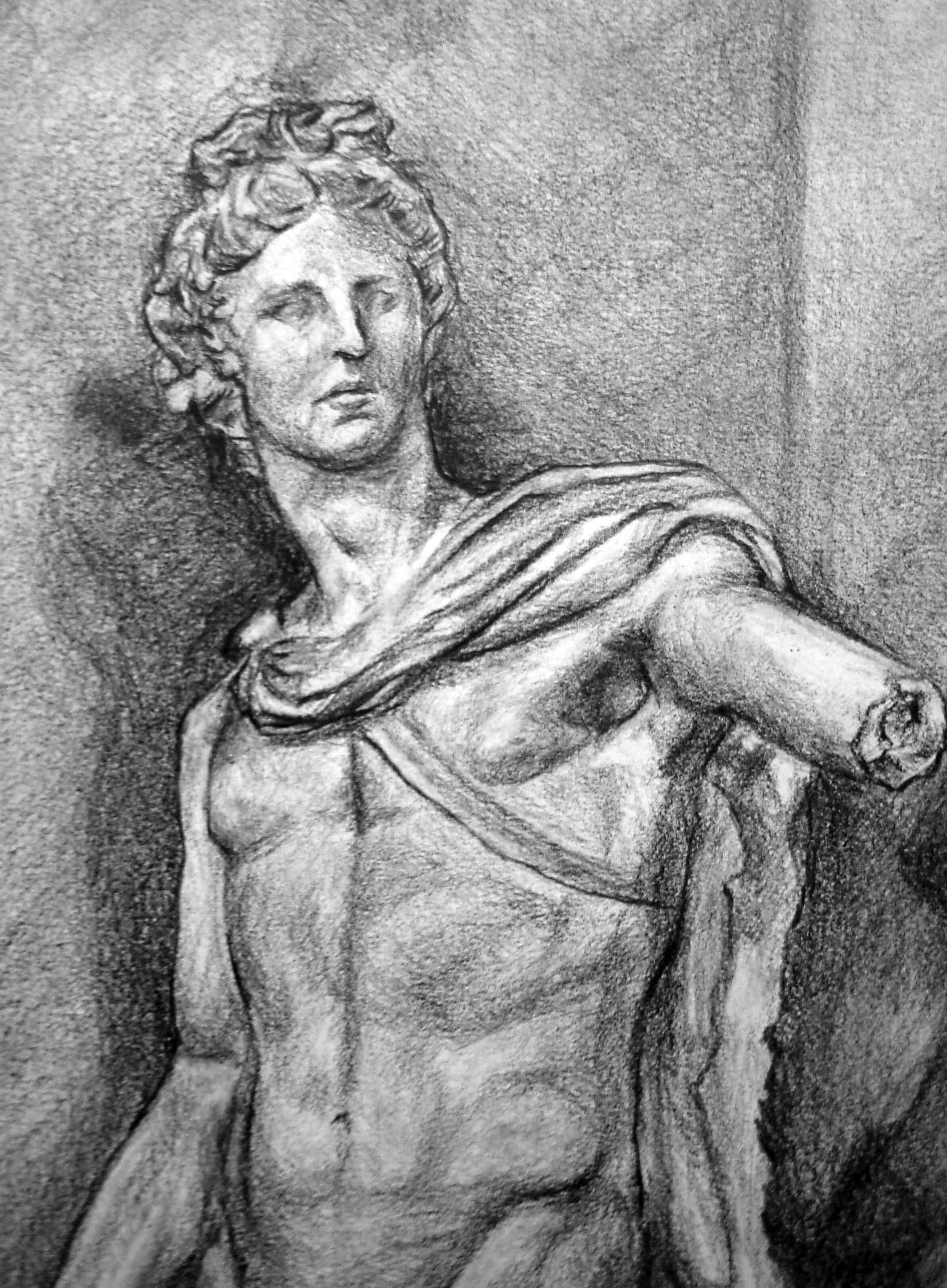
DSC07075Detail of Andi Tockstein’s Study of Apollo… you need to see this drawing in person!

Every Brushstroke An Opportunity to Help Change a Life

il_570xN.276209062Situation and Circumstance Overcome, Oil on Panel, 16 by 20 inches. 2003.

Eleven years ago I created this painting. Over the years many people have asked me to create copies of it for them. There are more than 15 versions of this piece scattered across the US. Now you have an opportunity to get one of your own AND help support the adoption process for two of my good friends, Aarik and Brooke Danielsen.

il_570xN.276129237Detail of Situation and Circumstance Overcome.

The original piece is one of the most important artworks I’ve created. Its quality of construction, unique place in the story of my art making, and the personal significance it holds cause me to value it highly. For $400 you can have your very own version of this painting. I will donate every cent of the sale price to the Danielsens’ adoption fund.

I am taking up to 10 orders and I will deliver the finished works by July 2015. If you want to have a beautiful, evocative work of art for your home and help give a child a home they deserve, please consider ordering one here. I love the Danielsens and am excited to give anything I can to their adoption journey. If you follow my blog, you know how close adoption is to my heart. I hope you’ll give me a lot of work to do; every brushstroke will be done with love and joy, and in the knowledge that each one is making a real difference to a real person.

To find out more about the Danielsens’ adoption and learn more about how you can help, check out their blog here.

If you have questions let me know.

il_570xN.276209106Detail of Situation and Circumstance Overcome.

PLEASE NOTE THAT THE SAMPLE IMAGES ABOVE ARE EXAMPLES OF THE ORIGINAL PAINTING. Copies that I create will have variation, but will maintain the overall composition, color, and general surface structure of the original, and will be created exactly to the scale of the original.

Becoming the Student, #20: Graham Higgs

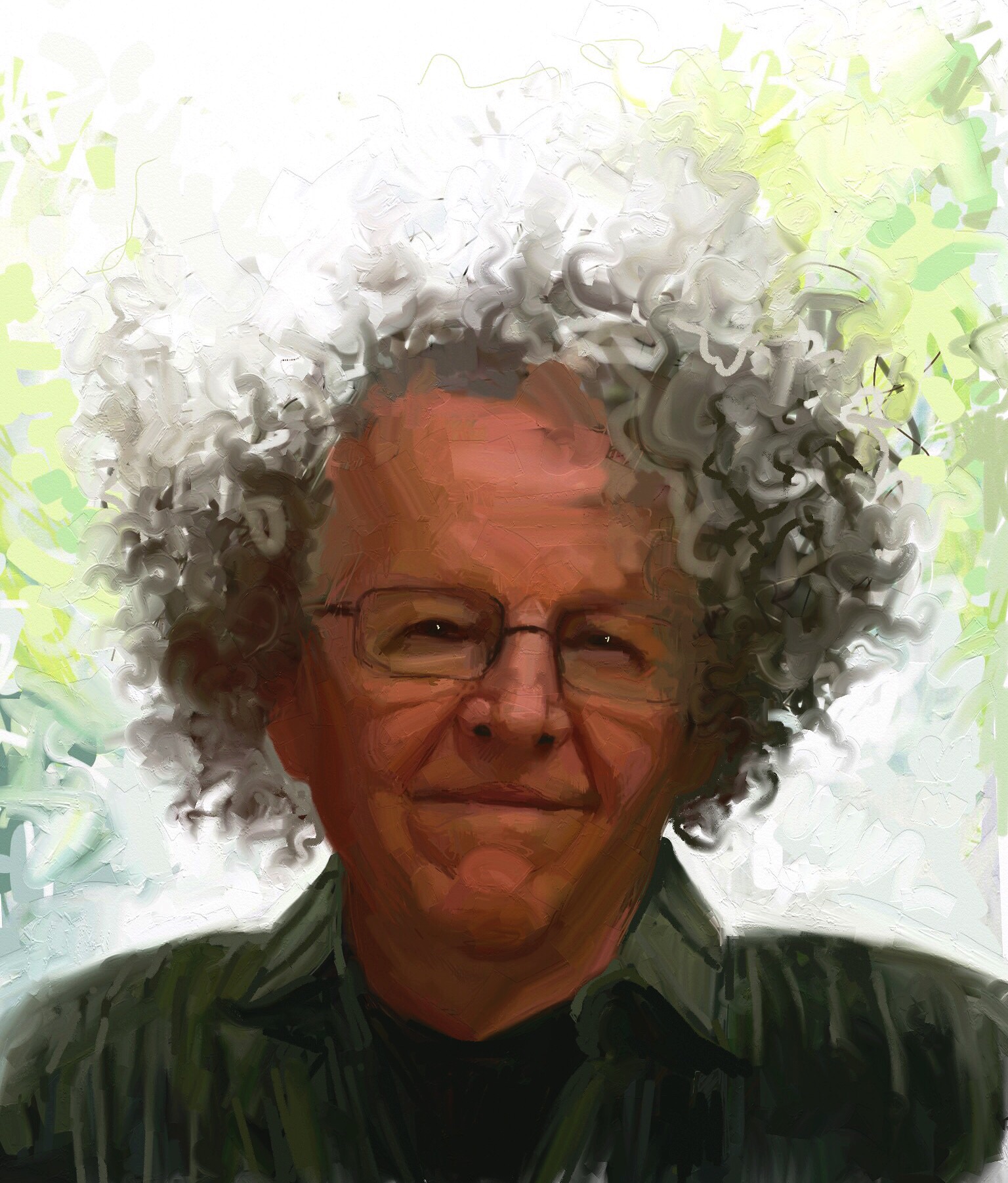
imageProfessor Graham Higgs Gloriously Lit. Digital painting, dimensions variable, 2014. Click to view LARGE.

In this post, I want Professor Higgs to speak for himself. If you have a few minutes, please read the story below. If you give the narrative time to work, I’m certain that you will sense both the great truths and the gentle spirit that animate Graham’s life.

~

The Cry of the Spirit Leaving

By Graham Higgs. Posted here by permission of the author.

It was one of those blazing hot, dry days at noon in a small village in Southern Africa, where I lived as a child. Not a soul was stirring. The sky shimmered with heat, and the only sound was the empty shush of a dry breeze against the screen on the porch, where I lay on my back, shirtless against the cool concrete floor.

I watched a fly circling in slow motion and finally settling on the floor a few feet from my head. My cheek felt cool against the floor as I watched the fly brushing its wing with one of its six legs.

Suddenly, from a distance in the back yard, I heard a man’s cry, “Nyoka! Nyoka!”

This was truly startling. “Nyoka! Nyoka!” the cry rang out.

In the Swahili language, the word “Nyoka” means snake, but not just any snake. It means dangerous snake. The odd thing about this was that snakes were very rarely seen in the heat of mid-day. I heard the cry again, and I heard the back screen door slam as my father left the house. I jumped up and left the porch at the front of the house and ran around back to see what was going on. When I reached the back yard I could see my dad crossing the field behind the house toward the garden. In the middle of the field, a tall, barefooted man wearing only khaki shorts and carrying a long stick was standing and pointing in the direction of the garden.

My father reached him and stopped. They slowly advanced, and then I saw the big old king cobra that they were watching. It was slowly moving toward the garden. They followed it, and it became aware of them, suddenly rising up high off the ground and displaying its broad, golden neck with two hypnotic dark eye-shaped spots.

My father and the garden man froze. The snake dropped back to the ground and began to move more quickly toward a large pile of brush near the end of the field. Several other men arrived and all began to pursue the snake, which continued toward the brush pile and then disappeared inside. The men surrounded the huge pile of brush. With long sticks they poked into the pile, jumping back, afraid the reptile would attack. King cobras are known to be aggressive when provoked.

While all this commotion was going on, many of the villagers began to come to see what was going on and stood in the shade of the tall eucalyptus trees that lined the field. Women and girls stood and watched while curious boys ran with sticks and threw stones at the pile. Mothers called out at them and tried to get them to be careful. The men stood and watched and pondered what to do next. The day was very hot and dry, and some of the men receded to the shade of the trees. A sentry of 4 or 5 men stood guard around the brush pile watching for any sign of the snake. The crowd of onlookers swelled to include just about everyone in the village. Some of the boys kicked a soccer ball around in the dust, and a dry breeze lifted the fine dust into swirls around their ankles. Sweat ran down the cheeks of the men watching the huge pile of brush.

One of the men walked over to my father, who was standing with me in the shade. I heard him say, “Baba, we could set the brush on fire. That would surely drive the Nyoka out so we can kill it.” No sooner had he suggested this than a man came running from the village fire with a burning stick, and the brush pile was soon a blaze of heat and crackling light. Visible waves of heat radiated away from and above the fire in visible auroras. The intensity drove almost everyone away and back toward the trees and the shade. Even in the shade you could feel the heat of the fire across the field. The fire cracked and popped, but no snake appeared. An hour went by, and no snake had come from the now smoldering fire. People began to mumble, and some began to return to their huts in the village. Women took their children and said they had food to prepare.

About this time, a quiet whistling sound began to be heard coming from the pile of ash. The whistling became louder, and everyone in the near vicinity could hear it. It became louder still and began to sound like a woman crying in a high-pitched tone. Now the sound could be heard throughout the village, and it became an ear-splitting scream. People looked at each other, terrified. The Nyoka was crying! What could this mean?

One wise, elderly woman said that she believed that the men had tried to kill an ancestor spirit. “What Nyoka ever comes out into the heat of the day?” she asked. “It is a sign” she said, “a sign that we did not heed. In our rush to kill this Nyoka, we may have tried to kill an ancestor who was trying to talk with us. See, she does not come from the fire. She waits, and she will certainly take her anger out on us. Just you wait and see.”

This prediction filled the hearts of the villagers with foreboding and fear, and those who had returned to the fire to see what the commotion was fled from the scene, taking their children and mumbling in low, fearful tones. After a few minutes the crying became quieter and slowly died away. A few men stayed with my father and watched the last of the smoldering coals. Then, as the day became long and the sun began to reach the horizon, my father and the other two men began to poke into the ashes with a long stick. At one point near the center of the ash pile, the stick hit a metal object.

With a shovel and a large stick, they found that a sheet of corrugated metal roofing was at the base of the fire. When they turned it over, the Then, as the day became long and the sun began to reach the horizon, my father and the other two men began to poke into the ashes with a long stick. At one point near the center of the ash pile, the stick hit a metal object.

With a shovel and a large stick, they found that a sheet of corrugated metal roofing was at the base of the fire. When they turned it over, they found the king cobra coiled in a circle. Its mouth was open and the fangs exposed. It had been cooked by the fire, roasted under the corrugated roofing. I recall my father thinking for a few minutes after this discovery and then saying to the two men, “It is now clear to me what has happened here. As the snake cooked, it began to boil, and the moisture in the snake steamed out of its mouth and past the fangs, which created a whistling and crying sound, much like a penny whistle does.” The men looked puzzled.

One of the men was horrified. “Oh, no, Baba, this is not the case. This sound was the cry of the ancestor spirit leaving the snake. We have certainly offended one of our ancestors, and this is a very grave thing to have happened.”

He quickly left the field and returned to his family. That night as the village gathered to eat together and drink beer and tell stories around the communal fire, the talk was about whether to consult the Nganga (witch doctor) to see how they could make reparations to the ancestor. They believed that they had ignored a natural sign. They believed they had violated an ancestor, and they would be punished. My father tried to explain that this might not be the case, but the villagers would have nothing of it. They had their animistic beliefs that kept them in balance with nature. It was an evening of low talking and fearful discussion. Many retired to their huts earlier than usual. Only a few of the older men, including my father, sat and talked late into the night.

Early the next morning a 3-week-old infant died mysteriously while she slept. It was then the people knew that they had indeed angered an ancestor. The Nganga and a spirit medium and herbalist would need to be called to perform a ceremony to placate the ancestor. Women were asked to prepare extra beer, and the herbalist retreated to his hut on the outskirts of the village and pulled out his stock of hallucinogenic herbs and tinctures. Men sat around the village fire and talked while the women served beer and food and in their own groups ate and sang and danced. A couple of drummers and mbira (thumb-piano) players worked themselves into a chanting rhythm and flow that began to persuade those who participated to sway and bob with the beat. The Nganga mixed a tincture and filled a pipe that he lit and passed around the group of men, and the tincture was swallowed by the spirit medium, a man who normally was a very odd fellow, said to possess special powers of vision and the ability to talk with the ancestors.

The spirit medium fell into a trance and passed out on the ground under the watchful eye of the Nganga, who bathed his face with cool water. The chanting and singing became more communal, and some men began to get up and dance. The women, including my mother, joined in the chanting and clapping of hands, and pretty soon, everyone was singing mournful and yet energetic songs of placation. Late into the night, the spirit medium began to speak, and the Nganga called for silence.

The spirit medium spoke in a language that no one but the Nganga understood. After listening to the strange sounds coming from the spirit medium, the Nganga conferred with the village chief, who called for a moment of reflection. Then he spoke about what the ancestor had advised. He said that tomorrow we must kill a goat and 7 chickens and prepare a feast in honor of the ancestor. In addition, we must begin to respect each other and to watch out for the children of others as well as we watch out for our own children.

We must work more regularly in the peanut fields, as the crops are almost ready, and we must always treat strangers with caution but respect. After a list of these sorts of things, some directed specifically at a few members of the community, the ancestor related that life would return to normal. Within a few days, the community had come together with a new commitment to work productively and live in peace as the ancestors intended.

~

I broke some of my rules while working on Graham’s portrait. I really wanted it to live up to the power of his story and the quality of his deep, quiet mind… so I spent a lot more than 2 or 4 or 6 hours on it. While drawing him in his office at Columbia College, I had the advantage of seeing him silhouetted against a bright spring scene, the intense near-white greens illuminating his head as if with a halo. I worked this portrait back and fourth in Sketchbook Pro and Art Rage v3, with some editing and shifting in Afterlight, for several months. I used both the Adonit Jot Touch 4 and the fiftythree Pencil to do the work. I’m thankful for the conversations I’ve had with Graham and I hope to have more in the future.

SERIAL

I’ve got a lot going on these days: some shows happening, some great visits with 5th graders at a local arts elementary school, and my own students really powering through the deep, hard content of the semester (not to mention the latest installments of Becoming the Student series, a few of which are REALLY backing up!). I really want to write about all of that (and write back to GEO, and write to my grandmother, and my high school art teacher, and, and, and… so many other things)…

But stories, people. STORIES.

This week I had my Beginning Drawing students work in Hitt Street Garage here at the University of Missouri. They were working some really challenging 180 degree perspective drawings… they didn’t really need me right on top of them the whole time. So as I made my “rounds” – walking up and down through the 5 level parking garage – I listened to the first two episodes of the new podcast called SERIAL.

It’s compelling, to say the least. The beginning of the first episode is gripping, emotionally intense, and absorbing. It has the feeling of investigative journalism mixed with a unique kind of (for lack of better words) memory-like-situational-recall that makes it sort of like a noir representation of recent history. Huge questions loom, and life-changing events take place. There’s an eery sense of “something else is going on here” in the narrative. It’s got everything. If you liked the movies Brick or Donnie Darko, you’ll get into this. Get over there and try it out. I know I’ll be in line for every upcoming episode this season. I need to know what really happened to Hae Min and if Adnan really deserves what he has received. Sarah Koenig is rocking this new project.

Go there now and check out Episode #01. Click the image below to get started.

Screen Shot 2014-10-07 at 10.29.57 PM


VINCENT

Andrew Vincent was one of my favorite students. He has a quiet presence, a quirky sense of humor, and the uniqueness that comes from arriving in middle America from somewhere else. In his case, it was South Africa. His father, a scientist and professor at Mizzou, brought his family to the US in time for Andrew to start 3rd grade. In many ways he retains a beneficial sort of otherness in spite of having lived much of his life here in Missouri.

Andrew made some amazing work for me in my Color Drawing classes, work that I have shown to several semesters of students. Here are a few of his pieces:

DSC07844Andrew Vincent, Spilled Milk, Oil Pastel on Paper, 15 by 30 inches. Drawn from an image created in Autodesk 3Ds Max. 2011.

DSC07025Andrew Vincent, Study After Vermeer’s The Milkmaid. Oil pastel on paper. 30 by 22 inches. 2011.

VincentA-Grid1-S11Andrew Vincent, Grid Study #1, Chalk Pastel on paper. 24 by 18 inches. 2011.

Also a gifted digital artist, Andrew has worked with Autodesk’s 3Ds Max for a while. Here is a render he created for a recent project:

10677326_10152670991425049_971583360_oAndrew Vincent, Naivety. Autodesk 3Ds Max. 1920 x 1080 PPI. Output dimensions variable. 2013.

~

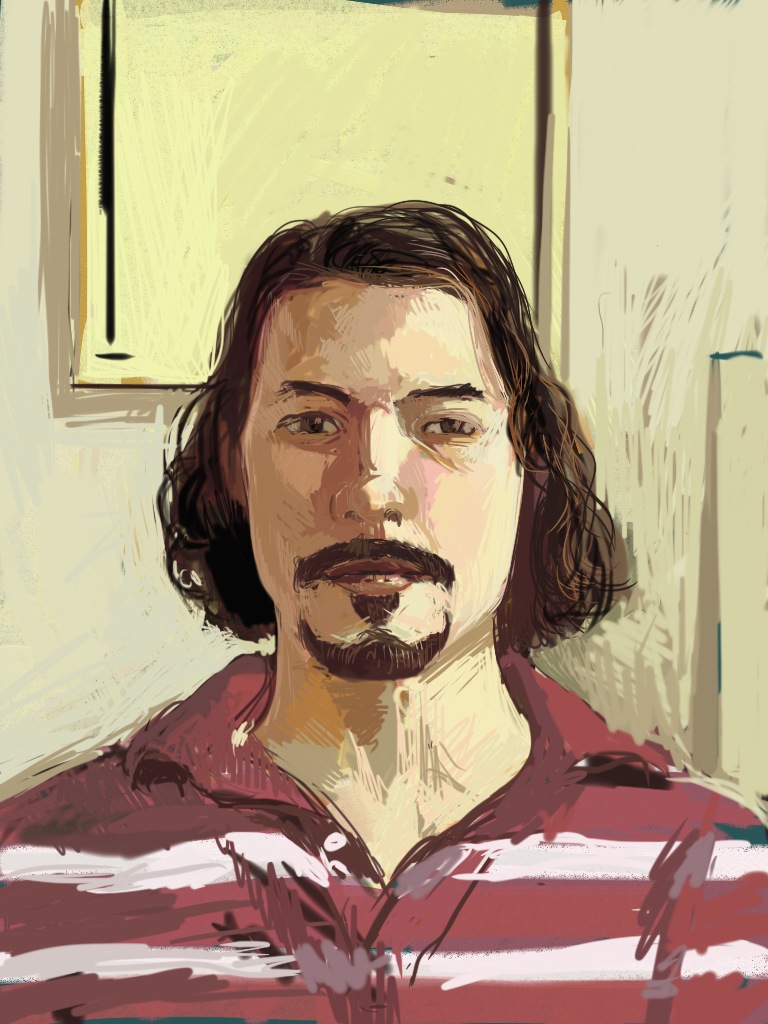
Andrew has taken the opportunity to move to Auburn, AL to work at the Jule Collins Smith Museum as a preparator. He’s aiming to enroll at Auburn sometime in the near future. The guy is on his way to an awesome future. I’m thankful I got to know him in my classes and in the time after he graduated… and I’m certainly looking forward to witnessing what he gets up to in his ongoing education and career. Here’s a portrait I created of him when he visited my office/studio before he left town:

VincentVINCENT, digital drawing created in ArtRage and Sketchbook Pro on an iPad. 2048 x 1536 PPI. Output dimensions variable, 2014.

I’ve always enjoyed my conversations with Andrew, and they have always been far-ranging. We have discussed, faith, meaning, culture, humor, analog and digital drawing/painting tools and concepts, and so much more. I have the feeling we’ll have the chance for more conversation and mutual encouragement going forward.

One of the best parts of my job as an educator is getting to see my students go on to become colleagues and truly function as fellow artists. Keep going forward, Vincent!

Ofeibea Quist-Arcton Deserves a Pulizer Nomination

Ofeibea Quist-Arcton has been working all over Africa for NPR as their West African Correspondent for the last decade. Before that she headed a regional bureau for the BBC in Ivory Coast. Her coverage of the Ebola outbreak over the last few months has been stellar, and necessary. She’s been right in the midst of it, reporting directly from ground zero of the epidemic. If you have not heard her excellent reports, please follow the links below.

2969729260_2d48c13f6b_bPhoto Credit: ©2006 NPR by Jacques Coughlin

Here are a few of Quist-Arcton’s important recent reports on Ebola:

August 2, 2014: As Ebola Death Toll Tops 700, Officials Fight To Contain Disease

August 5, 2014: Sierra Leone Imposes Drastic Measures To Stop Ebola’s Spread

August 7, 2014: Liberia And Sierra Leone Seal Off Ebola Epicenters With Troops

August 12, 2014: Guineans Scramble To Defend Themselves Against Deadly Virus

August 23, 2014: Borders Close As Ebola Spreads In West Africa

August 24, 2014: With Confirmed Cases In Congo, Ebola Now In 4 West African Nations

September 3, 2014: Liberia Lifts Ebola Quarantine From Monrovia Slum

September 6, 2014: Reporting From The Site Of The Ebola Outbreak’s Origin

September 8, 2014: Doctors Struggle To Treat Ebola Patients In Liberian Border Town

It’s powerful and terrifying news. We need to hear it. The authority of her voice, the live and in-depth reporting, and the importance of her mission all recommend her for a Pulitzer nomination. I hope those with the ability will do so (I’m talking to you, Ombudsman).

Thank you, Ms Quist-Arcton, for your clarity, bravery, and many years of service.

In Which I Recount Ten (Well, Fourteen […Fifteen]) Texts Of Some Importance To My Life

There are a number of my friends posting their versions of this list to Facebook these days. Lists such as these always fail in some way. Of course, I also fail at writing them. It’s so easy to come off either pretentious or flippant (or both). I prefer to share my true, deeply-held likes and dislikes in direct conversation. Preferably along with good bourbon or a nice beer.

But I decided to go ahead and try this one. I think that I’m in a stage of my life where my motivations and interests are shifting (yet again), and in times such as these it’s good to take stock and see what remains influential. And so I’ll add my own ten-plus to the never-ending generator that is human activity on the internet. I will present a main list – with commentary – in no particular order.

The criterion I used to gather this collection was simple: did the book initiate some transformation in me, either immediately or upon reflection? I read quite a lot, but I wanted to be careful to choose only the works that have really stuck with me. That’s why there are all sorts of different types of book here (I have intentionally left out the expressly Art and Art Theory books that have been important to me, as there are so many). There are comics, theology, grand adventure, memoir, philosophy, and most of those arenas all mixed together. I’m surprised (and pleased) how many of them I actually experienced in very early childhood. I know there are some big names and obvious choices… that’s just how it is. This selection is not meant to be exhaustive or exceptional in any universal sense; I know there are better and, perhaps, more notable pieces of writing. For each I’ve included there are many more that could have been present. These are just pieces of writing that I know have shaped my life. I felt like sharing them. Enjoy.

~

SPACE, TIME, and INCARNATION by Thomas F Torrance

Thomas F Torrance took on an enormous task in this slim text. Published in 1969, Torrance wrote the book in an attempt to explain Divine interaction in space and time in the light of contemporary scientific developments in theoretical physics and cosmology. Rather than allowing theology a trump card to get out of any exchange with science, Torrance drives deep into the epistemological questions that arise when one seriously examines spatial and temporal ideas involved in theological conceptions. I discovered the book in an old, disused inn library in 2001, and went on to fill my copy with outbursts of marginalia. It remains dear to me.

THE ANNOTATED LOLITA by Vladimir Nabokov (Annotations by Alfred Appel Jr.)

From its tip-of-the-tongue beginning to its devastating denouement, Lolita is one of those books lauded as a masterwork generation after generation that actually lives up to the hype. Alfred Appel’s annotations of the history and meaning behind Nabokov’s astounding and astute prose helped provide access to me as a Nabokov neophyte. The next Nabokov novels I read – Invitation to a Beheading, King, Queen, Knave, and Glory – were all immensely enhanced by the background The Annotated Lolita provided. “I shall be dumped where the weed decays, and the rest is rust and stardust.” (Page 257)

text-mobydickThe Leg and The Whale – Illustration for Moby Dick. Created in Paper with Pencil. 2014.

MOBY DICK by Herman Melville

In Summer 2013 I completed my third journey through this book. Each time it has become more subtle and significant to me. I know that Moby Dick is popular, and that it is popularly unread. This is unfortunate. Its dense passages offer much to submissive, receptive readers. The pugnaciousness, humor, and visual presence of this book make it one I know I’ll keep returning to over and over throughout my life. I even love the endless chapters on Cetology.

EPISTLE to the ROMANS by Saint Paul

Romans is, perhaps, the ultimate biblical text… maybe even more than the gospels themselves. It integrates the disparately organized theological concepts of the early Christian writers into an organized legalese. Though it contains many key chapters (One, Five, and Eight in particular) it is Chapter Five that has, for me, held an intensely disruptive power. Hundreds of readings and years of study have done nothing to dissipate its existential shock.

text-romansDirt and Blood – Illustration for Romans. Created in Paper with Pencil. 2014.

THE LIFE HISTORY of the UNITED STATES (Volumes 1, 2, and 3 of 12) by Henry Graff and Time/LIFE

As a young boy I loved to dive into these books. They were among my first exposure to “fine” art, not to mention the wild and wooly early history of America. I especially enjoyed the first three volumes of this set and, after a while, never really looked beyond them. They were extremely key to my life-long interests. The reproductions they contained of colonial era political cartoons have never left my mind’s eye.

ADA, or ARDOR: A FAMILY CHRONICLE by Vladimir Nabokov

Passionate, sweeping, and strange, Ada is a killer of a novel. Deeper and more powerful than its more famous sister (Lolita), Ada is one of the few books that have stopped me in my tracks. I mean this quite literally. On several occasions – my mind obsessed with the story – I pulled my car over (during my commute to and from school) to continue reading. It is a crushing emotional journey, one that forces consideration of not only the motivations of protagonists Van and Ada but also those that rumble within the reader. This book happened to be the first book my wife (then my girlfriend) and I read in tandem, sharing our thoughts and insights as we read.

GHOST in the SHELL by Masamune Shirow

The best of Masamune Shirow is on display in this, his magnum opus effort. In it he leaps beyond the dregs of manga cyberpunk and erotica to grasp higher ground. He asks huge questions: what is life, consciousness, and person-hood? Sociopolitical wrangling, heavy weaponry, and seamy underground characters collide in a richly imagined post-apocalyptic world on the rebound. His central character, Major Motoko Kusanagi, transcends her sex appeal to deliver existential queries that rock attentive readers. Unfortunately, Ghost in the Shell, along with earlier projects Appleseed and Orion, were Shirow’s only truly deep works. It’s too bad that he has never again turned his considerable artistic skill toward more redeeming themes.

THE ALPHABET VERSUS the GODDESS: THE CONFLICT BETWEEN WORD and IMAGE by Leonard Shlain

Though only a very cursory survey of the historical struggles contained within its pages, this book served as a major jumping off point for me to explore a variety of issues that have altered the course of my life as an artist and educator. Some of my greatest joys in teaching have come from discussions born of this text.

DIRK GENTLY’S HOLISTIC DETECTIVE AGENCY by Douglas Adams

Over the years, Douglas Adams‘ two Dirk Gently novels (the one above and The Long Dark Tea-Time of the Soul) have become my favorites among his various writings. In Holistic Detective Agency, Douglas weaves a tale of trans-historical curiosity, tying together his trademark humor, dual love of Bach and computers, the politics of vanity publishing, and just where exactly Coleridge came up with his vision of Kubla Khan‘s pleasure dome. The book is an epic, joyful trip. It finds ways to explain the strange, ridiculous nature of history so that the reader can laugh and weep with the realization. Adams was a genius.

PILGRIM at TINKER CREEK by Annie Dillard

No dilettante to Thoreau, Dillard finds a way to make her words – written as a 27 year old – take on majestic and epoch-encompassing power. Perhaps I was prepared to love it by my readings of theology and some of the American Transcendentalists, but Pilgrim at Tinker Creek does feel like a singular expression. I love her 20th century version of perception and awareness. A huge influence.

text-jabberwockyThe Jub-Jub Bird – Illustration for The Annotated Alice. Created in Paper with Pencil. 2014.

THE ANNOTATED ALICE: ALICE’S ADVENTURES in WONDERLAND and THROUGH the LOOKING GLASS by Lewis Carroll

This book has stayed with me since early childhood. It was my first inkling that something else may be going on under the surface subject matter of a story. The layering of concepts beyond the directly obvious – logic, mathematics, socio-political and theological suggestions – created a backbone to this text making it live far beyond its Victorian and children’s genre roots. If you visit my classroom you may hear me break into a dramatic recitation of The Jabberwocky for my undergraduates from time to time…

SCIENTIFIC PROGRESS GOES ‘BOINK’ by Bill Watterson

Calvin and Hobbes. Childhood and Imagination. Dreams and Awareness. Play and Learning. What else do I need to say?

INTERPRETATION and OVERINTERPRETATION by Umberto Eco and Richard Rorty

A roiling debate between Eco and Rorty forms the basis of this text and underpins so much of my own thoughts on how meaning is shaped. I routinely share it with my own graduate students in the spirit it was shared with me – with excitement and engagement. I was originally exposed to both Eco and Rorty by my fellow MFA grads at Indiana University. Fellow grad Matthew Choberka stimulated many of us in the program, and pushed our dialogue beyond the common complaints. Kudos to him.

SKETCHES IN CRUDE OIL: SOME ACCIDENTS and INCIDENTS of the PETROLEUM DEVELOPMENT in ALL PARTS of the GLOBE, CHAPTER XVII: SOME NITRO-GLYCERINE in THIS (Pages 383-406) by John J McLaurin

This chapter of a book published in 1898 loomed large in my imagination as an 8 year old in Grove City, PA. My then step-father George was studying at Grove City College under Austrian School economist Hans Sennholz. The college served as my initial exposure to academia and was a central catalyst in my intellectual imagination. I was allowed to roam the grounds and halls of Grove City; I’m certain that it provided the push that eventually led me to my current vocation as an educator. Sketches in Crude Oil was a book that George had been looking at and he read from the nitroglycerine chapter many times. The stories of wagons exploded into nothingness, men blown to atoms, flesh and bones thrown hundreds of yards, and single drops of the explosive hit with hammers have stuck with me for 30 years. That library, those books, and the pages of this volume permeated my conception of history, education, and life for the better.

text-bigbangThe Big Bang – Illustration for The Elegant Universe. Created in Paper with Pencil. 2014.

THE ELEGANT UNIVERSE by Brian Greene

Another popular science survey, but a good one. Reading Brian Greene‘s book, though certainly secular, was one of the most spiritual experiences I’ve had. His description of the various phase transitions taking place in the first millionths of a second after the Big Bang became nothing short of a transcendent sight to my inner eye. Making enormously complex ideas understandable is Greene’s business, and this book addresses many of those issues in direct, accessible language. Good stuff.

~

TEXTS (I have recently read) WHICH MAY EVENTUALLY WORM THEIR WAY ONTO THIS LIST…

CLOUD ATLAS by David Mitchell

BRIEF INTERVIEWS WITH HIDEOUS MEN by David Foster Wallace

BLOOD MERIDIAN: OR the EVENING REDNESS in the WEST by Cormac McCarthy

THE DUNWICH HORROR by H.P. Lovecraft

ABSENCE OF MIND: THE DISPELLING of INWARDNESS FROM the MODERN MYTH of the SELF by Marilynne Robinson

AN ETHICS FOR TODAY: FINDING COMMON GROUND BETWEEN PHILOSOPHY and RELIGION by Richard Rorty

PARADOX IN CHRISTIAN THEOLOGY: AN ANALYSIS of its PRESENCE, CHARACTER, and EPISTEMIC STATUS by James Anderson

THE POETICS OF SPACE and THE POETICS OF REVERIE by Gaston Bachelard

~

BOOKS WHICH HAVE BEEN INFLUENTIAL BY DEFAULT (And thus require no comment)

THE CHRONICLES OF NARNIA by C.S. Lewis

THE LORD OF THE RINGS by J.R.R. Tolkien

THE WIND IN THE WILLOWS by Kenneth Grahame

THE PSALMS

PROVERBS

The Books of THORNTON BURGESS

The Books of LAURA INGALLS WILDER

TO KILL A MOCKINGBIRD by Harper Lee

~

Thanks to Jill for tagging me in this one:)

Becoming The Student, #18: The PhD (Dr. Aja Holmes at Wakonse)

I was blessed to be able to attend the Wakonse Conference on College Teaching earlier this year (thanks, Deborah!) and while there I got to meet so many amazing people. One of them was Aja Holmes. As part of the cohort I was in, she set a tone of inclusion, concern, and thoughtfulness. She was welcoming, passionate, always engaging, and always ready with an encouraging word. It makes perfect sense that she’s found her niche as a Residence Life director working with Undergraduates. While at Wakonse, we got to share in the joy of her being appointed to a position at California State University-Sacramento. I’ve held onto this portrait of her since May, but since today is her birthday, it’s time to post it! Read below to find out more about this awesome individual!

photoThe PhD (Aja Holmes at Wakonse), gouache on paper, 10 by 16 inches. 2014.

 ~

You just earned your PhD. What drew you do your field and what was your educational trajectory?

“As a kid I always loved school. I would play school with my little brother – my first student. He would complain and ask our mom, ‘Why does Aja always want to play school? Didn’t she just come home from school?’ But he would go along with it if I promised to let him try wrestling moves on me (learning to compromise – HAHA!).

I also knew that I wanted to be a doctor, but when I saw blood for the first time it did not agree with me. I knew that I would have to take another route to becoming a doctor. While being involved as an undergraduate student leader someone told me about the work of Student Affairs and that I could live out the rest of my life on a college campus; I said SIGN ME UP! I loved everything about being on a college campus. So after undergrad I stayed on at Illinois State University for my Master’s Degree in College Student Personnel.

Back then I did not know for sure if I was going to get my PhD, but I knew that after my Master’s Degree I should get some significant work experience before going back for a doctorate. I did just that: worked at two universities in the area of ResLife. In 2009, I applied to doctoral programs in Higher Education Leadership and was accepted into Iowa State University. I had heard of Iowa State and I knew that if I wanted to finish I needed to be close to my family. Luckily Dad was a six-hour drive to Chicago and Mom was a three-hour drive to St. Paul, Minnesota. To be in the middle of my family really strengthened my support system.

People often ask ‘what is your ultimate goal in life?’ They ask even more since I earned my PhD. Ultimately, I would like to become a university president. I also want to teach in a higher education program that prepares student affairs professionals.”

You have such a warm and engaging personality. How you do maintain your passionate, hopeful, and excited outlook? 

“I am often asked why am I so happy all the time. I have had to really think about it and truly understand what makes me happy. I decided a while back to take control of my happiness. To rely on others to make you happy relinquishes control on your outlook in life. So I make sure that I have a say in what makes me happy, and things that do not – I rid my life of them. My passion stems from experiences that have occurred in my life that had some effect on my life. Being a multiracial woman oftentimes lends me to have different experiences than most. Whether it’s issues such as the Voting Rights Act being challenged, unarmed African Americans being killed by the police, the DREAM Act, or other situations that involve people of underrepresented groups, I have a passion to act. I take to heart quotes and sayings such as, ‘to whom much is given, much is required’ and, ‘service is what we pay for living’.”

When we spoke at Wakonse, you told me about the important impact your Dad made on your life. Can you name a couple key lessons he provided?

“I was raised in a single parent household. Unlike the norm, it was my father who raised me. He has been one of my biggest supporters and cheerleaders. Since I was in the 3rd grade, my father cared for for my brother and I. He has taught me so much in life, from how to mingle and get to know people you just met, to how to be a woman of Color in a white-male-dominated society, to how to use humor to break the ice. He told me to keep pushing and don’t let what other people think get in the way of my hopes and dreams. I saw his struggles of being a parent while trying to own a business, and of being a parent to a teenage daughter coming of age. He sought out advice from his sisters and other lady friends in his life. But my father had to step up when needed. I will forever be in awe of what he did.”

 10287004_10152438914589534_3993202260772184824_oMe working on Aja’s portrait while we chatted together.

You’re now at California State University-Sacramento working as the Senior Director for Housing and Residential Life. What inspired you to focus your career toward working with students in ResLife situations?

“I love everything about living in the residence halls! I lived in the halls all four of my undergraduate years. Working in ResLife has allowed me to get to know that part of the university from the inside and out. I get to interact with the students in a way that no other Student Affairs person does: while they are in their PJs at home. I get to see them grow into young citizens. Since my research is on supervision, and a large part of Residence Life is supervision, I am able to see how my research can evolve and help prepare student affairs professionals to be the best they can be in this area.”

What do you think is one of the most important issues university students are tackling in 2014?

“One of the most important issues facing students today is the appreciation of differences. I use the word difference in the total meaning of the word: everything that is different. Students are too desensitized to even recognize when something is racist, homophobic, or sexist, etc. Students on our campuses have a unique makeup. They have been using computers their whole life and technology is their way of life; that is all that they know. Interacting with people who are different from them is hindered because of the technology. Technology made the world smaller but actually talking to another human being is a hurdle for them… hence their lack of the appreciation of differences.”

I think you’re into tabletop gaming – at least you were running the show at Wakonse! What’s your favorite board game?

“My favorite board game is really any one that my nieces and nephew are playing. Every holiday season we play board games and I am able to see them learn the process of waiting their turn, reading directions, compromising among each other, and displaying good sportpersonship. It is much more interactive than video games. They are such a joy to be around and I love everything there is to being an Aunt. I will play board games with them for hours and hours!”

~

Thanks for sitting for me, Aja! Your portrait will be on the way soon!