
…a screen shot (featuring Peter O’Toole in a low point of his career) from Thomas Kinkade’s “Christmas Cottage.” This is, perhaps, one of the worst yet most hilarious movies ever. And here’s a chaser made by artist Sloane Snure Paullus.
Enjoy 2010!
…a screen shot (featuring Peter O’Toole in a low point of his career) from Thomas Kinkade’s “Christmas Cottage.” This is, perhaps, one of the worst yet most hilarious movies ever. And here’s a chaser made by artist Sloane Snure Paullus.
Enjoy 2010!

I’ve been obsessed with the sign shown above for months. As you can see from the image below, it’s located in an unused, locked lobby at a Landmark Bank location. Why would there be a neon HEAVEN sign at a bank? What does it mean? Is it art? Is it irony? Anyone out there have thoughts? Click on the pics for a clearer view…

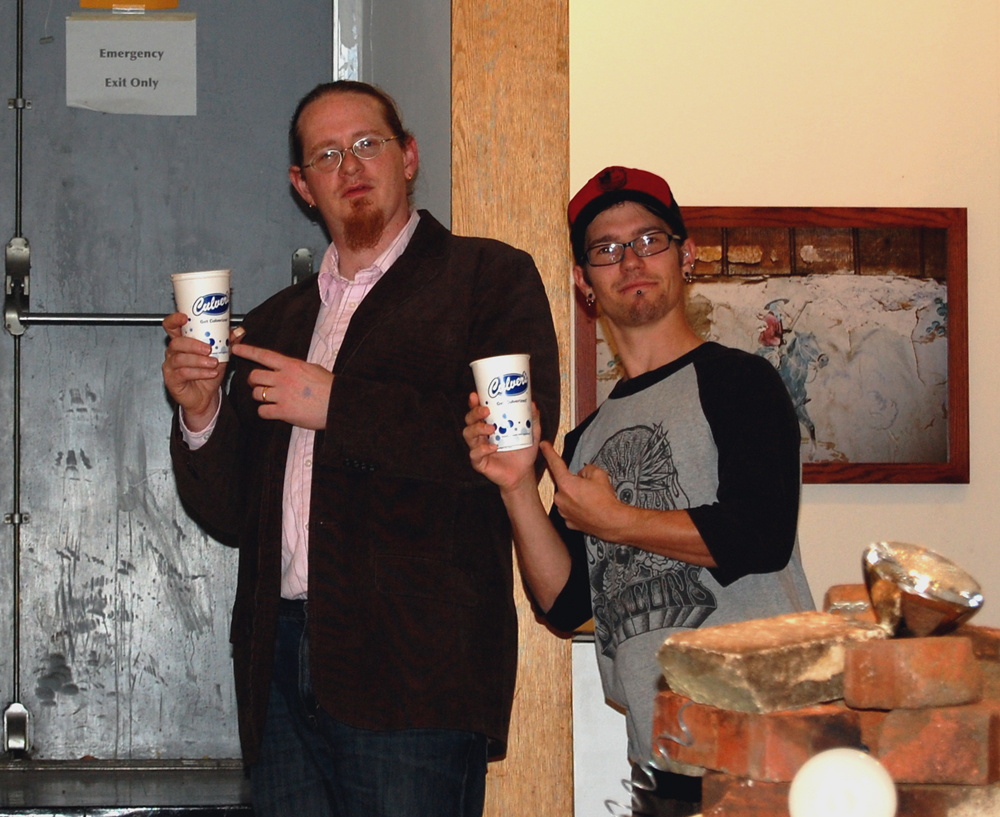
Me and MU BFA graduate Jake Crook at the MU Senior Exhibition on December 17, 2009. We had a donation of beverage cups from Culver’s… brought a new meaning to the phrase “get culverized!”
Me with one of my favorite art students, Shannon.

She earned honors for her work in Psychology at MU. She minored in Art, which is obviously where I worked with her.
Honor students often name a faculty person who walks with them in the procession to the ceremony where they receive their honors regalia. I was humbled when Shannon asked me to attend the festivities with her.
She is a dedicated, thoughtful, conscientious person. I’m looking forward to seeing the trajectory of her continued success as she looks toward Graduate School and combines her love for people with her love for art. Good job, Shannon!
A couple months ago I had a bug beer… or a beer bug, not sure.

Some of my favorite places to enjoy adult beverages here in Columbia, MO are Uprise Bakery and Broadway Brewery. Good stuff. Good people. Check ’em out.
My latest essay, Subjectivity and Robert Henri, was published this week over on the Neoteric Art Blog. I’m really proud of the piece. It challenged me while writing it and I think it’s something I’ll go back to again and again.
I have to say that Annie Dillard’s Pilgrim at Tinker Creek and Gaston Bachelard’s The Poetics of Space were major influences in the essay. Here’s to good thoughts and words, ones that reproduce (even if only in some small way) after their own kind.
 My students always do good work at the Cast Gallery of the Art and Architecture Department at the University of Missouri. I created a post on Art and Architecture’s Blog, Musings, explaining why I continue to take my students to work from the casts. Check it out.
Above: my demo drawing from this semester.
In my Drawing 3 (basically Life Drawing) course at the University of Missouri, we have a series of projects that focus on developing drawings that have a dynamic, shifting arrangement of bodies and spaces. The goal is for students to hone their ability to combine observed form and light with a knowing, thoughtful editing of the overall structure in order to create/direct the psychological environment of the picture. In earlier projects, students are asked to create a drawing of a model who, after a certain period of time, shifts part of his or her pose. Students have to adapt their drawing, learning how to react the experience of seeing rather than freak out that everything isn’t the same (as if anything stays the same anyway). Later on, we work on a longer series of poses over the course of 8 or 10 class periods. Using up to three different models who strike a couple different poses, the class develops larger drawings that incorporate the combination of the different figures in some kind of invented, yet observation-based, pictorial framework. Below are a few examples of what students have done. Keep in mind that none of the models posed together, and often very little of the stage arrangement was the same. I could go on and on about how I believe these projects really strengthen the students to have an EXPERIENCE of art rather than simply executing an exercise, but I’ll let their work speak for them. Click on each for a larger version.

by Lindsey Cole

by Dan Jimenez
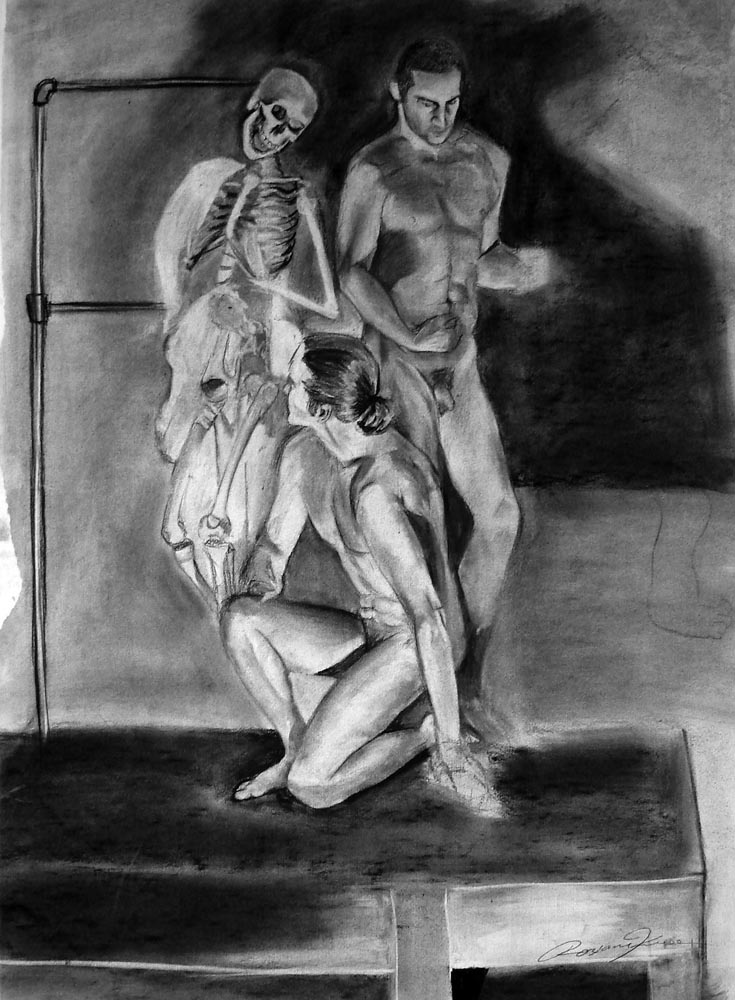
by Roxanne Kueser

by Charlie Hostman
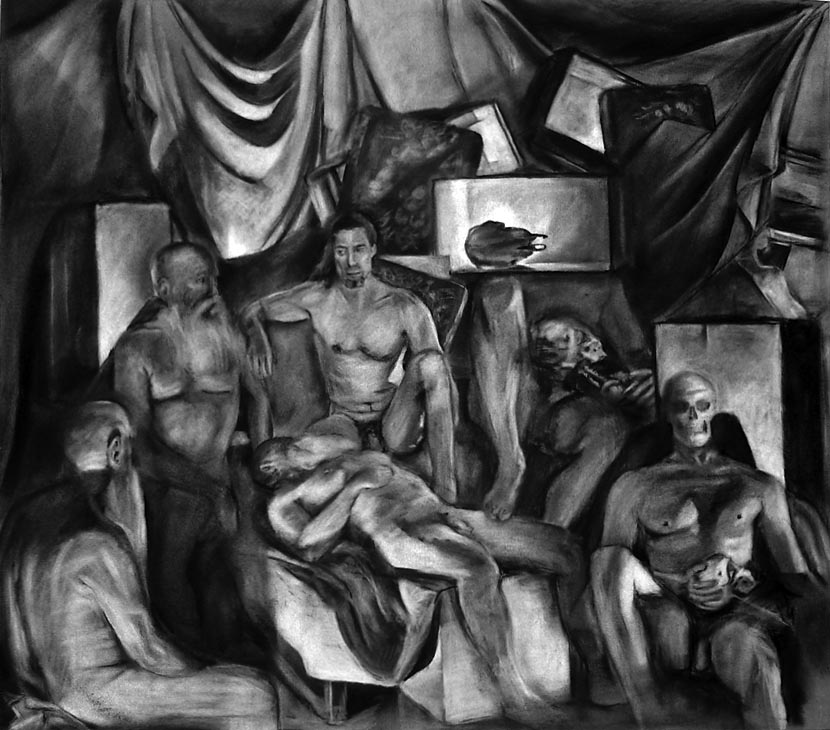
by Jared Fogue
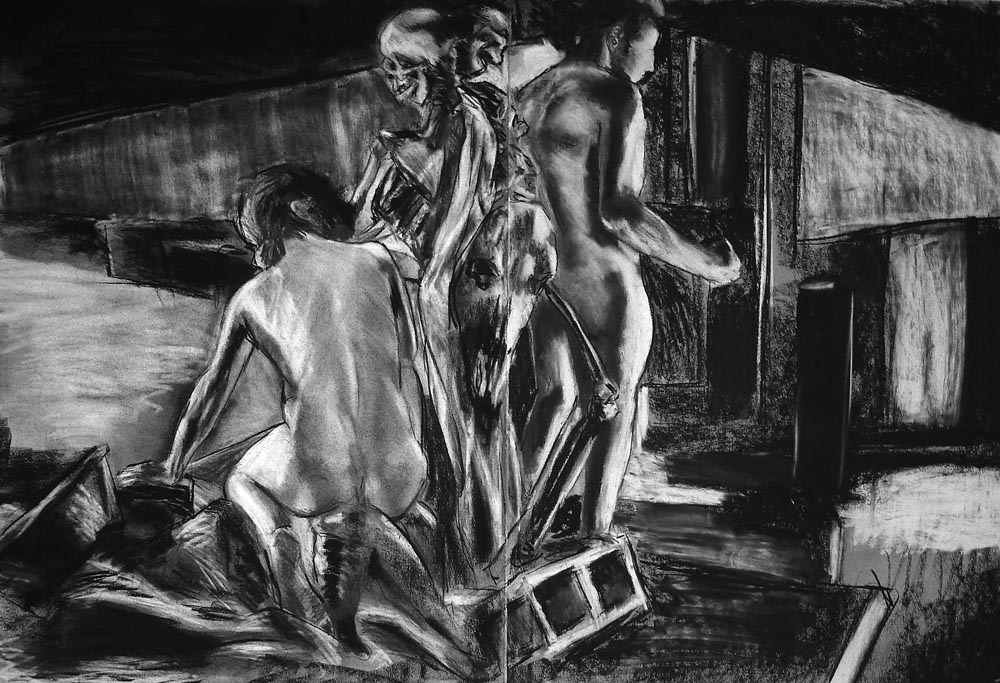
by Marcus Miers
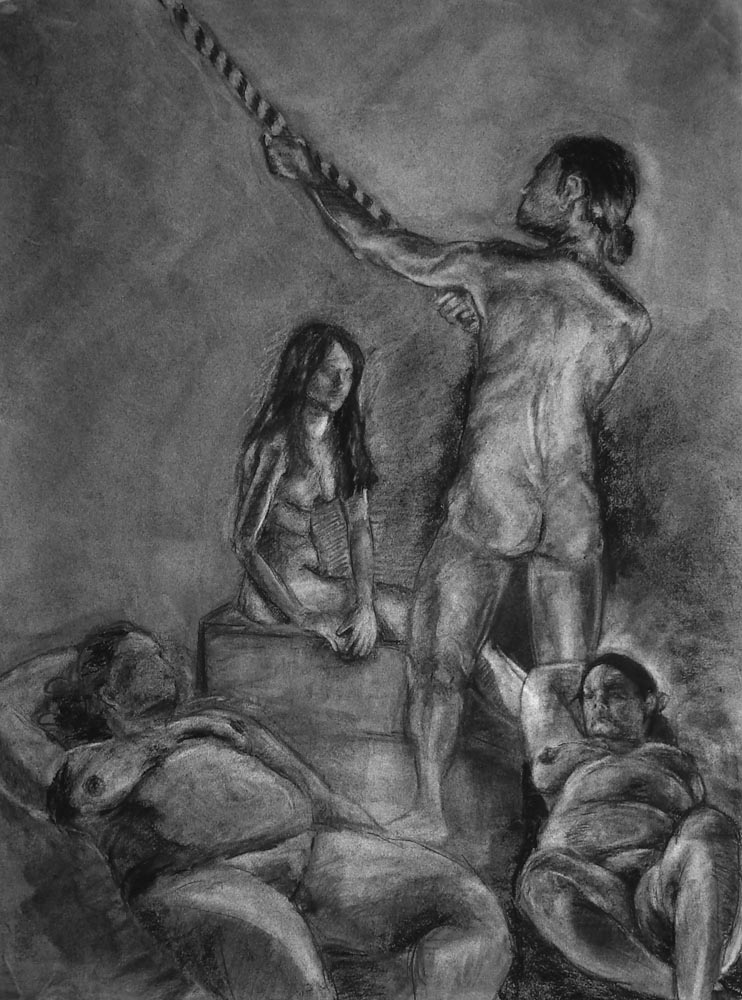
by Mallory Parsons

by Derek Frankhouser
Andy Goldsworthy functions as an artist in a continuum of what I would call shamanistic principles: permeability, density, liminality, derivation, change, and transformation. That is, he manipulates and transforms the materials of the environment in some dynamic sympathy with them. This sympathetic approach is one that makes him keenly aware of his communication with and orientation toward the world. Because of this the work is in a very real sense suggested by the environment, the work’s parameters of possibility defined by the environment, and the artist’s intuitive making directed by the environment. There is very little “manhandling” going on here, very little ham-fisted, blundering action. His art is not an image of mankind dominating or playing flippantly with the world, but rather one of the sensitive investigator being moved forward by suggestions from within the investigated schema. His message is his articulation to the environment, not in some sort of neo-pagan hippy vagary, but in action, physical touch, biological aesthetics (i.e. basic 2D design and shape dynamics, which extends beyond the 2D into the 3D via his spatial and sensation-based investigations). The message isn’t linear like literacy or mathematics. It’s kinesthetic and alchemical. Zero irony, total being-ness. Awesome.
Get more info on Goldsworthy here and here.

The sketches I post here are ones I made during a visit I and my cousin Chris (a photographer) made to the Storm King Art Center in New York State to see Goldsworthy’s Storm King Wall. The trip was inspirational; I highly recommend making a stop at SKAC if you’re in the area.
 Update (December 17, 2009): There’s a great piece on the ART21 Blog about Storm King that discusses the history of the place, how they think about acquiring/installing new work, and other interesting tidbits. Check it out.
 Above: “Shoulder (Grindstone Cliff, Fall 2009)” Click the image for more info.
I love the Grindstone Nature Area here in Columbia, MO. There are a series of cliffs located there, and several of them are within 5 or 10 minutes walk for me. I often go there to draw or read or think.
I’ve gotten some nice drawings out of my time there. One I did a while back can be seen here.
Good stuff.
 eikonktizo
