Doves – An Anniversary Memory

Nine years ago today my wife and I were married in an octagonal church in Joliet, IL That event – as awesome as it was – is not the main subject of this writing today, though it was key to how I experienced that subject. I’m writing about the amazing album titled Lost Souls, released in 2000 by the British band Doves. I heard it for the first time just a few hours before my wedding in 2003.

It is interesting to me how certain details from that celebration day stick with me while others fade. The faded aspects require photographs or the recollections of those who were present for me to remember them. On the other hand, the elements that have remained potent in my memory are transformed by the very act of my remembering; each time I call them to mind they accrue additional resonances, additional implications. So it is with the music on Lost Souls. It came to me just hours before my wedding and it could have easily been just a minor bit of media flotsam that was lost in time as so many other tidbits of those seconds and minutes and hours were.

But it was not lost. It began the journey with me. I’ve carried it with me constantly, had my most intimate thoughts with it, road-tripped with it, prayed along with it, and dreamed along with it. And, of course, it was part of the soundscape surrounding the love I have had for my wife all of these years.

Here It Comes

This is the day

This is the time

To stare at the skies in wonder

It was a perfect bridge, this collection of songs. The sounds that comprised those songs – their notes and pacing and cohesion – held a kind of iconographic power in my heart and mind. I don’t mean to over-romanticize this, but it’s true. The man I was when I began the adventure with my life-partner had a deep yearning to experience a feeling of rightness in the world. This music touched on that earnestness, striking me as if I was a bell (as all good artworks do), and I rang.

How can I explain this? I wanted so much. I wanted to be an artist and to remove all separation between my ability to know and my sense of what was real and true. Naive, I know, but that was the driver in my soul. That motivation to have unimpeded contact with what was Before, Beyond, and yet Within me is what grew the best parts of me. It connected me with ancient threads of meaning that our elders have handed down to us in so many ways, with so many different methods, and toward so many different ends.

There is so much more I could say about the person I was and how he thought. How he imagined a kind of distinction between himself and others, how he held glorious hopes and profane conceits simultaneously. He was a dreamer, a “fourth dimension kid”, and a yearner. In all that internal dialogue, argumentation, and analysis lay a sweet joy in simply being. That astonishment at being alive and aware – and also being conscious of that majestic maneuver in its multitude colors and forms – was, for me, so often connected to words and music and pictures and film. Art and the contemplation of the art were keys that unlocked deeper and deeper vaults within me.

Sea Song

Drive with me

Do the things you won’t believe

Drive with me

Past the city and down to sea

And then, there I was, in the midst of this other, very profound unlocking – marriage. My wife has been the catalyst for the creation of the best I could be within me. Covenanting with her on that day nine years ago opened deeps I didn’t realize I had. In some sense I was shallower than I realized, my depths still holding to shorelines of known continents. With her I found great swaths of unknowing spreading out Before me, Beyond me, and Within me. She was with me on the adventure.

What does this have to do with some specific album by an English indie rock band? Well, as I said, the record was a kind of bridge. It was the soundtrack to a very strange movement that I was about to undergo in my soul. The mood and sense of sadness in the songs perfectly matched my inner yearning. Yearning. I use that word again, in spite of its attendant tinge of sentimentality. We are all, each of us, sentimental and nostalgic beings. We all love the kitsch of our own inner menageries in spite of ourselves. It lulls us, comforts us, and it calls to us. It seemed to me that Lost Souls perfectly narrated the feelings I’d always had, always felt motivated by. And then, because those unnamed (unheard) inner emotions were made overt to me, I was able to see them and carry them differently. The music was a continual drawing out, and what it seemed to pull from me was a sense of what I meant by my being in the world. And now I was stepping into a new, unknown way of being – a marriage.

It’s a kind of connection I couldn’t have planned for. If someone asked me to – beforehand – pick a group of songs that would inspire, nurture, and propel both my inner life as an artist and my outward expression of love and commitment to my wife as a husband I wouldn’t have been able to do it. So how did Lost Souls come to be that?

It was just by coincidence, if you believe in that sort of thing. My soon-to-be brother-in-law Daniel took me to O’Hare Airport to pick up our rental car before the wedding. On the way there in his beat up ’92 Chevy Cavalier he played Lost Souls. He gave me an enduring, transcendent gift that day. From the opening seconds of the first track, Firesuite, I was mesmerized. I looked over the scuffed CD jewel case for the album. On it the noir-ish image of a boxer blended with the inky blackness and was only made visible by flares of light glinting off legs and floor. I was distracted by the music. It took me out of the stuffy car, out of the glare of bright sunlight, out of the blast of city traffic. Nights of seeking (of prayer, of looking toward a future, of trying new things, of failure, of desire, of wanting) leapt from the speakers. There was sadness in the words and sounds, but not the morose, limp sadness of the self turning in upon itself. This was rather the sadness of acknowledged brokenness, of the recognition of perspective. It’s a “majestic sadness” that “moves and invigorates.” This was the sadness of eyes looking upward at starlight.

A House

It was a day like this and my house burnt down

And the walls were thin and they crashed to the ground

It was a day like this and my life unwound

You could’ve struck me with lightning and that’s okay now

We could always put it together again

You could’ve told me a lie, and a lie so thin, so thin

Now everything’s clear

Day after day and the life goes on

And I try to see the good in everyone

If I ever find myself here again

I’ll give everything

Why does this music coordinate with my marriage? Why does this “majestic sadness” connect with the intimate glory possible in marriage? I honestly can’t entirely explain it. I think it has to do with the fact that we are not enough. That is why we yearn. That is why we make things. That is why we try. We’re trying to work through our lack, through our brokenness, through our inability. Great artworks always play on this fact. The late Ray Bradbury stated that it is “lack that gives us inspiration.”

So in my artwork I’m playing with and against my own incompetence. All of my attempts to do great things are based in my own recognition of that lack. Likewise, in my marriage I am constantly aware of my limitations and stupidities. Yet there is seemingly endless grace in my wife. In the Christian tradition, we hold to a notion that grace is unearned favor. Any lack – my brokenness, my foolishness, my inability – would only earn me loss. But lack when seasoned with great grace gives me favor and light and life and astonishment at being. And that’s what I am – astonished. Astonished that I found Alison. Astonished that I have my daughter Miranda. I’m astonished that we’re adopting another child soon. I’m astonished at my students, at my opportunity to teach. That I couldn’t ever really earn these things fills me with a gigantic yearning to do the best I can with them, but it also makes me immensely grateful that they have happened at all.

That counterintuitive gratefulness in the midst of sadness/yearning/trying/hoping is what Lost Souls is for me. That’s the button that it pushes. That’s the acknowledgement that it demands. It is a great work of art. Go buy it.

Alison: (remember when your nickname was “dove”?) Thank you for these nine years, for the grace, for the adventure. Let’s keep going.

Discussions and Digressions

“In places like universities, where everyone talks too rationally, it is necessary for a kind of enchanter to appear.” – Beuys

“Theory can only describe; it can never justify.” – Ballou

Above: Me with some grads after one of our early sessions, Spring 2012

This semester I got to dig deep with a group of graduate students here at Mizzou. In the discussion-based course I presented a series of texts – grouped into several general themes – and used them to attempt to open up the grads’ approach to thinking about, making, and viewing art. In our reading, discussion, and reflective writing, we took on some of the alternative histories/literacies that function within the art world. I wanted to use this post to give a general overview of the topics and content we touched on this semester, as well as offer a selection of some of the provocative ideas we read. I do this as a huge thank you to the individuals whose work we sampled; their words were encouraging, challenging, enraging, and powerful. I also wanted to take this opportunity to thank the students who took the journey with me. So here’s to Aron, Bethanie, Charlie, Chris, Danielle, Eric, Greta, Jahner, Jane, Matt, and Ron; none of us could have had the experiences we had without each of us being a part of it. As David Abram (or Bachelard, or Emerson, or Dillard) might say – all things are in relation.

Above: A grad class?

1) We began by discussing some key dichotomies through the easy-to-access survey work of Leonard Shlain. Contrasting ideas such as Image/Word, Nonverbal/Verbal, and Truth/Fiction were explored in a number of texts and films, the latter being most importantly represented by Herzog’s Lessons of Darkness and Reggio’s Koyaanisqatsi.

“Of all the sacred cows allowed to roam unimpeded in our culture, few are as revered as literacy.” – Shlain

Key Works:
Reggio, Godfrey. “Koyaanisqatsi.” Color Film, 1983.
Shlain, Leonard. “The Alphabet Versus the Goddess: The Conflict Between Word and Image.” 1998.
Herzog, Werner. “Lessons of Darkness.” Color Film, 1991.

2) Tightening our resolution from the expansive binary tensions in our initial overview, our second focus was to look at how the more central ideas and modes of art and aesthetics were defined/redefined and questioned in the first part of the twentieth century. Looking at early pragmatist philosopher/scholars of art and religion like George Santayana and Ananda Coomaraswamy we took the temperature of a certain corner of the institutional establishment in the throes of the Modernism moment.

“To be sensitive to difficulties and dangers goes with being sensitive to opportunities.” – Santayana
“The artist is not a special kind of man but every man is a special kind of artist.” – Coomaraswamy

Key Texts:
Santayana, George. “Reason in Art.” Originally published in 1905.
Coomaraswamy, Ananda. “Christian and Oriental Philosophy of Art.” From a 1956 Dover edition.

3) In our next group of readings we found ourselves looking away from socialized and received notions of making meaning and gazed into the huge vault of human biology itself. Using primarily Rudolf Arnheim and Ellen Dissanayake, we discovered that a very profound kind of knowledge precedes the cognitive ideas that may calibrate our understanding of art: the psychology of kinesthesis and developmental biology. We took Dissanayake as a jumping off point to engage with Evolutionary Psychology as it pertains to art, art-making, and meaning. Touching on the work of Denis Dutton (as well as his critics), we explored how biology has calibrated how human beings make meaning and put it to work in the world. Coming back to pragmatism, we saw how Dewey and Kupfer connected aesthetic experiences with moral growth.

“It is important to recognize that in large measure everything we know is ultimately based on our bodily senses: what we see, hear, and touch, in particular.” – Dissanayake

“The work of art symbolizes all the levels of reality that lie between the phenomenon and the idea.” – Arnheim

“We take pleasure in watching an athlete break a record, hearing a soprano in full flight, or reading a philosopher of depth and insight. Human accomplishment is the ultimate spectator sport. Apply as much historical analysis to it as we wish, and we’ll not unlock all its mysteries. The continuous capacity of genius to surpass understanding remains a human constant.” – Dutton

Key Texts:
Arnheim, Rudolf. “Toward a Psychology of Art.” 1966.
Dissanayake, Ellen. “Homo Aestheticus.” 1992.
Dutton, Denis. “Aesthetics and Evolutionary Psychology.” The Oxford Handbook for Aesthetics, 2003.
Dewey, John. “Art as Experience.” 1958.
Kupfer, Jospeh. “Aesthetic Experience and Moral Education.” Journal of Aesthetic Education, 1978.

4) Once fully ensconced in the notion that our biology (and the way that biology structured our thinking and making) is key to any real understanding of what art is and does, we looked at the intellectual analysis of artworks. This examination of interpretation – or, as it might be, overinterpretation – was overseen by Arthur C. Danto and Umberto Eco, with a significant dash of Richard Rorty thrown in for good measure.

“Interpretation is in effect the lever with which an object is lifted out of the real world and into the artworld, where it becomes vested in often unexpected raiment. Only in relationship to interpretation is a material object an artwork, which of course does not entail that what is an artwork is relative in any further interesting way.” – Danto

“From a certain point of view everything bears relationships of analogy, contiguity and similarity to everything else.” – Eco

“Reading [artworks] is a matter of reading them in the light of other [artworks], people, obsessions, bits of information, or what have you, and then seeing what happens.” – Rorty

Key Texts:
Danto, Arthur C. “The Philosophical Disenfranchisement of Art.” 2005.
Eco, Umberto. “Interpretation and Overinterpretation.” 1992.

Above: COME AT ME BRO!

5) In some sense our exploration of the hyper-intellectualized/philosophized interpretation of artworks took us from culture into a kind of ritualized, rarified space – albeit a secular one. From there we took a tack back toward culture-making and onward through it toward a more spiritual kind of ritual. We looked first at key texts from the famed philosopher of religion Mircea Eliade. Our perspective was updated to the mid-90s with Suzi Gablik’s The Reenchantment of Art.

“The numinous presents itself as something ‘wholly other’ (ganz andere), something basically and totally different.” – Eliade

“Ritual signifies that something more is going on than meets the eye – something sacred.” – Gablik

Key Texts:
Eliade, Mircea. “The Sacred and the Profane: the Nature of Religion.” 1959.
Gablik, Suzi. “The Reenchantment of Art.” 1991.

6) At this point we began to entertain the implications of the alternative histories/literacies we had explored over the semester. We aimed more directly at poetical understanding, beginning with Emerson as a representative of the American Transcendentalist Movement of the 19th century. From there we allowed Annie Dillard and David Abram to bring us up to the present day – and blow our minds along the way. In this section we spent a good amount of time attempting to understand an intuitive mode of aesthetics as opposed to a rationalist one.

“The life of [humanity] is a self-evolving circle, which, from a ring imperceptibly small, rushes on all sides outwards to new and larger circles, and that without end.” – Emerson

“The feelings that move us – the frights and yearnings that color our days, the flights of fancy that sometimes seize us, the creativity that surges through us – all are born of the encounter and interchange between our life and the wider Life that surrounds us. They are no more ours than they are Earth’s” – David Abram

“I’ve an eyeful of fish-scale and star!” – Dillard

Key Texts:
Emerson, Ralph Waldo. “Nature and Other Writings.” 2003 edition by Shambhala.
Abram, David. “The Air Aware.” 2009.
Dillard, Annie. “Pilgrim at Tinker Creek.” 1974.
For your listening pleasure, click here to hear David Abram read The Air Aware.

Above: They (the grads) were in some frightening trees (grad school)! Click here for more information…

7) Our final readings of the semester centered on Gaston Bachelard. This master dreamer – a giant of 20th century philosophy who influenced Foucault and Derrida – helped us grasp the constellations that populate our own inner universes. Bachelard gave us – through his inflected intonations of the words of Rilke and Baudelaire (among others) – a sense of how our intuitive manifestations might transcend the “geometrical ontological determinations” that dominate the empiricist, rationalist approach to contemporary art-making.

“Everything takes form, even infinity. We seek to determine being and, in so doing, transcend all situations, to give a situation of all situations.Man’s being is confronted with the world’s being.” – Bachelard
“By means of poetic language, waves of newness flow over the surface of being.” – Bachelard

Key Texts:
Bachelard, Gaston. “The Poetics of Space.” 1994.

I want to thank all of the grads for going with me on the journey this semester. Spring 2012 FTW!

Exploring Possibility

Jill Hicks of the Columbia Daily Tribune wrote a piece titled “Exploring Possibility” that ran on Sunday, March 18, 2012. The article follows Allison Reinhart, a student who’s been a major presence in the Art Department here at Mizzou. She’s currently taking an independent study with me. We’ve worked together in the past – most notably on this film by the inimitable Keith Montgomery – and she’s one of my favorite people at MU.

Jill quoted quite a bit of my thoughts on working with Allison. It’s really nice to find that you’ve said something that really rings true and you have to work to live up to it. I feel that way about this particular passage: “…making accommodations for my students isn’t an area of ‘special’ or ‘additional’ effort — it’s the way it ought to be,” […] “All culture-making is about access. When we — as institutions or individuals — legitimize the denial of access to those who wish to participate, we’re functioning as gatekeepers and operating in illegitimate systems of refusal. As an educator and person who deeply believes in the value of university-level teaching, I don’t want to be a part of that.”

Thanks to Jill for the great article and to Allison (and Gina, and others!) for being thoughtful, dedicated students. No, I didn’t say inspirational… Allison wouldn’t like that. :)

The Huffington Post Includes my Work in a “Top 10 Best” List

I was gratified to learn that The Huffington Post included my recent essay on Richard Diebenkorn, written for neotericART, in a “Top 10 Best” listing! The piece, written by Brett Baker of Painters’ Table, cited my work immediately after Raphael Rubinstein’s “Provisional Painting, Part 2.” This was excited to me, as Rubinstein’s original text on provisional painting was a catalyst to my thinking in my piece. Here’s the takeaway quote:

“Artist Matthew Ballou’s piece “Diebenkorn: Provisional Action, Provisional Vision” finds surprising and convincing connections to this kind of provisional approach in Richard Diebenkorn’s Ocean Park paintings” – Brett Baker for The Huffington Post.

Thanks, Mr. Baker! Painters’ Table is awesome! Read my essay at neotericART here!

A Powerful Vision of What Love is

“Your love should never be offered…”

by Hafez

Love sometimes wants to do us a great favor: hold us upside down and shake all the nonsense out.

Your love
Should never be offered to the mouth of a stranger,
Only to someone who has the valor and daring
To cut pieces of their soul off with a knife
Then weave them into a blanket
To protect you.

Stay close to any sounds that make you glad you are alive.

Ever since happiness heard your name, it has been running through the streets trying to find you.
I wish I could show you when you are lonely or in the darkness, the astonishing light of your own being.

There are different wells within your heart.
Some fill with each good rain,
Others are far too deep for that

Fear is the cheapest room in the house. I would like to see you living in better conditions.

Even after all this time the sun never says to the Earth, “You owe me”

There is no pleasure without a tincture of bitterness.

ballou - towardessential - two nautillus

***

Thanks go to Catherine Armbrust for bringing this to my attention, and Paulo Coelho for posting it here.

Diebenkorn, Painting, and Contemplation

My most recent essay is now available to read on neotericART. The piece was written after an October 2011 trip to Texas that was funded partially by the University of Missouri (where I teach). It is a long contemplation on the experience of seeing Diebenkorn’s work in significant number and in appropriate surroundings, but also reflects the long-time presence the great artist’s work has held in my mind. I also see the text as a lateral critique of Raphael Rubinstein’s (part 1, part 2) and Sharon Butler‘s writings about provisionalist/casualist painting. I hope you enjoy the piece and would welcome any comments you have.

New Directions

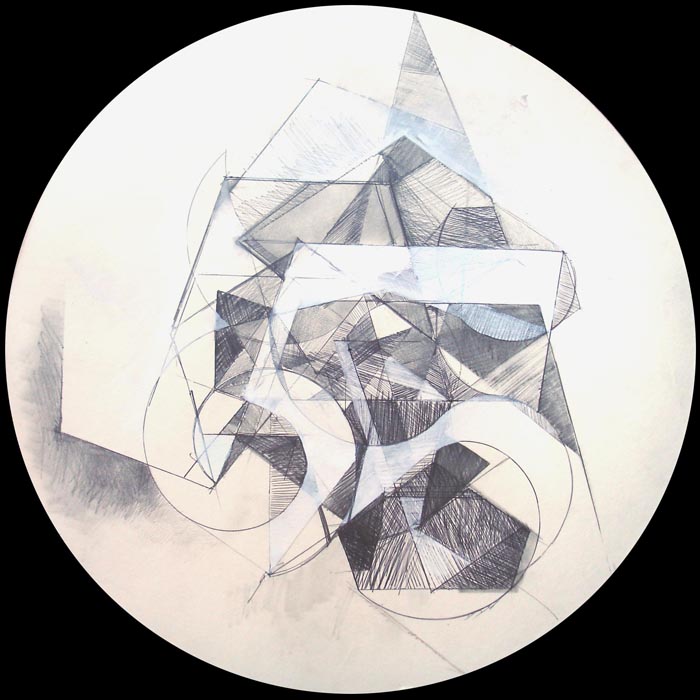
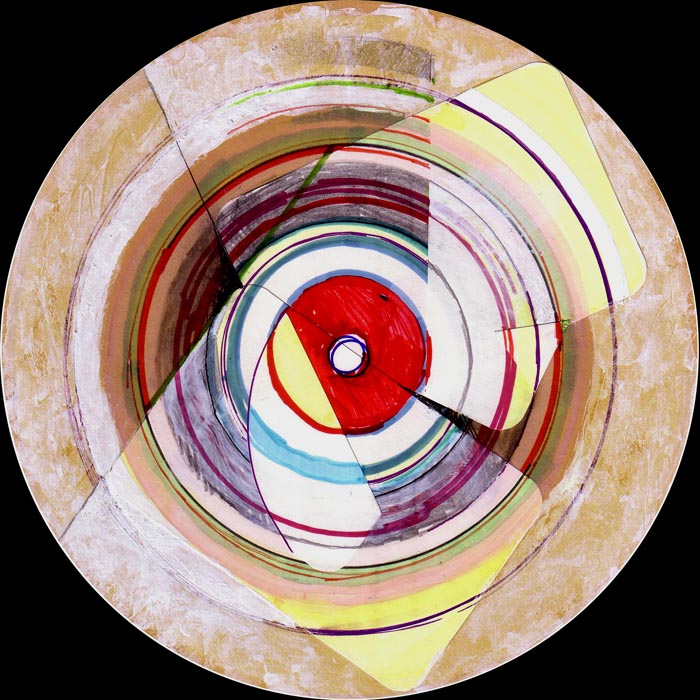
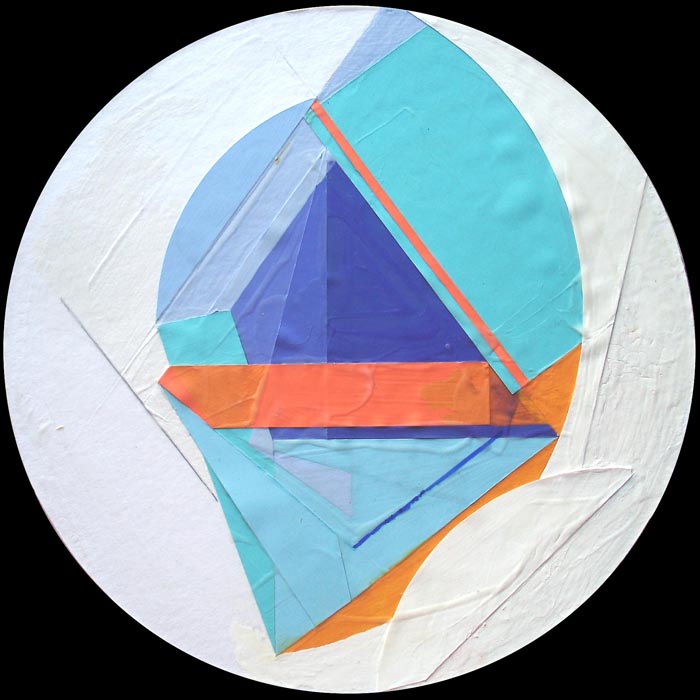
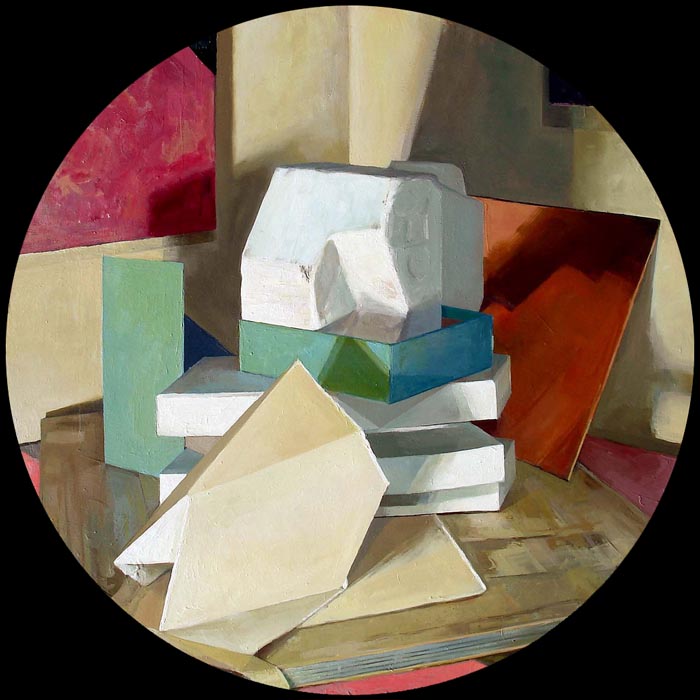
Much of my recent artistic exploration has been about the way visual perception of three-dimensional space may, in its translation into a two-dimensional format such as in a drawing or painting, coalesce as not only illusion but also as compositional formatting across the picture plane. A plane of color may be both flat surface interlocking with its neighbors and a receding plastic arena indicating distance and spatial relationships. An edge may – with angular force, contrast, and implied line – be both demarcation and cohesion, both joining and separating the shorthand elements of either illusion or formal structure.

So it is that I have been creating images that attempt to play with the edge between 2D compositional formatting and the illusion of 3D space. My guide is always perception – that is, my own sense that a form keys into illusion as well as into flat shape. Some of the works are more clearly abstract (seemingly without referent) while others are more obviously depictive. Yet both are aiming at the same goal. Below I present works in this vein I’ve been making over the last year or so – these are just a few of what is a growing body of work.

Ideal Form #2, Mezzotint and gouache, 7 inches in diameter.

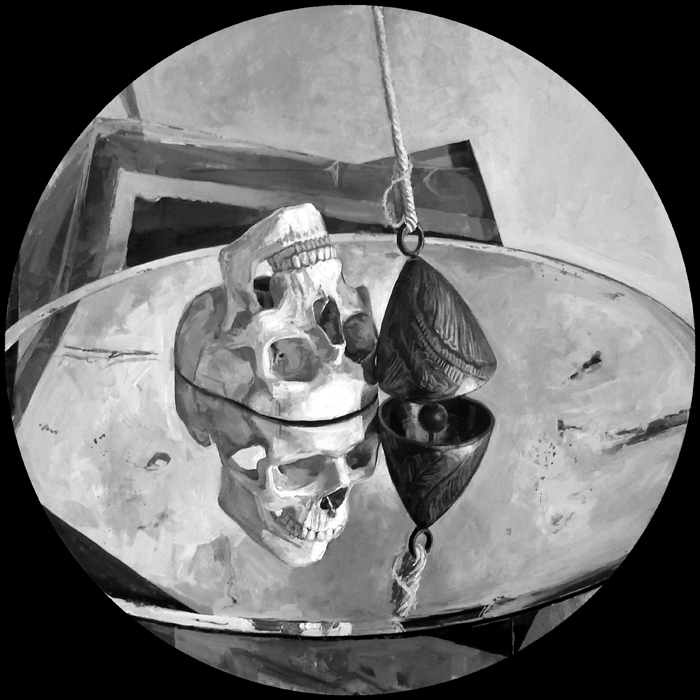
Two Bells, Acrylic on panel, 24 inches in diameter.

The Seedbed (#1, Subtractive), Graphite on paper on panel, 23.5 inches in diameter.

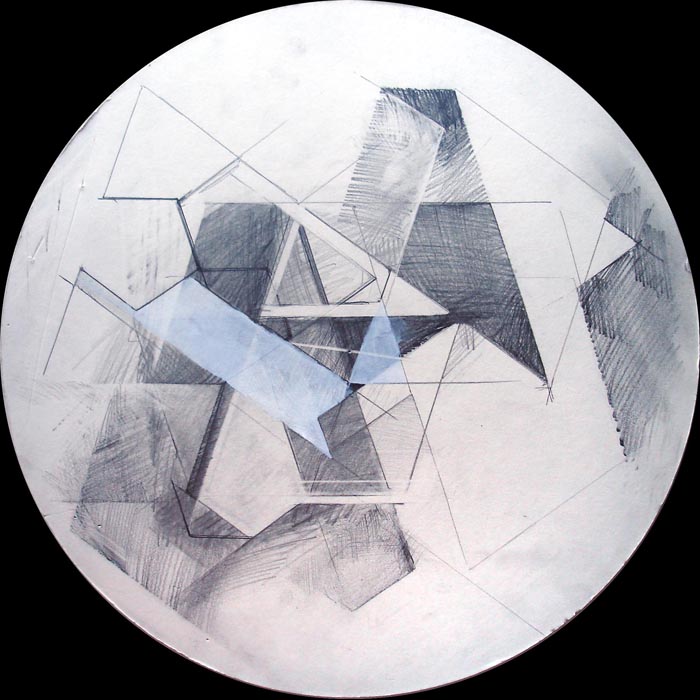
Untitled Template Drawing, Graphite and gouache on paper, 20 inches in diameter.

Untitled Template Drawing (A 5 for Daniggelis), Graphite, ink, and gouache on paper, 20 inches in diameter.

Seven Mandalas for the Murky History of Beginnings and Endings, #3, Marker, graphite, ink, collage and white-out on paper, 6.25 inches in diameter. Collection of Ian and Natalie Shelly, New Albany, IN.

Seven Mandalas for the Murky History of Beginnings and Endings, #5, Marker, graphite, ink, collage and white-out on paper, 6.25 inches in diameter. Collection of Tim and Denya Wolff, Camden, NY.

Pivot, Paper collage, gouache, and acrylic on paper, 9 inches in diameter.

For Tatlin, Paper collage, gouache, and acrylic on paper, 9 inches in diameter.

The Teachers, Oil on Panel, 24 inches in diameter.

The Resonators (In Progress), Oil on Panel, 12 inches in diameter.

Next post: I’ll break down the 2D and 3D binaries I’m thinking of in some of these works. Also, I wrote some initial thoughts about this process of settling in on a new focus in this post: “What I’ve Been Musing on Recently.”

Statement, January 2012

     I create paintings, drawings and prints in an attempt to address – through archetypal themes and symbols – the fundamental questions, ideas, hopes, and concerns I have about being in the world. I write texts in an attempt to integrate rational conceptions and reflections with my passionate, sometimes illogical, image making. In tandem, these avenues of expression form a multifaceted arena of investigation and inquiry that I use every day to – hopefully – understand and make sensible the miraculous reality of being.

     The statement above relies on the fact that I am deeply interested in three main aspects of the human condition: being, symbol, and body.

     I am intrigued by the state of evocative subjective experience that Gaston Bachelard described as “the astonishment of being.” Thus, though I am interested art of all kinds, I take particularly to those forms that connect with our embodiment or sense of being. This means the physical world, the objects we use and love, and the bodies we inhabit are particularly important to the sort of art I want to see and make.

     It follows then that I find the expression of meaning through symbol – that is, the potential for objects to accumulate and resonate with meaning – to be a central interest of my art-making practice.  Anything containing meaning has been, as John Dewey wrote, “funded” with importance through the physical interaction and intellectual contemplation human beings have invested in it over time.

     The body is the zone of incident where being-ness and the structures of significance coalesce. Therefore, I foster a deep appreciation for the human body as a container for and calibrator of meaning and knowledge. As a maker of images – be they painted, drawn, or printed – I function as a symbolist in the traditional sense; I create tableaus for the relational contemplation of that which is beyond the facts of appearance. In doing so I hope to stimulate an evocative, transformative experience in my fellow human beings.

What I’ve been musing on recently

I’ve been thinking about overtly shifting the direction of my work for a while now – perhaps a year. I don’t know that this shift would be easily discernible from the outside, but it represents a significant change of focus for me. As I look back over the last year of my practice and then cross-reference what I’m seeing there with some of the artists and artworks I’ve been looking at during that time, I can really see some connections forming.

For instance, check out these recent pieces:

The Teachers, Mandala for the Murky History of Beginnings and Endings #1, Portrait of Miranda at Thirteen Months, Two Bells, and The Seedbed #1.

Then compare their compositional formatting with aspects of the works of artists I’m looking at here:

Richard Diebenkorn, Miyoko Ito, Barry Le Va, Nicholas Byrne, David Rabinowitch, Julian Stanczak, Bernd and Hilla Becher, Marcelo Bonevardi, Frank Nitsche, Sharon Butler, and Vincent Fecteau.

It seems to me that my previous forays into more formal explorations – such as with the Locus Series (book here), and the conceptually interconnected Quintessence Series and Dodecahedron Series – are becoming more and more deeply apparent in my main body of work. In some ways I’m finding myself less drawn to the figure as a necessity and more drawn to the composition itself. I’m deeply interested in the perception of formal dynamics and the sense of haptic maneuvering that can take place within two-dimensional forces.

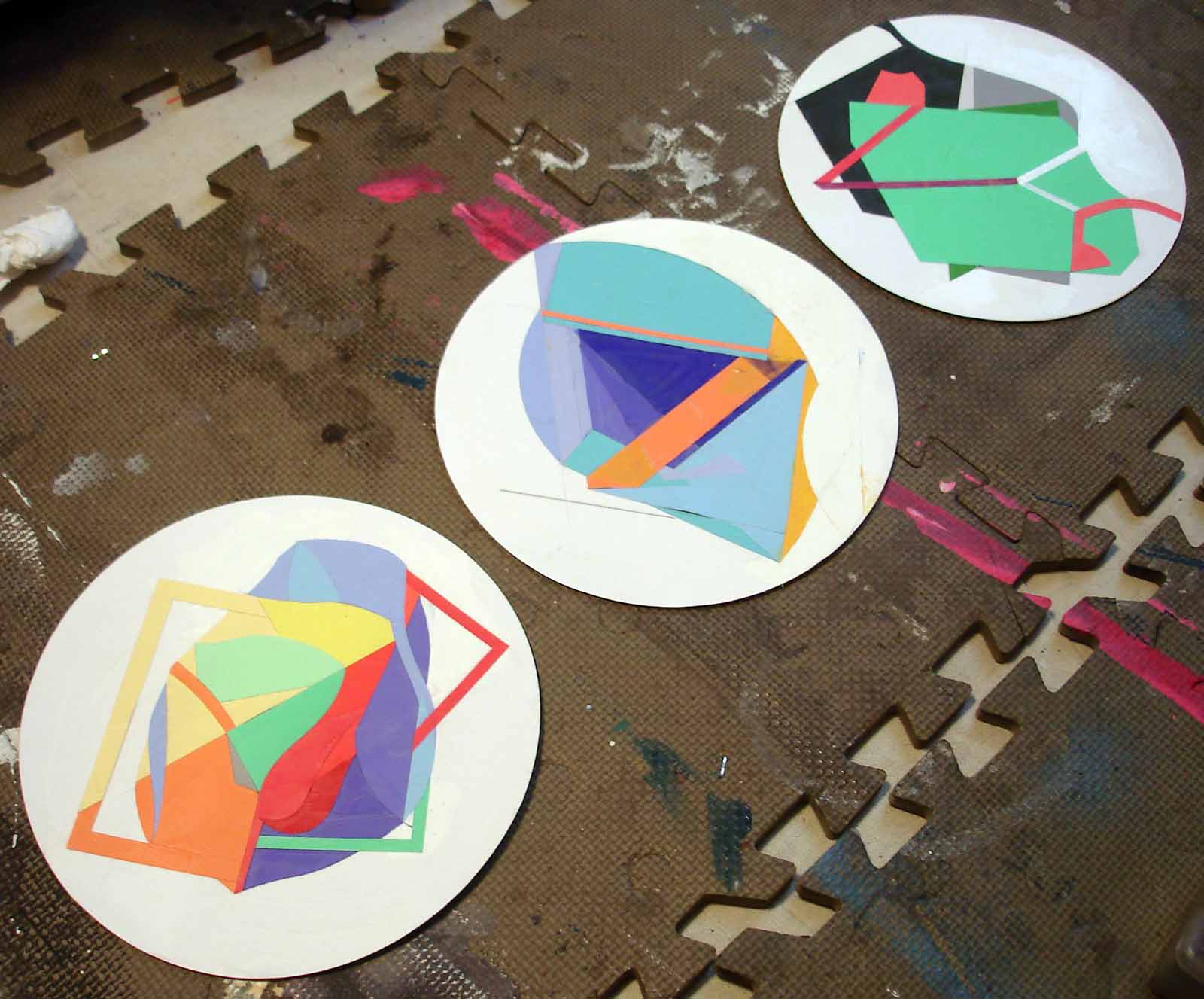
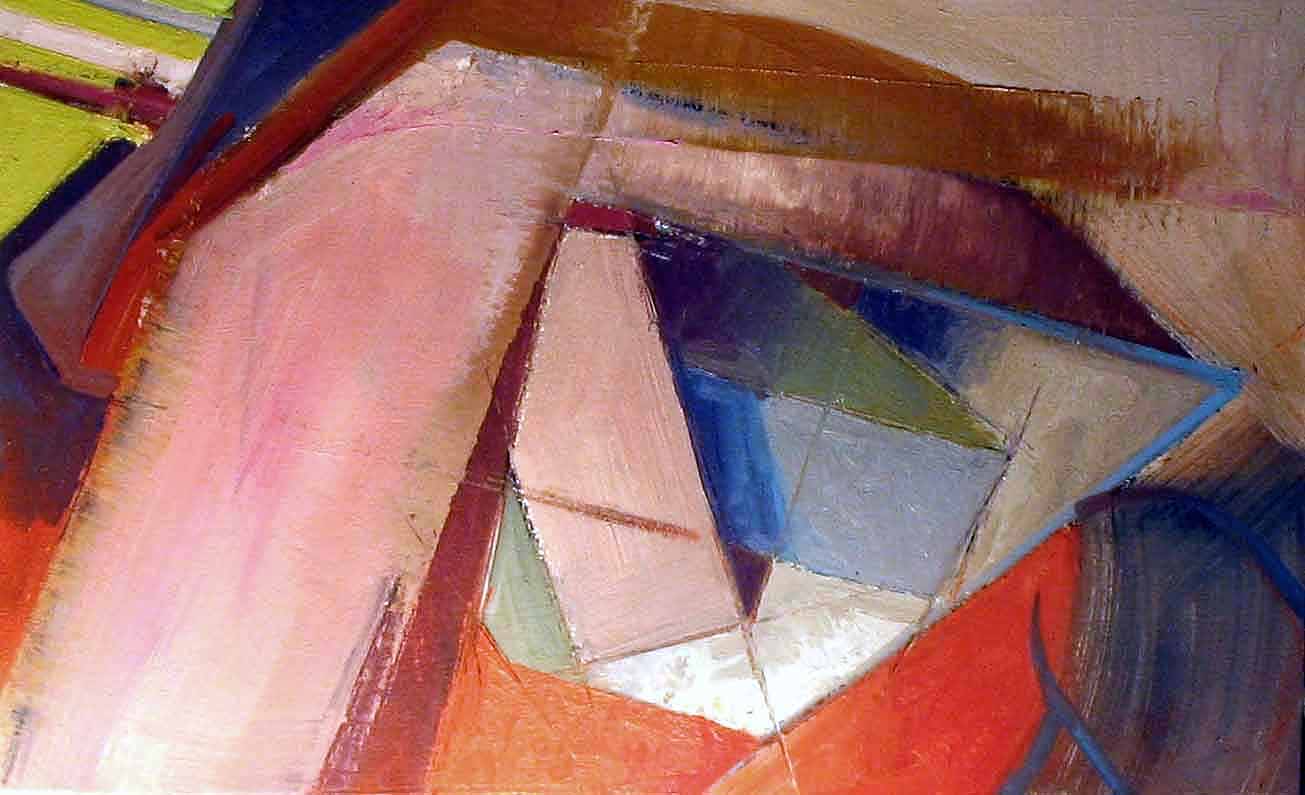
So it is that my recent miniseries, three of which are shown above in progress (9 inches in diameter, collage, gouache, acrylic and graphite on paper), have come about. They call back to previous works, such as this one from 2005, which was part of a side project I did while finishing up grad school (I needed a break from my thesis paintings):

First Bend, Oil on Canvas on Panel, 14 by 23 inches, 2005. Destroyed. Click to enlarge.

Anyway, who knows? We’re all moved and pressed and pushed, often by things we don’t entirely recognize. That’s why painting is so much more like getting lost in the woods than it is like jumping in a car and driving to the store for milk. It’s not meant to be that simple.

If it were that way there would be no discovery, no evocation beyond what we already know… and what good would that be?

Visiting Ocean Park

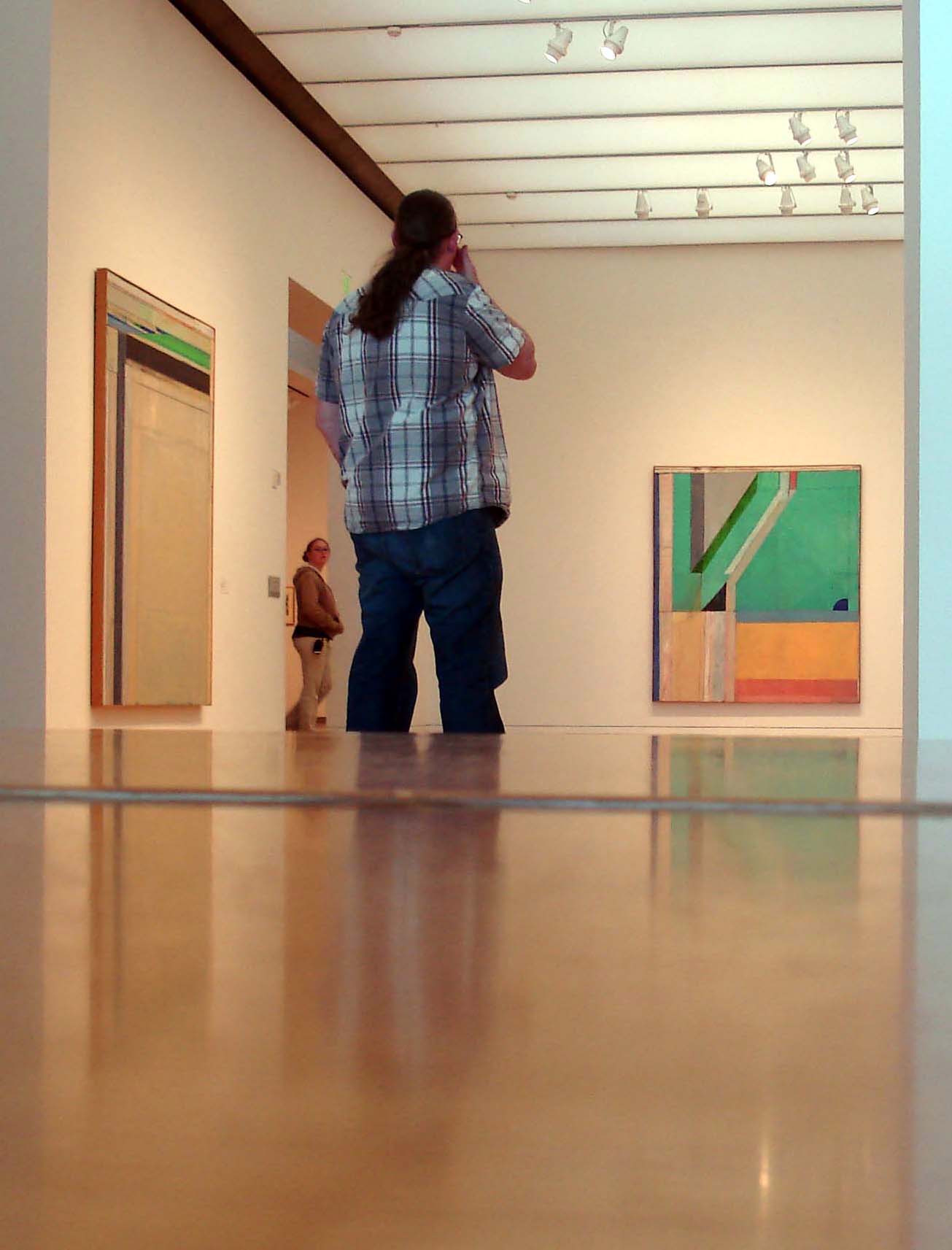
Recently I visited Fort Worth to experience the retrospective of Richard Diebenkorn‘s Ocean Park paintings. I have spent the last two weeks trying to process what I saw and what I think about what I saw. I’ve loved Diebenkorn’s work since my first encounter with it. I had to wait nearly 15 years to get the chance to really see the work in context. I’m in the midst of writing my reflections; they’ll appear over at Neoteric Art sometime in the next month or so. For now, check out some pictures of me and Marcus taking in the majesty of Ocean Park.

Marcus sketching from Ocean Park #30.

Marcus scrutinzing Ocean Park #135 – that’s the corner of Ocean Park #93 above his pencil.

Me taking in the glory of Ocean Park #40 from across the gallery.

Here I am considering Ocean Park #79.

And jump here and here to see some pages from my notebook written/scribbled during my time in the exhibition.

If you can’t make it to the venues the show will travel to over the next year, be sure to see this nice photo essay from the current iteration of the show.