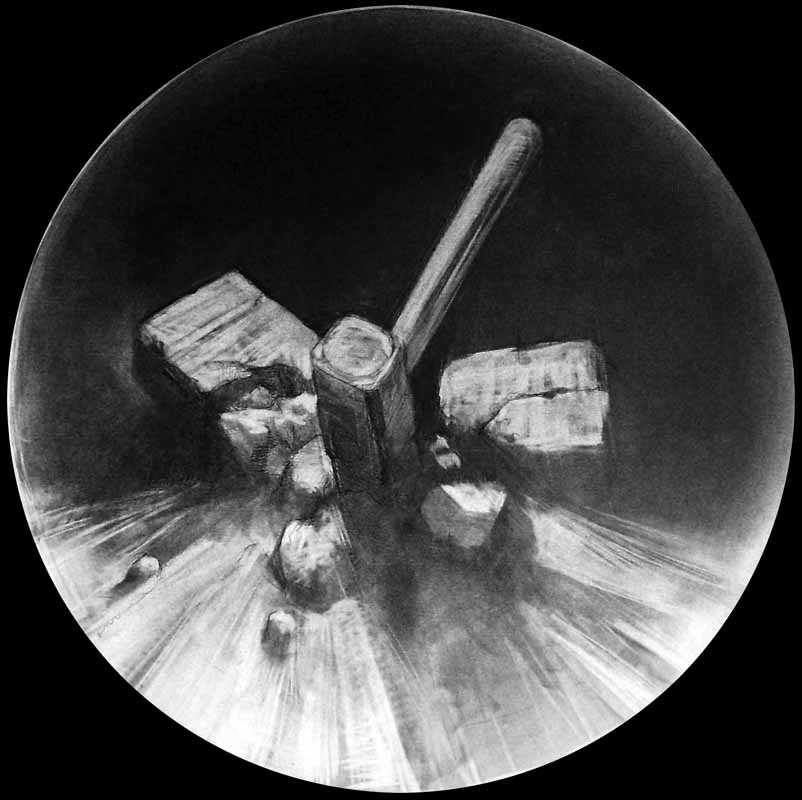
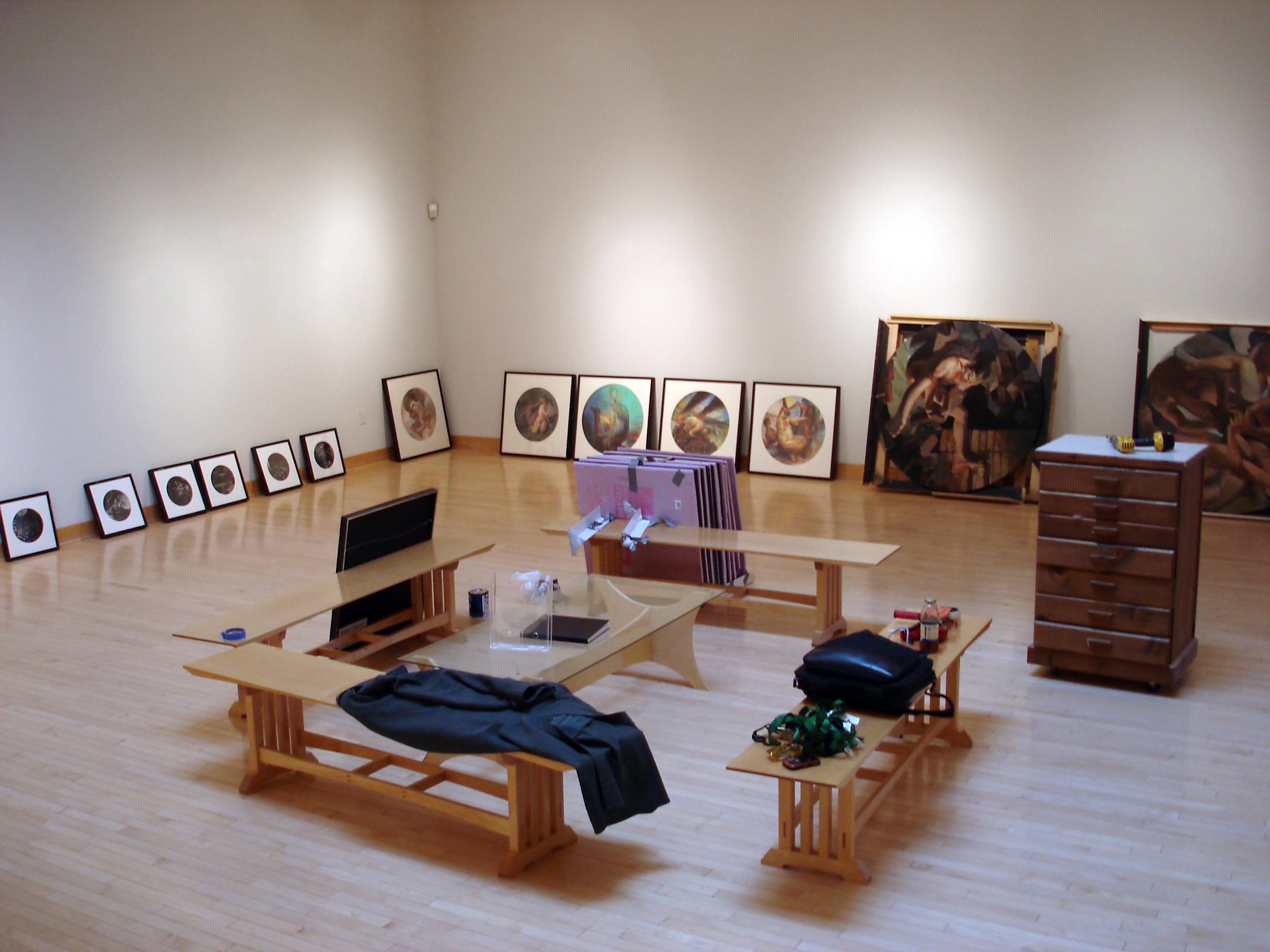
“The Bell, Struck” – Tondos by Tim Lowly and Matt Ballou

I’ve got an show coming up in Louisville, KY with Tim Lowly at the 930 Art Center. Click HERE to see the 930’s website for the show. Click HERE to see a gallery of some of the work I’ll be presenting there and HERE for work from Tim. I’m really looking forward to this exhibition! If you’re going to be in the area this summer, check it out!

Above: Bells, acrylic on paper mounted on panel, 24 inches in diameter. In progress.

IU Fine Arts Student Association Submission

IU’s Fine Arts Student Association recently solicited postcard sized works from alumni, like myself (MFA, Painting, ’05). Below is what I sent them.

Water From a Stone (Ballou, 2011 – For IU), ink on moleskin page.

Here’s a link what a fellow IU alum, Stephen Cefalo, submitted. The whole thing is to support FASA’s “Making Art Work” symposium on careers in the Arts. Click here for more information about it.

Drawing is…

Drawing is the literal manifestation of corrections, adjustments, and negotiations made during its own construction. A drawing (regardless of the manner of the image it displays) is always a representational work depicting the activity by which it was made. As we build a work, we self-correct. As we self-correct, we leave a trace of real observation and negotiation, declaring our willingness to leave behind what has not worked in the service of the total work and in anticipation of something that will work better. The final drawing is not a snapshot, not a slice of time, but a track record of integrations attempted, iterations discovered, and disparate elements syncretized.

Untitled (Beautiful Collision #3), Graphite on paper, 20 inches in diameter, 2008.


Another Semester, Another Round of Glory

Yes, it’s Beginning Color Drawing time again… Once again it’s been a great start to the semester. I feel pretty astounded at the talent of my Beginning Color students; even though they’ve all taken Drawing 1, and some have had other studio courses as well, they’re all making big strides. It’s fantastic work. Take a look:

Andrew Vincent “Grid #1” Chalk Pastel, 24 by 18 inches, 2011.

Melissa Hoefer “Grid #2 Colored Pencil, 18 by 18 inches, 2011.

Emily Armstrong “Two Colored Pencil Object Group Studies” Colored Pencil, 24 by 18 inches, 2011.

Lauren Roberts “Grid #1” Chalk Pastel, 18 by 24 inches, 2011.

Mitchell Baggett “Colored Pencil Object Group Study” Colored Pencil, 12 by 18 inches, 2011.

I know I’ll be posting more work from this group…

Installing at Gordon

Today I arrived at Gordon College to install my exhibition of paintings, drawings, and prints, titled Redeeming Tensions. Bruce Herman, a Professor at Gordon and director of the gallery, worked with Leo (installer extraordinaire!) and me to hang the show. Here are a few shots of it all going up.

I also spoke for Associate Professor Michael Monroe’s class of 75 or so – fielding all of the students’ questions made for a good time.

More tomorrow after the opening reception talk. If you’re in the area (eastern Massachusetts), stop by! It’ll be at the Barrington Art Center on the Gordon Campus.

So far I’ve felt such a kinship with everyone here. It’s a great place; the beautiful campus has a massive blanket of snow but everyone is pleasant and uplifting to talk to. I’m really looking forward to the reception…

The Figure Now at Fontbonne University

I have two pieces up at Fontbonne University’s show “The Figure Now”Michael Grimaldi was the juror. The mailer invite card is below, and below that one of my works from the show. If you’re in/near Saint Louis over the next month, stop over and check it out (and my two other current shows (in VA and WV) are on view now and will be up for a while).

(click for a larger view/event info)


The Angles, graphite on paper, 42 inches in diameter.

Tale of the Tin Foil

Back in 2007 I was teaching a Beginning Drawing class at the University of Missouri – one of the first of my time here. I was challenging my students’ notions of process and rendering. So many young people come into art classes believing that mere transcription – literally photographic-type replication – is the standard of quality. Basic verisimilitude rules their ideas of what is good and they have little to no idea of material, process, or context.

Early on in the semester I told them that if they used the strategies I was trying to teach they’d be able to do more than merely replicate what they think they know: they’d be able to feel an experience of the space and air and object-ness of their subject matter; they’d be able to move beyond trying to recreate the surface details of a photograph and begin to sense the deep masses of shape and movements of light that under-gird formal composition and communicative meaning. I told them that – moving from these general underlying abstractions, through a process of accumulation, toward the specifics of forms in space and light – they’d be able to do far more than attain photo-realistic images; they’d be able to make evocative explorations into the nature of being.

I don’t think they really believed me.

They didn’t realize that the subject of our class was not the simple manufacture of pictures, not the creation of images that corresponded to their referents in a sterile, monocular, photographic representative mode. Instead, what we were aiming at was (and still is in my Beginning Drawing courses) an exploration of sight itself. The subject and aim of my classes is to help students become aware of their own conscious seeing, and to inform that sight with particular sorts of logical and intuitive approaches to what is before their eyes.

They’re always dubious, but I think most of my students go with me on that journey of discovery and awareness.

In any case, that first class in 2007 challenged me. They essentially said, “you can’t use these observational, sighting-and-measuring, general-to-specific, experience-not-execution techniques to make something better than a transcribed photograph.” They asked me to try my hand at tin foil – crinkled, wrinkled up, then spread back out again.

Above is the final drawing – click through for a detailed view. Below is an animation of the process – I took images to show the students how I moved through the construction of the drawing (click on it to see the procession of images):