Matt Ballou: RANGE – Reception at William Woods University

02

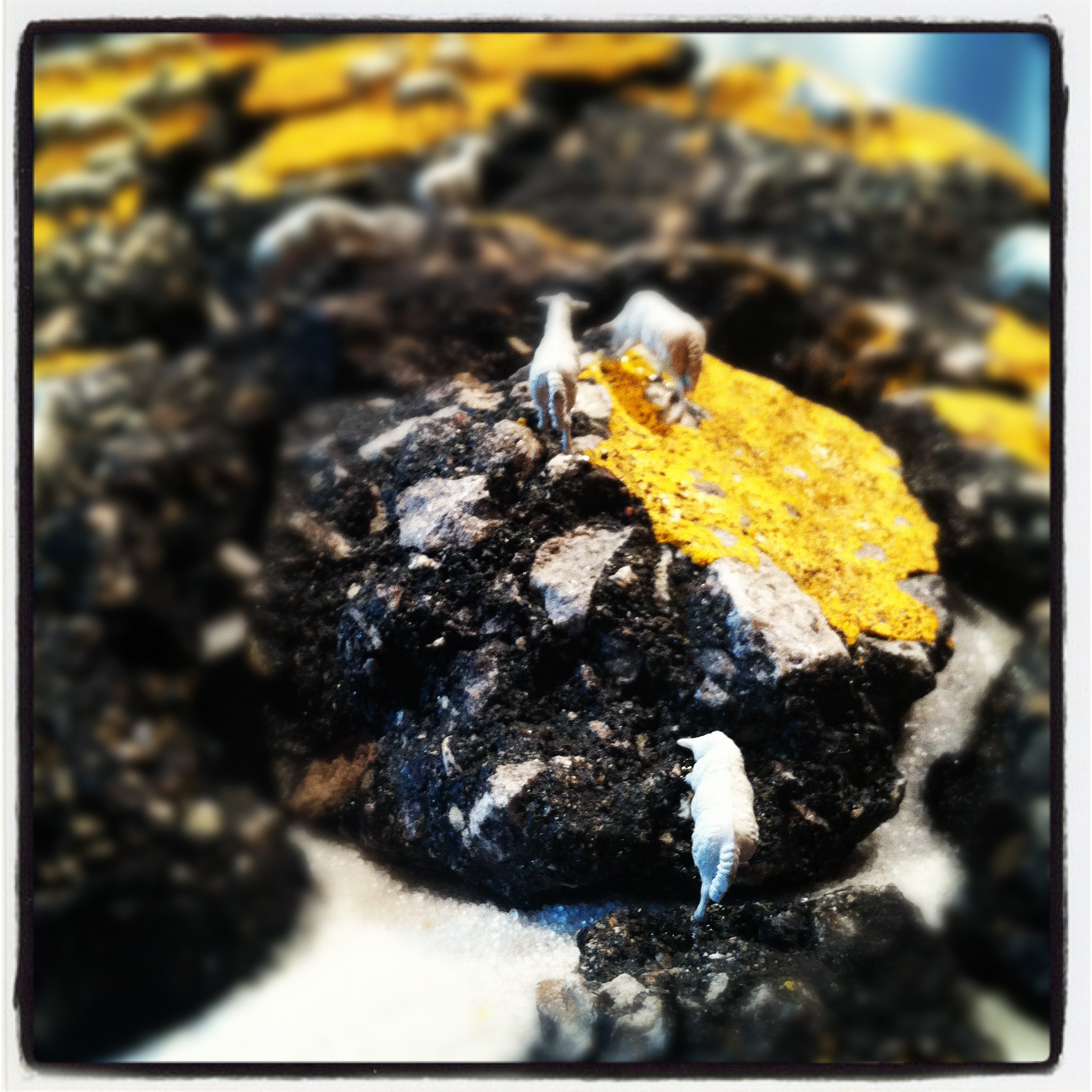
My exhibition – Matt Ballou: RANGE – is still up at William Woods University until December 16, 2012. I hope you can go see it if you haven’t yet. Below are some photos of the space, both after the installation and during the reception. I want to thank everyone who came out – friends, students (graduate and undergrad, current and former), and colleagues – and especially Jennifer Sain for her help in making the exhibition happen. Special thanks to Jane Mudd for encouraging William Woods to host this show.

01

Installation, back on November 12, 2012.

04

05

06

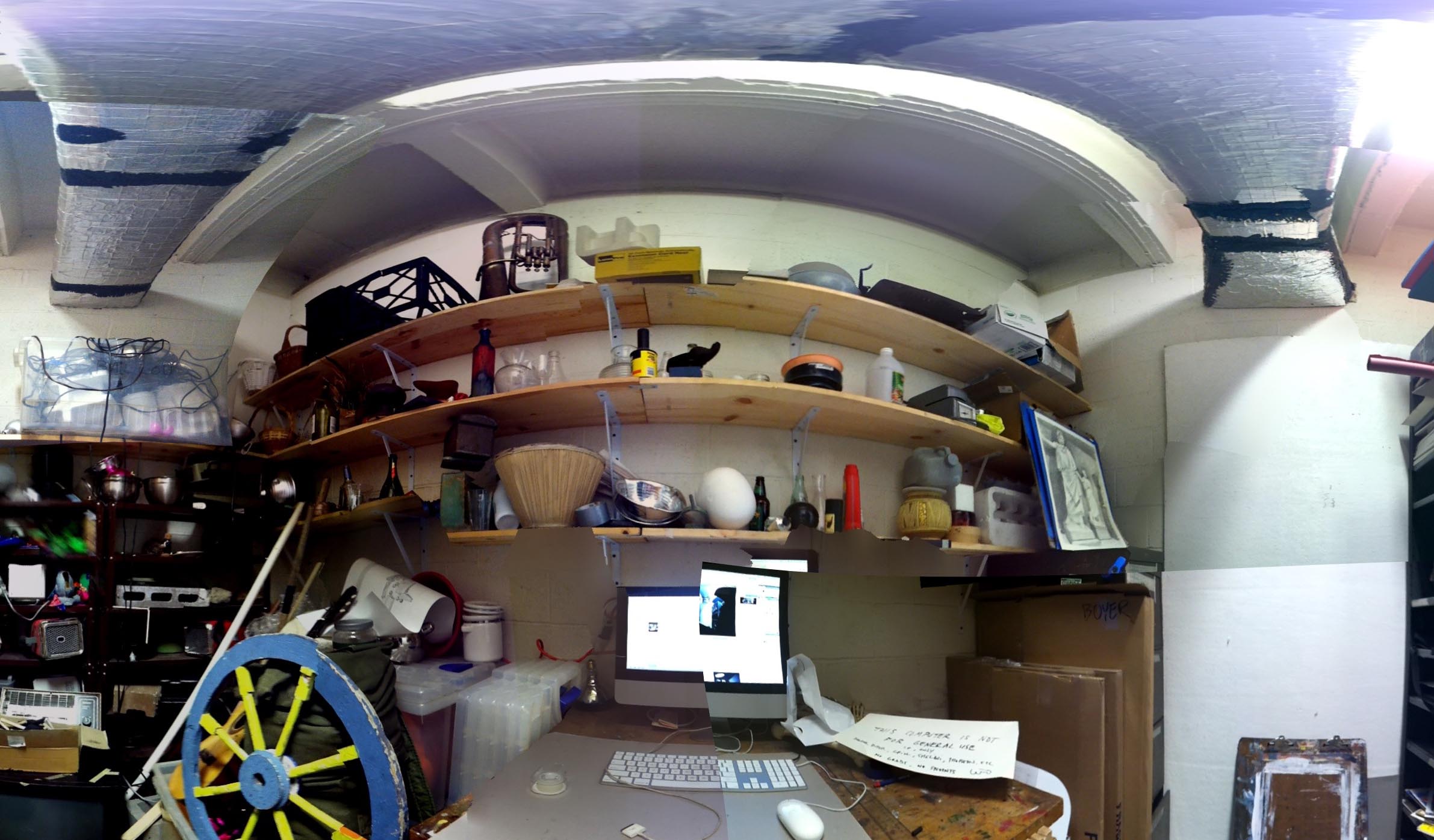
Three panoramas of the installed work.

03

Two of my all-time favorite works… Locus #77 and #78

09

10

07

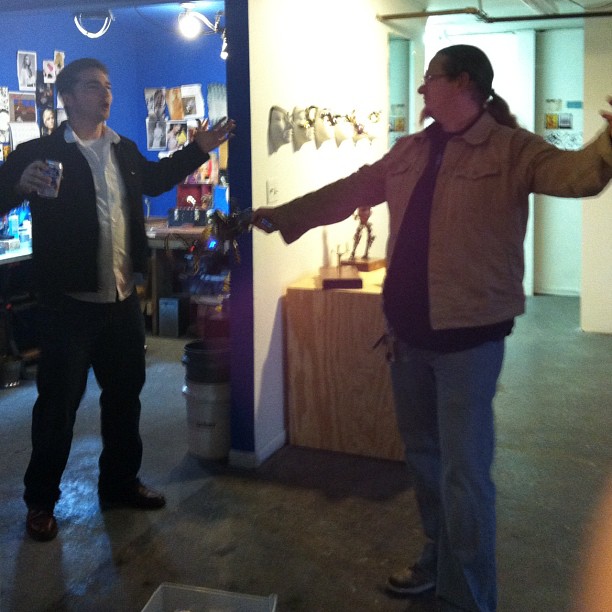
Beautiful angles and shapes during the reception…

At the reception I gave a brief impromptu talk that led into some interesting questions from the audience and my own musing on the work.

11

Me during my talk – Photo by Kevin Larson.

Click here to download the talk and Q+A session (42 MB MP3 format, 50 minutes long).

Some notes about the talk:

12

Photo of me at the talk – Photo by Eric Norby.

Color Drawing, Fall 2012

We’re halfway through another great semester of Color Drawing. Below are just a few examples of some of the standout work from this year. Click for higher res!

Danielle Wallace, Chalk pastel of reflections.

Emily Brewer, Oil pastel study of colored and fluid filled glass.

Emily Brewer, Oil pastel large arrangement of reflective and glass objects.

Jessica Bremehr, Colored pencil study of a lamp.

Jessica Bremehr, Oil pastel large arrangement of reflective and glass objects.

Jessica Bremehr, Chalk Pastel study of reflective surface.

Ginny Algier, Oil pastel large arrangement of reflective and glass objects.

Kevin Moreland, Chalk Pastel self portrait in a reflective surface.

Julie Bennett, Oil pastel large arrangement of reflective and glass objects.

Click HERE to see more of my posts on my Color Drawing class glory!

Inspiration – Norleen Nosri

Norleen Nosri is a talented ceramist from Malaysia who is earning her MFA here at the University of Missouri. I’m privileged to work with her and to own several of her beautiful pieces. Her work is, to me, almost above comment. The compositions she creates are gentle and evocative. She says they are an attempt to “elicit harmony in duality.”

Above: Two images I took when I met with Norleen in her studio this past week. These groups of objects were there awaiting their placement in larger compositional arrangements and I was struck by the incidental beauty of their color, interrelated shapes, and intimate space. There was an amazing northern light coming in through a bank of windows; it produced a wonderful glow on the exquisite surfaces of Norleen’s porcelain vessels…

Here are two cups my wife and I have that were made by Norleen.

This last image is an example of Norleen’s awesome maker’s mark. The Nosri name is of tremendous importance to her, and is a connection to her family, her country, her heritage, and the meaning she understands of life. Having discussed this name with her many times, I always make it a point – whenever I hold one of her creations – to turn it over and look upon this honorable name.

Inspiration – Ian Shelly

Ian Shelly is a former student – and current friend – of mine. He teaches at Indiana University Southeast with his wife, the inimitable Natalie Shelly. They are awesome people and I’m so glad to know them.

Yesterday I drove out to St. Charles, MO to see Ian’s show at the Foundry Art Center there. It was great to see the continuity between his newer work and the thesis work he made here at Mizzou. Below are a few shots of the works installed at the Foundry. For best viewing check it out yourself! The Foundry is a very large space with tons of art and it’s situated in a beautiful waterfront area with lots of shops and parks. I think the space offered some really nice context for Ian’s work.

Title

A glorious homestead… I loved the overhead views that dominated this exhibition. Ian works to make the wall a ground plane and affords his viewers a God’s-eye perspective. This piece has a synergy with some of the not-so-intended intensities in Thomas Kinkade works…

Grazing

Orchestration of shadowspacestructure!

Pallet! The many miniature elements in this body of work are quite beautiful to investigate and serve to focus viewers on the deeper subtexts of Ian’s work. You can read a bit more on what he’s trying to do here and here.

Egress Solution!

Rooted – this piece was especially dynamic and evocative. The lighting and overall space around the piece was also powerful – a typical aspect of Ian’s work.

Archetypal… the shapes, forms, and the interactions of mass with shadow and light, as well as the dynamics between tension, balance, and stillness are all elements of Ian’s works that helps them access a sense of the archetypal. Go see the show to learn about titles for these works and to read Ian’s longer statement about the work. Seriously, you need to experience the light and space around each work to get a true feeling for what he’s accomplishing through his playful yet intensely felt art. Good stuff. Glad I got to see it.
The show is up until September 7th, so check the Foundry’s website to get directions and hours of operation. Go there!

PS: This isn’t the first time Ian’s inspired me… Click here.

Sea of Red

Sterling W. Wyatt, a native of Columbia, Missouri, died in Afgahnistan on July 11th. The Westboro “Baptist” “Church” people decided that they would continue their crusade of hate and idiocy by picketing his funeral. They sent out a press release to that effect on the 17th. Within hours, people all over Columbia were mobilizing against the horrific, destructive weirdness that the Phelps clan stands for. Today, July 21st, Columbia showed up en masse in red clothing to stand with Wyatt’s family. This is some of what it looked like.

Click the panorama for a wide view of just part of the crowd.

The mass of people in front of the church. The crowd lined the streets for miles between the church and cemetary.

I was proud to attend this event, stand in the heat for four hours with my brother-in-law, and witness the unity and care of this town that is now my home. What was amazing and truly special is that this show of solidarity crossed all ideological boundaries. There were Christians and agnostics and atheists there. There were Republicans and Democrats and Libertarians there. There were blacks and whites and asians there. There were artists and teachers and politicians there. There were babies and teenagers and old people there. There were gay and straight and questioning people there. There were rich and poor and homeless people there. There were veterans and conscientious objectors and peaceniks there.

All standing together.

All standing together in 100+ degree heat. All calm and quiet and respectful. All recognizing the complexities of the situation. All willing to stop their day for 2 or 4 or 6 or 8 hours to honor a man who died along some dirty road in Kandahar. All willing to step out and deny twisted fools any chance to spread pain and misinformation. I was pretty proud to be there to see it.

There was a moment when Sterling’s mother was making her way toward the church, and the crowd parted for her. As she moved through a wave of clapping began to take shape. Wave after wave built into an ovation that lasted for minutes on end. It was a whole community of support – not making it any easier, not pretending it was all ok – but recognizing her sacrifice. We’ve been in these damn wars for so long now and most of us don’t have to count the cost so we needed to see her face. We needed to be near her and respect her. She’s paying. Her son paid. They paid in real blood and real tears and real years gone. If the only thing Columbia could give this woman was an ovation of encouragement, if all we could do was let her memory of this day be filtered through our good wishes and red shirts, if our best job was to keep her from seeing the blasphemy that the Westboro picketers brought… then we did well. We couldn’t make it better, but we kept them from making it worse.

I’m a Christian. I’ve spent the last two decades intensely studying the bible and Christian thought. I’ve heard it. I’ve read it. I’ve preached it. I’ve encountered it in history and in individual lives. I’ve seen it in Pontormo and Dostoevesky, in U2 and NASA. I’ve witnessed it through the chance and paradox and uncertainty of real life. It’s a part of who I am. And it offends me at a level that I can’t even begin to describe to see it distorted by the Westboro “Baptist” “Church” (or pedofile priests or opportunitistic politicians). Their actions are so pestilential, so putrifyingly wrong… yet they have become a picture of what Christianity is, who Jesus is, to so many in this country.

In the face of this absolute distortion all I can do is try to be a good man, a good husband, a good dad, a good teacher, a good artist. The only real way for me to show people that Westboro Hate Mongers (or abusive clergy or rightwing pseudo-Christian politicians) don’t represent MY Jesus is by acting out what I believe He’s all about in my own life. I know I can’t do it in my own strength, but that’s part of what I was trying to do today. It’s what I try to do as a teacher. It’s what I try to do as a dad and a husband. I can’t make any big difference. I can’t change anyone’s heart. None of that is my job. But I can try to be a peacemaker and promote justice, try to express reconcilliation, and work to function in a humble, gentle way with everyone.

“He has shown you what is good and what is required of you: do justice, love kindness, and walk humbly with God.” – Micah 6:8

While thinking about all of the distortion and hate and foolishness is frustrating, it was tremendously encouraging to see my community rise up in a positive way today. I’ll say it again: I’m really proud to live here. I hope our efforts today had some impact – at least on ourselves.

RIP Specialist Sterling W. Wyatt

Current Shows and News

It’s been a full summer so far… plenty to be excited about in spite of the 107 degree heat!

I’ve currently got work up at PS Gallery in Columbia, MO. It’s a solo show – titled Adding – in their secondary gallery space, the Hallery. It’ll be up through July 28th. The Reception for the exhibition takes place July 14th at 6:00pm and we’ll be around for that. Also, stop by on Artrageous Friday, July 20th. Artageous Fridays are always epic cultural events in Columbia. Below are a few images from the installation.

Already making sales!

I have a piece of work at First Street Gallery in NYC until July 14th. First Street is a quality stop if you’re out there!

I am in a show (exhibiting a collaboration with Marcus Miers) at the 930 Art Center that runs through August 12th, called Phoneography. Check it out if you’re in Louisville!

I’ve got a work – already sold! – up at the Columbia Art League Annual Member’s Summer Open Exhibition. It garnered a 2nd place ribbon even…

I was the juror for Figure It Out! at the Craft Studio Gallery on the campus of the University of Missouri which was up from June 14 through June 28. I was delighted to select some amazing work and have a piece of my own there as well. See some shots below.

A detail of Catherine Armbrust’s amazing “The Titillator”

Ryan Johnson’s Crisis (on the pedestal) and Morgan Hobbs’ Self Portrait – which won an Honorable Mention.

Detail of John Schneider’s Do These Stripes Make Me Look Fat? – Oil on panel.

Detail of Jane Jun’s Journey.

My own monotype print titled Extend on the back wall, and a front view of Armbrust’s The Titillator.

Detail of David Mazure‘s Habakkuk, a luminous ink and marker on translucent paper that won Best in Show.

Wow… quite a bit going on since the spring semester ended. I’m trying to get my studio really set up and am enjoying time with my wife and daughter. I’m teaching a summer session of painting at Mizzou, which is quite a lot of fun, and working on a few odds and ends here and there in our new place. I made some hanging polyhedral sculptures for the front porch, a first for me. But perhaps the most effervescent developments of the last few days are my first brews – both IPAs – a Chinook and a Double. I’m using Northern Brewer equipment.

Beer Room…

ACTIVE FERMENTATION!


Discussions and Digressions

“In places like universities, where everyone talks too rationally, it is necessary for a kind of enchanter to appear.” – Beuys

“Theory can only describe; it can never justify.” – Ballou
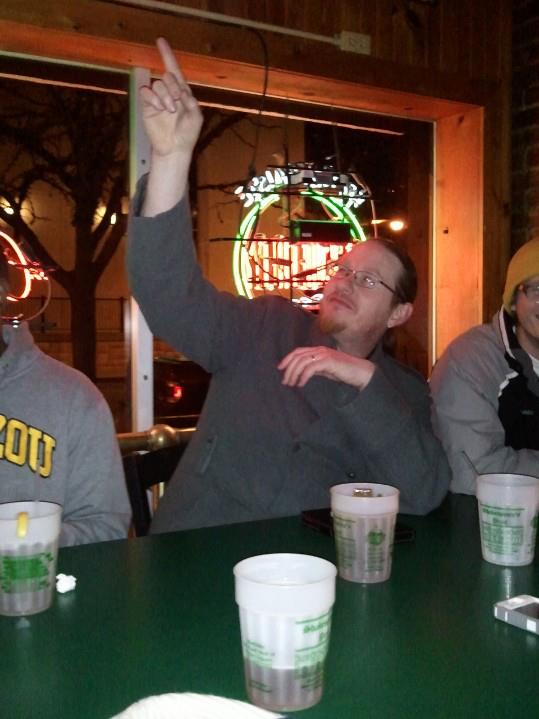
Above: Me with some grads after one of our early sessions, Spring 2012

This semester I got to dig deep with a group of graduate students here at Mizzou. In the discussion-based course I presented a series of texts – grouped into several general themes – and used them to attempt to open up the grads’ approach to thinking about, making, and viewing art. In our reading, discussion, and reflective writing, we took on some of the alternative histories/literacies that function within the art world. I wanted to use this post to give a general overview of the topics and content we touched on this semester, as well as offer a selection of some of the provocative ideas we read. I do this as a huge thank you to the individuals whose work we sampled; their words were encouraging, challenging, enraging, and powerful. I also wanted to take this opportunity to thank the students who took the journey with me. So here’s to Aron, Bethanie, Charlie, Chris, Danielle, Eric, Greta, Jahner, Jane, Matt, and Ron; none of us could have had the experiences we had without each of us being a part of it. As David Abram (or Bachelard, or Emerson, or Dillard) might say – all things are in relation.

Above: A grad class?

1) We began by discussing some key dichotomies through the easy-to-access survey work of Leonard Shlain. Contrasting ideas such as Image/Word, Nonverbal/Verbal, and Truth/Fiction were explored in a number of texts and films, the latter being most importantly represented by Herzog’s Lessons of Darkness and Reggio’s Koyaanisqatsi.

“Of all the sacred cows allowed to roam unimpeded in our culture, few are as revered as literacy.” – Shlain

Key Works:
Reggio, Godfrey. “Koyaanisqatsi.” Color Film, 1983.
Shlain, Leonard. “The Alphabet Versus the Goddess: The Conflict Between Word and Image.” 1998.
Herzog, Werner. “Lessons of Darkness.” Color Film, 1991.

2) Tightening our resolution from the expansive binary tensions in our initial overview, our second focus was to look at how the more central ideas and modes of art and aesthetics were defined/redefined and questioned in the first part of the twentieth century. Looking at early pragmatist philosopher/scholars of art and religion like George Santayana and Ananda Coomaraswamy we took the temperature of a certain corner of the institutional establishment in the throes of the Modernism moment.

“To be sensitive to difficulties and dangers goes with being sensitive to opportunities.” – Santayana
“The artist is not a special kind of man but every man is a special kind of artist.” – Coomaraswamy

Key Texts:
Santayana, George. “Reason in Art.” Originally published in 1905.
Coomaraswamy, Ananda. “Christian and Oriental Philosophy of Art.” From a 1956 Dover edition.

3) In our next group of readings we found ourselves looking away from socialized and received notions of making meaning and gazed into the huge vault of human biology itself. Using primarily Rudolf Arnheim and Ellen Dissanayake, we discovered that a very profound kind of knowledge precedes the cognitive ideas that may calibrate our understanding of art: the psychology of kinesthesis and developmental biology. We took Dissanayake as a jumping off point to engage with Evolutionary Psychology as it pertains to art, art-making, and meaning. Touching on the work of Denis Dutton (as well as his critics), we explored how biology has calibrated how human beings make meaning and put it to work in the world. Coming back to pragmatism, we saw how Dewey and Kupfer connected aesthetic experiences with moral growth.

“It is important to recognize that in large measure everything we know is ultimately based on our bodily senses: what we see, hear, and touch, in particular.” – Dissanayake

“The work of art symbolizes all the levels of reality that lie between the phenomenon and the idea.” – Arnheim

“We take pleasure in watching an athlete break a record, hearing a soprano in full flight, or reading a philosopher of depth and insight. Human accomplishment is the ultimate spectator sport. Apply as much historical analysis to it as we wish, and we’ll not unlock all its mysteries. The continuous capacity of genius to surpass understanding remains a human constant.” – Dutton

Key Texts:
Arnheim, Rudolf. “Toward a Psychology of Art.” 1966.
Dissanayake, Ellen. “Homo Aestheticus.” 1992.
Dutton, Denis. “Aesthetics and Evolutionary Psychology.” The Oxford Handbook for Aesthetics, 2003.
Dewey, John. “Art as Experience.” 1958.
Kupfer, Jospeh. “Aesthetic Experience and Moral Education.” Journal of Aesthetic Education, 1978.

4) Once fully ensconced in the notion that our biology (and the way that biology structured our thinking and making) is key to any real understanding of what art is and does, we looked at the intellectual analysis of artworks. This examination of interpretation – or, as it might be, overinterpretation – was overseen by Arthur C. Danto and Umberto Eco, with a significant dash of Richard Rorty thrown in for good measure.

“Interpretation is in effect the lever with which an object is lifted out of the real world and into the artworld, where it becomes vested in often unexpected raiment. Only in relationship to interpretation is a material object an artwork, which of course does not entail that what is an artwork is relative in any further interesting way.” – Danto

“From a certain point of view everything bears relationships of analogy, contiguity and similarity to everything else.” – Eco

“Reading [artworks] is a matter of reading them in the light of other [artworks], people, obsessions, bits of information, or what have you, and then seeing what happens.” – Rorty

Key Texts:
Danto, Arthur C. “The Philosophical Disenfranchisement of Art.” 2005.
Eco, Umberto. “Interpretation and Overinterpretation.” 1992.

Above: COME AT ME BRO!

5) In some sense our exploration of the hyper-intellectualized/philosophized interpretation of artworks took us from culture into a kind of ritualized, rarified space – albeit a secular one. From there we took a tack back toward culture-making and onward through it toward a more spiritual kind of ritual. We looked first at key texts from the famed philosopher of religion Mircea Eliade. Our perspective was updated to the mid-90s with Suzi Gablik’s The Reenchantment of Art.

“The numinous presents itself as something ‘wholly other’ (ganz andere), something basically and totally different.” – Eliade

“Ritual signifies that something more is going on than meets the eye – something sacred.” – Gablik

Key Texts:
Eliade, Mircea. “The Sacred and the Profane: the Nature of Religion.” 1959.
Gablik, Suzi. “The Reenchantment of Art.” 1991.

6) At this point we began to entertain the implications of the alternative histories/literacies we had explored over the semester. We aimed more directly at poetical understanding, beginning with Emerson as a representative of the American Transcendentalist Movement of the 19th century. From there we allowed Annie Dillard and David Abram to bring us up to the present day – and blow our minds along the way. In this section we spent a good amount of time attempting to understand an intuitive mode of aesthetics as opposed to a rationalist one.

“The life of [humanity] is a self-evolving circle, which, from a ring imperceptibly small, rushes on all sides outwards to new and larger circles, and that without end.” – Emerson

“The feelings that move us – the frights and yearnings that color our days, the flights of fancy that sometimes seize us, the creativity that surges through us – all are born of the encounter and interchange between our life and the wider Life that surrounds us. They are no more ours than they are Earth’s” – David Abram

“I’ve an eyeful of fish-scale and star!” – Dillard

Key Texts:
Emerson, Ralph Waldo. “Nature and Other Writings.” 2003 edition by Shambhala.
Abram, David. “The Air Aware.” 2009.
Dillard, Annie. “Pilgrim at Tinker Creek.” 1974.
For your listening pleasure, click here to hear David Abram read The Air Aware.

Above: They (the grads) were in some frightening trees (grad school)! Click here for more information…

7) Our final readings of the semester centered on Gaston Bachelard. This master dreamer – a giant of 20th century philosophy who influenced Foucault and Derrida – helped us grasp the constellations that populate our own inner universes. Bachelard gave us – through his inflected intonations of the words of Rilke and Baudelaire (among others) – a sense of how our intuitive manifestations might transcend the “geometrical ontological determinations” that dominate the empiricist, rationalist approach to contemporary art-making.

“Everything takes form, even infinity. We seek to determine being and, in so doing, transcend all situations, to give a situation of all situations.Man’s being is confronted with the world’s being.” – Bachelard
“By means of poetic language, waves of newness flow over the surface of being.” – Bachelard

Key Texts:
Bachelard, Gaston. “The Poetics of Space.” 1994.

I want to thank all of the grads for going with me on the journey this semester. Spring 2012 FTW!

The Big Tree

This week was Spring Break for me (and the rest of the University of Missouri). Not that it really felt like much of a break. I honestly don’t remember what it’s really like to just be free. I don’t begrudge my responsibilities – much to the contrary, I’m grateful that they’re things I believe in and understand to be meaningful. Yet the freshness of just being able to BE… well, I guess I’ll have to experience that vicariously. 

One of the ways I see that “astonishment of being” taking place is through the experiences of my daughter. This week when we took her to see The Big Tree near Columbia where we live (here’s the Tree’s Facebook page) she was pretty excited. 


A group of shots of her at the base of the tree.


And with mom out in the field nearby…


…she picked flowers for the first time!


A pretty nice view.

Overall it was a good, joyful day. I’m blessed by the delight in her eyes at moments like these. I’m hopeful that we can let Miranda just experience being alive for as long as possible, before the cares and responsibilities crowd out wonder.