The Garage Cheese Tale

As 2023 rolls toward an ending, I want to share with you something I’ve been keeping to myself for a few years now.

Go back to the beginning of the pandemic. Schools closed. Information and misinformation flew back and forth. Of course everything was a political dumpster fire; a pervasive heaviness spread over the land. And don’t even get me started on the ritual of using disinfecting wipes on every square centimeter of grocery item delivered to our front door. Even on nature trails and in wild spaces we were warned to keep spectacular distance from each other.

It was the weirdness of being told we shouldn’t use the nature trails for hiking or triking that caused me to consider using the Hitt Street Garage as a place to get my miles each day. School had closed in March, and after finishing up that semester remotely I began to spend time in the garage. There were no cars there, and often my children got some out-of-doors time in by riding their bikes around the middle levels while I walked (click here to see evidence of one of my first workouts in the garage).

By the time May ended I was going to the garage several times each week. It was then that I took special notice of a denizen of that forsaken building: the cheese. That’s right: a slice of processed cheese product cheekily flung off a take out burger and – somehow – perfectly caught on the concrete wall. It was THE garage cheese.

I had seen it earlier in the year – perhaps the first week of March. I had no solid idea how long it had been there, but it was leathery and tough (yes, I touched it). It might have been there a month or two. It still had the strong, unnatural hue I’d come to expect from cheese like this. At first it was just a funny bit of ephemera living in the garage, much like the plethora of unused .223 bullets, spent CO2 cartridges, or carcasses of baby birds that hadn’t made it through the summer heat. But as I passed the cheese over and over again in my rounds up and down the floors of the parking garage, it began to take on more and more importance.

Crazy, right?

I shared my observation of the cheese only with family and a few close friends; I didn’t want it to be disturbed. Being early in our collective quarantine, I felt sure the cheese would be safe. But I was keenly aware that once things went “back to normal” there would be some frat-bros carousing in the garage. There was no way the cheese could survive the onslaught of undergraduates! I just wanted to see how long it would last, and I didn’t want any human intervention. There was an alchemy taking place between the cheese and the garage, a synergy that must be allowed to continue! I was committed to no engagement other than photographic documentation.

The Garage Cheese on September 12, 2020. Ballou.

I began taking periodic shots of the cheese, with my first one from September 2020. I know I took earlier images, but I didn’t see the cheese as anything more than a humorous curiosity then, and so didn’t save them. It wasn’t until March 2021 that I made the decision to document the state of the cheese monthly, as well as make periodic check-ins every other week or so. I viewed the month of March as the anniversary of the installation of the cheese, and it felt right since that was when Mizzou closed down. In a way, the cheese was a physical artifact of the many ways in which COVID altered our experiences of life.

Over time, the cheese itself began to change. Flexing with the heat and humidity, cracking under the pressures fighting against its preservative-laced body, the cheese maintained its grip on the concrete. Something in the material nature of the porous wall and the glue-like substance of the cheese made their union not only possible, but hearty. By March 2022 the cheese was gnarly and swarthy, hung all over with dust and the debris of generations of spider webs. The darker coloration made me feel more secure that people wouldn’t see it.

This was important, because life was returning to the campus. The garage was being used more and more. By the fall semester, most people felt safe teaching and learning in masks. This was a tense time for me. I began to check on the cheese several times a week, certain that it would be gone one day. I took to obtaining photos of the cheese only when I would not be observed. I didn’t want my attention to a seemingly nondescript section of the garage to draw others near.

The Garage Cheese on March 14, 2023. Ballou.

I got a bit more intentional with the photography in 2023. The shot from March that year is particularly nice. I began to think the cheese really would make it to the four year mark. People encouraged me to post about the cheese, to make an Instagram account for it, even to mark it on maps. But I knew there would be time later to show folks where it had been. I wanted it to make four – maybe even five – years! As Thanksgiving passed, I felt more confident than ever. After the first day of graduate reviews on December 1st, 2023, I made a pass by the cheese for my December check-up. It looked robust, confident. It was ready to press on toward another anniversary upon the wall. So it was that when the second day of grad reviews concluded on December 8th, I took one of my grad students over to see the cheese. I figured I could share the glory with more people. Surely that would be okay.

THE CHEESE WAS GONE.

Astonished, I rushed out to investigate the scene. There, amid a thick mass of trash and various organic detritus, rested the cheese. It was in a gap between the wall and the floor, and it seemed to be intact. No one had abused this artifact; it had let go of the wall on its own. Its time was up. The race was won.

I carefully rescued the cheese. It was rough and hard, as dense as holding a fragment of bone. Yet, like bone, I perceived it would be brittle. Maybe it had been the dusty garage trash that provided a soft enough landing to save the cheese from breaking against the concrete. Whatever the reason, after nearly 45 months on the wall, the garage cheese was now mine!

The Garage Cheese, framed in a shadowbox on December 26, 2023. Ballou.

I quickly collated my photos of the cheese and obtained a simple shadowbox frame for it. Now safely transferred to the wall of my studio, the cheese can exist in perpetuity, assured the status of a protected relic. As part of the process of documenting and celebrating the garage cheese, I have created the GIF below. I did a modicum of image adjustment so that you can get a sense of the changes that happened over the course of the years. Of course, it’s not perfectly color-corrected, nor entirely aligned for precision, but you can definitely get the sense of how the cheese transformed.

While the cheese itself has left the Hitt Street Garage, there is something that remains behind: a kind of oily stain is still quite visible on the wall of the garage. If you look in this wide shot below, you can see it just a bit left of center. Follow the inner vertical line of the leftmost column downward, and you’ll notice the apostrophe-like arcing shape. That’s a ghostly shadow of the cheese, somehow still clinging to that precarious perch.

The location of the Garage Cheese, photo taken on December 26, 2023. Ballou.

Click below to take a look at a curated selection of the cheese. If you’d like to purchase a print of one of these images, send me $20 on Venmo (here), and I’ll mail it out to you. Just be sure to tell me which one you’d like.

The distance between months and years, and all that we did and saw and felt… in one image. Maybe I should do some risograph prints of these, too… On to 2024!


A final thought, as I sit here with family and smile at my cheese…

Here’s hoping your ’24 is joyful, safe, and peaceful. We know it probably won’t be, though. At least not for most of us. So why do I offer the above trifle about faux fromage? Why present some cast off cheese as a visual metaphor or point of access for meaning? Well, I think the greatest part of our human experience is in the realm of attention. I teach my students this, and I try to teach my own children it as well. When we are attentive to the world around us, when we believe in the value of observation and awareness, then we are most able to be both realistic and hopeful. It is willful ignorance or chosen obfuscation that breaks the social contract, that causes us to care less about each other and the world.

We are living in times of serious violence against not only people but against our ability to apprehend true things. We desire to be told what we want to hear, rather than what we ought to hear. We ignore what should be seen straight on, seeking instead things that distract us from beingness. These are our great sins, particularly in America. We have allowed our politicians to be criminals. We enable them and they stroke our egos in return. Our domestic and foreign policies – for all of our posturing to the contrary – are not “pro-life.” We have become the arm of death. We resist over and over the chance to do what is right, because we know that will make us feel a little uncomfortable. Our comfort is our chief aim, and it’s obvious.

In light of all of that, perhaps everyone would do better to pay close attention to their own version of garage cheese. I hope we can get started on putting our collective house back in order in 2024.

Peace.

Poltergeist (1982) is really good.

I watched Poltergeist again this year, and am still so impressed with it. There are a lot of reasons, but a few things really stand out.

It’s not just the expertly crafted and paced music (Jerry Goldsmith).

It’s not just the practical, in-camera, optical effects (Richard Edlund, John Bruno, Nilo Rodis-Jamero).

It’s not just the fantastic physical and emotional presence of JoBeth Williams (an absolute classic performance that should have been rewarded).

JoBeth Willams as Diane Freeling

It’s not just the introduction of one of the most compelling characters in all of cinema (Zelda Rubinstein as eccentric medium Tangina Barrons).

Zelda Rubinstein in Poltergeist.

All of that is great and worthy of note.

But it’s also that the children and women are centered. They’re not “hysterical” nor are they “irrational.” They see and know deep realities, even if they can’t understand or entirely describe them (a theme borrowed from Spielberg’s Close Encounters of the Third Kind). These characters are the central interpreters. They stand in for the viewer. We don’t dismiss the father as a moron, but neither do we have to make him the hero. Furthermore, we don’t have to MANUFACTURE the heroism of the Carol Anne, mom Diane, or mystic Tangina. The film naturally makes them function in ways that stimulate the narrative arc without BS or montage-based tropes. They don’t miraculously and instantaneously become triumphant; they live through a trajectory of growth. They don’t automatically know everything; they use their innate characteristics to attend to the film-reality in specific and logical ways.

Heather O’Rourke, JoBeth Williams, and Craig T. Nelson in Poltergeist.

Sure, there are other examples of these qualities in popular (and more niche) media. But an average suburbanite mom coming into contact with a situation so physically and conceptually counter-intuitive gives this movie a sense of genuine humanity. Its influence is still palpable in the the horror genre some forty years on, and it’s an experience always worth a revisit.

See it if you haven’t yet (it’s available on MAX)!

The Body as Zone of Incident Guest Lecture

This past week I gave a talk for The Honors College at The University of Missouri. The theme this fall was The Art and Science of Living, and they asked me to give a guest lecture about the nature of the body in the context of my work. I chose to focus on a number of artists who have shaped my ideas about the meaning of the body. – from Anne Harris and Robin F. Williams to Kathe Kollwitz and Charles White.

To hear the talk and see all of the artists and images I explore in the presentation, click the link here.

Andrew Wyeth. Spring. Tempera on panel. 1978.

Panel Discussion on AI and Art

I had the opportunity to sit on a panel at The Columbia Art League on October 12, 2023. Moderated by Diana Moxon and including CAL Executive Director Kelsey Hammond, the wide-ranging talk engaged with a lot of what artists are thinking about in the age of AI. Watch the video below to see a visual presentation of our research, examples, opinions (and humorous asides) as you follow along with the discussion.

OK Computer Panel Discussion Video

Many artists were mentioned in this presentation, and many others could have been included. A few of them were Daniel Ambrosi, Joey Borovicka, and Geo K. Weissler.

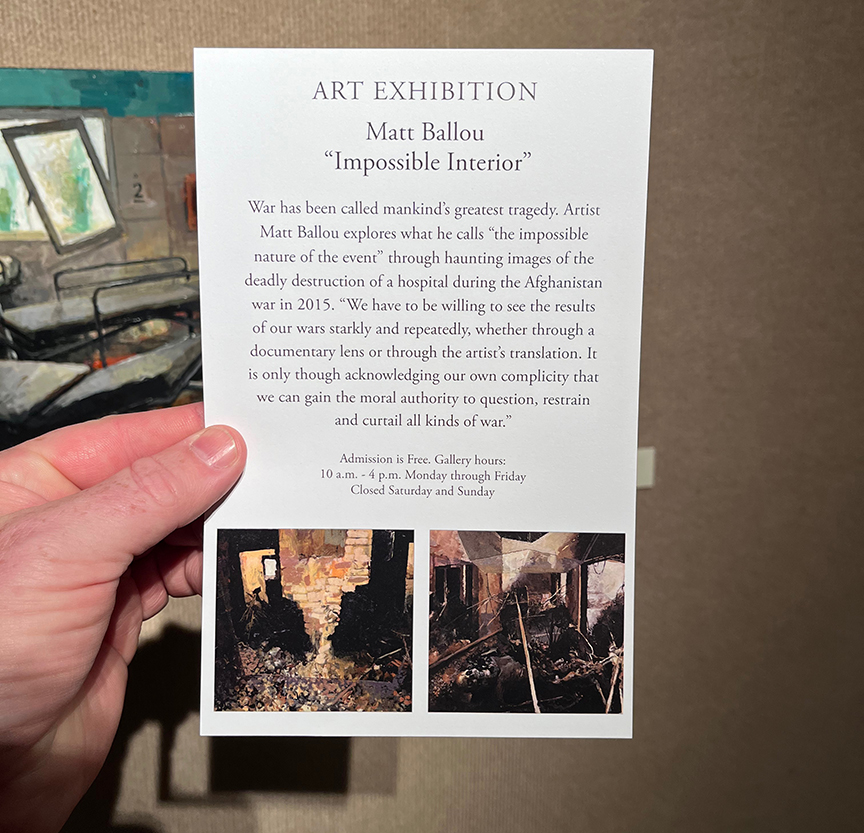
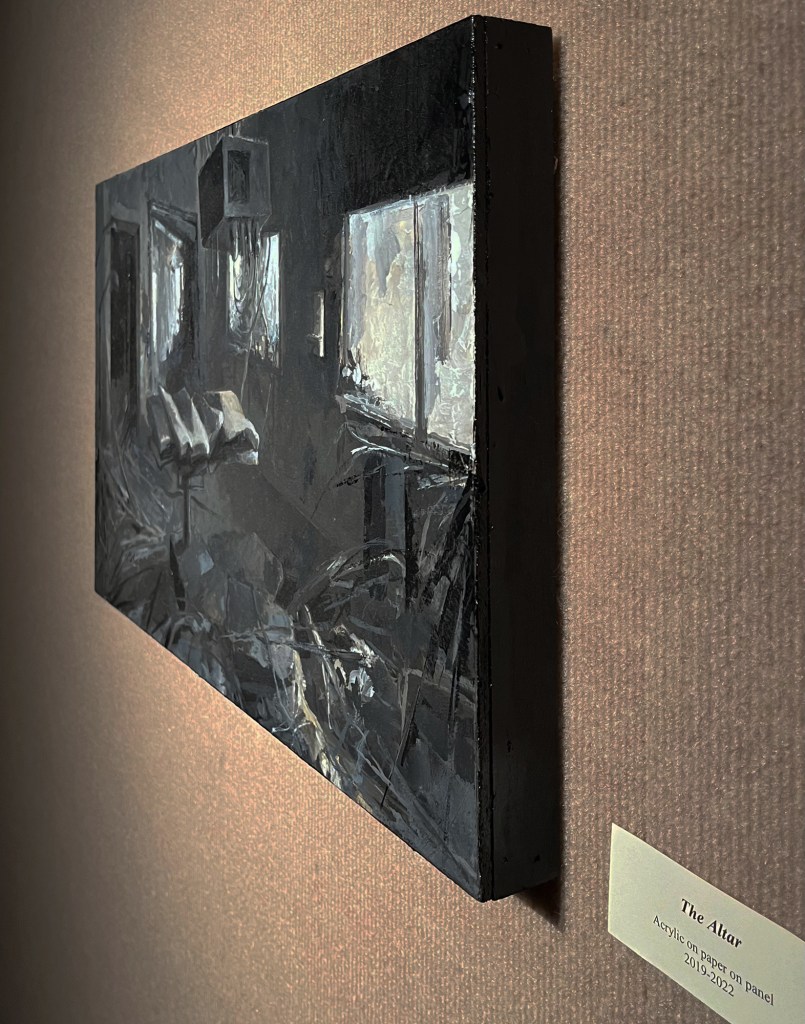
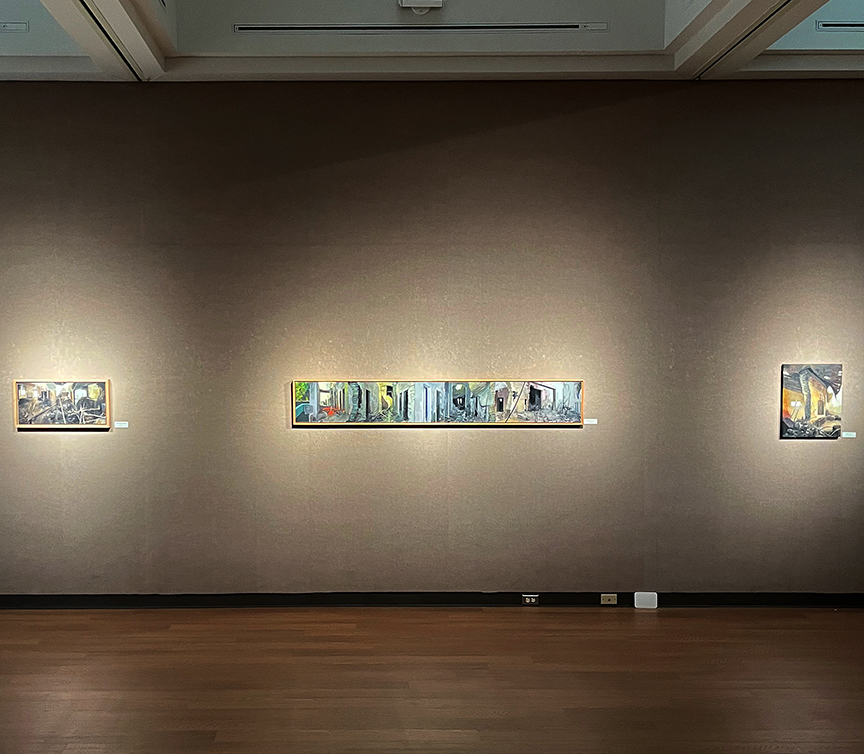
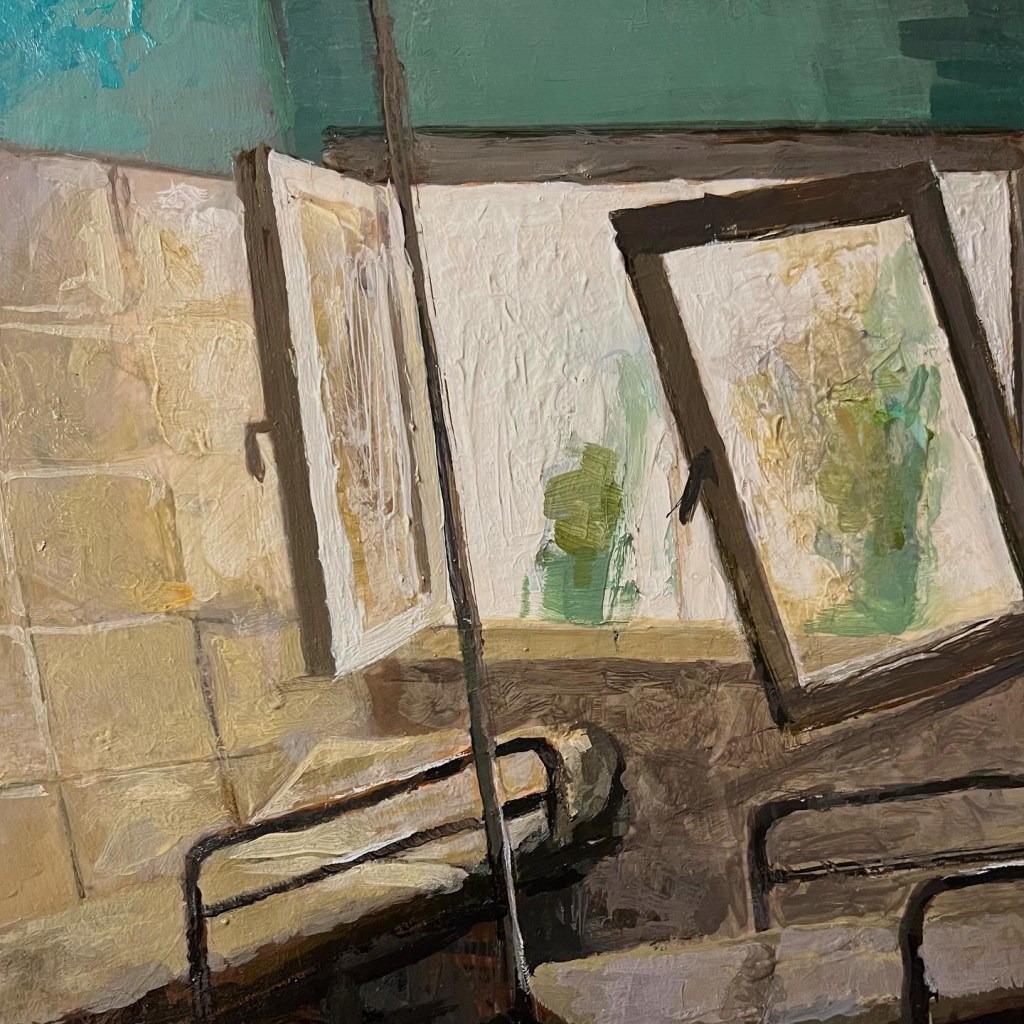
Impossible Interiors at William Woods University

I’ve got a group of works on display at William Woods University in Fulton, Missouri. The show runs through October 6th, and I’ll be giving a talk that evening. For a preview, look below.

This is the third time I’ve shown this body of work, and I’d like to get the chance to show it again. The subject of the work – a “friendly-fire” bombing of a Doctors Without Borders hospital in Kunduz, Afghanistan. If you’d like to see more about this situation, check out my writing about it here.

The card for the exhibition.
Back of the card with description of the show.

I’m also pleased to have a small group of my collaborations with Joel T Dugan also on display at the gallery. These Phoneme works are some of my favorites, and there are a number of just finished works included.

Seize The Sixth, Again

Background

Eric L. Sweet left us suddenly on April 6, 2015, at age 44. Sweet was a beloved member of the MU Art faculty, having worked at MU since 2012 as an Adjunct Assistant Professor, teaching Printmaking, Drawing and 2-D Design courses. He was an alumnus of the Art program, having earned both his BFA (1997) and MFA (2011) from the University of Missouri. In 2008, he received an MA in Printmaking from the University of Missouri-Kansas City. Sweet was an active member of the Southern Graphics Council International and the College Art Association.

The “Running Devil” icon that was embroidered on one of Eric’s shirts.

To celebrate Eric’s life and positive role as an educator, Sweet’s wife, Catherine Armbrust, established The Eric Sweet Exhibition & Speaker Series to continue passing on his gift. I have created a series of work celebrating Eric almost every Seize the Sixth, and this year is no different. I will be donating 100% of the sales of these pieces to the Fund. This program was created because he strongly believed in the importance of community accessibility to art and encouraged meaningful conversations about the state of contemporary art. Funding this annual exhibition and speaker series for the gallery is the perfect way to make contemporary work accessible to the MU and Columbia communities, and to honor this special man who made an impact on so many lives. In fact, the initial funding goal was met in 2021 and the very first iteration of The Eric Sweet Exhibition & Speaker Series took place on December 6, 2021. See the exhibition poster here.

Look over my limited series of CNC relief cuts, posted below. If you’d like one, contact me. You’ll get an icon of Eric’s life and students and community members will get to see art because of the donation I make from the sale. As Eric (and his 4th grade teacher) might say, “You don’t HAVE to, you GET to.”


The Artwork

I’ve made eight artworks for Seize The Sixth this year. There is one group of five CNC relief cuts that feature the classic “running devil” icon that Eric had embroidered on one of his work shirts. Below the devil is featured part of Eric’s axiom, “YOU GET TO.” It’s a proclamation of hopefulness and gratefulness. Here’s a detail of the Running Devil carving if you want to see a close up view.


There are three of these – just the Running Devil without the text.

How to get one?

I can take PayPal, CashApp, and Venmo (click each for a link to my info). If you’re local you can give me cash. The cost $50 each for these. Ones with text are 5.25×5.75 inches and those without text are 4.5×5.5 inches. Each piece is made on a PVC sheet and painted in gold spray paint. Each is signed and numbered. The ones with text are numbered 1 through 5 and the ones without text are numbered 1 through 3. First come, first serve. Feel free to email me if you have any questions – balloum (at) missouri (dot) edu.

Why no Sweet Audio this year?

Most of the time I’ve been able to put together a compilation of classic Sweet audio clips. Unfortunately, I couldn’t find any more usable clips this year. There’s a chance I still have some in the depths of my files, but I just couldn’t locate anything for this year. In lieu of that, please head over to SoundCloud and check out the previous years’ offerings!

Ballou SweetTalk collections for 2018, 2019, 2020, and 2021.


Now, go Seize the Sixth! Remember… you don’t HAVE to, you GET to!

Subway Abstractions, Chicago

More than 20 years ago, when I first came to Chicago to study art at The School of The Art Institute of Chicago, the city shocked me. I was constantly in awe of the people, the exchange of pressure between the land and the lake, and the iconic architecture and spaces that mark this quintessentially American city.

I spent a good deal of time at subway stations and riding the L train rails. So much of what I remember about Chicago is from the vantage points the CTA afforded me. A lot changed in the years I spent there, and I witnessed a lot of those changes aboard the L or from the buildings where I took my classes at SAIC. I was always seeing through the modulating weather and variances of sunlight and season. It all kept my attention. Light, glass, rock, water, cloud, steel, snow, or asphalt; they all intrigued me.

My dad’s trusty Minolta was with me during those years, and I took many hundreds of photos. It was an attempt to understand what my eyes were being drawn to, and how my Eye – my aesthetic sense – wanted to see. It’s wonderful now, in looking back, to see how I was being developed (through education) and developing (through instinct and choice) the categories of judgement and intuition that would inform all of my work right up to today.

Among those photos is a series of pictures of empty signboards within subway stations. Often they would be left open for a while when advertisements were being changed out, but many times they stayed vacant for weeks on end. They had an austerity, and seemed to me to speak the language of modernist abstraction and abstract expressionism. What was interesting to me, beyond that formal similarity to intentionally crafted artworks, was that these were the result of the natural environment of the subway. The dust and grease and grime combined with blowing air – almost like a lung or the systolic/diastolic rhythms of the heart – to create strange inflow behind the placards of ads.

In other cases, workers who routinely painted around the frames designed to hold the placards, would inadvertently create dynamic fields of shapes via over-spray. This was a rhythm, too, a movement of maintenance and service reflecting the attempt to keep these arterial passageways operating. The spaces within the ad frames were a different kind of arena, moving at a different pace from the rest of the L train structures.

Thus that area behind the ads became a kind of palimpsest of the subway, but also of the city itself. The deposits of dirt accumulated in swaths of gray scale gradients. Intimately connected to the subway tunnel textures and layers of paint, the dust-fields were allowed to stick, protected behind ad boards for who knows how long.

Once revealed, these delicate, dirty paintings, which had been made by the trains and the people and the detritus of Chicago, held (it seemed to me) beauty. I loved them. I rode the L looking for them at every stop. I took dozens of photos. Perhaps one day I’ll try to publish them in a better form – I still have the original negatives, after all – but for now, I present a few of them here.

Statement for a new exhibition of WHENEVERwhen works, January 2018

Note: I’m getting the opportunity to show a new group of WHENEVERwhen pieces right off the bat in 2018. Here is my statement for the exhibition, with a few of the works interspersed within the text. I’ve enjoyed some wonderful experiences at Sager Braudis Gallery over the years, and this is the high point. I’m pleased with their installation and think the work looks great there. Of course, I’m biased. I’d love to hear what you think. You can see some gallery information here.

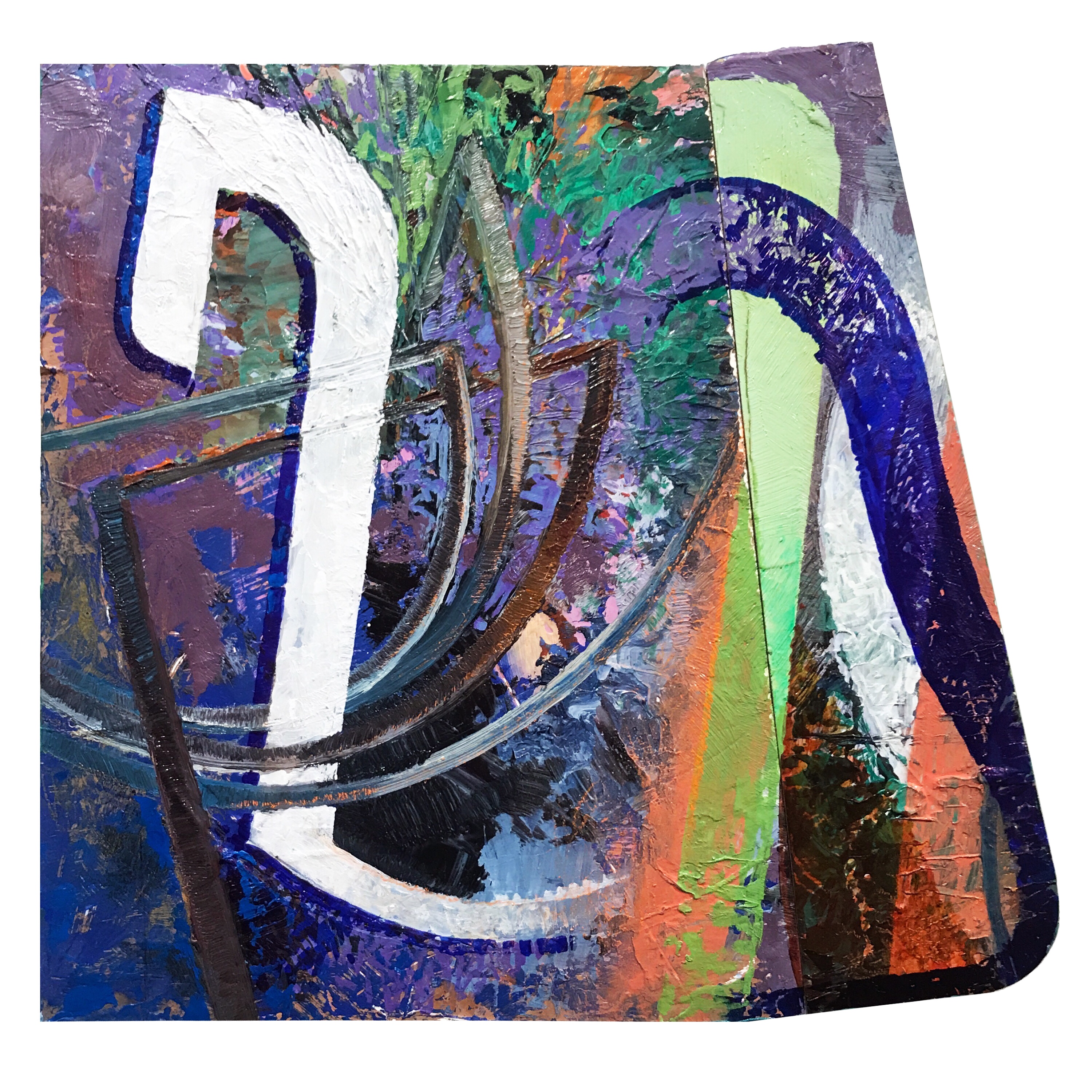
Splint – Oil on panel with custom oak frame. 2015-2017.

For more than twenty years, my painting, drawing, and printmaking have oscillated between symbolism-heavy representational imagery and formal explorations in the tradition of 20th century abstraction. This seemingly broad swing of subject and purpose in my work is directly related to my conviction that the core visual dynamics of either mode are, essentially, the same. I often tell my students that I’ve been making the same picture for my entire artistic life.

Sometimes I have felt led to apply those underlying compositional forces to the service of representational imagery, and other times I have felt the need to strip away everything but color, material, and surface. When I pursue abstraction, the resulting work is a foray into perceptual and physical experience. Thus, even though the works do not depict discernible objects, they are still – to me – realist in the sense that they focus on observational and haptic (sense of touch) phenomena. Conversely, my representational paintings are always abstract inquiries into the nature of meaning, purpose, and human engagement.

Periodically, when the communication of abstract, metaphorical ideals feels incongruous to me, I move intuitively into abstraction. The last time this shift occurred was about two years ago. I was coming out of a long period of working exclusively in the tondo format and had begun to readdress the rectilinear format standard to most painting and drawing. I had rejected it previously because it felt too much like a window or door space. I was looking to depict my ideas in some other form of oculus, something more subjective and mysterious. I started, in sketches and digital studies, to break the picture plane in a number of specific ways. These breaks were related to the work and ideas of artists such as Magalie Guerin, Vincent Fecteau, and Marcelo Bonevardi (among others). I was also greatly influenced by my research into Eastern and Western mandala forms as well as the newer generations of digital painting and drawing apps I was using.

Then, at age 39, I had a heart attack.

The near-death I experienced purged my interests. Though I have completed a few straight representational works since that cardiac arrest in February 2016, the vast majority of my work has focused on a series of abstract investigations I call WHENEVERwhen. In the WHENEVERwhen series I deploy an array of formal strategies that accumulate over time and leave a record within the work. These strategies are diverse; they might function in terms of simultaneity of form – for example, an area may appear to manifest as both light and solid structure – or display a counterintuitive sense of weight and balance. I have also incorporated a significant amount of collage, relief cutting, carving, and digital prototyping into my working methods.

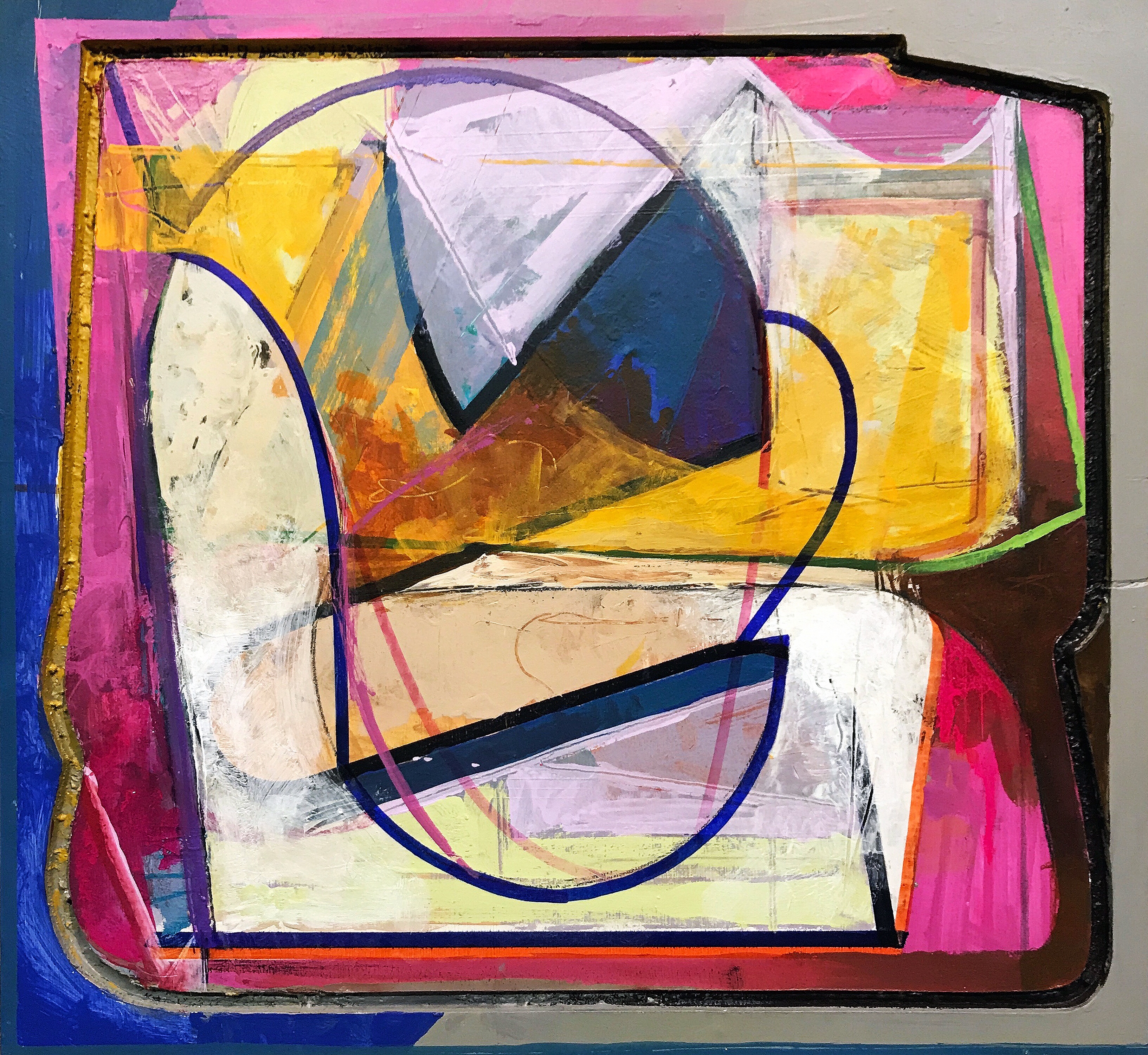
Icon Eikon – Oil, acrylic, marker, and spray-paint on shaped panel. 2016-2017.

Another significant development of the WHENEVERwhen series was my use of shaped surfaces and disrupted framing. I have been obsessed with making frames a part of the work for many years. At first I used clean, minimal float frames. More recently the frames both hold the work and are painted on or defied in specific ways – often through cutting and reassembly – in order to fit them into the pictorial language of the work. This integration of the frame is important to the sense of edge, continuity/discontinuity of the visual field, and aesthetic structure I seek. A number of my WHENEVERwhen works are framed in vintage oak reclaimed from old church pews and University of Missouri drawing desks. This 50 to 70 year old wood adds a density that corresponds to the surfaces and textures comprising my work.

The WHENEVERwhen series is serving as a kind of pivot within my life as an artist. I am bridging influences across history and media in ways I have not done in the past. I am pushing through old modes of working and thinking. My proclivities are both affirmed and challenged. My assumptions are acknowledged, and either used or left aside. Of course, this pivoting is also happening in the paintings, drawings, and prints themselves. Somewhat disheveled and awkward, yet bursting with chromatic beauty, these works are artifacts of aesthetic exploration, distillations of influence, and tributes to rigorous play.

Matthew Ballou – December 2017

A la Lutes – Acrylic, gouache, Sharpie, and graphite on relief structure. 2015-2017.

Here are some installation shots of some of the work… I hope you can come and see the work before the show closes at the end of January.

img_0259img_0262img_0261img_0260


Current Influences

As I prepare for a few up-coming exhibitions I think it’s important to state plainly what has been stuck in my aesthetic craw for a while.

Certainly my experience of working with Joel T. Dugan the last 4 years has been huge. He has definitely been a catalyst for a number of important changes and new foci in my work. But for an even longer time, the following artists have been steadily putting pressure on me. One is dead. A number are around my own age. I’m going to list them in alphabetical order – I encourage you to research them. I’ll link to a decent page on their work, but poke around the web on your own. Really good stuff.

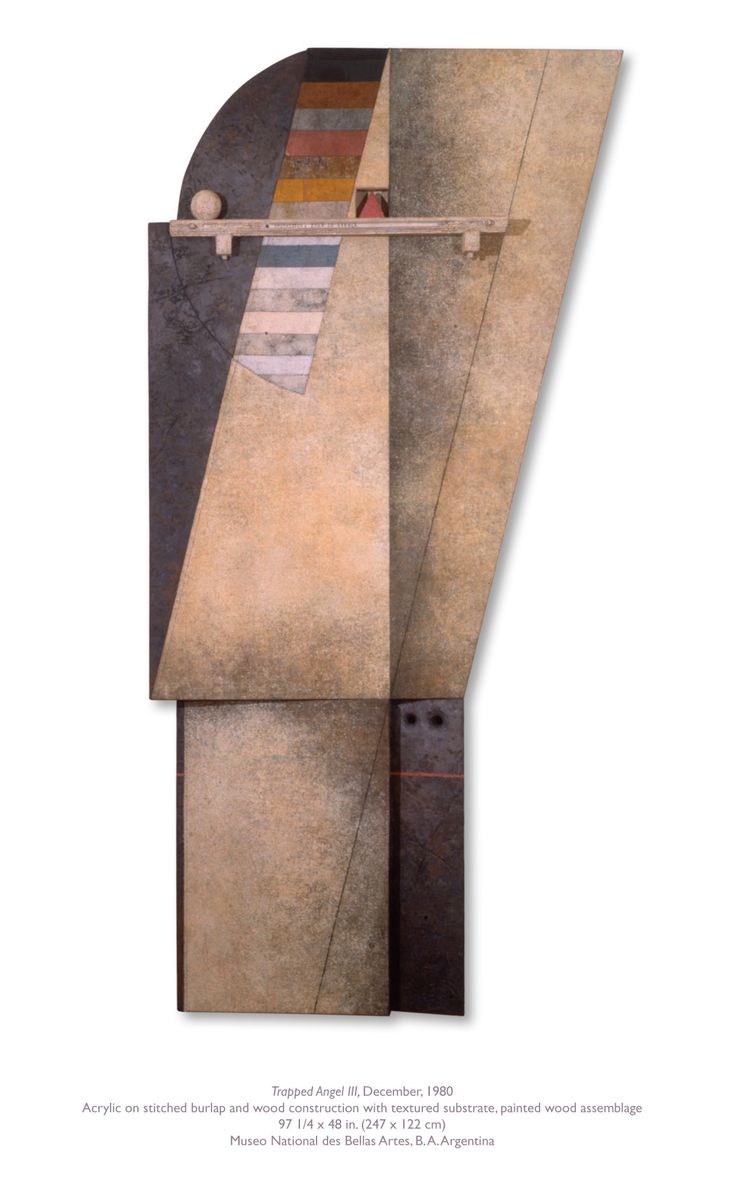
Marcelo Bonevardi – Bonevardi, along with Diebenkorn and Manuel Neri, has been a massive influence on my sense of plasticity, composition, haptic maneuvering, and surface. Do yourself a favor and get the major book on his work here.Sharon Butler – An important artist and writer, Butler has been a wonderful champion of abstraction during her career. She’s also a part of a traveling exhibition that I’ve curated (I’ll post separately about that, but here’s a link to the blurb about its first incarnation at the University of Missouri).

Sharon Butler – Good Morning Drawings. Digital work. Dimensions variable. 2016.

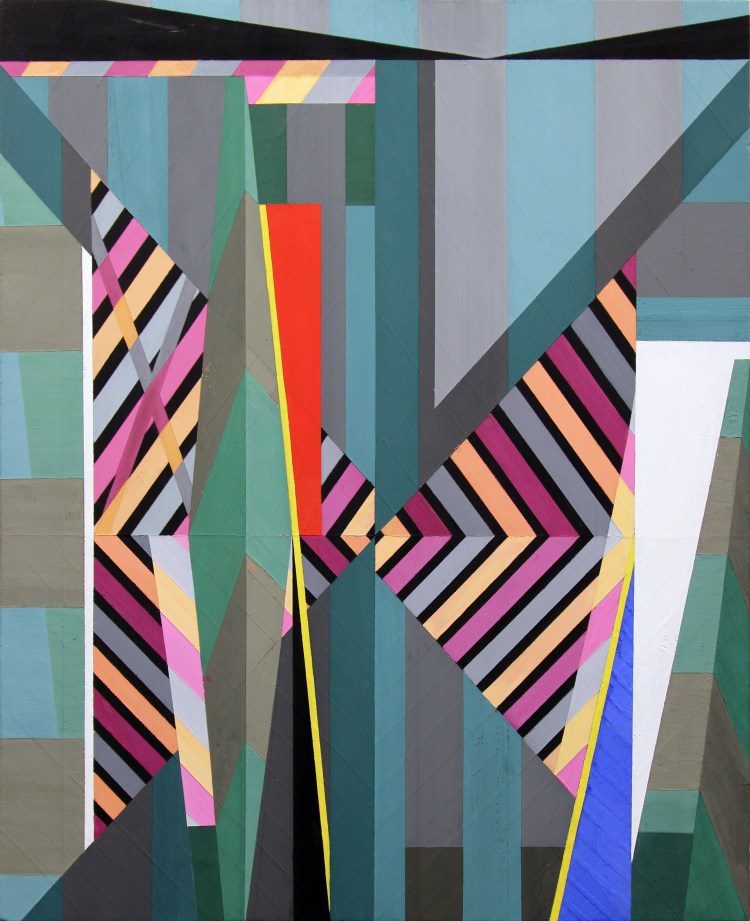
Nicholas Byrne – Byrne’s dynamic surfaces, use of a kind of template system, and expansion beyond the rectilinear format of painting have all been inspirational to me. I particularly love his works on copper. Wonderful stuff. This piece. WOW.

Gianna Commito – Commito’s dense surfaces – taped off, gritty, solid, vibrant – are like jewels. I have had the great privilege of handling her works as she is also in the traveling exhibition I’ve organized, set to open at The University of Missouri at the end of this month. These paintings, while mostly small, do not shrink from the viewer’s eye. They are sharp, palpable, and fierce. I love them.

Gianna Commito – Plas. Casein and marble dust on panel. 2015.

Vincent Fecteau – I have mentioned Fecteau to people for nearly a decade. His work is mysterious, shapely, and finely-fitted, yet organic. It is strange to behold. See it in person if you can.

Magalie Guerin – Guerin is a staple of the Chicago art landscape these days. Her modest-sized works defy their scale, becoming means to mine the distance between observational notation and suggestive shape. I love their interlocking, colliding parts.

Julian Hoeber – Julian Hoeber’s slathered-on paintings are, in all of their scummy, impasto glory, treatises to precision and formal rigor. They GLOW. They are illuminated with some kind of Cherenkov light. Epic and weird. See an example below:

Emil Robinson – A powerhouse operating in Ohio currently, Robinson has been working on a series of works that is at once confusing and inspirational. He is a huge influence on a number of artists, especially in terms of his pastel-based figure studies. See his latest work on his website; a few are below. Ecstatic Spaces 1, 2, and 3. Oil on panel, 41×29, 2017.

For each of these there are a half dozen contemporary artists who are important to me as well (like Brian Guidry, Catherine Kehoe, Sangram Majumdar, Hanneline Røgeberg, and Linnea Spransy. As I continue to live and make art, I find that so many people touch me, transform me, make me what I am.

Keep your eyes open for news of new publications, exhibitions, and work. All are coming SOON.

~

PS: I love being floored by seeing a fresh work by an artist new to me. Here’s something that really caught my eye this past week: Amy Sinbondit‘s Section Break. Red eartheneware, engobe, terra sigillata glaze. 14.5 x 18 x 11.5 inches, 2011.

A Decade of Teaching at Mizzou

_MG_3410Me, teaching in 2011. Photo by M. Kannan.

Ten years ago this month, I arrived in Columbia, Missouri to start teaching painting and drawing at the University of Missouri. I remember the experience of arriving in town well. My wife was reading to me from the new Harry Potter book (Deathly Hallows was just released the week prior) and we, being Missouri newbies, inadvertently took a scenic route from Chicagoland to MidMo. Those first months were nerve-wracking. It was a one year Visiting appointment (Eventually it was extended, then extended again). I loved the challenge and pretty soon felt at home, especially once Alison joined me. By 2010 I was able to apply to a Teaching Track position.

DSC02231Triumphant with former grad Ian, 2012.

I really am one of the lucky ones. Unless you’re living the art/teaching life, I don’t know if you can comprehend just how lucky. Yes, I’m a competent teacher. I’m a vigorous and engaged artist. But my art-making is not revolutionary, it is investigatory. I don’t believe in originality, I believe in interrogating meaning and experience by acknowledging the vast array of cross-contextual elements that surround us (histories, cultures, systems of thought, traditions of creativity, etc).

Just as nothing that I make exists on its own, so too my teaching is based on the broad constellations of influences that have coalesced into my particular perspective. My frame of reference is not only my own, it’s a kind of index of everyone and everything that has inflected my understanding.

SONY DSCPosing for one of my former grads, Jake Johnson, way back in 2009. Photo by Jake Johnson.

Ultimately I’m not a huge standout from the other (VERY small number of) MFA graduates who are able to keep up the studio work, exhibitions, and become embedded as an educator. I learned early on that teaching scratched the same itch as painting did for me. I’ve used that. I’ve lived that. If I’m down, feeling blown out and sort of worthless – put me in front of a class of 20 twenty year old undergraduates. I’ll come out supercharged. That’s the power of working with human beings who are in the midst of a transfiguration of personality and purpose. I love teaching.

sloanekinkadeIan and Sloane at the first Thomas Kinkade’s Christmas Cottage viewing party…

Consider it: I get to think about art, creativity, and even BEING itself for a job. I get to push paint around, push ideas around, and push minds around (including my own). I get to mentor and be mentored by amazing people. I get to work with creative humans of all ages, backgrounds, worldviews, and experiences. I get to read and write and speak about things that move me. I get to show my work around the country (and sometimes around the world). I get to spend time exploring what it means to make things in the world (and what it means for things to make us who we are, too). I get to share those realms of exploration with others.

I’ve gotten to travel around the world to adopt two of my children.  I’ve been afforded the chance to elevate my standard of living well beyond what it was while growing up. I have the privilege of good insurance and great health care – two things that have made the quality of my post-heart attack life, and the life of my daughter suffering from osteogenesis imperfecta, much better. I’ve become a home owner. A mini van owner. A back yard mower.

enchanter-whatgradclassisWith former grad Jane Jun at the old Shakespeare’s, 2012.

12832461_10106823713056199_4957316273168848908_nWith former grad student Laura at a gallery opening, 2014 or so.

All of these things have come to me through the blessing of employment at Mizzou. It is “an honor and a privilege”* to go into my classroom, greet those faces, and set off on a task of vision and awareness.

So many have challenged me and moved me forward. Bill Hawk, now retired, calling me out in my first talk at Mizzou and asking me to point out what I meant by an abstract assertion I had made. Lampo Leong, telling me to “just teach them” in that first class. Dr. Adrienne Hoard, guiding me in the subtle art of holding a grad student’s feet to the fire. Professor Chris Daniggelis, feverishly baptizing me into the art of mezzotint. Catherine Armbrust and the latex, Jane Jun and identity ghosts, Eric Sweet and the teeth, Maurice and the parking mountain, Shannon and the tree outside the art building, Tina and Midwestern dreams, Norby and graying out, Marcus and awkward dad jokes, Emily and softball excellence, Simon and Caymanian memory… so many more.

So much love, and work, and determination. So many reasons to be grateful.

chrishallapproves-03Joke meme image I created for Chris Hall.

13432296_10107258458921999_331676234204831219_nQuality time with former student Marcus Miers, 2016.

The first round of grad students I worked with still loom large in my mind. Ian, Sloane, Nancy were the first… then Natalie, and then Chris, Jane, and Norby… eventually Colleen and Nikos… Each and every one brought a unique inflection to my experience of the world. I am so much better for having spent time with them.

11960094_10106163680641449_3315752712489631165_nWith Lishan, Simon, and Sumi at an art opening a few years ago. Photo by Bobby.

There are so many stories I could put down: grilling pizzas with Maurice, brewing beer with Norby, taking art trips with everyone, having wonderfully intense conversations in Graduate Theory classes, and hilariously irreverent conversations over beverages at any number of our local establishments. I’ve had many wonderful students from China, and I’ll never forget Peking Duck with Jackie or making won-tons with Tianyuan and our children in the kitchen. I’ll never forget when I got to officiate the wedding of two of my former students. I’ll never forget the response of my students and colleagues to my heart attack, and how they supported me and helped me through it.

Jake, visiting for an evening of food and drink, 2008 or so. Nancy isn’t impressed, 2010.

I know that I can’t really express what all of this has meant to me. If I had to bring it all down to the most important thing, I think I would say it’s time with the students. That’s what secure employment for teachers creates. I get the time to get better at teaching and the students get the value of an educator who is growing alongside them. Continuity – hours and days over the long haul – makes the difference. Those students see me living day to day and I see them living day to day. The ones who get it, who really believe they are real and that others are real, who believe in translating human experience into evocative forms… they are the people that get me out of bed. They’re the ones who inspire me.

20091219_WinterCommencement_0007Standing as a faculty mentor with Shannon at Honors Convocation, 2009.

14907629_10107947068902079_2162397385667730310_nWith grads Guigen, Zach, Amy, Simon, and Nikos at lunch during an art event, 2016. Photo by Waitress.

_MG_3368Working with Emily during a summer drawing session, 2011. Photo by M. Kannan.

I am incredibly thankful for the opportunities I’ve been afforded. My biggest motivation is to be effective as a person, educator, and artist. To make an impact and reveal the world to myself and others through the act of teaching and making artworks. As the years go by, it is the response of my students that gives me such deep encouragement.

The lives of my students are glorious confrontations in the best of ways. They are the world brought to my classroom. Black, white, South Korean, Chinese, Brazilian, Caymanian, Russian, Japanese, gay, straight, trans, Muslim, Christian, Wiccan, conservative, liberal, questioning, broken, certain, self-actualized, brilliant, wondrous, and strange. They come in skittish and green, and they leave full of the power they’ve always had. It’s beautiful to see their transitions, and it never gets old.

With former grad and then colleague David Spear. At Marcus Mier’s wedding.

img_6603A portrait of me with Darth Vader by Jane Jun, 2013. Acrylic on canvas, 7 by 5 inches.

img_6602Portrait of me as The Dude from The Big Lebowski by Jake Johnson, 2009. Acrylic on wood panel, 7 by 5 inches.

This post hasn’t even really scratched the surface of what that last ten years have meant to me and what I’ve experienced. I haven’t even mentioned my passion for the Cast Collection or Rocking The First Day with Deborah. I haven’t spoken about how much I love Wakonse. I haven’t talked about the strange projects we’ve had to do, the cobbling together of nominal spaces for our students. I haven’t mentioned the glory of Dr. Melvin Platt’s parliamentary prowess or Ferrie and Brenda holding down all the details like heroes. There have been dozens more faculty and students who have made these years amazing.

I’m so thankful, and every semester I try to be worthy of what I’ve received. Here’s to another decade!

11022556_10105427628949939_1438644933721545290_oA group of my Color Drawing students at work, 2015.

*I’m quoting Professor Corly Blahnik, Emeritus at ISU.
Continue reading →