Recently I rotated a bunch of the art in our home, and so I felt that an update to my ongoing series of posts featuring various artworks I’ve collected over the years was in order.
My most recent purchase is this wonderful gouache painting on handmade paper by Mary Sandbothe.
Mary Sandbothe. Mystery Snowball. Gouache on handmade paper. 7×5 inches. 2023.
Mary is an awesome artist and educator here in Columbia, MO, and has been a pillar of the art community here for many years. She had a wonderful show at the Columbia Art League late in 2023 that really stood out to me. Called “Heritage Unfolded: Gouache Interpretations of Missouri Quilts,” (you can see the works here), the show featured some evocative, intimate works. I knew I needed to jump on one of them, and I’m glad I did.
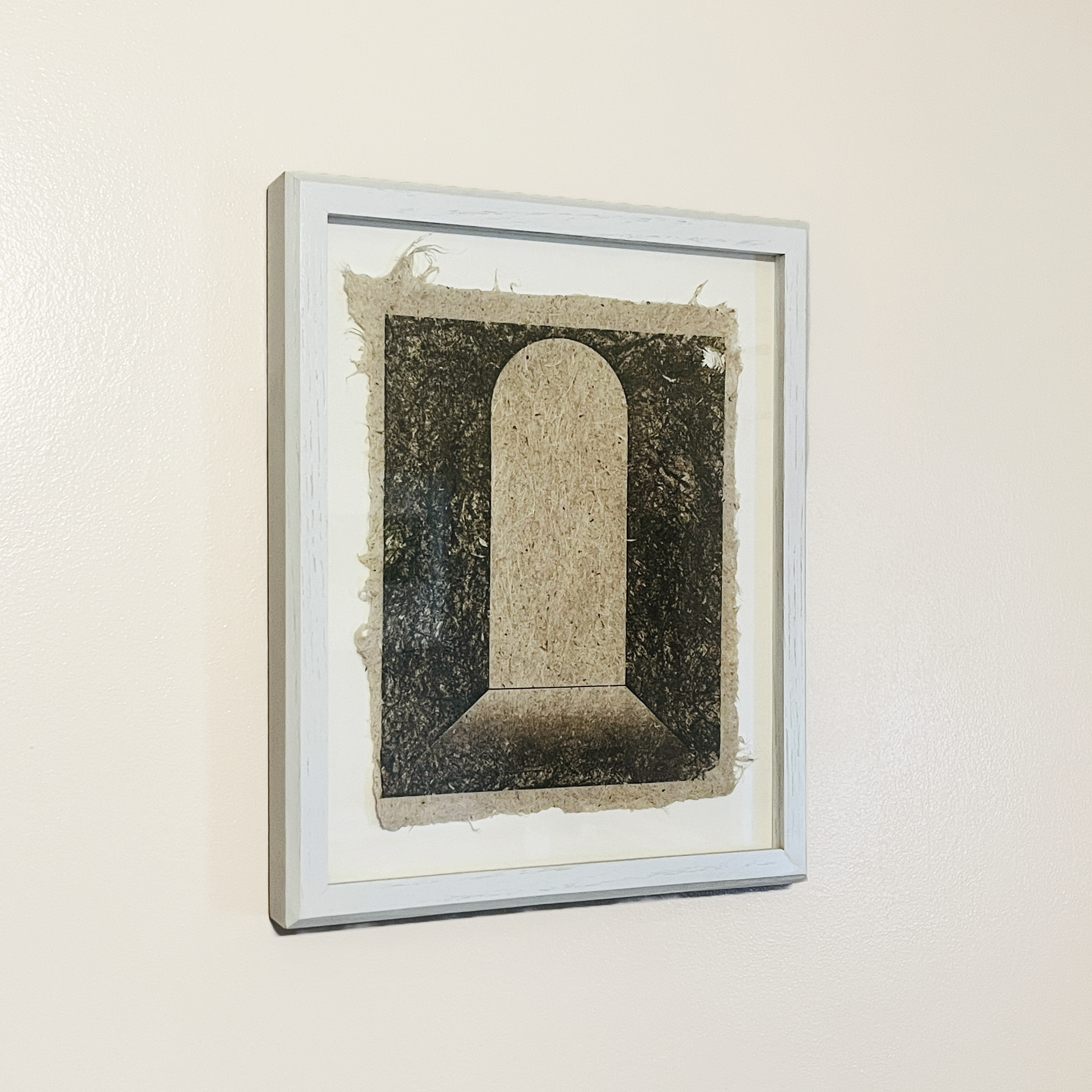
Next to the Sandbothe Mystery Snowball piece is a striking print on handmade Yucca paper by Caleb McMurray. The untitled work features a doorway or aperture, something that McMurray has returned to again and again.
I also have a sister print to this one, but it features an arching opening that is in the distance rather than up close like this one. Windows, doors, and other passageways are features of many of the works I’ve collected over the years.
Lastly, a small painting by Hayley Auxier‘s shares the wall with the two works I’ve shared above. Hayley was one of my stand out undergraduate students, and I love seeing her carry on her artwork as she has since graduating. This piece is one of a series she made celebrating National Parks and celebrating her experiences of them. Hayley shows a strong affinity for gouache, so I’m glad to have an example of her painting in that medium.
Hayley Auxier. Acadia National Park. Gouache on paper. 4 by 6 inches. 2018.
Acadia National Park is special to me because that’s where my partner and I went on our honeymoon all those years ago, so I like the piece because of it’s connection to my own history. But it’s also got a wonderful note from Hayley on the verso, and so the small work feels like it connects all of these different threads of my life: personal, professional, aspirational, and historical. That synergy of references – those that I bring to the work and those the artist embeds within the piece – is what makes art special.
I’m loving seeing these three works every day as I have a meal or hang out with my family. Art that lives with us is the best kind. Really thankful to have these pieces close to me.
Eight years ago today one of the few most significant pivots of my life happened. My cardiac arrest is intimately tied to the death of my sister, to my experience of my home town, to my understanding of life and spirituality, and to my way of moving through every day life.
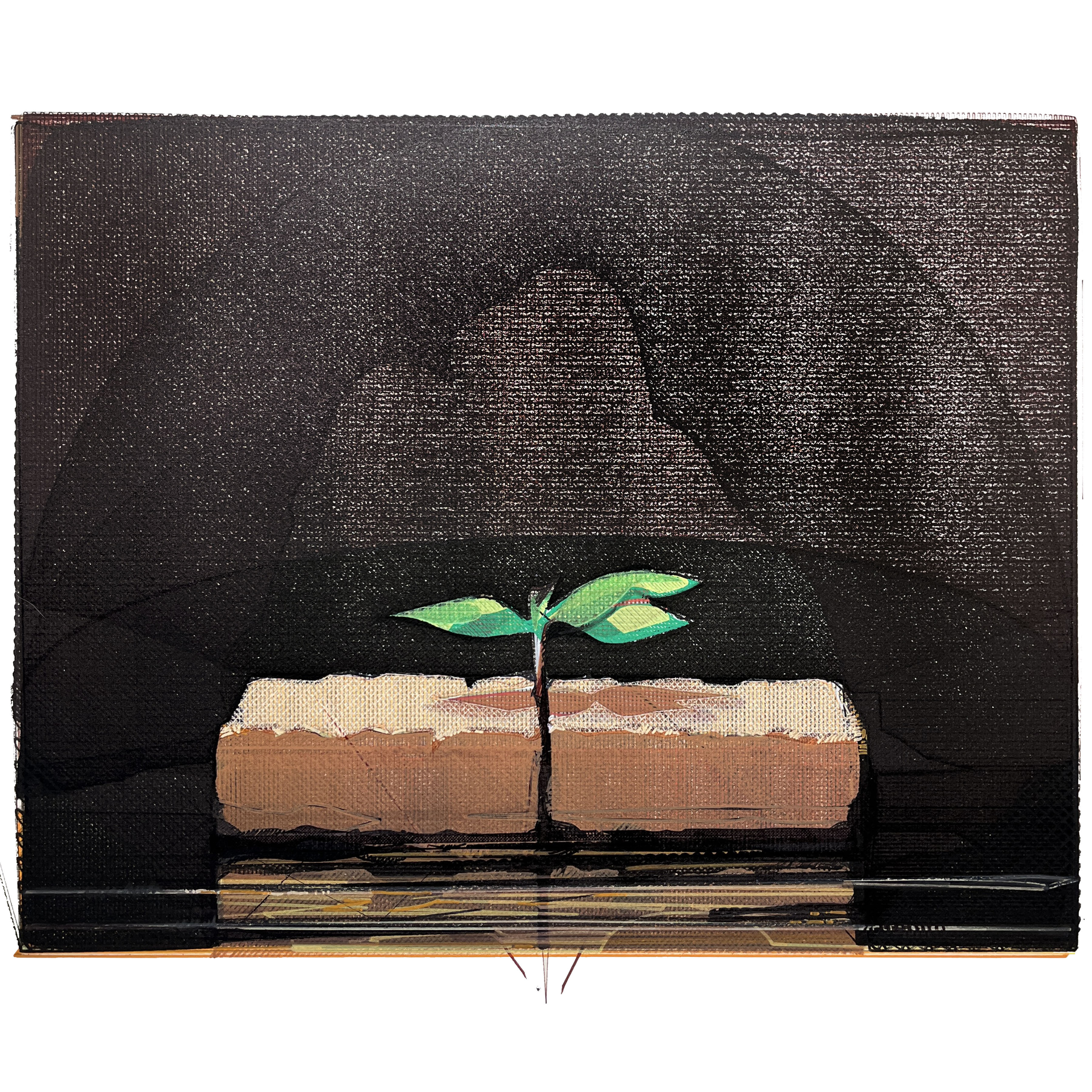
This year I’m commemorating the traumaversary with a new version of an old work. I first created Situation and Circumstance Overcome in 2003. It is definitely my most successful and most owned work, as I’ve created many copies – both paintings and prints – of the work as fundraisers for adoptions and other charitable occasions. For this version I chose to use my AxiDraw X&Y plotter. Using a new print of my old mezzotint plate of the piece (fig. 1) as a visual source, I created a large vectored image in Inkscape that had roughly 30 layers printed upwards of 5 times each (fig. 2).
Fig. 1: Situation and Circumstance Overcome. Mezzotint print on paper. 16×20 inches. 2023.
Ink the vectored image you can see many of the layers along with the direction of the hatch fills and choices I made for density of pigment load. Each color was created with Sharpies, Posca acrylic markers, and a few other ink-based markers. The layers shown in the Inkscape file don’t correspond fully to the final image (fig 3.) because I made adjustments/changes to individual layers as I moved through building the image. There is a call and response between the digital and physical realms here that I really appreciate. I’ve also included a few details of the piece so you can see the finer textures and lines.
Fig. 3: Situation and Circumstance Overcome (’24 Traumaversary Version). Ink and acrylic on Arches paper. 16×20 inches. 2024.
I like having a rich, sentimental image like this following me through life. I’m convinced we’re all sentimental (if we’re honest and not sociopathic). By this word I don’t mean any kind of unexamined, saccharine idealization of some past version of reality. Rather, I mean that we really did experience real things in our pasts, and those things carry with them real emotions, real artifacts of our real selves. In some sense, sentimentality can give us momentary access to who we used to be in the past. It is a simultaneous connection and rupture. We know we can’t return to that person or that experience. And we know that we can’t really feel anything the same way again. And yet… some part of that reality is there for us in our sense of sentimentality. It’s akin to a certain scent or song taking us back to a prior state of being. There’s nothing wrong with this. Moreover, I suspect it has some adaptive advantage for the species by stimulating social/familial/relational/tribal/spatial cohesion.
In any case, I think making the image of life in the form of tiny sapling breaking up between the bricks has been a worthy thing for me. It’s a little picture of triumph in the midst of hardship. I’m glad it resonates with so many people. I’m glad variations of this piece hang in homes all over the world. And I’m glad I’m still here to appreciate it and add to its legacy.
I’m glad I didn’t miss these last eight years. There have been a lot of situations to overcome, but the life I’ve seen makes it all worth it. Here’s to another year. Peace.
If you’d like to inquire about purchasing the traumaversary robot version of Situation and Circumstance Overcome, contact me over here.
As 2023 rolls toward an ending, I want to share with you something I’ve been keeping to myself for a few years now.
Go back to the beginning of the pandemic. Schools closed. Information and misinformation flew back and forth. Of course everything was a political dumpster fire; a pervasive heaviness spread over the land. And don’t even get me started on the ritual of using disinfecting wipes on every square centimeter of grocery item delivered to our front door. Even on nature trails and in wild spaces we were warned to keep spectacular distance from each other.
It was the weirdness of being told we shouldn’t use the nature trails for hiking or triking that caused me to consider using the Hitt Street Garage as a place to get my miles each day. School had closed in March, and after finishing up that semester remotely I began to spend time in the garage. There were no cars there, and often my children got some out-of-doors time in by riding their bikes around the middle levels while I walked (click here to see evidence of one of my first workouts in the garage).
By the time May ended I was going to the garage several times each week. It was then that I took special notice of a denizen of that forsaken building: the cheese. That’s right: a slice of processed cheese product cheekily flung off a take out burger and – somehow – perfectly caught on the concrete wall. It was THE garage cheese.
I had seen it earlier in the year – perhaps the first week of March. I had no solid idea how long it had been there, but it was leathery and tough (yes, I touched it). It might have been there a month or two. It still had the strong, unnatural hue I’d come to expect from cheese like this. At first it was just a funny bit of ephemera living in the garage, much like the plethora of unused .223 bullets, spent CO2 cartridges, or carcasses of baby birds that hadn’t made it through the summer heat. But as I passed the cheese over and over again in my rounds up and down the floors of the parking garage, it began to take on more and more importance.
Crazy, right?
I shared my observation of the cheese only with family and a few close friends; I didn’t want it to be disturbed. Being early in our collective quarantine, I felt sure the cheese would be safe. But I was keenly aware that once things went “back to normal” there would be some frat-bros carousing in the garage. There was no way the cheese could survive the onslaught of undergraduates! I just wanted to see how long it would last, and I didn’t want any human intervention. There was an alchemy taking place between the cheese and the garage, a synergy that must be allowed to continue! I was committed to no engagement other than photographic documentation.
The Garage Cheese on September 12, 2020. Ballou.
I began taking periodic shots of the cheese, with my first one from September 2020. I know I took earlier images, but I didn’t see the cheese as anything more than a humorous curiosity then, and so didn’t save them. It wasn’t until March 2021 that I made the decision to document the state of the cheese monthly, as well as make periodic check-ins every other week or so. I viewed the month of March as the anniversary of the installation of the cheese, and it felt right since that was when Mizzou closed down. In a way, the cheese was a physical artifact of the many ways in which COVID altered our experiences of life.
Over time, the cheese itself began to change. Flexing with the heat and humidity, cracking under the pressures fighting against its preservative-laced body, the cheese maintained its grip on the concrete. Something in the material nature of the porous wall and the glue-like substance of the cheese made their union not only possible, but hearty. By March 2022 the cheese was gnarly and swarthy, hung all over with dust and the debris of generations of spider webs. The darker coloration made me feel more secure that people wouldn’t see it.
This was important, because life was returning to the campus. The garage was being used more and more. By the fall semester, most people felt safe teaching and learning in masks. This was a tense time for me. I began to check on the cheese several times a week, certain that it would be gone one day. I took to obtaining photos of the cheese only when I would not be observed. I didn’t want my attention to a seemingly nondescript section of the garage to draw others near.
The Garage Cheese on March 14, 2023. Ballou.
I got a bit more intentional with the photography in 2023. The shot from March that year is particularly nice. I began to think the cheese really would make it to the four year mark. People encouraged me to post about the cheese, to make an Instagram account for it, even to mark it on maps. But I knew there would be time later to show folks where it had been. I wanted it to make four – maybe even five – years! As Thanksgiving passed, I felt more confident than ever. After the first day of graduate reviews on December 1st, 2023, I made a pass by the cheese for my December check-up. It looked robust, confident. It was ready to press on toward another anniversary upon the wall. So it was that when the second day of grad reviews concluded on December 8th, I took one of my grad students over to see the cheese. I figured I could share the glory with more people. Surely that would be okay.
THE CHEESE WAS GONE.
Astonished, I rushed out to investigate the scene. There, amid a thick mass of trash and various organic detritus, rested the cheese. It was in a gap between the wall and the floor, and it seemed to be intact. No one had abused this artifact; it had let go of the wall on its own. Its time was up. The race was won.
I carefully rescued the cheese. It was rough and hard, as dense as holding a fragment of bone. Yet, like bone, I perceived it would be brittle. Maybe it had been the dusty garage trash that provided a soft enough landing to save the cheese from breaking against the concrete. Whatever the reason, after nearly 45 months on the wall, the garage cheese was now mine!
The Garage Cheese, framed in a shadowbox on December 26, 2023. Ballou.
I quickly collated my photos of the cheese and obtained a simple shadowbox frame for it. Now safely transferred to the wall of my studio, the cheese can exist in perpetuity, assured the status of a protected relic. As part of the process of documenting and celebrating the garage cheese, I have created the GIF below. I did a modicum of image adjustment so that you can get a sense of the changes that happened over the course of the years. Of course, it’s not perfectly color-corrected, nor entirely aligned for precision, but you can definitely get the sense of how the cheese transformed.
While the cheese itself has left the Hitt Street Garage, there is something that remains behind: a kind of oily stain is still quite visible on the wall of the garage. If you look in this wide shot below, you can see it just a bit left of center. Follow the inner vertical line of the leftmost column downward, and you’ll notice the apostrophe-like arcing shape. That’s a ghostly shadow of the cheese, somehow still clinging to that precarious perch.
The location of the Garage Cheese, photo taken on December 26, 2023. Ballou.
Click below to take a look at a curated selection of the cheese. If you’d like to purchase a print of one of these images, send me $20 on Venmo (here), and I’ll mail it out to you. Just be sure to tell me which one you’d like.
The Cheese Garage, September 2020The Cheese Garage, July 2022The Cheese Garage, November 2022The Cheese Garage, March 2023The Cheese Garage, April 2023The Cheese Garage, August 2023
The distance between months and years, and all that we did and saw and felt… in one image. Maybe I should do some risograph prints of these, too… On to 2024!
A final thought, as I sit here with family and smile at my cheese…
Here’s hoping your ’24 is joyful, safe, and peaceful. We know it probably won’t be, though. At least not for most of us. So why do I offer the above trifle about faux fromage? Why present some cast off cheese as a visual metaphor or point of access for meaning? Well, I think the greatest part of our human experience is in the realm of attention. I teach my students this, and I try to teach my own children it as well. When we are attentive to the world around us, when we believe in the value of observation and awareness, then we are most able to be both realistic and hopeful. It is willful ignorance or chosen obfuscation that breaks the social contract, that causes us to care less about each other and the world.
We are living in times of serious violence against not only people but against our ability to apprehend true things. We desire to be told what we want to hear, rather than what we ought to hear. We ignore what should be seen straight on, seeking instead things that distract us from beingness. These are our great sins, particularly in America. We have allowed our politicians to be criminals. We enable them and they stroke our egos in return. Our domestic and foreign policies – for all of our posturing to the contrary – are not “pro-life.” We have become the arm of death. We resist over and over the chance to do what is right, because we know that will make us feel a little uncomfortable. Our comfort is our chief aim, and it’s obvious.
In light of all of that, perhaps everyone would do better to pay close attention to their own version of garage cheese. I hope we can get started on putting our collective house back in order in 2024.
I have mentioned the importance of Miyoko Ito many times before (here, here, and here), but there’s a little more to celebrate this Christmas day: I just received the new book Miyoko Ito: Heart of Hearts hot off the press.
Published by Pre-Echo Press, and featuring the research and writing of Jordan Stein, Heart of Hearts is the major publication that Miyoko Ito and her work deserve. Jordan Stein is an active and insightful curator who has developed a major presence nationally over the last decade. His research into and presentations on Ito are extremely significant, adding great depth to what is available on the artist.
Detail of Orange Cloud from 1977 by Miyoko Ito as shown in Heart of Hearts.
Loaded with chromatically accurate images, Heart of Hearts is the most complete compendium of Ito’s work available. Beyond this, the book provides a single place from which students and admirers of her painting can find all pertinent information about her life and process. Stein’s essay provides key context, deftly connecting Ito to not only her roots in the Chicago art scene but the broader aesthetic superstructure to which she belonged.
Detail of Susquehanna (The River) from 1959 by Miyoko Ito as shown in Heart of Hearts.
These two arenas – solid text and quality images – really set this publication apart. From the beautiful debossed cover (front AND back) to the matte surfaces of the large full color spreads, this book delivers. The sense of texture and painted action is wonderfully realized in these pages. I kept being surprised by the surfaces of the paintings coming to life. This is an ESSENTIAL book for anyone interested in mid-20th century painting generally, or Miyoko Ito in particular. To finally have one volume that really pulls it all together is just wonderful.
Front and back covers of Heart of Hearts.
This book is an appropriate celebration of Miyoko Ito as a person and as an artist. It includes nearly all of her work, some of which have been lost. While not technically a catalogue raisonne, it might be the next best thing, as it provides the most complete picture of her work that we’ve ever had. For this, we can thank Jordan Stein and Pre-Echo Press.
In my opinion Miyoko Ito: Heart of Hearts is the most important publication dealing with American painting since Yale’s four-volume catalogue raisonne of the work of Richard Diebenkorn. Go buy it.
I watched Poltergeist again this year, and am still so impressed with it. There are a lot of reasons, but a few things really stand out.
It’s not just the expertly crafted and paced music (Jerry Goldsmith).
It’s not just the practical, in-camera, optical effects (Richard Edlund, John Bruno, Nilo Rodis-Jamero).
It’s not just the fantastic physical and emotional presence of JoBeth Williams (an absolute classic performance that should have been rewarded).
JoBeth Willams as Diane Freeling
It’s not just the introduction of one of the most compelling characters in all of cinema (Zelda Rubinstein as eccentric medium Tangina Barrons).
Zelda Rubinstein in Poltergeist.
All of that is great and worthy of note.
But it’s also that the children and women are centered. They’re not “hysterical” nor are they “irrational.” They see and know deep realities, even if they can’t understand or entirely describe them (a theme borrowed from Spielberg’s Close Encounters of the Third Kind). These characters are the central interpreters. They stand in for the viewer. We don’t dismiss the father as a moron, but neither do we have to make him the hero. Furthermore, we don’t have to MANUFACTURE the heroism of the Carol Anne, mom Diane, or mystic Tangina. The film naturally makes them function in ways that stimulate the narrative arc without BS or montage-based tropes. They don’t miraculously and instantaneously become triumphant; they live through a trajectory of growth. They don’t automatically know everything; they use their innate characteristics to attend to the film-reality in specific and logical ways.
Heather O’Rourke, JoBeth Williams, and Craig T. Nelson in Poltergeist.
Sure, there are other examples of these qualities in popular (and more niche) media. But an average suburbanite mom coming into contact with a situation so physically and conceptually counter-intuitive gives this movie a sense of genuine humanity. Its influence is still palpable in the the horror genre some forty years on, and it’s an experience always worth a revisit.
See it if you haven’t yet (it’s available on MAX)!
This past week I gave a talk for The Honors College at The University of Missouri. The theme this fall was The Art and Science of Living, and they asked me to give a guest lecture about the nature of the body in the context of my work. I chose to focus on a number of artists who have shaped my ideas about the meaning of the body. – from Anne Harris and Robin F. Williams to Kathe Kollwitz and Charles White.
To hear the talk and see all of the artists and images I explore in the presentation, click the link here.
I had the opportunity to sit on a panel at The Columbia Art League on October 12, 2023. Moderated by Diana Moxon and including CAL Executive Director Kelsey Hammond, the wide-ranging talk engaged with a lot of what artists are thinking about in the age of AI. Watch the video below to see a visual presentation of our research, examples, opinions (and humorous asides) as you follow along with the discussion.
Barbara Rossi. “Shep Step II” from 1973. Elmhurst University Art Collection
RIP Barbara Rossi, one of my favorite teachers. One memory:
Her old-school slide shows are legendary. One particular day the class sat in darkness as Professor Rossi went through slide after slide of her travels in India. She had amazing experiences around the world, but I found myself particularly fascinated by her images of street life there. Her eye for design and the presence of design in spaces was sharp and always curious. I’ll never forget the Coca-Cola signs she she showed that day.
They displayed economic/corporate colonization, yes, but also intimated a kind of cultural osmosis; they took on some essential Indian quality in spite of their western origin. It was the kind of thing I’d see personally many years later in China.
Professor Rossi turned my eye on in a real way, and maybe that’s the best thing we can hope for from our teachers. She (like Jim Lutes and Anoka Faruqee from around the same time in my education) is one of the enduring influences on my work and thinking.
PS: Her epic study of Indian painting, “From the Ocean of Painting: India’s Popular Paintings, 1589 to the Present”, was published in 1998 by Oxford University Press. Buy it here.
2023 has been an amazing time of fishing so far this year. We’ve gotten in some great trips in MI and around Mid-Missouri, but the best part – even more than catching the fish and seeing their beauty – has been being out and in nature with my kids. While they don’t all love angling equally (Atticus and MeiMei are PASSIONATE, while Miranda and FangFang aren’t very interested), they have all had some great successes and days of fun.
Favorite Spot
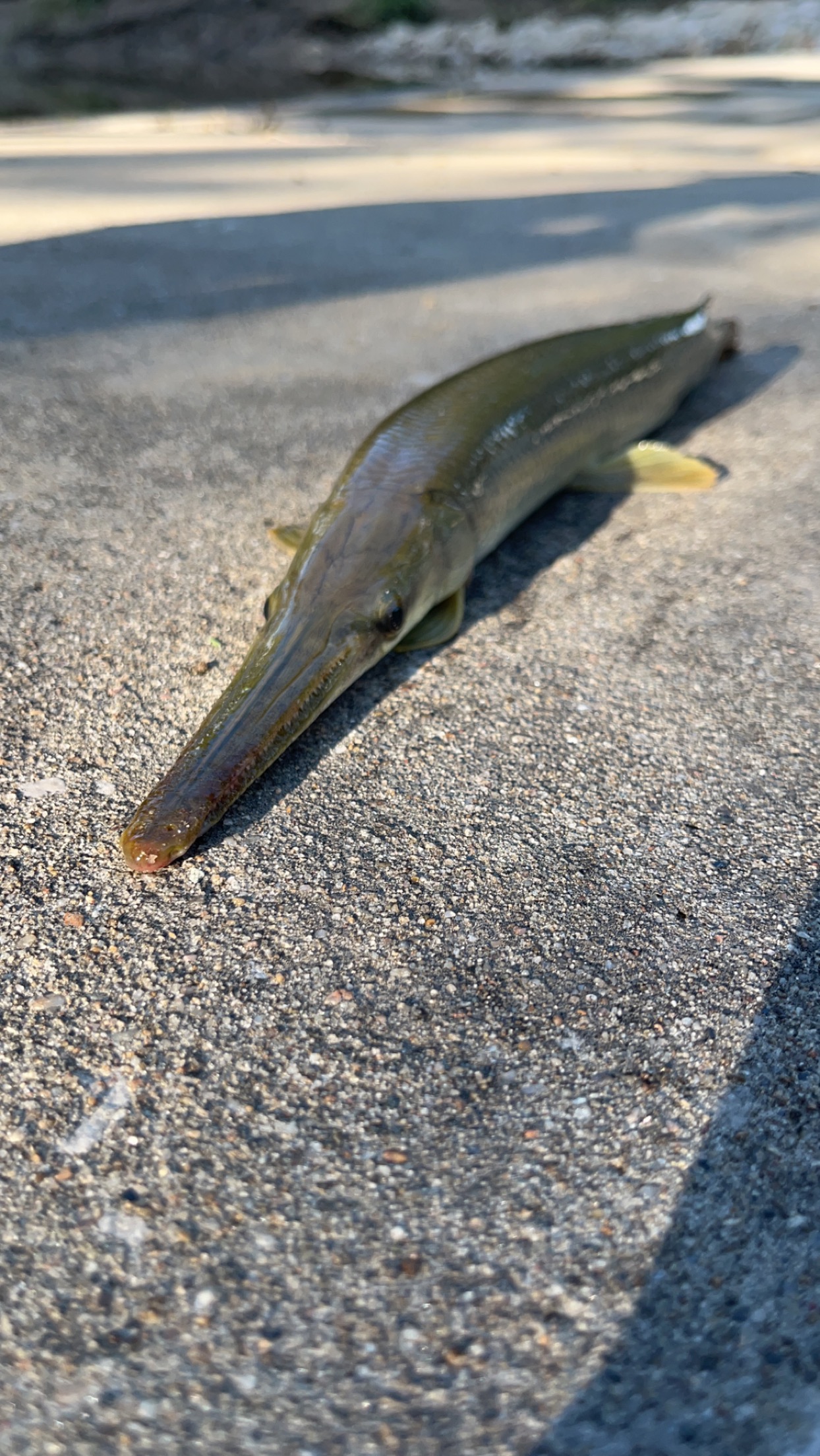
The kids love fishing in Hinkson Creek. It’s a dynamic spot that changes almost daily. Sometimes there are only minnows and small Bluegills there. Other times it’s got decent-sized Bass, Catfish, and Gar. It’s easy to get to, and even pretty accessible for my daughter who uses a wheelchair.
This summer we got to see Hinkson Creek radically transform in a matter of minutes. There have been a number of flash floods in the area this year, but we happened to be fishing during one warning. We watched the sky and checked weather constantly, but other than a short shower, nothing was amiss where we were. But we knew there were high winds and strong rains just miles away to the north. Hinkson Creek runs southward through Columbia, and gathers water from a lot of land in the area. Eventually the creek deposits into Perche Creek, which itself hits the Missouri River several miles south of town.
That day, the storm surge from the north rolled up to our little spot on Hinkson Creek. We first noticed the water picking up speed, then heard a rush in the forest upstream. We turned to look and saw a wall of debris and muddy water heading our way. Within just a few minutes the river rose six feet. Dirt, rocks, and even entire trees blasted through the area. It was awesome to behold, and such a learning experience.
You can see in the images above just what I mean by the creek rising. The concrete bridge my kids are fishing from in the image above is UNDER the water in these three images.
We stood by, watching the raging waters, for a good long time. It was illustrative of the power of even smaller sections of rivers, and it gave us even more appreciation for our proximity to the Missouri.
GAR
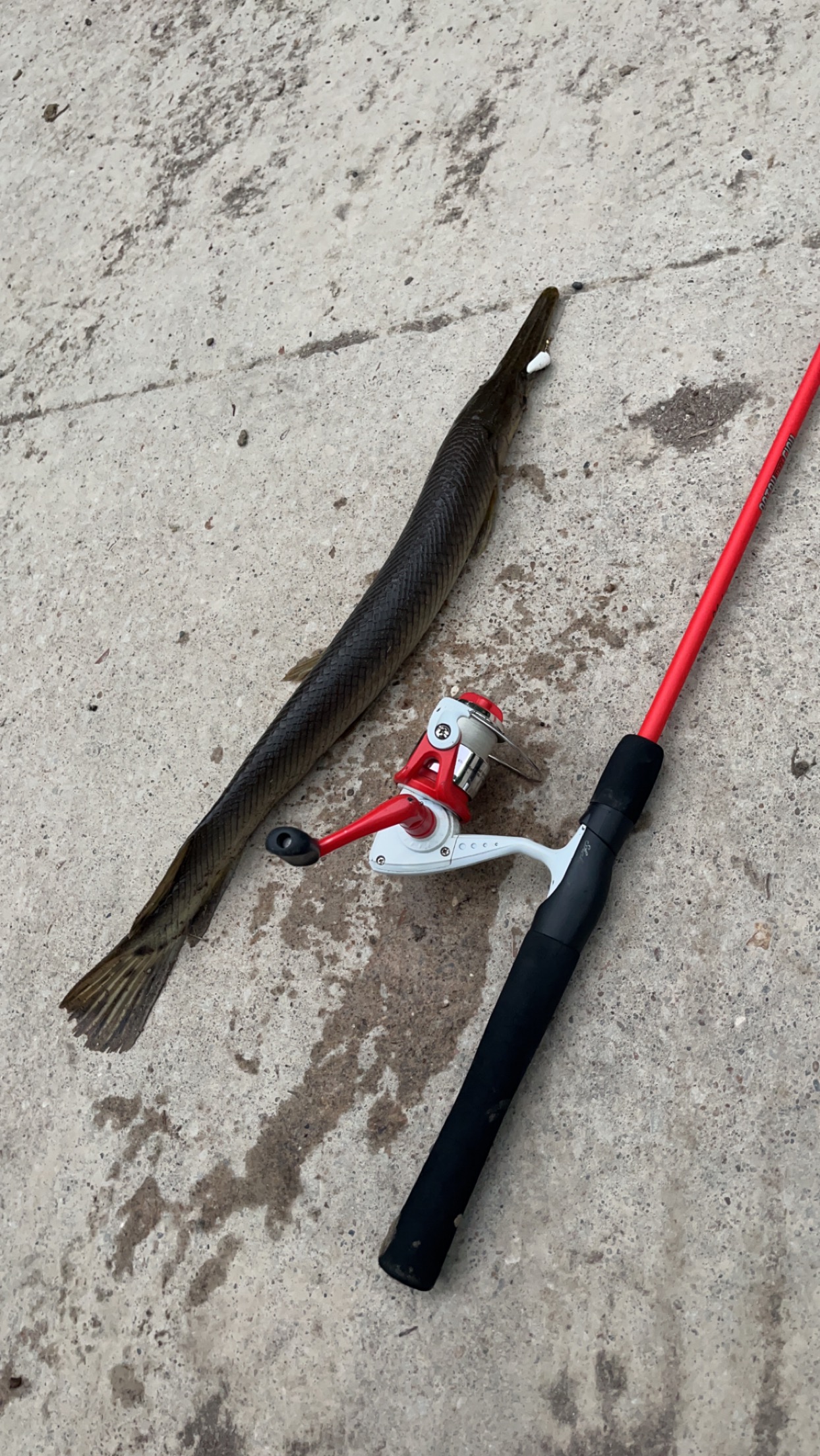
One of our favorite types of fish is Gar. We have Spotted, Longnose, Shortnose, and Alligator Gar varieties. They’re always fun to battle and they come from an ancient lineage of fish that really look almost dinosaur-like. They’ve got serious teeth and definitely don’t want to be caught. Bony and strong, Gar are hard to hold onto and are known for spitting hooks easily because they aren’t very fleshy in the mouth area.
In the creeks and smaller rivers, Gar don’t grow super large, but we do get some that are in the 28-32 inch range at times. We’ve even been able to land them on hook-less rope lures, which is fun.
Beast Bass
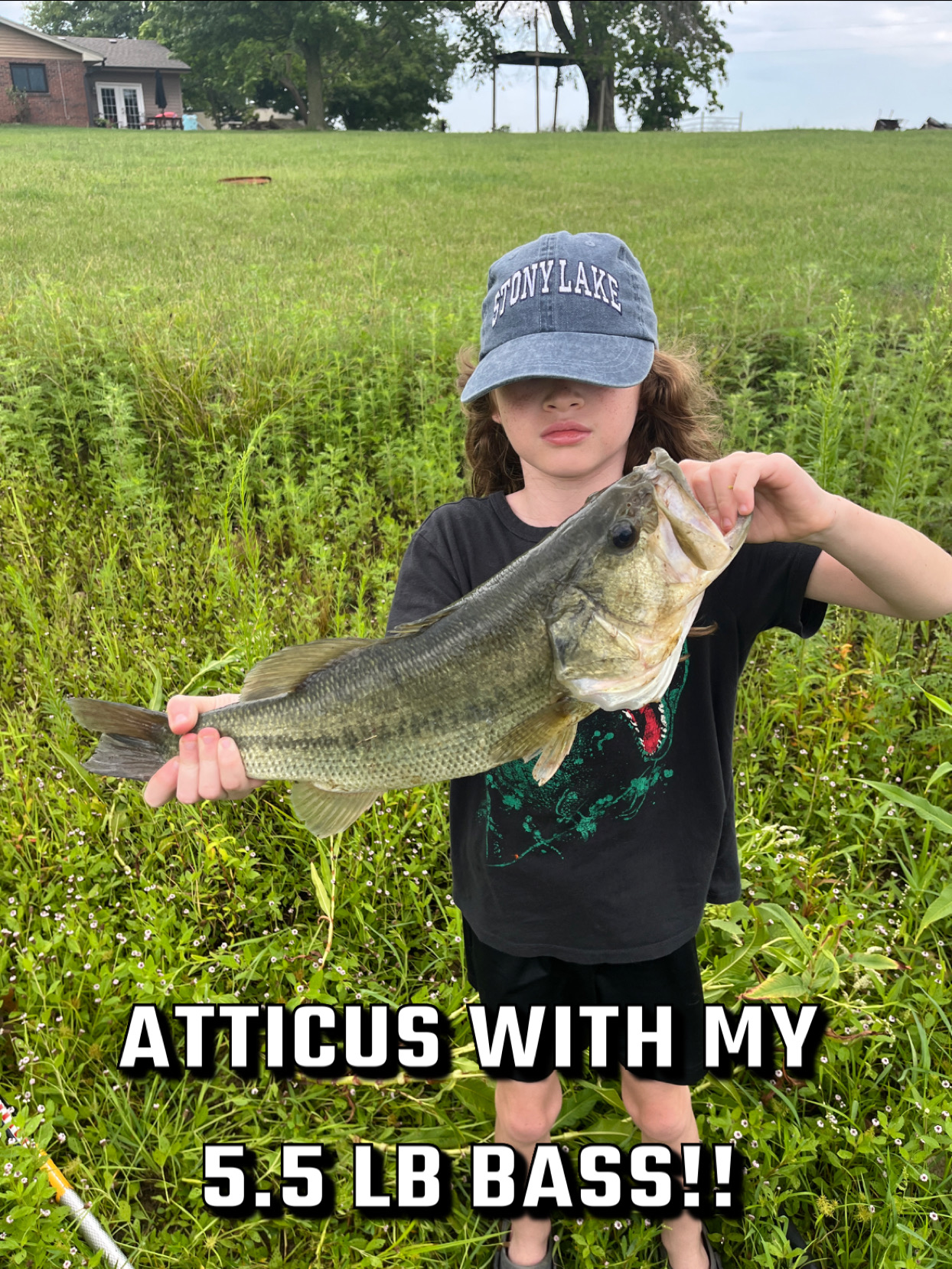
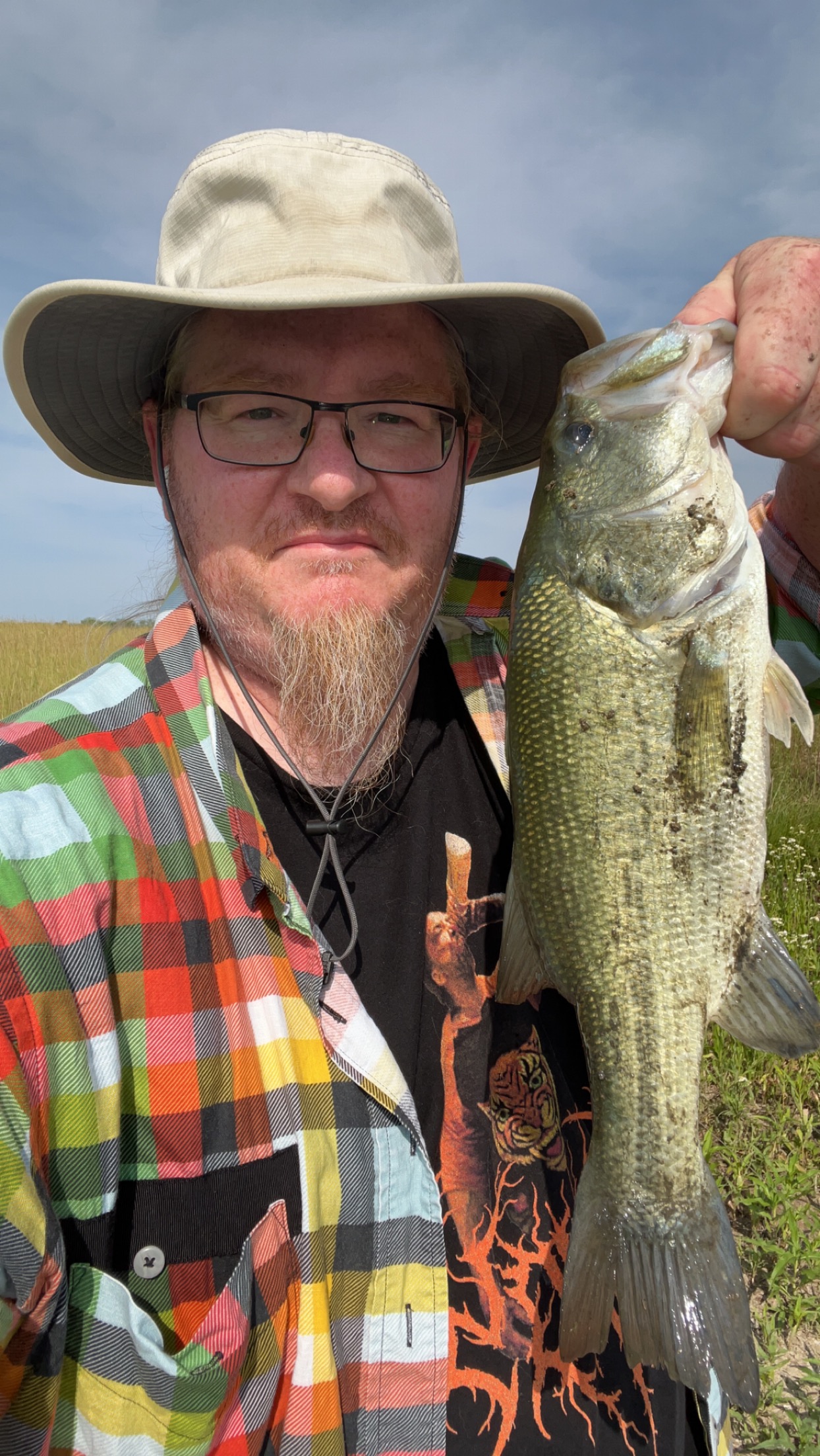
This summer gave us some SERIOUS Bass. The current Smallmouth Bass record in the state of Missouri is 7lbs, 2oz, and two of the fish we caught this summer were pretty close to that size. In May Atticus caught a huge Largemouth coming in over 6lbs (right). Later that month when we went to Michigan he hauled in this beautiful Smallmouth that was 5.8lbs (center). Given that we’d lost so many bigger bass with our lighter line, by June we’d converted over to 15lb test. It wasn’t until late July that I got my 5.5lb Largemouth (right). These personal bests are going to last a while, I think.
Good Lessons
We will continue to fish our favorite spots in the area through the rest of the year, but we’ve also planned to hit one more longer trip before the end of the summer. Meramec Springs, where the state fish hatcheries stock Trout, are not too far away. Though it might be a bit too hot for Trout, we’ll give it a try. I haven’t yet taught the kids how to clean and cook fish; we’ve been catching and releasing everything so far. Given how much they seem to respect the fish, I think they’ll understand and appreciate the circle of life aspect of harvesting some for food. But I think I’ll wait on that until Trout are on the menu.
I’m very proud of the kids in regards to angling. It has been a great way to get them out in nature, yes, but it’s also developed their resilience and patience. They’ve grown in understanding delayed gratification and following through. And they’ve gotten to work on problem-solving, working together toward common goals, and appreciating the efforts and successes that each one reaches. I’m impressed with them.
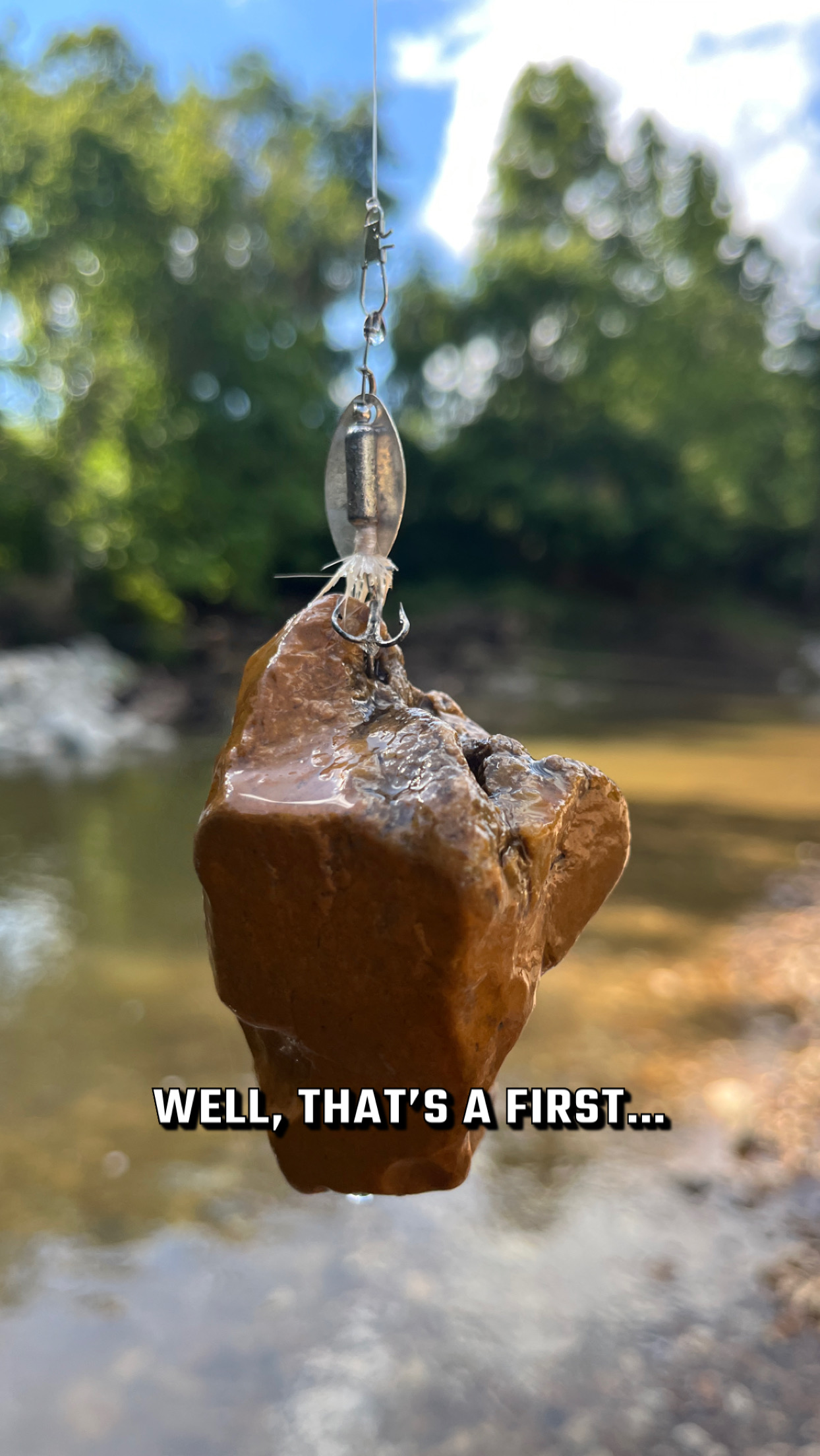
There’s Always a First Time!
Each trip to the creek or river or lake offers chances to learn new things and experience life together. That makes it all worth it.
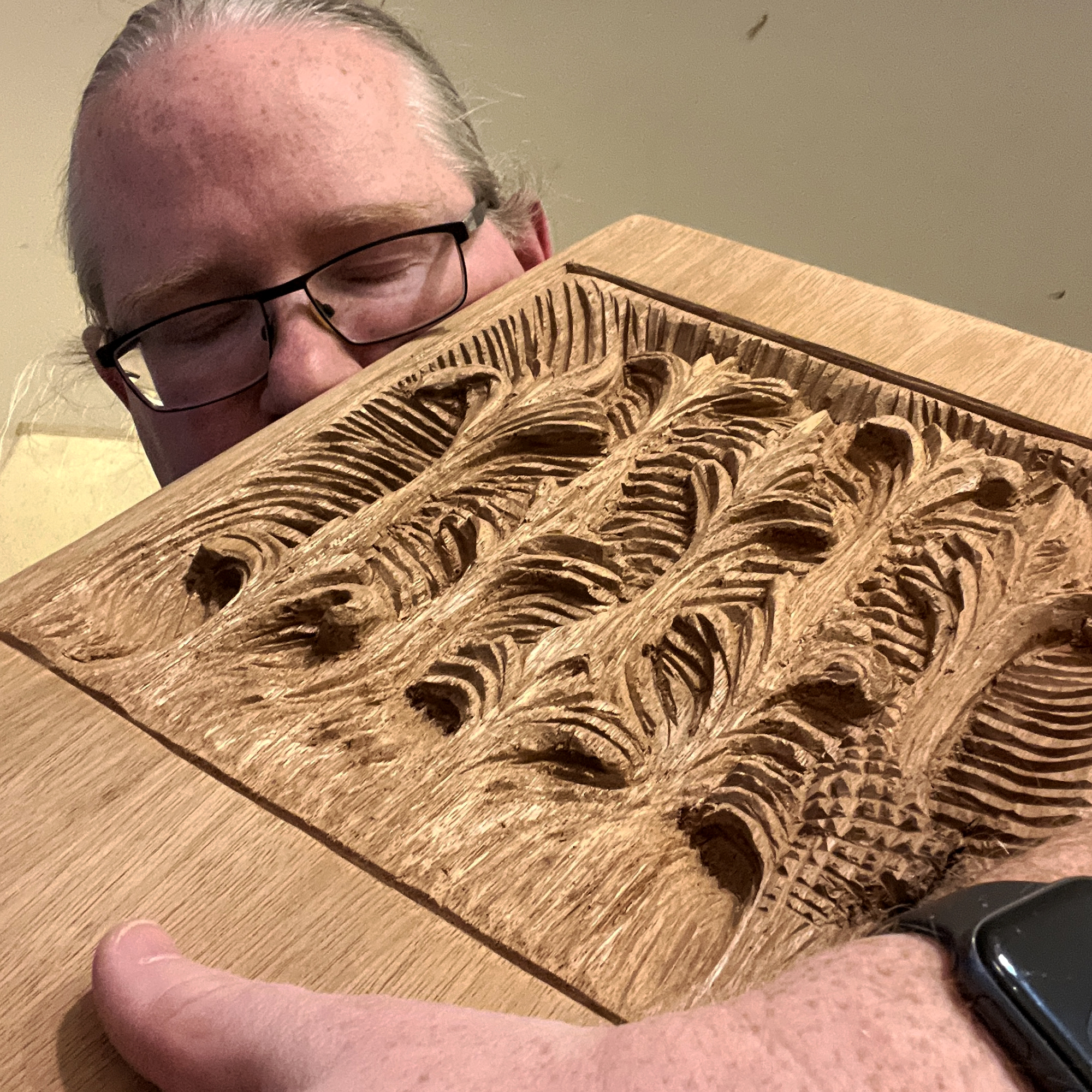
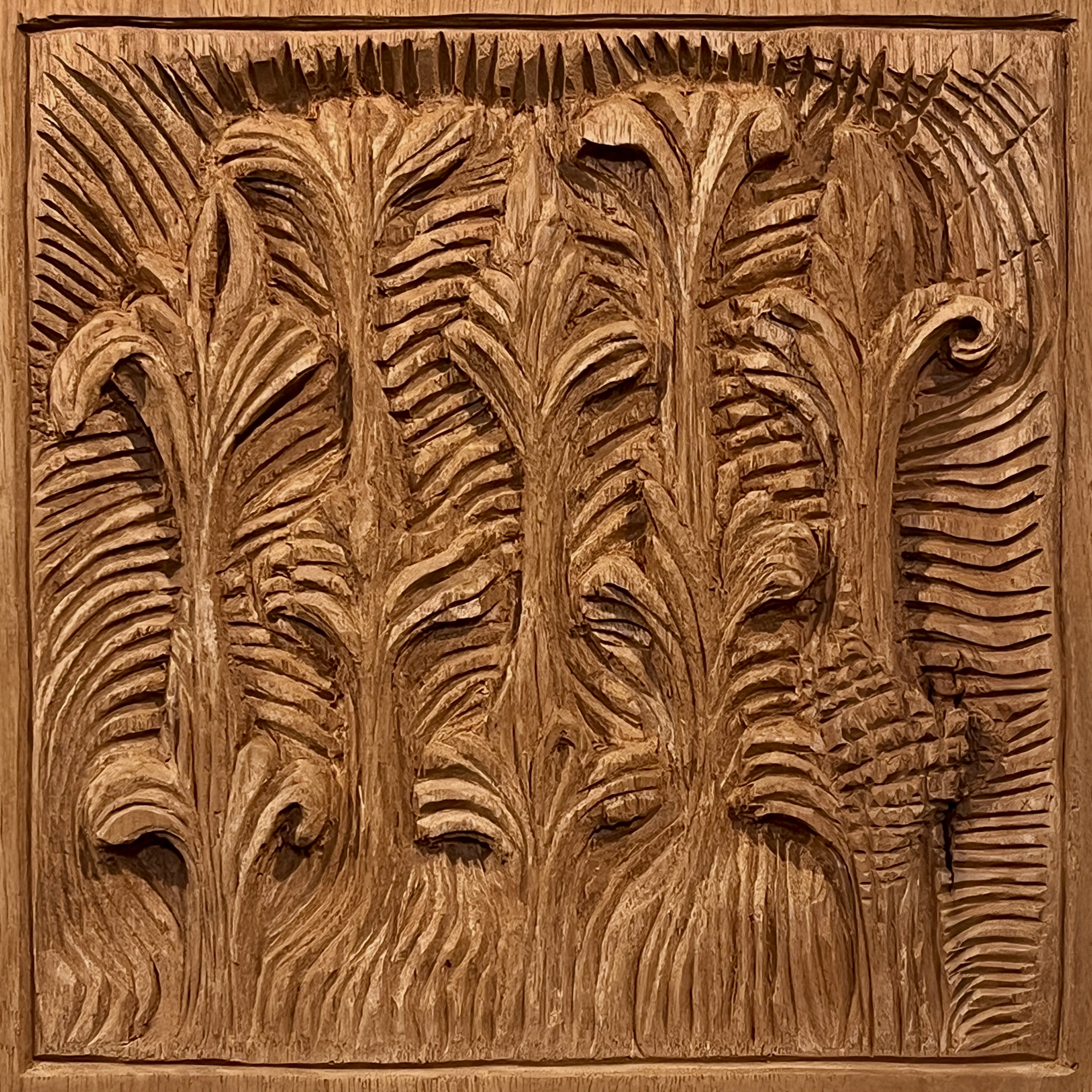
Late last year I talked about how Geo and I were working back and forth with some artwork/carving/A.I./carving/artwork-type collaborative stuff. The process has continued.
Smelling the newly carved oak from Geo!
I know, I know. You see the initials A.I. and you’re skeptical. As you should be. I’ve been doing a lot of research on A.I. generated images, and while I think the majority of the A.I. space is trashy, there are a few people doing some amazing exploration. Joey Borovicka over in The Timeout Zone is doing quite interesting “synthography” using A.I. models. Wolfe von Lenkiewicz is also making intensive forays into image-making with precision A.I. models.
I have been interested in using image-generation tools in a limited way. Basically, I’ve been incorporating them into the workflow. This means we start with ideas, images that we’ve made ourselves, or carvings that Geo has made. Then, uploading the images as a baseline source for the A.I. generator to use, we add text prompts to encourage various modifications. In this way we use our own images in the A.I. system and calibrate them using the wording we input. Obviously, since the models have been trained on images borrowed from the wider world, we’re viewing this as a limited experiment, but I think it’s worth it.
Here’s a sequence of explorations that we’ve done with imagery of the acanthus and my own artwork: first, I used some wording from Geo in the Dream by WOMBO A.I. app, then I loosely drew over the generated images. After making a various edits and selecting one of the versions that I’d drawn, I sent a copy to Geo, who used it as a basis for his carving.
Quilt-form based on acanthus leaves. A.I. generated from Weissler prompt wording. Acanthus Quilt. Geo Weissler. Carved oak. 2022.Drapes. Ballou. Tempera and oil pastel on panel. 2021-2023.Hidden Drapes (After Ballou). Geo Weissler. Carved oak. 2023.
Living Carve. Ballou. 10×10 inches. Ink, colored pencil, gouache on paper mounted on panel. 2023. Private collection.
The image above, Living Carve, was built by using words of Geo Weissler in Midjourney, then modified digitally in Procreate on my iPad. I took that result, printed it on a large format Epson printer using Epson Enhanced Matte paper. I then used colored pencils and gouache to develop the image and enhance the richness of color and depth of surface. Below you can see a shot of the piece framed. You can see some of the surface treatment, the sense of the material accumulating to present the image. I like the chiaroscuro and quality of light. There is a subtle feeling of trompe l’oeil to this piece, which is something I’ve only tried to do a few times before. I may try a composition like this once again. If you’d like to inquire about work like this, visit me on Instagram.














 eikonktizo