The Kasper Collection of Contemporary Biblical Art

Over the last five or six years, I’ve been involved with a project by an artist and collector named Jim Kasper. In January 2026, that project will come to fruition with the publication of a new book featuring the work of many excellent painters and drafts-persons. These artists are drawn from a range of generations, backgrounds, and faith traditions, but they were commissioned by Jim to build a current vision of artworks that take on the complex themes and histories that form the bible.

Two incredible essays – as well as writings by the artists themselves – help contextualize the works and elucidate the ways these artists add their current voices to ancient conversations.

Also, as part of the upcoming initial dual-site exhibition in Columbia, MO (more info on that when it’s ready), I am offering prints of 5 of my works in the Kasper Collection. I hope you’ll click below and check them out – it’s always good to support artists instead of billionaires, especially in times such as the ones in which we’re living.

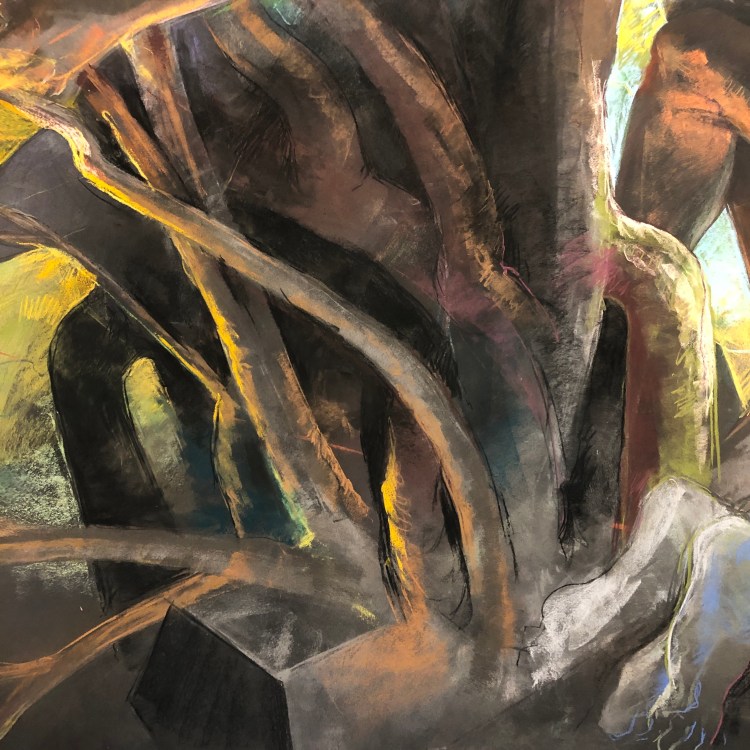
My contributions to the Collection are varied. I was glad that Jim allowed me to pursue more straightforward “traditional” painting, but also to work in relief carving and enigmatic, abstract imagery. With the five images above, I was inspired by everything from Correggio’s Jupiter and Io to the physical stylization in the mythology-based paintings of Kyle Staver. I wanted the works to embrace their illustrative side, with strong visual dynamics, weird bodies to match weird activities, and intense colors.

I hope you’ll take a look!

Sidney Larson, the Riback Murals, and Benjamin Franklin’s “Slipper Tub”

One of the weirdest objects that used to exist in Columbia, Missouri is pictured below.

Benjamin Franklin in a tub shaped like a shoe, conducting a meeting, all the while stoking a fire beneath his own ass. Just look at it. AMAZING.

Sadly, the painting is now destroyed. I took pictures of it in 2013 when I did some art conservation work for Riback Pipe and Steel Company. The image below is a digital collage of shots because it was so hard to get the right angle on the work (there was a large, north-facing window opposite the painting.

My understanding is that the tub DID NOT ACTUALLY look like a slipper, but was what is called a “slipper tub” and was fairly common. I can find no reference to a tub shaped exactly like a shoe/slipper anywhere. I think Larson was taking some creative license here.

“France, Late 18th Century” by Sidney Larson

Missouri painter Sidney Larson completed this painting entitled “France, Late 18th Century” in 1969 as part of the “The Riback Mural,” commissioned by Harold H. Riback for the Riback Pipe and Steel Company building, which is situated at the east end of Business Loop 70 in Columbia, Missouri.

The Ribacks sold the business to Plumb Supply Company in 2015. Eventually, the building housing the mural was remodeled and the paintings were destroyed. According to the State Historical Society of Missouri’s Art Collections Manager Greig Thompson, the mural couldn’t be preserved due to the methods by which it was installed.

Notley Hawkins took photographs of the mural in December 2021, at the request of Vicky Riback-Wilson to preserve a record of the paintings. Hawkins studied painting and drawing with Sidney Larson at Columbia College in the 1980s.

In 1980, Larson published a booklet entitled “The Riback Mural” which included the following description of painting:

“Benjamin Franklin landed in France in December of 1776 and soon after set up quarters at Passy outside of Paris. His purpose was to solicit aid from the French toward the defeat of the British during the American Revolution. He proved to be a very popular man and was in great demand. He did suffer from attacks of gout for which his doctor recommended hot baths. For this, Franklin had the slipper tub, pictured above, built for him. He took hot baths twice a week, each one lasting as long as two hours. Hence the occasional meeting held while in his tub.”

Top left quarter: Marie Antoinette prior to losing her head. Top right quarter: Empress Josephine looking a bit like “The Death of Marat” in her bath. Bottom half: Franklin taking a meeting in the shoe tub. So weird.

You can see the rest of the Riback Murals here.

The Ballou Collection – Auxier, McMurray, Sandbothe

Recently I rotated a bunch of the art in our home, and so I felt that an update to my ongoing series of posts featuring various artworks I’ve collected over the years was in order.

My most recent purchase is this wonderful gouache painting on handmade paper by Mary Sandbothe.

Mary Sandbothe. Mystery Snowball. Gouache on handmade paper. 7x5 inches. 2023.
Mary Sandbothe. Mystery Snowball. Gouache on handmade paper. 7×5 inches. 2023.

Mary is an awesome artist and educator here in Columbia, MO, and has been a pillar of the art community here for many years. She had a wonderful show at the Columbia Art League late in 2023 that really stood out to me. Called “Heritage Unfolded: Gouache Interpretations of Missouri Quilts,” (you can see the works here), the show featured some evocative, intimate works. I knew I needed to jump on one of them, and I’m glad I did.

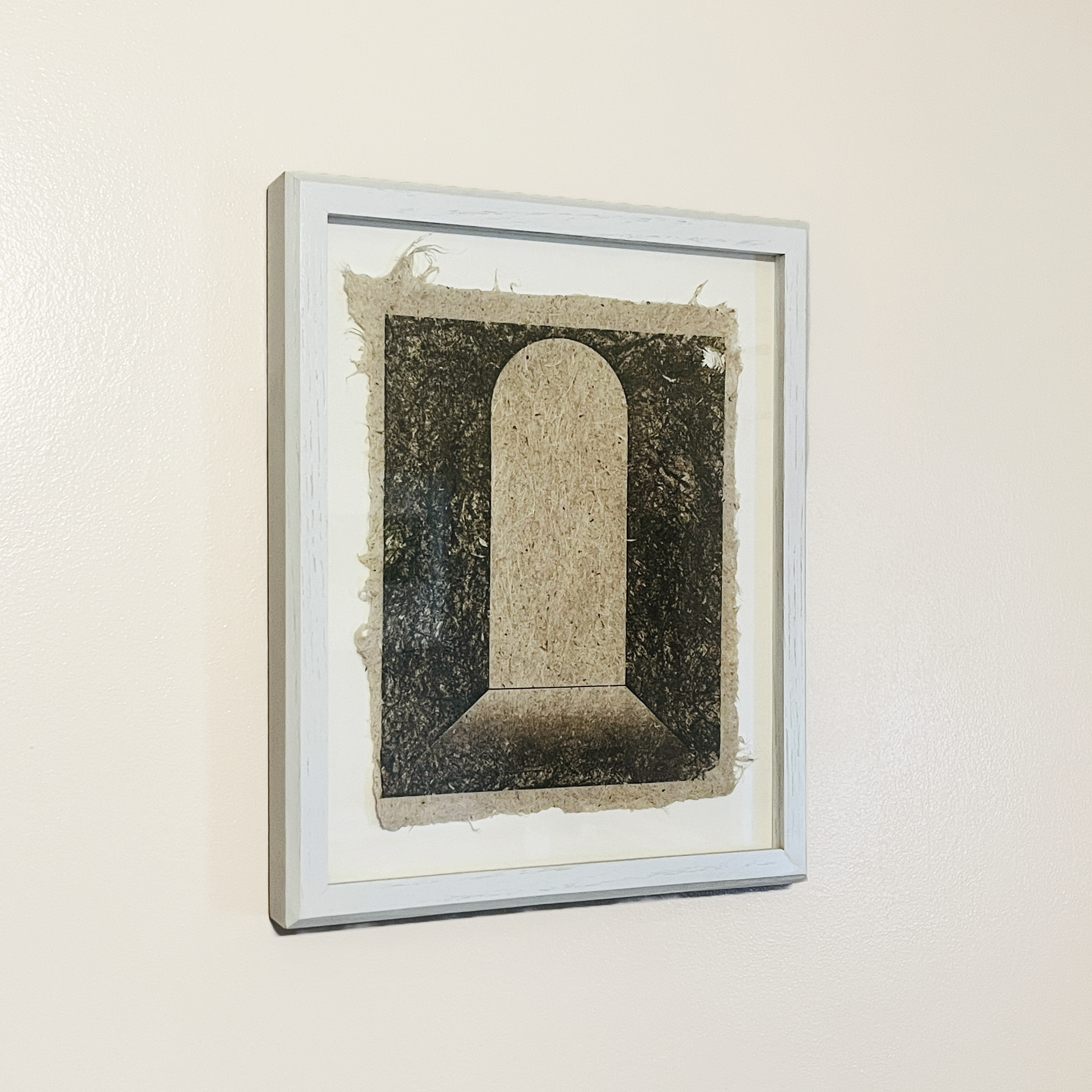
Next to the Sandbothe Mystery Snowball piece is a striking print on handmade Yucca paper by Caleb McMurray. The untitled work features a doorway or aperture, something that McMurray has returned to again and again.

Caleb McMurray. Untitled. Ink on handmade Yucca paper. 10x8 inches. 2014.
Caleb McMurray. Untitled. Ink on handmade Yucca paper. 10×8 inches. 2014.

I also have a sister print to this one, but it features an arching opening that is in the distance rather than up close like this one. Windows, doors, and other passageways are features of many of the works I’ve collected over the years.

Lastly, a small painting by Hayley Auxier‘s shares the wall with the two works I’ve shared above. Hayley was one of my stand out undergraduate students, and I love seeing her carry on her artwork as she has since graduating. This piece is one of a series she made celebrating National Parks and celebrating her experiences of them. Hayley shows a strong affinity for gouache, so I’m glad to have an example of her painting in that medium.

Hayley Auxier. Acadia National Park. Gouache on paper. 4 by 6 inches. 2018.

Acadia National Park is special to me because that’s where my partner and I went on our honeymoon all those years ago, so I like the piece because of it’s connection to my own history. But it’s also got a wonderful note from Hayley on the verso, and so the small work feels like it connects all of these different threads of my life: personal, professional, aspirational, and historical. That synergy of references – those that I bring to the work and those the artist embeds within the piece – is what makes art special.

I’m loving seeing these three works every day as I have a meal or hang out with my family. Art that lives with us is the best kind. Really thankful to have these pieces close to me.

The Garage Cheese Tale

As 2023 rolls toward an ending, I want to share with you something I’ve been keeping to myself for a few years now.

Go back to the beginning of the pandemic. Schools closed. Information and misinformation flew back and forth. Of course everything was a political dumpster fire; a pervasive heaviness spread over the land. And don’t even get me started on the ritual of using disinfecting wipes on every square centimeter of grocery item delivered to our front door. Even on nature trails and in wild spaces we were warned to keep spectacular distance from each other.

It was the weirdness of being told we shouldn’t use the nature trails for hiking or triking that caused me to consider using the Hitt Street Garage as a place to get my miles each day. School had closed in March, and after finishing up that semester remotely I began to spend time in the garage. There were no cars there, and often my children got some out-of-doors time in by riding their bikes around the middle levels while I walked (click here to see evidence of one of my first workouts in the garage).

By the time May ended I was going to the garage several times each week. It was then that I took special notice of a denizen of that forsaken building: the cheese. That’s right: a slice of processed cheese product cheekily flung off a take out burger and – somehow – perfectly caught on the concrete wall. It was THE garage cheese.

I had seen it earlier in the year – perhaps the first week of March. I had no solid idea how long it had been there, but it was leathery and tough (yes, I touched it). It might have been there a month or two. It still had the strong, unnatural hue I’d come to expect from cheese like this. At first it was just a funny bit of ephemera living in the garage, much like the plethora of unused .223 bullets, spent CO2 cartridges, or carcasses of baby birds that hadn’t made it through the summer heat. But as I passed the cheese over and over again in my rounds up and down the floors of the parking garage, it began to take on more and more importance.

Crazy, right?

I shared my observation of the cheese only with family and a few close friends; I didn’t want it to be disturbed. Being early in our collective quarantine, I felt sure the cheese would be safe. But I was keenly aware that once things went “back to normal” there would be some frat-bros carousing in the garage. There was no way the cheese could survive the onslaught of undergraduates! I just wanted to see how long it would last, and I didn’t want any human intervention. There was an alchemy taking place between the cheese and the garage, a synergy that must be allowed to continue! I was committed to no engagement other than photographic documentation.

The Garage Cheese on September 12, 2020. Ballou.

I began taking periodic shots of the cheese, with my first one from September 2020. I know I took earlier images, but I didn’t see the cheese as anything more than a humorous curiosity then, and so didn’t save them. It wasn’t until March 2021 that I made the decision to document the state of the cheese monthly, as well as make periodic check-ins every other week or so. I viewed the month of March as the anniversary of the installation of the cheese, and it felt right since that was when Mizzou closed down. In a way, the cheese was a physical artifact of the many ways in which COVID altered our experiences of life.

Over time, the cheese itself began to change. Flexing with the heat and humidity, cracking under the pressures fighting against its preservative-laced body, the cheese maintained its grip on the concrete. Something in the material nature of the porous wall and the glue-like substance of the cheese made their union not only possible, but hearty. By March 2022 the cheese was gnarly and swarthy, hung all over with dust and the debris of generations of spider webs. The darker coloration made me feel more secure that people wouldn’t see it.

This was important, because life was returning to the campus. The garage was being used more and more. By the fall semester, most people felt safe teaching and learning in masks. This was a tense time for me. I began to check on the cheese several times a week, certain that it would be gone one day. I took to obtaining photos of the cheese only when I would not be observed. I didn’t want my attention to a seemingly nondescript section of the garage to draw others near.

The Garage Cheese on March 14, 2023. Ballou.

I got a bit more intentional with the photography in 2023. The shot from March that year is particularly nice. I began to think the cheese really would make it to the four year mark. People encouraged me to post about the cheese, to make an Instagram account for it, even to mark it on maps. But I knew there would be time later to show folks where it had been. I wanted it to make four – maybe even five – years! As Thanksgiving passed, I felt more confident than ever. After the first day of graduate reviews on December 1st, 2023, I made a pass by the cheese for my December check-up. It looked robust, confident. It was ready to press on toward another anniversary upon the wall. So it was that when the second day of grad reviews concluded on December 8th, I took one of my grad students over to see the cheese. I figured I could share the glory with more people. Surely that would be okay.

THE CHEESE WAS GONE.

Astonished, I rushed out to investigate the scene. There, amid a thick mass of trash and various organic detritus, rested the cheese. It was in a gap between the wall and the floor, and it seemed to be intact. No one had abused this artifact; it had let go of the wall on its own. Its time was up. The race was won.

I carefully rescued the cheese. It was rough and hard, as dense as holding a fragment of bone. Yet, like bone, I perceived it would be brittle. Maybe it had been the dusty garage trash that provided a soft enough landing to save the cheese from breaking against the concrete. Whatever the reason, after nearly 45 months on the wall, the garage cheese was now mine!

The Garage Cheese, framed in a shadowbox on December 26, 2023. Ballou.

I quickly collated my photos of the cheese and obtained a simple shadowbox frame for it. Now safely transferred to the wall of my studio, the cheese can exist in perpetuity, assured the status of a protected relic. As part of the process of documenting and celebrating the garage cheese, I have created the GIF below. I did a modicum of image adjustment so that you can get a sense of the changes that happened over the course of the years. Of course, it’s not perfectly color-corrected, nor entirely aligned for precision, but you can definitely get the sense of how the cheese transformed.

While the cheese itself has left the Hitt Street Garage, there is something that remains behind: a kind of oily stain is still quite visible on the wall of the garage. If you look in this wide shot below, you can see it just a bit left of center. Follow the inner vertical line of the leftmost column downward, and you’ll notice the apostrophe-like arcing shape. That’s a ghostly shadow of the cheese, somehow still clinging to that precarious perch.

The location of the Garage Cheese, photo taken on December 26, 2023. Ballou.

Click below to take a look at a curated selection of the cheese. If you’d like to purchase a print of one of these images, send me $20 on Venmo (here), and I’ll mail it out to you. Just be sure to tell me which one you’d like.

The distance between months and years, and all that we did and saw and felt… in one image. Maybe I should do some risograph prints of these, too… On to 2024!


A final thought, as I sit here with family and smile at my cheese…

Here’s hoping your ’24 is joyful, safe, and peaceful. We know it probably won’t be, though. At least not for most of us. So why do I offer the above trifle about faux fromage? Why present some cast off cheese as a visual metaphor or point of access for meaning? Well, I think the greatest part of our human experience is in the realm of attention. I teach my students this, and I try to teach my own children it as well. When we are attentive to the world around us, when we believe in the value of observation and awareness, then we are most able to be both realistic and hopeful. It is willful ignorance or chosen obfuscation that breaks the social contract, that causes us to care less about each other and the world.

We are living in times of serious violence against not only people but against our ability to apprehend true things. We desire to be told what we want to hear, rather than what we ought to hear. We ignore what should be seen straight on, seeking instead things that distract us from beingness. These are our great sins, particularly in America. We have allowed our politicians to be criminals. We enable them and they stroke our egos in return. Our domestic and foreign policies – for all of our posturing to the contrary – are not “pro-life.” We have become the arm of death. We resist over and over the chance to do what is right, because we know that will make us feel a little uncomfortable. Our comfort is our chief aim, and it’s obvious.

In light of all of that, perhaps everyone would do better to pay close attention to their own version of garage cheese. I hope we can get started on putting our collective house back in order in 2024.

Peace.

A Different Birthday

Normally on my birthday I try to take some time to myself for reflection, good food, and maybe some limited frivolity with friends. This year I wanted to try something different.

Parenting is hard. The logistics of family life is hard. Everyone is in different emotional and physical states. So while I do take my kiddos out for play in the park and do other things very frequently, it’s been a long time since I got one-on-one time with each of the kids.

About 9am on my birthday, I got started. CaiQun and I visited B&B Bagels, just about the best real bagels west of the Mississippi. She loves her plain bagel with plain cream cheese… to each their own, right? Then we went to look at LEGOs and talk about building things. It was a sweet time with a daughter who often has to shout at home to be heard, but who is quiet and calm when she gets some quality time one-on-one.

MeiMei was pleased to get to hang out in B&B and do some reading and chatting.

Next it was Miranda’s turn. She has been asking to go to the Library for some new books about cats and baking, two of her passions. She’s been watching some of the baking shows available on Netflix and has gotten the basic concepts down. She wanted to get more focused understanding (she often over-applies sugars and under-applies flour!), so we searched for some books (“No, daddy, ADULT baking books!”). I steered her away from volumes on French Cooking (talk about delusions of grandeur), but she settled on some good stuff. Then we got her some frosting application bags. Needless to say she’s been very pro-dad for the last 24 hours!

MGB writing down her library finds!

It was now a bit after lunch time, so I decided to take FangFang out for a meal at Panera, one of her favorites. She got mac&cheese and a fruity drink while I opted for a large salad. We chatted a lot about food, food-eating techniques (“I like to double-fist it!” she exclaimed), and potential future meals we might have. This is a girl who definitely likes to eat. After that we had a fun walk around the mall, observing and commenting on many things.

FangFang demonstrates the “double-fisting” technique.

Last but not least was Atticus. He is so excited about all things water these days… and often we come into a bathroom or walk past the cat dishes to see that he has flooded a portion of the room. I knew this caring, curious boy would love some time on a local river in one of the several nature preserves that dot Mid-Missouri.

Atticus had so much fun chasing minnows and crawdads in the shallows.
So much joy in this little guy’s eyes while on the river.

Capen Park, which is a section of the Grindstone Nature Area, features a nice cliff climb that even little kids can do and access to the river for exploration. It was great to be able to give my boy 2+ hours of self-directed play on the water and rocks.

Atticus loves doing some rock climbing… and he was careful around the edge of the cliff (whew!)
Spying the way forward…

It was a FULL day – basically 9am to 4pm of consistent activity. I think I’ll hold onto these memories to help me through rough patches… hell, even today I called them up to help me regulate when the kiddos were having some fits.

I’m sad a lot these days. All things are stranger and harder than I thought they would be. But I am blessed and fortunate. A day like this one, taking the kiddos out on individual dad-dates, was really necessary. It was good for my heart and it was good for theirs, too. Each of them has talked to me about their special time. Glad to know I can still do something right.

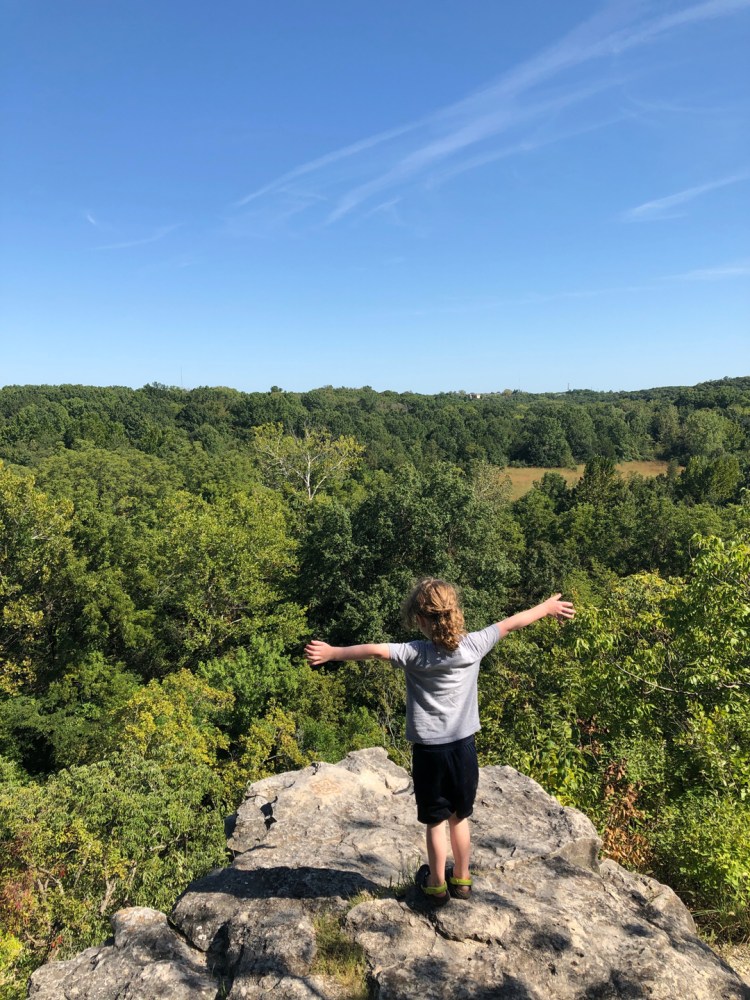
Now if I could just feel as triumphant as Atticus does here, spreading his arms out at the top of the cliff…

King of the world!

I definitely won’t wait until my next birthday to do this again. A good start to #43.

Recent Artist’s Talk and Q&A

My current solo show, The Eternal Idol: Conflict, Impossible Scenes, and the Denial of Human Value, is on view right now (April 4-June 2, 2019) in the Montminy Gallery inside the Boone County Museum.

Detail of Head and Hole.

The exhibition features older work based in personal and spiritual conflict. One such piece is from 2001, created along the eastern shore of Lake Michigan amid the reverie of a pre-social-media world. A number of the large drawings were begun in 2006 and 2007 behind the apartment we rented on Elmwood Avenue in Evanston, Illinois. Little did I know then that those works would find their completion more than a decade later in Mid Missouri after many iterations.

The most recent paintings came from my fury over the US bombing of a Doctor’s Without Borders hospital in Kunduz, Afghanistan in October of 2015.

Detail of Current Events.

All of the works represent my ongoing attempt to picture the impossible spaces created by our collective unwillingness to constrain power, war, greed, consumerism, and ignorance – in ourselves and in society at large. Whether using documentary photos and videos or inventing from the history of the human form as a zone of violent incidence, I attempt to make plain the foolishness of conflict, oppression, and war.

At the reception event for this exhibition, I gave a talk and took questions from the audience. I present that talk here as a video, which features many images of the works on display and a number of photos taken during the reception event.

Detail of The Falling.

Here you can watch the video I’ve uploaded to YouTube. I’d love to hear any thoughts or questions you have – hell, I’ll even respond with more details if you ask me any!

The Glory of 2019 in Color Drawing

Listen. Look and Listen.

The recent work coming out of my color drawing students is phenomenal. They are thinking around my assignments, participating with the materials, and generally making leaps and bounds into understanding the physical properties of pastel and colored pencil (among other things).

Here are just a few of their amazing works this semester.


Sveta Wunnenberg. Study of Hose and Other Objects. Chalk Pastel. 18×24 inches. 2019.
Sveta Wunnenberg. Still Life in Colored Pencil. Colored Pencil. 18×21 inches. 2019.
Madison Read. Still Life with Strawberries and Glass Jars. Colored Pencil. 24x18x inches. 2019.
Devan Sweeney. Gummy Bears. Chalk Pastel. 18×24 inches. 2019.
Jessica Parker. Lunch. Oil Pastel. 16×16 inches. 2019.
Lydia Kappelmann. Apples and Brownies. Colored Pencil. 15×15 inches. 2019.
Elizabeth Finck. Bottle Caps and Pills. Colored Pencil. 17×17 inches. 2019.
Ashley Bigos. Spoon Reflection. 22×10 inches. Oil Pastel. 2019.
Jessica Parker. Reflection in the Angel. 14×16 inches. Colored Pencil. 2019.
Madeline Amack. Lunch. Chalk Pastel. 24×18 inches. 2019.
Sveta Wunnenberg. Me and Carter Reflected in a Spoon. Colored Pencil. 18×18 inches. 2019.


Restraint&Limitation Exhibition at Mizzou

I have curated an exhibition at the George Caleb Bingham Gallery at the University of Missouri called Restraint&Limitation. This show features the work of Anna Buckner, Sharon Butler, and Gianna Commito, along with some people with connections to Columbia, Missouri – Hali Oberdiek, Jessica Thornton, Elise Rugolo, Lauren Steffens, and Jennifer Ann Wiggs.

Lauren Steffens’s floor piece, Rugolo’s encaustic work, and Gianna Commito’s sharp-edged abstraction in the exhibition.

It is a spare, economically arranged show. It’s openness grew out of my musings on abstraction of all sorts. I have long felt that bigger is not really better when it comes to abstraction, and I set out to bring together just a few examples of works that do this. Here is my curatorial statement for the show (a text/painting pair) with a number of shots of the installation interspersed. There will be a catalog of this exhibition available soon.

Detail shot of Ballou’s Curator’s Statement.

Curator’s Statement for Restraint and Limitation

Contemporary abstraction is a huge, multifaceted project.  From Katharina Grosse, Julie Mehretu, or El Anatsui to Cordy Ryman, Odili Donald Odita, or Amy Sillman, the range of potential and diversity of referent available to artists is obvious.

There are no clear boundaries, no distinct definitions that provide a unified perspective on the practice of abstract painting. That contemporary abstraction utilizes the history, physical interactions, and conceptual structure of painting is axiomatic. Yet to suggest that it is limited to the realm of painting is a dramatic misunderstanding.

Detail of Anna Buckner’s Dutch Still Life.

The old discourse that endlessly returns to the interplay between abstraction and representation has lost any potency to report on what is actually happening in much of contemporary abstraction. With this exhibition, I hope to present a sliver-like view into the modes of abstraction that intersect with painting as a form and which, in unique ways, demonstrate the limitations of depiction and representation to clarify the kinds of experiences that abstraction affords us. I also seek to show how smaller works may defy the conceit that abstraction is most powerful in its more monumental expressions.

Commito and Buckner works hanging in the show.

A side view of Butler’s four goodmorningdrawings and their presentation.

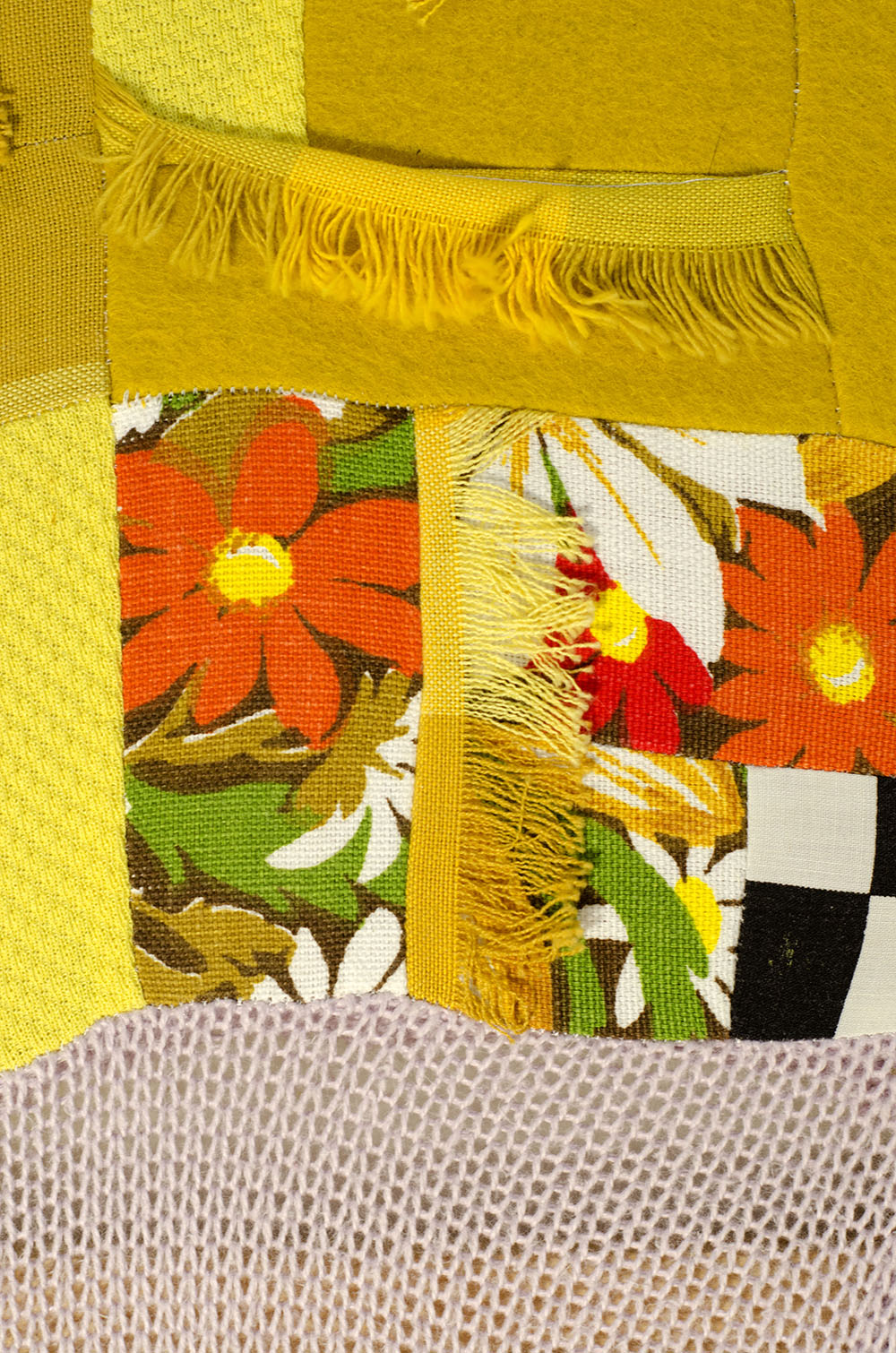
The three primary artists here are women from different stages of their careers. They show commitment to the aesthetics and procedures inherent in painting practice today, yet bring diverse pressures to the form. Buckner – a newly minted MFA – pieces scraps of fabric into small, taut grid fields. Butler – with decades of art making and writing behind her – brings us small digital drawings created on her iPhone. Commito – a mid-career educator and artist with broad impact – focuses on sharp geometries and wonderful chromatic synergies. Their influences – ranging from post-paint materiality to provisionality to traditional hard-edged painting – form an invigorating view into a restrained yet evocative corner of artmaking.


Detail of an Elise Rugolo work.

Grouping of Wiggs pieces, with Commito off to the right.

Post Script ~

I was particularly excited to have Butler in this exhibition – ten years ago we participated in an online “shared critique” event that took place on the now defunct Thinking About Art blog. I was writing about the work of someone else, but Butler was assigned to write about one of my paintings. I thought her response sharp, knowledgeable, and strong. Though she did seem to dismiss that work, I was pleased to have her voice address my art making, and I have followed her closely ever since. Her art making, writing, and blogging – especially with the influential site Two Coats of Paint – are important. I’m really glad to have be a part of this.

Another view of the installation of Butler’s works.

A Decade of Teaching at Mizzou

_MG_3410Me, teaching in 2011. Photo by M. Kannan.

Ten years ago this month, I arrived in Columbia, Missouri to start teaching painting and drawing at the University of Missouri. I remember the experience of arriving in town well. My wife was reading to me from the new Harry Potter book (Deathly Hallows was just released the week prior) and we, being Missouri newbies, inadvertently took a scenic route from Chicagoland to MidMo. Those first months were nerve-wracking. It was a one year Visiting appointment (Eventually it was extended, then extended again). I loved the challenge and pretty soon felt at home, especially once Alison joined me. By 2010 I was able to apply to a Teaching Track position.

DSC02231Triumphant with former grad Ian, 2012.

I really am one of the lucky ones. Unless you’re living the art/teaching life, I don’t know if you can comprehend just how lucky. Yes, I’m a competent teacher. I’m a vigorous and engaged artist. But my art-making is not revolutionary, it is investigatory. I don’t believe in originality, I believe in interrogating meaning and experience by acknowledging the vast array of cross-contextual elements that surround us (histories, cultures, systems of thought, traditions of creativity, etc).

Just as nothing that I make exists on its own, so too my teaching is based on the broad constellations of influences that have coalesced into my particular perspective. My frame of reference is not only my own, it’s a kind of index of everyone and everything that has inflected my understanding.

SONY DSCPosing for one of my former grads, Jake Johnson, way back in 2009. Photo by Jake Johnson.

Ultimately I’m not a huge standout from the other (VERY small number of) MFA graduates who are able to keep up the studio work, exhibitions, and become embedded as an educator. I learned early on that teaching scratched the same itch as painting did for me. I’ve used that. I’ve lived that. If I’m down, feeling blown out and sort of worthless – put me in front of a class of 20 twenty year old undergraduates. I’ll come out supercharged. That’s the power of working with human beings who are in the midst of a transfiguration of personality and purpose. I love teaching.

sloanekinkadeIan and Sloane at the first Thomas Kinkade’s Christmas Cottage viewing party…

Consider it: I get to think about art, creativity, and even BEING itself for a job. I get to push paint around, push ideas around, and push minds around (including my own). I get to mentor and be mentored by amazing people. I get to work with creative humans of all ages, backgrounds, worldviews, and experiences. I get to read and write and speak about things that move me. I get to show my work around the country (and sometimes around the world). I get to spend time exploring what it means to make things in the world (and what it means for things to make us who we are, too). I get to share those realms of exploration with others.

I’ve gotten to travel around the world to adopt two of my children.  I’ve been afforded the chance to elevate my standard of living well beyond what it was while growing up. I have the privilege of good insurance and great health care – two things that have made the quality of my post-heart attack life, and the life of my daughter suffering from osteogenesis imperfecta, much better. I’ve become a home owner. A mini van owner. A back yard mower.

enchanter-whatgradclassisWith former grad Jane Jun at the old Shakespeare’s, 2012.

12832461_10106823713056199_4957316273168848908_nWith former grad student Laura at a gallery opening, 2014 or so.

All of these things have come to me through the blessing of employment at Mizzou. It is “an honor and a privilege”* to go into my classroom, greet those faces, and set off on a task of vision and awareness.

So many have challenged me and moved me forward. Bill Hawk, now retired, calling me out in my first talk at Mizzou and asking me to point out what I meant by an abstract assertion I had made. Lampo Leong, telling me to “just teach them” in that first class. Dr. Adrienne Hoard, guiding me in the subtle art of holding a grad student’s feet to the fire. Professor Chris Daniggelis, feverishly baptizing me into the art of mezzotint. Catherine Armbrust and the latex, Jane Jun and identity ghosts, Eric Sweet and the teeth, Maurice and the parking mountain, Shannon and the tree outside the art building, Tina and Midwestern dreams, Norby and graying out, Marcus and awkward dad jokes, Emily and softball excellence, Simon and Caymanian memory… so many more.

So much love, and work, and determination. So many reasons to be grateful.

chrishallapproves-03Joke meme image I created for Chris Hall.

13432296_10107258458921999_331676234204831219_nQuality time with former student Marcus Miers, 2016.

The first round of grad students I worked with still loom large in my mind. Ian, Sloane, Nancy were the first… then Natalie, and then Chris, Jane, and Norby… eventually Colleen and Nikos… Each and every one brought a unique inflection to my experience of the world. I am so much better for having spent time with them.

11960094_10106163680641449_3315752712489631165_nWith Lishan, Simon, and Sumi at an art opening a few years ago. Photo by Bobby.

There are so many stories I could put down: grilling pizzas with Maurice, brewing beer with Norby, taking art trips with everyone, having wonderfully intense conversations in Graduate Theory classes, and hilariously irreverent conversations over beverages at any number of our local establishments. I’ve had many wonderful students from China, and I’ll never forget Peking Duck with Jackie or making won-tons with Tianyuan and our children in the kitchen. I’ll never forget when I got to officiate the wedding of two of my former students. I’ll never forget the response of my students and colleagues to my heart attack, and how they supported me and helped me through it.

Jake, visiting for an evening of food and drink, 2008 or so. Nancy isn’t impressed, 2010.

I know that I can’t really express what all of this has meant to me. If I had to bring it all down to the most important thing, I think I would say it’s time with the students. That’s what secure employment for teachers creates. I get the time to get better at teaching and the students get the value of an educator who is growing alongside them. Continuity – hours and days over the long haul – makes the difference. Those students see me living day to day and I see them living day to day. The ones who get it, who really believe they are real and that others are real, who believe in translating human experience into evocative forms… they are the people that get me out of bed. They’re the ones who inspire me.

20091219_WinterCommencement_0007Standing as a faculty mentor with Shannon at Honors Convocation, 2009.

14907629_10107947068902079_2162397385667730310_nWith grads Guigen, Zach, Amy, Simon, and Nikos at lunch during an art event, 2016. Photo by Waitress.

_MG_3368Working with Emily during a summer drawing session, 2011. Photo by M. Kannan.

I am incredibly thankful for the opportunities I’ve been afforded. My biggest motivation is to be effective as a person, educator, and artist. To make an impact and reveal the world to myself and others through the act of teaching and making artworks. As the years go by, it is the response of my students that gives me such deep encouragement.

The lives of my students are glorious confrontations in the best of ways. They are the world brought to my classroom. Black, white, South Korean, Chinese, Brazilian, Caymanian, Russian, Japanese, gay, straight, trans, Muslim, Christian, Wiccan, conservative, liberal, questioning, broken, certain, self-actualized, brilliant, wondrous, and strange. They come in skittish and green, and they leave full of the power they’ve always had. It’s beautiful to see their transitions, and it never gets old.

With former grad and then colleague David Spear. At Marcus Mier’s wedding.

img_6603A portrait of me with Darth Vader by Jane Jun, 2013. Acrylic on canvas, 7 by 5 inches.

img_6602Portrait of me as The Dude from The Big Lebowski by Jake Johnson, 2009. Acrylic on wood panel, 7 by 5 inches.

This post hasn’t even really scratched the surface of what that last ten years have meant to me and what I’ve experienced. I haven’t even mentioned my passion for the Cast Collection or Rocking The First Day with Deborah. I haven’t spoken about how much I love Wakonse. I haven’t talked about the strange projects we’ve had to do, the cobbling together of nominal spaces for our students. I haven’t mentioned the glory of Dr. Melvin Platt’s parliamentary prowess or Ferrie and Brenda holding down all the details like heroes. There have been dozens more faculty and students who have made these years amazing.

I’m so thankful, and every semester I try to be worthy of what I’ve received. Here’s to another decade!

11022556_10105427628949939_1438644933721545290_oA group of my Color Drawing students at work, 2015.

*I’m quoting Professor Corly Blahnik, Emeritus at ISU.
Continue reading

Maintaining Momentum For Change At Mizzou

One of the big issues that has come up in the days following the protests is what can be done to keep the momentum going. The protests and interventions that took place this semester are intertwined with a huge number of categories, among which are:

  • Race and gender.
  • The rights of all students and the proper remuneration for graduate students in particular.
  • The failures of a business mindset in a university setting.
  • The responsibilities of administrators to deal with racial and gender-based discrimination.
  • The necessity of recruiting, mentoring, and retaining students and faculty of color.
  • The proactive development of the University of Missouri as a place where students and faculty of every kind can feel safe, heard, and valued.

We’ve got a long way to go. The national media certainly pigeonholed the protests and reduced the reality of what is, and has been, happening at Mizzou down to overly simplified binaries. They wanted to pitch free speech against racial tension. They wanted to make it seem as if the grievances that were being aired amounted only to vapid temper tantrums of spoiled millennials. They cast the reality of racially-based aggression as fantasy. They collapsed over two years of issues into a couple scattered spats about imagined racism. All of that was wrong.

So in the wake of all of this, how are we to be clear about the problems we face, the progress we’ve already made, and stay the course on the work yet to be done? These were the sorts of questions Dr. Maya Gibson had in mind a couple days ago when she posted on her Facebook wall. I met Maya at the Wakonse Conference in May of 2015, and that was one of the most compelling aspects of the event. Getting to hear from her then, and having the pleasure of a few interactions with her since then, made me want to add my voice to the others who were posting their answers on Dr. Gibson’s Facebook wall. I decided to post the questions Maya asked and my answers here to get a chance to express these thoughts out beyond Facebook.

Maya Gibson: Dear white MU friends and allies: what do you think MU could do to make it a more welcoming place for black people (students, faculty, and the COMO community)?

Matt Ballou: One of the main things I have been doing is curating the canon of art history and art-making techniques. Rather than defaulting to 12 or 15 dead white males, I strive to show the work of artists in ways that empower my students. That means showing artists of color, artists of underrepresented genders and gender-expressions, and artists of different abilities and disabilities. That means talking about these examples as Artists and Thinkers, not as some label or hyphenation that could be used to disqualify their contribution. Students need to see themselves in the classroom, in the examples that are presented in the classroom. They need to know the possibilities for THEM.

I don’t view this as fulfilling some quota – I see it as part of the central aims of my work as an educator: to provide and advocate for ACCESS. Most of my students are female; they deserve to see the true breadth of approach to art-making that’s out there and know the significant contributions of women throughout time.

I could keep going… I think this is what I’m trying to do in the classroom to keep the movement going. When they see the institution respecting people they relate to and who look like them, they can believe that the institution – or at least ME – is on their side.

MG: Thanks, Matt. If you can keep your list going, I would encourage you to do so. I am learning and I hope others are too. What are specific things you do to make Mizzou a welcoming and safe place for black students, faculty, and the greater-MU community? I love that you are proactive in the ways in which you shape and recreate the canon for your students. You’re actively resisting the model of euro- and ethnocentrism that comprises so much (western) art pedagogy. We have that problem in music, too. I also have to say that I greatly appreciate the way in which you’ve advanced a notion of diversity writ large. Do you encounter resistance, and if so, how do you handle it?

MB: In terms of specific things, here is one big thing:

I always try to engage with others in such a way that they – and anyone observing the interaction – believe I think they are real. One of the biggest issues I have with most discussions in the public sphere and in the media is that they can so easily dilute the REAL lives, REAL experiences, and REAL perspectives of REAL people. So whether it’s informal – walking past an acquaintance on the sidewalk – or more formal – in a critique session in class – I want to concretely show that I believe in the truth of others’ existence. This means, for example, thoughtfully building on the comments of my colleagues of color during a graduate review. That may seem small, but it shows my white students that I affirm the things my colleague is saying and it demonstrates for my black/minority/female students that I listen when an African American woman speaks. They can see clearly that I hear that voice. It may seem little, but this sort of courtesy does, I think, make a difference.

Obviously it’s complex, but I think the idea I shared above about curating the canon and then following that up with visible positive engagement with my colleagues and students helps create an environment where welcoming other voices and actually hearing them can build a safe space and a more legitimate learning space.

In general I don’t personally get resistance. I think that’s a reflection of my privilege. I’m a pudgy white dude who looks semi-homeless half the time; no one questions the legitimacy of what I say or how I look. But I have heard about a number of situations where the appearance and ability to communicate of my female and minority colleagues have come under question. And that’s bullshit right there. When I talk about black artists, no one questions. But I have known of situations where black colleagues of mine have been accused of being shrill or having an ax to grind when they bring up the exact same artists in the exact same sort of situation. That’s bullshit. So my job is to recognize that difference between my experience and their experience and state my support for them. They didn’t do anything wrong, yet students felt it appropriate for them to give these educators a hard time. That’s bullshit. So, yes, there is resistance… We need to be vigilant.

Another thing I’ve tried to do is speak to my students – the majority of which are female and many of which are minorities of various sorts – as if they know what they are doing. They are used to professors talking down to them. I don’t do that. Some times they really don’t know what they are doing but they need someone to look at them with respect and ask them questions and make observations like they ARE already accomplished. And THAT will go a long way toward them actually becoming accomplished. This is exactly what happened to me. My main professors treated me like an artist and thinker long before I was actually there. And that’s why I have had some success. So I pay attention to my students in such a way that they hear the message that their lives are important and they can do this thing I’ve set before them.

MG: Thank you for seeing, acknowledging, and recognizing me, which is what I want more than anything. I have grown weary of being negated, silenced, and rejected by the majority, some of whom are so-called, supposed-to-be colleagues. Thank you for modeling for students how to treat people. Thank you for slapping the mess out of my hand when I raise it (at least it’s grounding). In short, thank you for being you.

~

I realize that this is just one conversation among all of the ones that have happened in and around Mizzou over the last semester. I hope that in some small way my clarification of my own attempts to be an educator who advocates for his students can help. God knows we don’t need more white dudes mansplaining, but I wanted to honor what I saw as Dr. Gibson’s serious and heartfelt request to her white colleagues. The primary thing I have learned throughout all of this is that LISTENING is one of the primary ways I can be an ally. Over and over I’ve seen Maya and other African American friends say “LISTEN” when the cacophony of viewpoints swirled up, when weird racist stuff crowded in and fostered disunity. Listen. Hear.

Listen. For me, part of listening well and preparing myself to hear well is having a strategy. What I wrote in response to Maya’s questions above amounts to my strategy as an educator to create a space for listening to my students and hearing their perspectives. LISTEN.

Let’s start now, and listen to Nina Simone…